
On this page
Start here
Quick answer
For a GE room air conditioner that is running but not cooling, first separate weak airflow from airflow that feels normal but is not cold. Confirm the model's cooling mode and temperature setting; on a mechanical dial GE says the highest setting provides maximum cooling, while on electronic controls a lower temperature setting provides maximum cooling. Make sure curtains, furniture, plants, or other items are not blocking the front or rear grille, close windows, and allow more time if the room started very hot. Clean the model-specific filter—GE recommends cleaning it every 30 days—and reinstall it completely dry. Look for ice on the indoor coil: GE identifies outdoor temperature, low fan speed, and a dirty filter as common causes; turn the unit off and let the ice melt rather than chipping it. GE says outdoor temperatures at or below 70°F can limit cooling and can frost the coil, while a cool-only unit must not be used below freezing. If the filter and airflow are clear, settings and outdoor conditions are suitable, and the compressor still does not cool, the unit repeatedly ices, the rear coil is clogged, or it has an electrical, water, smoke, or refrigerant-related symptom, stop at external checks and arrange qualified service. Do not hose or pressure-wash the unit, bend coil fins, open the cabinet, live-test wiring, or handle refrigerant.
Before you begin
Safety first
- The user may identify the model, verify documented controls, clear accessible grille obstructions, clean and dry the correct filter, allow ice to thaw, and perform only model-approved external cleaning. Cabinet removal, electrical testing, fan or compressor access, coil-fin or sealed-system work, and refrigerant handling belong to qualified service.
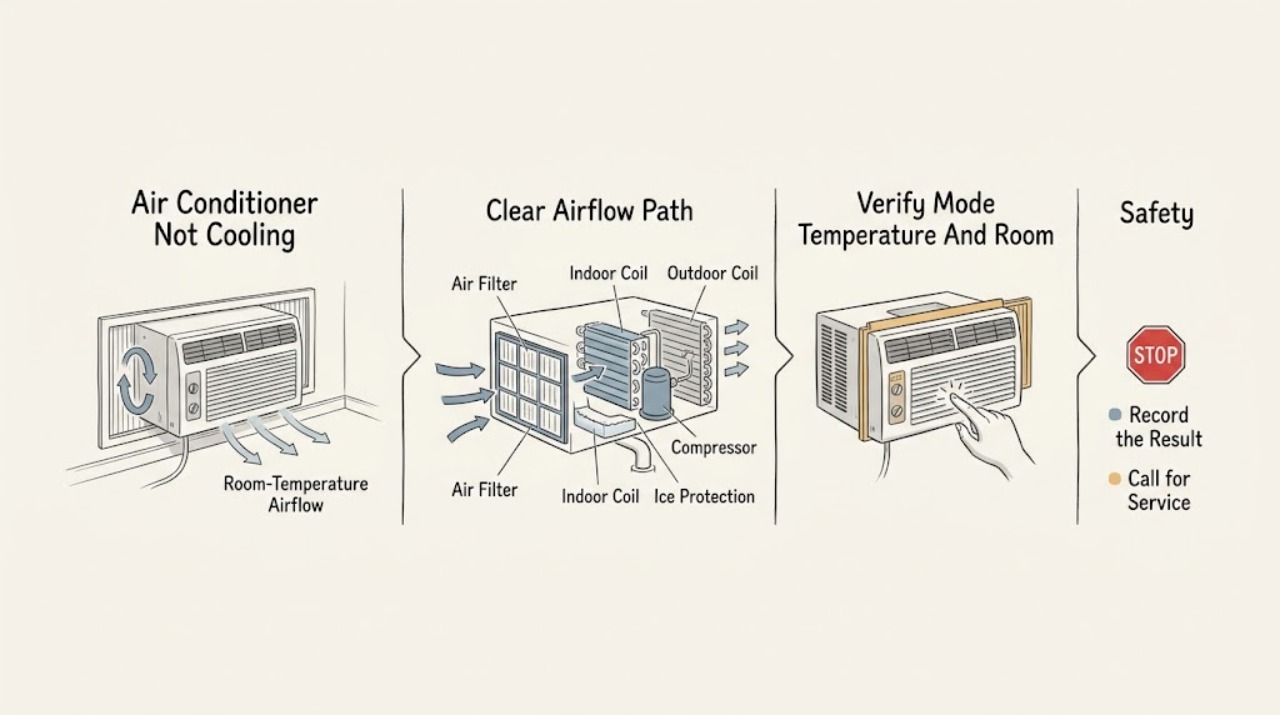
Work through in order
Diagnostic checks
Use only checks that match the exact appliance or system and its official guide.
-
Check 1
From a safe position, classify the symptom as no airflow, weak airflow, normal airflow with room-temperature air, intermittent cooling, continuous running, or cooling that worsens after ice appears. Record the exact GE model, installation type, current mode, set temperature, outdoor temperature, room temperature, and whether the issue began after cleaning, moving, or a weather change.
Expected result: The fan does not move air, airflow is weak, airflow is normal but not cool, the unit cycles normally, it runs continuously, or ice or water is visible.
Next step: Continue to the branch matching the observation. Use the exact model manual for controls and filter access; do not infer a sealed-system failure before checking safe external conditions.
Stop if: Stop for smoke, burning odor, sparking, a hot or damaged cord, water near electrical parts, or repeated breaker operation. Do not open the cabinet or perform live tests.
Why this matters
Why: No or weak airflow starts with the grille, filter, fan, or ice branch. Normal airflow with no cooling starts with settings, outdoor conditions, and compressor operation. Ice changes the airflow and cooling interpretation and should be defrosted before judging performance.
-
Check 2
Confirm that the unit is in the model's cooling mode, the fan is allowed to operate, and the thermostat calls for cooling. For a mechanical dial, use the model's maximum-cooling direction; for electronic controls, use a lower temperature setting for maximum cooling. Close windows in the cooled area and check whether curtains, furniture, or other items block the front or rear grille.
Expected result: The unit was in the wrong mode or setting, a grille was blocked, windows were open, or the settings and installation appear correct.
Next step: Correct only the accessible setting or obstruction and allow a normal cooling period. If airflow and settings are correct but the unit still does not cool, check the filter and outdoor temperature next.
Stop if: Do not remove the cabinet or alter wiring to improve airflow.
Why this matters
Why: A wrong mode, insufficient cooling demand, warm air entering, or restricted grille can explain poor cooling without an internal fault. Correct settings and clear airflow are more informative than repeatedly changing the set temperature.
-
Check 3
Following the exact owner's manual, inspect the accessible air filter and the front and rear grilles. Clean a washable filter as GE directs, let it dry completely, reinstall it, and keep the unit off the filter path while it is removed. Remove only accessible curtains, furniture, plants, dust, or other grille obstructions.
Expected result: The filter is dirty, damaged, damp, missing, or clean; the grille was blocked or clear; airflow improves or remains weak after the filter is restored.
Next step: Run the unit only with the correct dry filter installed and monitor airflow. If weak airflow remains, inspect externally for ice and arrange service rather than reaching into the blower or coil.
Stop if: Do not run without the filter, reinstall a damp filter, use an unapproved filter, force the grille, or reach through the opening toward a fan or coil.
Why this matters
Why: A dirty or damaged filter and blocked grille restrict airflow and can reduce cooling or contribute to coil ice. Persistent weak airflow after a correct dry filter and clear grilles makes a blower, indoor coil, ice, or internal control issue more likely.
-
Check 4
If ice is visible on the indoor coil or the unit blows water or ice, turn the air conditioner off and allow it to defrost at room temperature. On models whose manual documents the controls, use a warmer temperature and higher fan setting to help thaw; never chip or scrape the ice.
Expected result: The ice melts and normal airflow returns, ice returns after the filter and settings are corrected, the unit continues to spit water or ice, or the coil does not visibly ice.
Next step: After complete defrosting, install the dry correct filter, use suitable outdoor conditions, and monitor one normal cooling period. If icing recurs or cooling remains poor, stop and arrange qualified service.
Stop if: Do not use a sharp tool, heat gun, open flame, or forced mechanical method to remove ice; do not open the cabinet or handle coil tubing.
Why this matters
Why: A temporary recovery supports an airflow, low outdoor-temperature, low fan-speed, or dirty-filter cause. Recurring ice after those conditions are corrected raises the likelihood of an airflow, fan, thermostat, or refrigeration fault and is not fixed by repeatedly thawing it.
-
Check 5
Compare the outdoor temperature with GE's room-air-conditioner guidance and look only at accessible external coil and grille surfaces. GE says temperatures at or below 70°F can limit cooling and may frost the coil; a cool-only unit must not be used below freezing. Look for dirt or soot on the rear coil without bending fins or spraying it.
Expected result: Outdoor temperature is at or below 70°F, the unit is being tested below freezing, the rear coil is visibly clogged, or outdoor conditions and the accessible coil appear suitable.
Next step: Do not use a cool-only unit below freezing; allow frost to clear and retest only under suitable conditions. For light accessible surface dust, use the model's safe cleaning procedure. Have a professional clean a heavily clogged coil or diagnose continued poor cooling.
Stop if: Do not pressure-wash or hose the unit, bend coil fins, remove covers, or test compressor terminals.
Why this matters
Why: Cold outdoor air can explain weak cooling or a compressor that does not start and can cause frost. Heavy rear-coil dirt can restrict heat rejection. Suitable outdoor conditions with a clear accessible coil make a persistent internal fault more likely after the filter and settings are verified.
-
Check 6
After the settings, grille, dry filter, ice, and outdoor-condition checks, observe one normal cooling period. Record whether the fan runs, whether the discharged air is cooler than the room, whether the compressor cycles, whether the room temperature falls, and whether the unit ices or shuts down.
Expected result: Cooling returns, the unit runs continuously without reaching the set point, the fan runs but air is not cool, the compressor does not start in suitable conditions, or the fault returns after defrosting.
Next step: Arrange qualified GE or HVAC/appliance service for persistent poor cooling, recurring ice, or a compressor or control symptom. Provide the model and the complete check history; do not continue repeated resets or thaw cycles.
Stop if: Stop for smoke, odor, sparking, a hot cord, water near electrical parts, or repeated breaker operation. Do not open the cabinet or add refrigerant.
Why this matters
Why: Recovery supports a correctable setting, airflow, temperature, or temporary ice condition. Persistent room-temperature discharge, repeated icing, or no compressor operation under suitable conditions may involve the fan, thermostat, control, compressor, or sealed system and cannot be selected from symptoms alone.
-
Check 7
If safe external checks do not restore cooling, give a qualified technician the complete model and serial information, installation type, mode and set temperature, outdoor and room conditions, filter and ice history, airflow observations, and any breaker, odor, water, or noise symptoms.
Expected result: The problem is persistent, the same fault returns after a clean filter and defrost, the unit has no cooling with normal airflow, or an electrical or refrigerant warning is present.
Next step: Keep the unit out of service for a hazard or repeated fault and arrange qualified service. If only capacity or installation is inadequate, discuss sizing or installation with a qualified provider rather than altering the refrigeration circuit.
Stop if: Do not open panels, live-test wiring, bypass a control, drill or solder a coil, or add, recover, or release refrigerant.
Why this matters
Why: The remaining possibilities include internal fan or blower, thermostat or control, compressor, wiring, or sealed-system work. The evidence does not safely identify a replacement part or justify cabinet access.
Use your observations
Decision map
Find the observation that best matches what you see, then follow the next safe action.
-
PATH 01Safety boundary
What you see
The unit runs and produces airflow, but it was not in cooling mode, the temperature demand was wrong for its control type, a front or rear grille was blocked, or warm air entered through an open window.
Do this next
Correct the accessible setting or obstruction, close windows, and allow a normal cooling period. If the symptom remains, continue with the filter, ice, and outdoor-temperature checks.
Why this path and its safety boundary
Why it matters: A mode, setting, installation, or room-load condition is more likely than an internal cooling-system failure.
Safety stop: Do not move a built-in unit or open the cabinet to improve airflow.
-
PATH 02Safety boundary
What you see
Airflow is weak, the filter is dirty or damaged, or accessible grilles and the rear coil area are restricted.
Do this next
Clean and fully dry the correct filter, restore it, clear accessible grille obstructions, and monitor airflow. Persistent weak airflow needs service diagnosis of the fan, coil, or internal path.
Why this path and its safety boundary
Why it matters: Restricted airflow can explain weak cooling and can contribute to indoor-coil ice; the filter and grille condition should be corrected before judging the compressor.
Safety stop: Do not run without a filter, use a damp filter, force louvers, or reach toward a blower or coil.
-
PATH 03Safety boundary
What you see
Ice is visible, the unit spits water or ice, or outdoor temperature is at or below GE's stated 70°F threshold, especially with a low fan setting or dirty filter.
Do this next
Turn the unit off and allow complete defrosting. Restore a dry correct filter and suitable settings, and do not use a cool-only unit below freezing. Recurrent ice under suitable conditions needs service.
Why this path and its safety boundary
Why it matters: Low outdoor temperature, low airflow, or a dirty filter is more likely than an immediate sealed-system conclusion; ice itself blocks airflow and cooling.
Safety stop: Do not chip ice, apply flame or concentrated heat, open the cabinet, or handle coil tubing.
-
PATH 04Safety boundary
What you see
The filter and airflow are clear, settings are correct, but the room started very hot, heat continues entering, the room is larger than the unit's intended capacity, or the unit runs for long periods without reaching the target.
Do this next
Reduce accessible heat entry, close windows, allow stored heat in walls and furnishings to dissipate, and verify sizing against the model information. If discharged air is not cool or cooling is abnormal, arrange service rather than assuming sizing alone.
Why this path and its safety boundary
Why it matters: Room heat load, open windows, installation, or sizing may be limiting comfort even when the refrigeration circuit is operating.
Safety stop: Do not alter the refrigeration circuit or electrical supply to compensate for capacity.
-
PATH 05Safety boundary
What you see
Airflow, filter, settings, outdoor conditions, and ice have been checked, but the unit still blows room-temperature air, the compressor does not start in suitable conditions, ice repeatedly returns, or an electrical, water, smoke, or odor symptom is present.
Do this next
Stop using the unit for any hazard or repeated fault and arrange qualified GE or HVAC/appliance service with the model and observation history. Keep any water away from electrical areas.
Why this path and its safety boundary
Why it matters: An internal fan, thermostat or control, compressor, wiring, or sealed-system problem is more likely, and the symptom cannot identify one safe replacement part.
Safety stop: Do not open the cabinet, live-test, bypass controls, hose the unit, or add or release refrigerant.
Helpful context
Understand the symptom
First separate weak airflow from no cooling
With the unit operating normally, note whether air comes out of the front grille and whether it feels cooler than the room. Also note whether the compressor appears to cycle, whether the unit runs continuously, whether the room was very hot when cooling began, and whether ice or water is visible. GE's support is written for room air conditioners and its model pages include window and built-in configurations; do not transfer a control or access instruction between models without checking the owner's manual.
Correct settings and installation conditions
Verify that the unit is in the model's cooling mode and that the temperature control is calling for cooling. GE notes that mechanical dial and electronic controls use different directions for maximum cooling. Keep the front and rear grilles clear of curtains, furniture, plants, and other obstructions, close windows in the cooled area, and allow extra time when walls, furniture, rugs, and draperies have stored heat. A unit that is too small for the room may run a long time without reaching the desired temperature; that is an installation or sizing issue rather than proof of a failed compressor.
Clean the filter and restore airflow
Filter location and removal vary by GE model. Follow the exact owner's manual, clean the filter at least every 30 days, and let a washable filter dry completely before reinstalling it. GE says not to run the unit without its filter or with a damaged filter. A dirty filter can reduce airflow and contribute to an iced coil, so a filter check is meaningful only after the filter is correctly fitted and the grille is unobstructed.
Treat ice as an airflow and temperature branch
If ice covers the indoor coil or the unit spits water or ice from the front, turn the air conditioner off and allow it to defrost at room temperature. GE identifies outdoor temperature, low fan speed, and a dirty filter as primary causes. On a model that documents the option, a warmer setting and higher fan speed can help the thaw; do not chip, scrape, or pry ice from the coil. After the ice is gone, return to the model's normal settings and see whether the condition returns under suitable outdoor temperatures.
Account for outdoor temperature
GE says operating a room air conditioner at 70°F outdoor temperature or below can reduce cooling and allow the indoor coil to frost or freeze. Around 50°F or below, the compressor may not start depending on room temperature; a cool-only unit must not be used below freezing. Do not judge the compressor or refrigerant circuit from a cold-weather test. If cooling remains poor during conditions in which the model should operate, continue to the service branch after checking the filter and airflow.
Clean accessible surfaces without wetting electronics
With the appliance switched off and disconnected only as the model's instructions permit, clean accessible grilles and the cabinet with a mild detergent-and-water solution or a vacuum brush. GE says a dirty rear coil may require professional cleaning and specifically does not recommend a garden hose or pressure washer because water may enter electronic areas. Do not force louvers or bend coil fins. If debris is packed into a coil or blower area that is not safely accessible, stop and arrange service.
Know when the cooling system is a professional boundary
A fan that runs without cold air, a compressor that does not start in suitable conditions, repeated icing after a clean filter and correct airflow, a clogged coil, damaged wiring, or a refrigerant-related fault cannot be identified safely from the symptom alone. Keep the unit out of service for smoke, burning odor, sparking, a hot or damaged cord, water near electrical parts, or repeated breaker operation. Do not open the cabinet, bypass controls, live-test wiring, drill the coil, or add or release refrigerant. Give service the model, operating mode, outdoor and room conditions, filter history, ice behavior, and whether airflow is weak or normal.
Only after diagnosis
Potential parts
- model-specific air filter
Consider this category only when the exact model's filter is damaged, missing, or cannot be restored to clean condition after the documented cleaning procedure.
Filter location and fit vary by model; verify the complete GE model and use only the specified filter. - fan or blower assembly
Consider this category only when qualified diagnosis confirms persistent weak airflow or a fan fault after the correct dry filter, clear grilles, and complete defrost.
Fan and blower designs vary across window, built-in, and other GE air conditioner models; confirm fit by the complete model. - thermostat or electronic control
Consider this category only after qualified testing confirms that correct settings and suitable outdoor conditions are present but the compressor is not being commanded or cooling control is failing.
Controls are model-specific and may involve hazardous electrical access; do not select a control from a no-cooling symptom alone. - compressor or sealed-system component
Consider this category only after qualified diagnosis of no cooling with normal airflow and suitable conditions, or recurring ice after airflow causes are ruled out.
Compressor and refrigerant-circuit work is professional service; the symptom does not establish the failed component or compatibility.
When checks do not resolve it
Need a professional?
Arrange qualified GE or HVAC/appliance service when cooling remains poor after the correct mode, clear grilles, clean dry model-specific filter, suitable outdoor conditions, and complete defrost; when the fan runs but air is not cool; when the compressor does not start in suitable conditions; when ice returns; when the rear coil is heavily clogged; or when internal access would be required. Stop using the unit immediately for smoke, burning odor, sparking, a hot or damaged cord, repeated breaker operation, water near electrical parts, or a damaged cabinet. Do not open the cabinet, perform live electrical tests, pressure-wash the unit, or add or release refrigerant.
Safety scope: The user may identify the model, verify documented controls, clear accessible grille obstructions, clean and dry the correct filter, allow ice to thaw, and perform only model-approved external cleaning. Cabinet removal, electrical testing, fan or compressor access, coil-fin or sealed-system work, and refrigerant handling belong to qualified service.
Common questions
FAQ
Why is my GE air conditioner running but not cooling?
Check the model's cooling mode and temperature control, clear the front and rear grilles, close windows, and clean and dry the correct filter. Then check outdoor temperature and visible coil ice. If airflow is normal but the discharge air is not cool under suitable conditions, qualified service is needed for the fan, control, compressor, or sealed system.
What should I do if my GE air conditioner has ice on the coil?
Turn the unit off and let the ice melt at room temperature. A dirty filter, low fan speed, or outdoor temperature at or below 70°F can contribute to icing. Reinstall a clean, dry filter and use model-appropriate settings after defrosting; recurring ice under suitable conditions needs service.
Can cold outdoor weather make a GE air conditioner stop cooling?
Yes. GE says outdoor temperatures at or below 70°F can limit cooling and cause frost, and around 50°F or below the compressor may not start depending on the room temperature. A cool-only unit must not be used below freezing. Do not diagnose the compressor from a cold-weather test.
How often should I clean the GE air conditioner filter?
GE recommends cleaning a room-air-conditioner filter every 30 days. Follow the exact model manual for removal, clean it as directed, let a washable filter dry completely, and reinstall it before using the unit. Do not run without the correct filter.
When does a GE air conditioner need professional service for no cooling?
Arrange service when cooling remains poor after the correct mode, clear grilles, clean dry filter, suitable outdoor conditions, and complete defrost; when ice returns; when the fan runs but air is not cool; or when diagnosis would require cabinet access, electrical testing, compressor work, or refrigerant handling. Stop immediately for smoke, burning odor, sparking, a hot cord, water near electrical parts, or repeated breaker operation.
Read the exact guide
Official sources
- Troubleshooting for AHE18DZGE Appliances · GE AHE18DZ 18,000 BTU heat/cool electronic window air conditioner; used to establish GE model-specific support, not as a universal control or access instruction
- Air Conditioner Usage During Cold TemperaturesGE Appliances · GE room air conditioners; exact low-temperature behavior varies by model
- Air Conditioner - Not Cooling / Cold Outdoor TemperaturesGE Appliances · GE room air conditioners, especially cool-only or window configurations
- Air Conditioner - Ice On Indoor CoilsGE Appliances · GE air conditioners with accessible indoor coils; exact fan and thermostat controls vary by model
- Air Conditioners - Benefits Of Having A Clean FilterGE Appliances · GE air conditioners with replaceable or cleanable air filters
- Room Air Conditioner - CleaningGE Appliances · GE room air conditioners; coil and grille access varies by model
- Air Conditioners - Poor Air FlowGE Appliances · GE air conditioners; louver and fan controls vary by model
- Air Conditioner - Not Cooling Well / Running ConstantlyGE Appliances · GE room air conditioners; filter location, controls, capacity, and installation vary by model
- Air Conditioner - How To Remove Ice On CoilsGE Appliances · GE air conditioners with iced indoor coils
- Air Conditioner - Cleaning the FilterGE Appliances · GE room air conditioners; filter location and removal vary by model
Community feedback
Share a repair observation
Share a plain-text repair observation. Accepted observations are published automatically; this page may take a moment to update.