
On this page
Start here
Quick answer
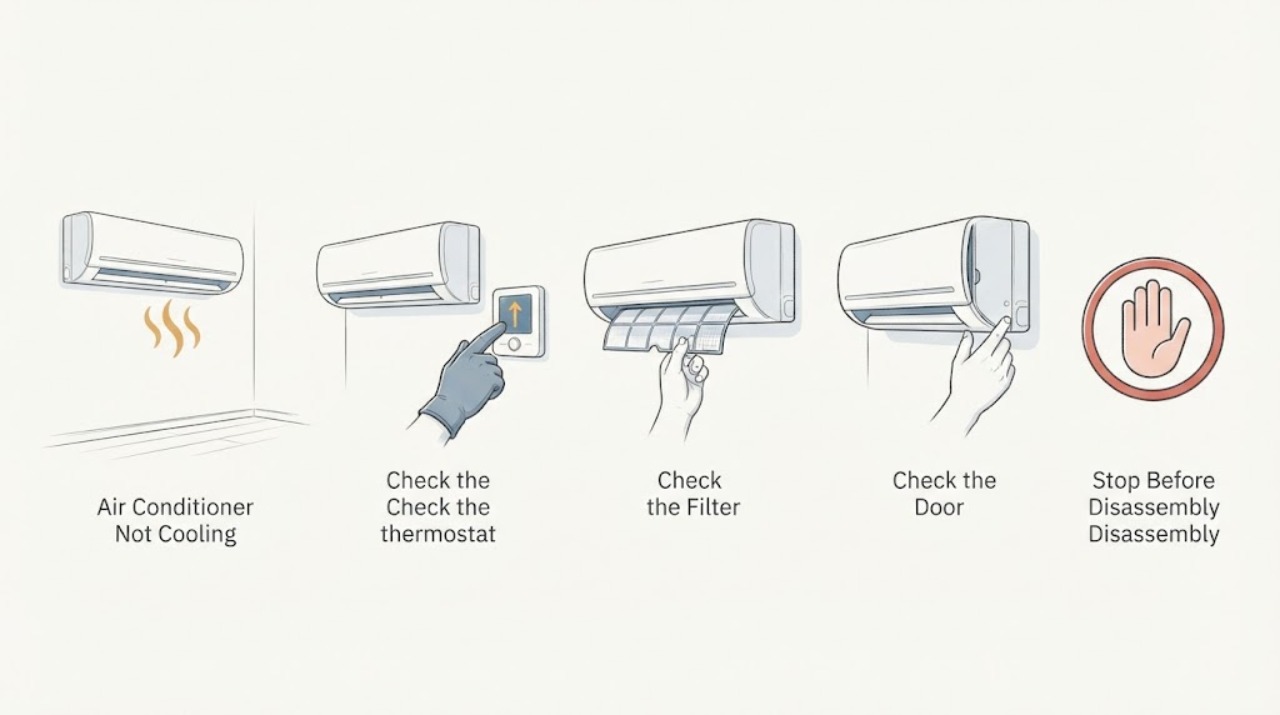
When an air conditioner is not cooling, first check the thermostat mode and setpoint, airflow through a clean filter, and visible debris around the outdoor condenser. Observe whether the indoor fan runs, whether the outdoor fan runs, and whether ice is present on lines or coils. Ice, repeated electrical trips, loud outdoor-unit noise, or continued warm air after basic airflow checks points to a refrigerant, coil, motor, compressor, or electrical issue that requires qualified HVAC service.
Work through in order
Diagnostic checks
Use only checks that match the exact appliance or system and its official guide.
-
Check 1
Check the thermostat from the user interface: confirm cooling mode, a setpoint below room temperature, and fan set to Auto when that option exists. Wait briefly for the call to cooling and note whether air leaves the registers.
Expected result: The thermostat was in another mode or at a higher setpoint, the indoor fan runs with warm air, or there is no airflow.
Next step: Correct only the visible settings and continue once; do not repeatedly cycle a system that trips protection.
Why this matters
Why: A wrong mode or fan setting can mimic a failure; warm air with airflow shifts attention to filter, condenser, frozen coil, or refrigerant paths, while no airflow needs service if settings are correct.
-
Check 2
Turn the system off before inspecting the accessible indoor air filter. Replace or clean it according to the unit instructions if it is visibly clogged, then check that supply and return grilles are not blocked.
Expected result: The filter is visibly dirty, the grilles are blocked, or airflow remains weak with a clean filter.
Next step: Restore only the filter and grille access panels. Arrange HVAC service if airflow remains weak.
Why this matters
Why: Carrier identifies a dirty filter as a common airflow and cooling problem; persistent weak airflow with a clean filter may involve the blower, coil, ductwork, or another service condition.
-
Check 3
From a safe distance, inspect the outdoor condenser area for leaves, grass, or other debris blocking the coil and note whether the outdoor fan runs during a cooling call. Do not remove panels or touch the fan or electrical parts.
Expected result: Debris blocks the coil, the fan is not spinning, the unit is silent, or the unit runs but air remains warm.
Next step: Clear loose debris around the unit only with power isolated according to the owner instructions; leave internal cleaning and diagnosis to a qualified technician.
Why this matters
Why: Blocked coils can reduce cooling; a stationary fan, silent condenser, or continued warm air can indicate motor, compressor, refrigerant, or electrical faults.
-
Check 4
Look for ice on accessible copper lines or the outdoor unit and note continuous operation, short cycling, unusual noise, or water around the indoor unit. Do not scrape ice or continue running the system to force cooling.
Expected result: Ice or excessive water is present, the system runs continuously, short-cycles, or none of these signs appears.
Next step: Turn the system off when ice or abnormal noise is present and arrange qualified HVAC service. Do not handle refrigerant.
Why this matters
Why: Carrier associates ice with airflow or refrigerant problems and says continued operation can damage the compressor; continuous or short-cycle operation also needs professional assessment.
Use your observations
Decision map
Find the observation that best matches what you see, then follow the next safe action.
-
PATH 01Next step
What you see
Cooling returns after correcting thermostat mode or a clogged filter.
Do this next
Monitor the system and follow the equipment maintenance schedule; seek service if warm air returns.
Why this path and its safety boundary
Why it matters: A control or airflow restriction was more likely than a confirmed refrigerant or compressor fault.
-
PATH 02Next step
What you see
The filter is clean but the outdoor coil is blocked or the outdoor fan does not run.
Do this next
Stop at accessible debris removal and arrange qualified HVAC service for the outdoor unit.
Why this path and its safety boundary
Why it matters: Heat rejection or outdoor-unit operation is impaired; a motor, capacitor, compressor, or electrical issue remains possible.
-
PATH 03Next step
What you see
Ice is visible or the system runs continuously without cooling.
Do this next
Turn off cooling and arrange professional diagnosis; do not scrape ice or handle refrigerant.
Why this path and its safety boundary
Why it matters: A frozen coil, restricted airflow, or refrigerant problem is more likely than a simple setting error.
-
PATH 04Next step
What you see
The breaker trips again, there is burning odor, loud abnormal noise, or no response after correct settings and airflow checks.
Do this next
Turn the system off, do not repeatedly reset protection, and contact a qualified HVAC technician or electrician.
Why this path and its safety boundary
Why it matters: This is an electrical or mechanical service boundary.
Helpful context
Understand the symptom
Not cooling can mean no airflow, warm airflow, or a system that runs continuously without reaching the setpoint. Start with controls and airflow, then use the outdoor-unit and ice observations to decide whether the symptom has crossed into professional HVAC work.
When checks do not resolve it
Need a professional?
Call qualified HVAC service for ice, refrigerant suspicion, a stationary outdoor fan, repeated trips, burning odor, loud abnormal noise, or warm air that persists after the thermostat, filter, and visible airflow checks. Do not open electrical panels or handle refrigerant.
Common questions
FAQ
Why is my air conditioner running but not cooling?
Carrier points to thermostat settings, a dirty filter, blocked condenser coil, frozen coil, low refrigerant, and outdoor-unit or compressor faults. Use the visible checks first, then stop for professional service when ice or mechanical symptoms appear.
Should I keep running an AC with ice on the lines?
No. Carrier says to shut the system off when ice is present because continued operation can damage the compressor; arrange service for the underlying airflow or refrigerant issue.
Can I add refrigerant myself?
No. Carrier says suspected refrigerant issues require certified handling and professional diagnosis.
Read the exact guide
Official sources
- Why Is My AC Not Blowing Cold Air? 7 Common CausesCarrier · Carrier residential air-conditioner not-cooling symptom guidance
- Troubleshoot an Air Conditioner: 6 Steps to Fix an AC Not WorkingCarrier · Carrier air-conditioner thermostat, electrical, frozen-coil, condenser, refrigerant, and service boundary
Community feedback
Share a repair observation
Share a plain-text repair observation. Accepted observations are published automatically; this page may take a moment to update.