
On this page
Start here
Quick answer
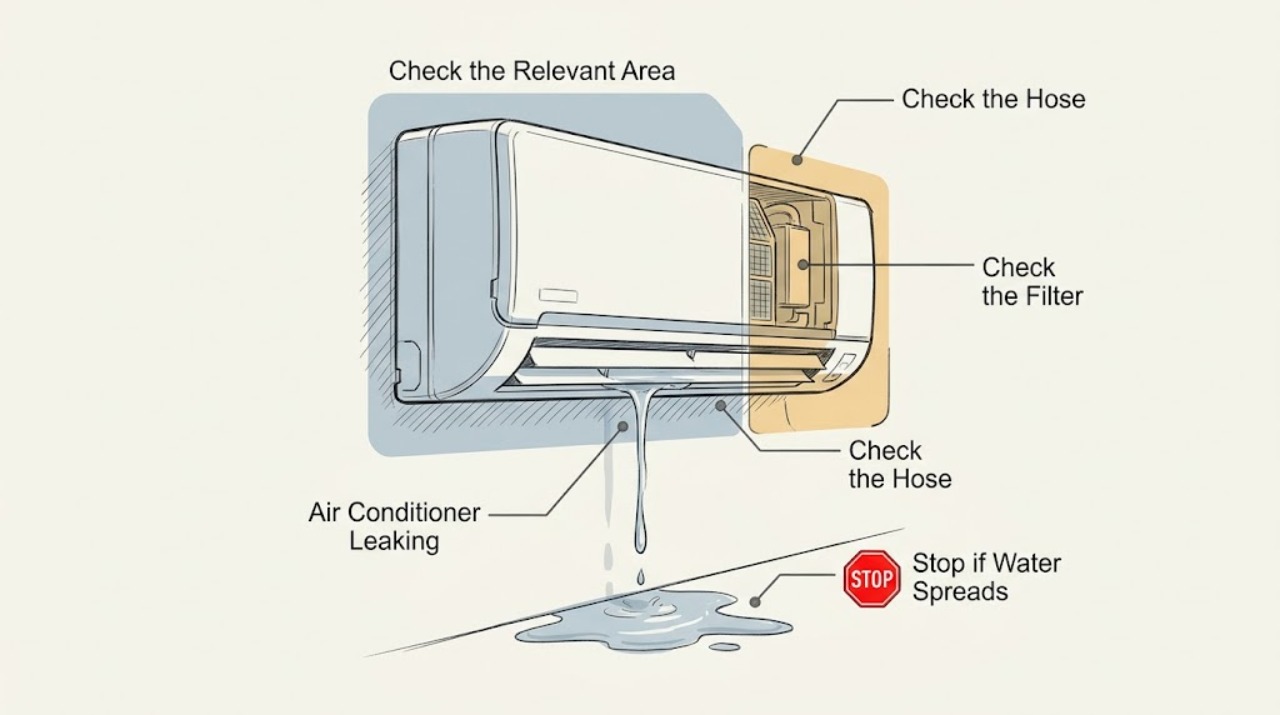
A Samsung air conditioner that leaks indoors usually has a condensate path, hose routing, level, filter, or airflow issue; a small amount of outdoor pipe condensation can be normal. First switch the unit off, protect the area, and identify where the water appears. Check the drain hose from a safe, dry position and clean the accessible filter only as described for your model. If water continues, reaches electrical parts, or the hose or installation is damaged, stop using the unit and arrange Samsung-trained service.
Work through in order
Diagnostic checks
Use only checks that match the exact appliance or system and its official guide.
-
Check 1
Turn the air conditioner off, keep water away from plugs and controls, and place a container under the drip while you identify whether the water is from the indoor unit, a drain-hose end, or the outdoor pipe.
Expected result: Water is coming from the indoor housing or the outdoor pipe connection, and there is or is not water near electrical parts.
Next step: If water is near wiring, a plug, or a control, leave the unit off and have it inspected. Otherwise continue with the matching visible check.
Why this matters
Why: Samsung distinguishes indoor condensate overflow and drainage problems from normal dew that can form on an outdoor pipe; water near electricity is a safety boundary.
-
Check 2
Inspect the visible drain hose without opening the cabinet. Confirm it points downward, is straight rather than kinked, and does not end underwater; look for a loose connection or visible damage.
Expected result: The hose rises, bends, is submerged, disconnected, or damaged, or it is routed downward and intact.
Next step: Correct only an obvious, accessible routing issue according to the installation instructions. Do not dismantle the indoor unit; request service for a hidden blockage, damaged hose, or loose connection.
Why this matters
Why: Poor slope, reverse flow, submersion, blockage, or damage can keep condensate from leaving the indoor unit; an intact route makes leveling, filter, or internal drainage issues more likely.
-
Check 3
With the unit off and disconnected as directed by the model instructions, remove and wash the accessible air filter, then let it dry completely before reinstalling it.
Expected result: The filter is heavily dusty or damp, or it is clean and dry after reinstallation.
Next step: Run the unit only after the filter is fully dry and fitted correctly. If dripping returns, stop rather than repeatedly operating it.
Why this matters
Why: Samsung says a blocked filter can reduce airflow and contribute to leakage; a clean filter shifts attention to the drain, level, settings, or refrigerant-related service causes.
-
Check 4
If the drip is only light condensation on the indoor blade or casing, check the selected cooling temperature, fan speed, room humidity, and whether doors or windows are allowing humid air in; do not adjust sealed-system parts.
Expected result: The unit is set very cold with low fan speed or high humidity, or the water is a persistent stream from the housing.
Next step: Use the model controls to moderate condensation and monitor briefly. Persistent or severe leakage requires professional inspection.
Why this matters
Why: Samsung lists low set temperature, humidity, low fan speed, and blade position as condensation contributors, while persistent indoor flow points to drainage or installation trouble.
Use your observations
Decision map
Find the observation that best matches what you see, then follow the next safe action.
-
PATH 01Next step
What you see
The indoor unit leaks and the hose is kinked, points upward, or ends underwater
Do this next
Leave the unit off while correcting only accessible routing; arrange service if the route cannot be safely corrected or leakage continues.
Why this path and its safety boundary
Why it matters: The visible drainage route can explain reverse flow or condensate backup more readily than a control fault.
-
PATH 02Next step
What you see
The indoor filter is blocked and the drip improves after it is cleaned and fully dried
Do this next
Maintain the filter on the model schedule and monitor; stop and request service if water returns.
Why this path and its safety boundary
Why it matters: Restricted airflow was supported as a contributor, but it does not prove that the drain path is clear.
-
PATH 03Next step
What you see
Water persists from the indoor housing despite an intact hose route and clean filter, or water is near electrical parts
Do this next
Stop using the air conditioner and arrange Samsung-trained service; do not remove panels or handle refrigerant.
Why this path and its safety boundary
Why it matters: An internal drain, level, installation, refrigerant, or component issue remains possible and is not safely identified from outside.
When checks do not resolve it
Need a professional?
Stop using the Samsung air conditioner and request qualified service for persistent indoor leakage, a blocked or damaged hidden drain, an unlevel installation, suspected refrigerant-related icing, water near electrical parts, or any cord, plug, or wiring damage.
Common questions
FAQ
Is a small amount of water from a Samsung air conditioner always a failure?
Not necessarily. Samsung notes that temperature differences can create dew, especially on outdoor piping. Persistent or severe water from the indoor housing is different and needs the drain and filter checks above.
Can I keep running a Samsung air conditioner that is leaking indoors?
Turn it off while water is near electrical parts or while a persistent indoor leak is being investigated. If the visible hose and filter checks do not resolve it, arrange qualified service rather than repeatedly operating the unit.
Read the exact guide
Official sources
- How to Fix Water Leaks from a Samsung AC Indoor UnitSamsung Gulf · Samsung split air conditioner indoor-unit water leakage
- What to do if water drips from my air conditioner?Samsung Gulf · Samsung air conditioner indoor and outdoor water-drip symptoms
Community feedback
Share a repair observation
Share a plain-text repair observation. Accepted observations are published automatically; this page may take a moment to update.