
On this page
Start here
Quick answer
The JGP970SEKSS is a built-in gas cooktop, not an electric radiant cooktop: GE's manual says the surface burners use electric ignition without standing pilot flames and that a burner is turned off by turning its control clockwise to OFF. A grate or burner cap can remain warm after cooking, but a visible flame, hissing, gas odor, or heat that is being actively produced while the control is OFF is not something to test by relighting. From a safe distance, first distinguish residual warmth or heat from another burner, oven, vent, or cookware from a live flame or gas warning. If gas is smelled, do not use switches, phones inside the building, matches, or a lighter; leave and contact the gas supplier or emergency services. If there is no gas warning but the same burner is actively heating or remains abnormally hot after all controls have been OFF and the cooktop has had time to cool, stop using it and arrange qualified gas-appliance service.
Before you begin
Safety first
- Owner checks are limited to no-touch visual observation, confirming the visible OFF positions after the cooktop is cool, identifying nearby heat sources, recording the exact model and symptom, and correcting only an obvious burner-cap or head placement issue under the owner manual. Do not ignite a burner to test a leak, use a flame or switch near suspected gas, lift the cooktop, open the manifold, bypass a control, or make live electrical or gas measurements.
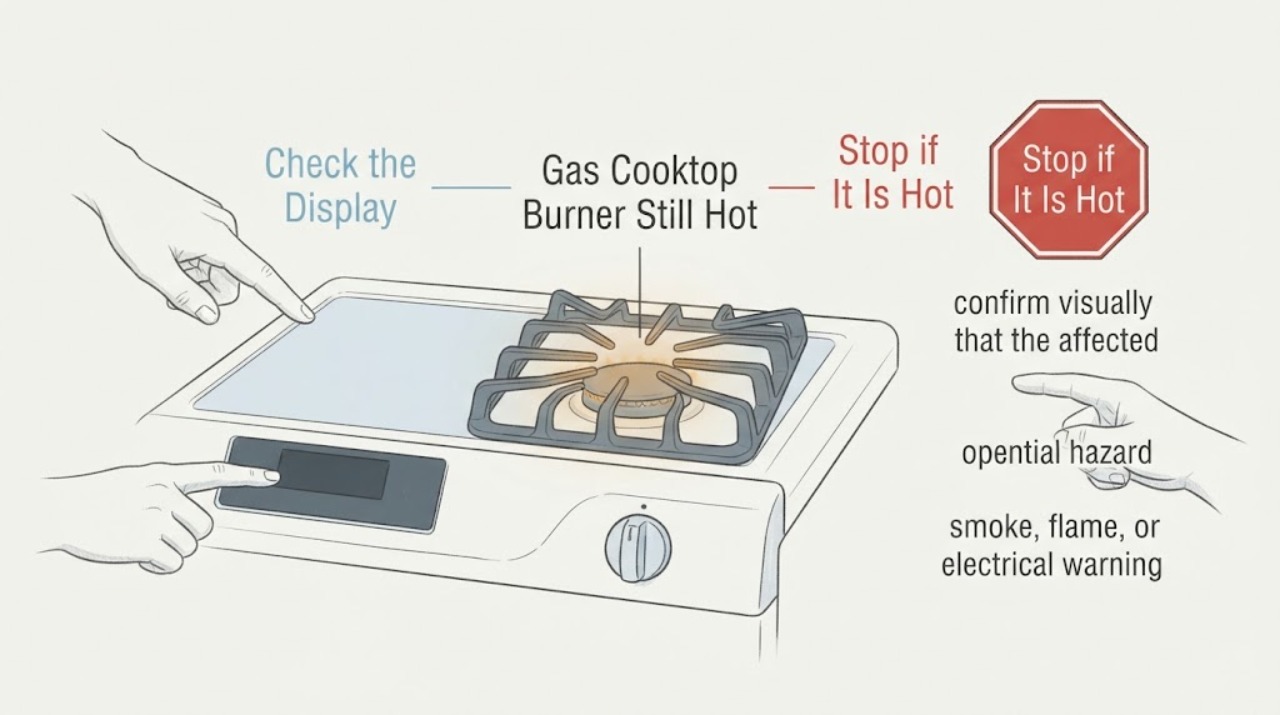
Work through in order
Diagnostic checks
Use only checks that match the exact appliance or system and its official guide.
-
Check 1
Without touching the burner, grates, cap, or glass, look from a safe distance at the affected position with every cooktop control visibly aligned to OFF. Note whether there is an active flame, flame glow, smoke, or only a reported warm surface; do not relight the burner to make the observation.
Expected result: A flame or other active heating is visible; there is no flame and the area is only warm; or the observation cannot be made safely.
Next step: For an active flame, smoke, or uncontrolled heat, leave the cooktop unused and follow the gas-safety branch below. If there is no active flame, allow the unit to cool fully before any external inspection; do not use touch as the test.
Stop if: Do not light a match, use a lighter, remove a burner part while hot, or reach over the cooktop to investigate.
Why this matters
Why: A gas burner should not be actively burning with its control at OFF. No visible flame does not prove that a surface is safe to touch, while warmth alone can be retained heat or heat conducted from a nearby burner or cookware.
-
Check 2
After the cooktop is fully cool, confirm visually that the affected knob and every other cooktop knob are at the exact OFF position. Check whether a pan, grate, adjacent burner, oven vent, or other nearby heat source could have warmed that location overnight; do not force or repeatedly rotate a knob that does not move normally.
Expected result: Only the affected grate or cap is warm, several nearby parts are warm, another burner or appliance was operating, or no plausible external heat source is present.
Next step: Remove only a clearly movable heat source after everything is cool and monitor whether the abnormal warmth recurs without cooking. If the affected burner alone reheats or remains abnormally hot, stop using the cooktop and arrange qualified service.
Stop if: Do not lift the cooktop, open the gas manifold, loosen a connector, or attempt a gas-flow or leak test yourself.
Why this matters
Why: A localized warm grate or cap with no flame can be residual or conducted heat, while a wider pattern points to another heat source. If no source explains the heat and the control is truly OFF, a control or gas-flow fault becomes more concerning, but the symptom still cannot select a replacement part.
-
Check 3
If there is no gas odor, smoke, flame, or electrical warning and the cooktop is fully cool, inspect only the visible burner cap and head for an obvious displacement, spill residue, crack, or wrong-position appearance. For this model family, do not interchange caps or heads; if cleaning is needed, use only the owner-manual procedure with power disconnected and all parts completely dry before service use.
Expected result: The cap or head is visibly out of position or damaged; residue is present; or all visible parts are correctly seated and intact.
Next step: Correct only an obvious, model-manual-permitted seating or cleaning issue after the parts are cool and dry, then use the burner normally once while observing from a safe distance. If heat or flame returns with the control OFF, stop use and call qualified service.
Stop if: Do not remove the burner base or electrode, operate with missing parts, use water in the gas orifice, or perform a live ignition experiment.
Why this matters
Why: GE's JGP970-family manual says burner heads and caps are not interchangeable and must sit in the correct position. A mis-seated or damaged burner part can affect normal ignition and flame shape, but it does not prove why a burner was hot overnight with the control OFF.
-
Check 4
Check the gas-hazard signs from outside the immediate cooktop area: odor of gas, hissing, a flame that will not stop, smoke, burning odor, damaged controls, or evidence of a fire. Do not operate a switch, unplug the cooktop, use a phone inside the building, or create any ignition source while gas may be present.
Expected result: Gas odor, hissing, an uncontrolled flame, smoke, or another immediate hazard is present; or none of these signs is present.
Next step: If any gas or fire warning is present, leave the building or immediate area as appropriate, contact the gas supplier or emergency services from a safe location, and follow their instructions. If no warning is present but the burner reheats or remains abnormally hot with OFF controls, keep the cooktop out of use and schedule qualified gas-appliance service.
Stop if: Never use a match, lighter, candle, flame, electrical switch, or undocumented leak detector to locate or confirm a leak.
Why this matters
Why: GE treats a gas odor as an emergency condition. The absence of odor does not authorize a user to test the valve or burner, but it allows the less urgent cool-down and model-specific service path when there is also no active heating.
-
Check 5
Record the model JGP970SEKSS, which burner is affected, whether the control was physically at OFF, how long the cooktop had been unused, whether another burner or appliance was operating, and whether there was a flame, odor, hissing, smoke, or only residual warmth. Give that record to the service provider instead of ordering a part from the symptom.
Expected result: The burner becomes normal after a genuine cool-down and no hazard recurs; the burner reheats with all controls OFF; or the observation is inconsistent or cannot be repeated safely.
Next step: Use the model-specific GE service route for any repeatable abnormal heating, any control that will not reach OFF, or any persistent uncertainty. Keep the cooktop unused until a qualified technician assesses it when the burner is actively heating or the control response is abnormal.
Stop if: Do not remove the cooktop from the countertop, bypass a gas valve or control lock, make live electrical measurements, or restart the appliance merely to reproduce a hazardous symptom.
Why this matters
Why: A one-time warm surface with no active flame may be retained or conducted heat, but repeatable heating with the control OFF requires diagnosis of the gas-control path and possibly the ignition or electrical controls. Inconsistent results still do not justify a live test or part selection.
Use your observations
Decision map
Find the observation that best matches what you see, then follow the next safe action.
-
PATH 01Safety boundary
What you see
A flame, gas odor, hissing, smoke, or uncontrolled heating is present while a control is OFF.
Do this next
Do not use switches, phones inside the building, matches, or lighters. Leave to a safe location and contact the gas supplier or emergency services; follow their instructions before anyone returns to the appliance.
Why this path and its safety boundary
Why it matters: This is a gas or fire safety condition, not ordinary residual heat. The cooktop should not be tested or relit by the owner.
Safety stop: Do not approach the burner to close a valve if doing so would expose you to gas, flame, or smoke.
-
PATH 02Next step
What you see
There is no flame or gas warning, all controls are visibly OFF, and the affected grate or cap cools normally after a complete cool-down with no nearby heat source.
Do this next
Keep flammable items away, avoid touching the surface until cool, and record whether the condition recurs during normal use. If it recurs without a heat source, arrange service rather than attempting a leak or valve test.
Why this path and its safety boundary
Why it matters: The report is more consistent with retained or conducted heat than with proof of active gas flow, although the surface must still be treated as hot until cool.
-
PATH 03Safety boundary
What you see
No gas warning is present, but the same burner becomes hot again or shows an active flame with its control at OFF, or the control cannot be positioned normally.
Do this next
Stop using the cooktop and arrange qualified gas-appliance service. Provide the exact model, affected burner, control position, recurrence timing, and any visible flame or odor observations.
Why this path and its safety boundary
Why it matters: The control is not reliably stopping the burner, or another internal gas or ignition condition may be involved. A valve, knob, igniter, or control cannot be identified from this observation alone.
Safety stop: Do not operate the burner to compare it with another burner, remove the cooktop, or make live electrical or gas measurements.
Helpful context
Understand the symptom
The exact model changes the first decision. GE identifies JGP970SEKSS as a GE Profile Series 36-inch built-in gas cooktop, and its owner manual covers the JGP970 family. That manual describes electric ignition without a constantly burning pilot and says the burner is turned off at the OFF position. Therefore, a burner that feels warm the next morning is not automatically proof of a failed part, but an active flame, gas odor, hissing, or renewed heating with the control at OFF must be treated as a gas-appliance safety problem rather than as normal electric-cooktop residual heat.
Do not prove the diagnosis by touching the burner, lighting it, spraying or applying a flame to look for a leak, or repeatedly turning controls. First use only a visual, no-touch observation from a safe position. The useful distinction is whether the burner is merely retaining heat from recent cooking or a nearby heat source, versus producing heat now with all controls OFF. A persistent abnormal result after the cooktop is fully cool needs qualified service; it does not identify a valve, knob, igniter, or other part by itself.
When checks do not resolve it
Need a professional?
Use the gas supplier or emergency service route for gas odor, hissing, flame, smoke, or fire warning. Use qualified appliance service for repeatable heating with OFF controls, a control that will not turn fully OFF, damaged burner or controls, or any internal valve, ignition, wiring, or gas-flow concern.
Safety scope: Owner checks are limited to no-touch visual observation, confirming the visible OFF positions after the cooktop is cool, identifying nearby heat sources, recording the exact model and symptom, and correcting only an obvious burner-cap or head placement issue under the owner manual. Do not ignite a burner to test a leak, use a flame or switch near suspected gas, lift the cooktop, open the manifold, bypass a control, or make live electrical or gas measurements.
Have this ready
- Provide JGP970SEKSS, the affected burner location, whether the gas supply or only the burner knob was turned off, the control position, how long the unit was idle, the presence or absence of flame, odor, hissing, smoke, nearby heat, and whether the condition recurred after a complete cool-down.
Common questions
FAQ
Can a gas burner stay hot overnight after it is turned off?
A grate or burner cap can retain heat for a while, and nearby cookware or another burner can conduct heat to it. However, heat that is actively produced with the control at OFF, a visible flame, gas odor, or hissing is not a normal residual-heat explanation. Do not touch or relight the burner; use the gas-safety or qualified-service branch.
Does turning off the home's gas supply make it safe to test the GE burner?
No. Closing a supply valve does not authorize a user to open the cooktop, test the burner with a flame, or take gas-flow measurements. If gas is smelled, avoid switches and ignition sources and contact the gas supplier from a safe location. Otherwise, keep the cooktop unused and arrange qualified service for repeatable heating with the controls OFF.
Could this be an electric radiant burner even though the GE model is called a cooktop?
The assigned JGP970SEKSS is identified by GE as a built-in gas cooktop, and its family manual describes gas surface burners with electric ignition. Do not apply troubleshooting for an electric glass radiant element or infer an electric limiter fault from warmth at a gas burner.
Can I replace the burner valve or igniter based on this symptom?
No. A warm burner after an overnight interval does not distinguish a retained-heat report from an active gas-flow, control, ignition, wiring, or neighboring-heat problem. Record the no-touch observations and have a qualified technician diagnose the exact model before selecting a component.
Read the exact guide
Official sources
- Owner's Manual: Cooktops Built-In Gas (JGP970 family)GE Appliances · Opened through the exact-model GE Owner Center. The PDF cover lists JGP970 among the covered models. It supplies the burner OFF operation, electric-ignition/no-standing-pilot description, gas-emergency instructions, service boundary, and burner cap/head handling limits used here.
- Installation for JGP970SEKSS | GE AppliancesGE Appliances · Opened GE's exact-model Owner Center page. It identifies JGP970SEKSS as a GE Profile Series 36-inch built-in gas cooktop, dates the model family, and links the model's owner manual and service route.
Community feedback
Share a repair observation
Share a plain-text repair observation. Accepted observations are published automatically; this page may take a moment to update.