
On this page
Start here
Quick answer
If the oven on a GE gas range works but none of the surface burners produces a usable flame, first make sure there is no unburned-gas odor. If you smell gas or are unsure, do not light a burner, touch electrical switches, or use a phone inside; leave and call the gas supplier or emergency responders from outside. If there is no gas odor, confirm the exact appliance type and model, the knobs are being turned to Lite, each burner cap is on the matching burner, the cooktop has electrical power for its ignition system, and any model-specific Control Lock is off. GE states that when the oven comes on but no surface burners work, service is needed. Do not open the gas manifold, adjust a regulator, remove an orifice, or repeatedly try to ignite the burners; give the technician the model, fuel type, whether all burners are affected, whether the igniters click, and whether the oven was recently installed or moved.
Before you begin
Safety first
- Do not use a flame to test gas flow, remove the cooktop, open the gas manifold, adjust a regulator or orifice, disconnect a connector, bypass a lockout, or perform live electrical tests. For any gas odor, flame abnormality, hissing, shock, smoke, or recurring breaker trip, stop and follow the emergency or electrical-safety path.
Work through in order
Diagnostic checks
Use only checks that match the exact appliance or system and its official guide.
-
Check 1
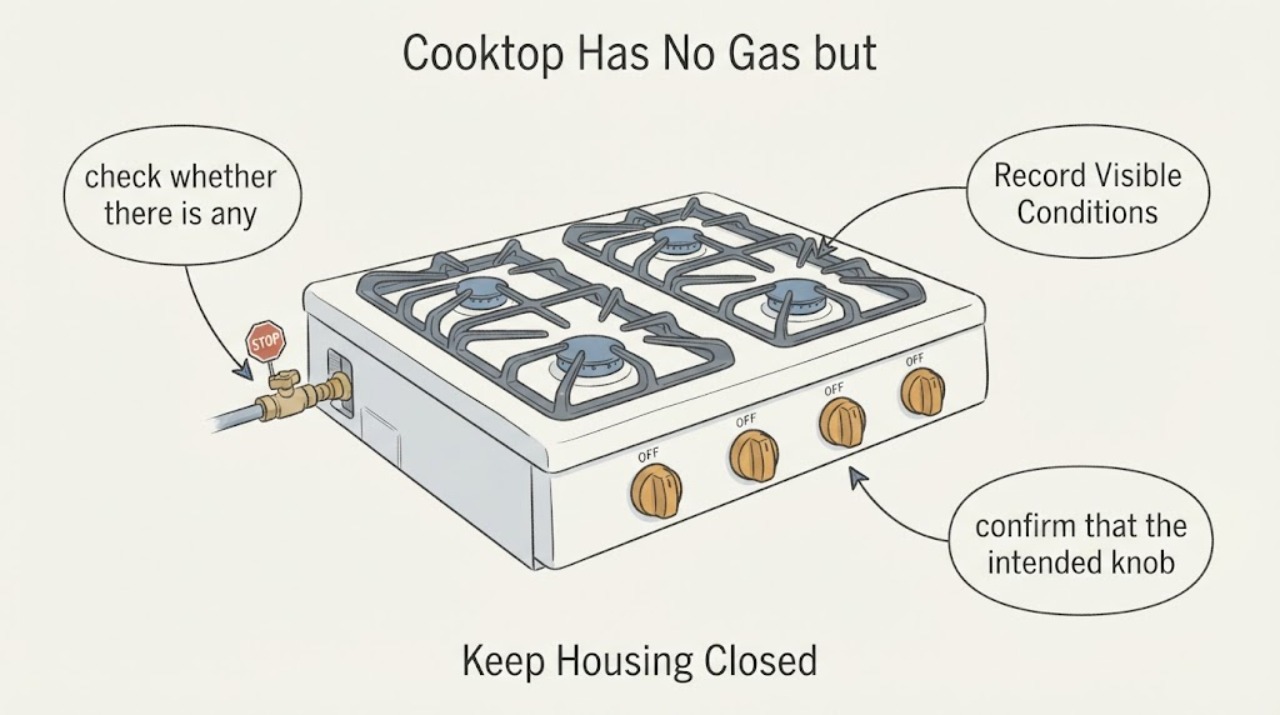
From a safe distance, check whether there is any rotten-egg or unburned-gas odor, a hissing sound, an unexplained flame, or anyone feeling unwell. Do not turn a burner on to test for gas.
Expected result: An odor is present or uncertain, or there is no odor and no other gas-emergency sign.
Next step: For odor or uncertainty, do not touch switches or use a phone inside, clear the area, leave, and call the gas supplier or emergency responders from outside. If there is no odor, keep all knobs off and continue without removing covers.
Why this matters
Why: An odor or uncertain situation must be treated as suspected unburned gas rather than as a burner ignition problem. No odor allows only the limited external checks below; it does not prove that the gas system is safe to open.
-
Check 2
Record the full model number and confirm whether this is a GE gas range with an oven or a standalone gas cooktop. Note whether one burner or every surface burner is affected, whether the oven actually heats, and whether the problem began after installation, cleaning, or moving.
Expected result: The oven heats while all surface burners fail, only one burner fails, the appliance type is uncertain, or the oven result is not confirmed.
Next step: Use the exact model manual for any product-specific step. If all surface burners fail while the oven works, stop user diagnosis after the external checks and arrange service; do not pull out the range or inspect the gas line.
Why this matters
Why: GE specifically treats a working oven with no working surface burners as a service condition. A single-burner failure or an uncertain oven result follows a different model-specific path and should not be generalized to the whole gas supply.
-
Check 3
With the cooktop cool and all controls off, confirm that the intended knob is matched to the intended burner and that the knob reaches Lite before any normal lighting attempt. Verify each burner cap is seated on the correct burner and is not swapped with a different-size cap.
Expected result: A knob was mismatched, a cap is missing or on the wrong burner, or the controls and caps are correctly matched but no burner lights.
Next step: Correct only the visible knob or cap placement and follow the model manual for one normal ignition attempt if there is no gas odor. If all burners still fail, stop and schedule qualified GE gas-appliance service.
Why this matters
Why: GE says selecting the correct burner, using Lite first, and matching cap size can determine whether a surface burner operates properly. Correct caps and controls with all burners still failing point beyond a simple assembly error.
-
Check 4
From ordinary access, verify that the range or cooktop is plugged into its intended outlet and that the relevant breaker or fuse is not tripped. Do not remove the outlet, cord, control panel, or burner manifold to make the check.
Expected result: The appliance has no power, a breaker is tripped, the plug is loose, or power appears normal while the oven works and surface burners still fail.
Next step: If safe and dry, restore only a plainly tripped breaker once; stop if it trips again. Do not repeatedly reset it or test live wiring. If power is normal or the fault returns, arrange service and mention the breaker behavior.
Why this matters
Why: GE notes that the ignition system requires electrical power even on a gas appliance. A power problem can prevent clicking, while normal power with an operating oven and no surface burners leaves a surface-burner fault for service.
-
Check 5
If the model has a Range Lockout or Cooktop Control Lock, look for the lock indicator or the exact lockout instruction in the owner manual. Do not use a generic button sequence from another GE model; keep all burner knobs at Off before changing a lockout setting.
Expected result: A lockout is visibly active, the model has no documented lockout, or the lockout is off but no surface burner produces a flame.
Next step: Disable the lockout only by the matching manual, then make one normal check with no odor. If the lockout is off or the burners remain dead while the oven works, contact qualified service; do not adjust a regulator or gas valve.
Why this matters
Why: GE documents that some lockout systems stop gas flow to surface burners and that lockout behavior differs by model and production period. An inactive lockout does not explain away a persistent all-burner failure.
Use your observations
Decision map
Find the observation that best matches what you see, then follow the next safe action.
-
PATH 01Next step
What you see
The GE oven heats, all surface burners fail, there is no gas odor, the caps and knobs are correctly matched, and electrical power is present.
Do this next
Keep the surface burners off and arrange qualified GE gas-appliance service. Provide the complete model, fuel type, whether any igniter clicks, recent installation or movement, and the checks already made.
Why this path and its safety boundary
Why it matters: This is the exact combination GE identifies for service. A surface-burner ignition/control or gas-delivery problem is more likely than a single dirty burner, but the appliance's internal gas components cannot be selected from the symptom alone.
-
PATH 02Next step
What you see
Only one burner fails, a cap is on the wrong burner, the knob was not turned to Lite first, or the burner assembly was disturbed during cleaning.
Do this next
With the cooktop cool and no odor, correct only the visible cap or control arrangement under the exact manual and make one normal attempt. If the burner still fails, arrange service rather than probing ports or replacing an orifice.
Why this path and its safety boundary
Why it matters: The pattern is more consistent with a local cap, control-selection, or model-specific burner-assembly issue than with a failure affecting the whole surface gas path.
-
PATH 03Next step
What you see
The surface burners do not click, the cooktop or range has no power, or a breaker trips when ignition is attempted.
Do this next
Leave the burners off, restore a breaker only once if it is plainly tripped and safe to do so, and call service if power is normal or the breaker trips again. Use a licensed electrician for a confirmed household supply fault.
Why this path and its safety boundary
Why it matters: A power or ignition-control issue is in scope. A gas oven may still provide a useful comparison, but electrical symptoms make live troubleshooting unsafe.
-
PATH 04Next step
What you see
A GE Range Lockout or Cooktop Control Lock indicator is active, or the control panel buzzes when a burner is selected without gas flow.
Do this next
Follow only the exact model manual to remove the lockout with all knobs off. If the lockout is not active or the burners remain unavailable, stop and arrange service.
Why this path and its safety boundary
Why it matters: The lockout may intentionally be preventing surface-burner operation. Because GE lockout behavior varies by model and age, a generic reset sequence could create a new hazard.
-
PATH 05Next step
What you see
Any rotten-egg or unburned-gas odor appears, the odor is uncertain, a burner is left at Lite without a flame, a flame is abnormal, or someone feels unwell.
Do this next
Do not light, relight, move the appliance, touch switches, or use a phone inside. Clear occupants, leave, and call the gas supplier or emergency responders from outside; wait for authorized clearance before any service or use.
Why this path and its safety boundary
Why it matters: This is a gas-safety event, not a no-gas-to-cooktop diagnosis. An unlit burner can release gas, and abnormal flames can indicate a fuel, pressure, airflow, or conversion concern.
Helpful context
Understand the symptom
Why an oven that works changes the first check
The symptom is not simply a failed ignition at one burner. If an oven on the same GE gas range operates but every surface burner is affected, the oven-versus-surface comparison points to a surface-burner control, ignition, lockout, or gas-delivery problem that the owner should not diagnose by opening the appliance. GE's own guidance sends this combination to service after the basic knob, cap, and power checks.
Do not confuse no ignition with no gas
A burner that clicks but does not light is different from one that produces no click, and both are different from a burner that lights weakly or has a yellow flame. A missing spark can be an ignition or power issue; no flame on all burners with a working oven still needs professional assessment. Never use a match to investigate whether gas is reaching the burners, and stop immediately for any gas odor.
Model and installation details matter
GE publishes separate behavior for ranges, standalone cooktops, older lockout systems, and newer control-lock designs. The complete model number, fuel type, country, and any recent installation or movement are needed before a technician selects a regulator, valve, ignition module, or other component.
Only after diagnosis
Potential parts
- surface-burner ignition or control assembly
Only consider this part category after the complete model is identified and qualified service confirms that the oven works, all surface burners are affected, power and lockout checks are normal, and the ignition/control path is faulty.
GE surface-burner systems vary by range, standalone cooktop, fuel type, and model. Confirm fitment in the matching GE documentation; do not use a generic igniter or module listing. - surface gas valve, regulator, or gas-supply component
This category is relevant only if the gas supplier or qualified gas-appliance technician confirms a delivery or valve problem after the oven-versus-surface comparison and visible checks.
Gas components require model, fuel, and regional verification and professional installation. Do not adjust a regulator, change an orifice, disconnect a connector, or order by symptom alone.
When checks do not resolve it
Need a professional?
Arrange qualified GE gas-appliance service when the oven works but no surface burners work after the matching cap, control, power, and lockout checks, when igniters do not click, when the fault returns after a breaker reset, or when diagnosis would require internal gas or electrical access. Call the gas supplier or emergency responders from outside for any unburned-gas odor or uncertainty, and a licensed electrician for a recurring household supply or breaker fault.
Safety scope: Do not use a flame to test gas flow, remove the cooktop, open the gas manifold, adjust a regulator or orifice, disconnect a connector, bypass a lockout, or perform live electrical tests. For any gas odor, flame abnormality, hissing, shock, smoke, or recurring breaker trip, stop and follow the emergency or electrical-safety path.
Have this ready
- Provide the complete model and serial information, country, natural-gas or LP fuel type, whether the appliance is a range or standalone cooktop, whether the oven heats, number of failed burners, click/no-click behavior, lockout indication, power or breaker behavior, and whether it was recently installed, moved, or cleaned.
Common questions
FAQ
If the GE oven works, does that prove gas is reaching the cooktop?
No. It only provides a useful comparison. GE says that when the oven comes on but no surface burners work, service is needed after the basic cap, knob, and power checks. Do not open the gas system to investigate the difference.
Can I light the GE surface burner with a match?
Do not use a match as a diagnostic test, especially when the reason for no ignition is unclear. GE describes manual lighting only for specific electric-ignition models during a power outage; if the oven works but all surface burners fail, GE directs the owner to service. Never attempt it when gas odor is present.
Could Control Lock stop gas to the GE cooktop?
On some GE ranges and cooktops, yes. GE documents model- and age-dependent lockout behavior, including systems that stop surface-burner gas flow or make the control buzz. Use only the exact model manual to change it, with all knobs off.
Should I replace the regulator or burner valves first?
No. A working oven and failed surface burners can involve ignition, lockout, power, controls, or gas delivery. Confirm the model and have qualified service test the applicable path before selecting a gas component.
Read the exact guide
Official sources
- If You Smell Gas in Your HomeGE Appliances · Official GE safety page opened for the emergency boundary whenever gas odor is present or uncertain.
- Gas Range - Gas OdorsGE Appliances · Official GE odor guidance opened to distinguish transient combustion odor from unburned-gas odor; it does not authorize a user to test a no-gas condition by lighting a burner.
- Gas Range & Cooktop - Surface Burners Not Clicking, Not Trying to IgniteGE Appliances · Official GE support page opened for external checks when one or more surface burners do not click or ignite; exact model instructions still govern.
- Gas Range - Explanation of the Lockout FeatureGE Appliances · Official GE lockout guidance opened to establish a possible external control branch; behavior differs by model, production period, and whether the product is a range or cooktop.
- Gas Range & Cooktop - Lighting Electric Ignition Burners During a Power FailureGE Appliances · Official GE page opened to distinguish gas flow from electric ignition during a power outage; manual-lighting guidance is not used as a diagnostic recommendation for an unexplained all-burner failure.
- Frequently Asked Questions About GE Ranges and Wall OvensGE Appliances · Official GE FAQ opened for model-dependent burner checks and the specific case where the oven works but surface burners do not; not a substitute for an exact owner manual.
Community feedback
Share a repair observation
Share a plain-text repair observation. Accepted observations are published automatically; this page may take a moment to update.