
On this page
Start here
Quick answer
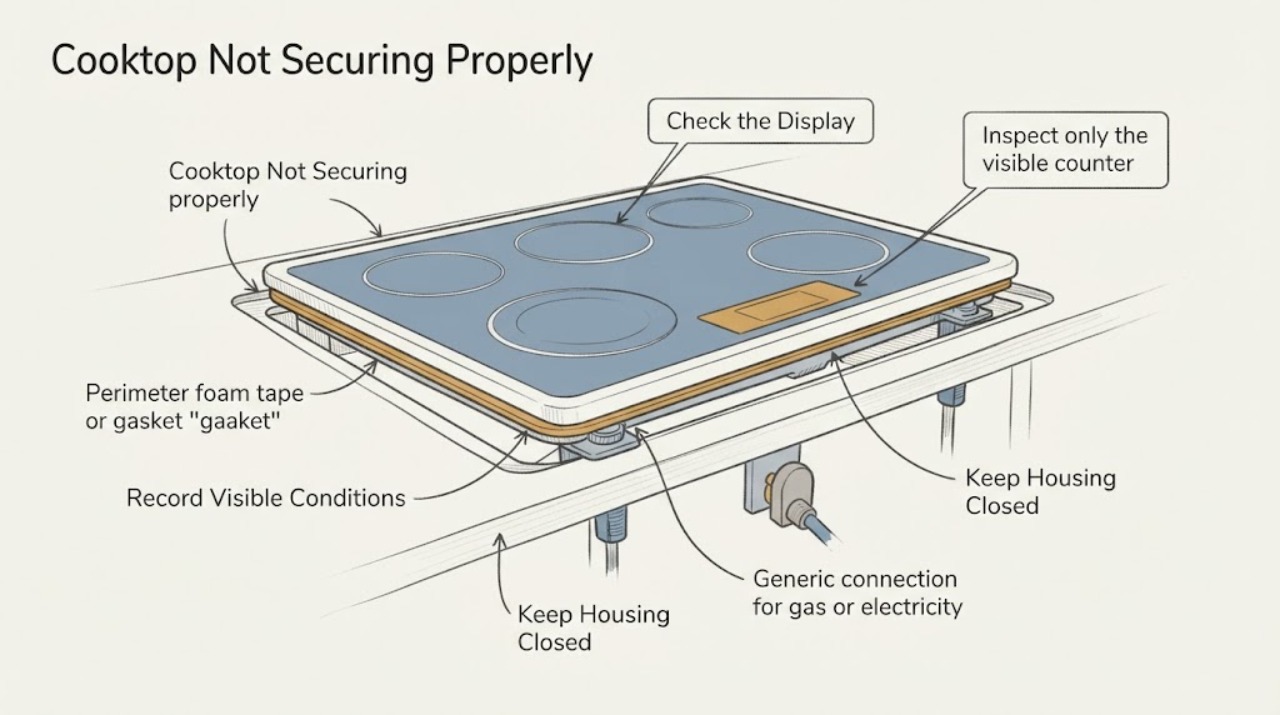
First separate a small, even edge gap from a cooktop that actually moves. GE says a slight gap can remain because the foam tape under the cooktop edge cushions the glass and compresses over time; GE does not recommend silicone or caulk because it can prevent removal for service. If the cooktop rocks, lifts, has a one-sided gap, sits on a damaged or distorted counter, or was disturbed during installation, stop using it and do not add improvised fasteners. Find the model and serial information, use the exact GE installation instructions to identify the approved retaining and cutout arrangement, and have a qualified installer or service technician handle any gas connection, hardwired electrical work, lifting, or refitting. A gas odor, smoke, heat-damaged wiring, cracked glass, or unstable unit is an immediate stop-use condition.
Before you begin
Safety first
- Do not pry or lift the cooktop, add silicone or caulk, fit hardware from another model, open a terminal or gas connection, perform live electrical tests, or restart the appliance to reproduce a gas or electrical hazard. Leave the area for gas odor and contact the gas supplier or emergency service from a safe location.
Work through in order
Diagnostic checks
Use only checks that match the exact appliance or system and its official guide.
-
Check 1
Turn every control off and let the surface cool. From above, look around the full perimeter without prying or lifting the cooktop; lightly touch the accessible edge only enough to tell whether it rocks or rises. Do not place weight on the glass.
Expected result: The gap is small and even and the cooktop remains stable, or one edge is lifted, the gap is uneven, the cooktop rocks, or the frame moves relative to the counter.
Next step: If the cooktop is stable and the gap is even, continue with model identification and do not caulk it. If it moves, lifts, or has a one-sided gap, stop using it and arrange inspection by the installer or a qualified appliance technician; do not try to reseat it yourself.
Why this matters
Why: GE says a slight gap can remain as the underside foam tape compresses. Rocking, lifting, or a localized gap is a different installation condition and cannot be classified as normal spacing from the public GE gap guidance.
-
Check 2
With the cooktop undisturbed, inspect only the visible counter surface and perimeter for a cracked or swollen opening, broken edge, displaced foam, crumbs or grease under the lip, and signs that the counter or cabinet has shifted. Do not slide the appliance, remove trim, or insert a tool into the opening.
Expected result: The counter and opening look sound and clean, or there is a crack, broken edge, distortion, moisture damage, a displaced cushion, or debris that prevents even seating.
Next step: If a small amount of accessible surface debris is present, clean only the exposed counter after the appliance is cool and off. For any crack, swelling, movement, or damaged cushion, stop and have the counter and cooktop assessed together; do not pack the gap or improvise a support.
Why this matters
Why: A stable, clean opening is compatible with a simple gap observation, while a damaged or distorted opening can prevent the cooktop from sitting in its designed position. The observation does not identify which retaining component or repair is required.
-
Check 3
Read the model and serial tag without moving the cooktop, or use the existing GE QR code if the tag is accessible. Record the complete model suffix and whether the unit is gas, electric, or induction, then open GE's manual page and enter that exact model.
Expected result: A complete model is available and produces matching installation information, or the tag is missing, unreadable, or the result is for a different cooktop family.
Next step: Use only the matching installation information to discuss the problem with the installer or service provider. If the model cannot be confirmed, stop at visual checks and provide photographs and the tag details to GE support; do not borrow a procedure from another model.
Why this matters
Why: GE's manual portal and cooking-product support route are model-driven. A similar-looking GE cooktop is not enough to confirm the correct gasket, retaining method, countertop opening, or service procedure.
-
Check 4
Review whether the cooktop was newly installed, the counter was replaced, the appliance was lifted for cleaning or service, or the gas or electrical connection was recently disturbed. Do this from the installation record and visible condition; do not remove the cooktop to investigate.
Expected result: The problem began after installation, remodeling, lifting, or connection work, or there is no known recent change and the unit has gradually developed movement.
Next step: For a new or altered installation, contact the original installer and supply the exact model and photographs. If a gas connection or hardwired electrical work was disturbed, stop using the cooktop and use a qualified installer or technician rather than rechecking the connection yourself.
Why this matters
Why: A timing link makes an installation or seating issue more likely, but it does not prove a missing retainer or a wiring or gas fault. The correct fix depends on the exact model and the installation type.
-
Check 5
Without running the cooktop to reproduce the issue, look for gas odor, smoke, scorching, heat-damaged wiring or controls, a cracked glass surface, liquid near electrical areas, or a unit that could shift or fall.
Expected result: No hazard is visible and the cooktop is stable, or there is a gas odor, smoke, heat damage, liquid at electrical areas, cracked glass, or unsafe movement.
Next step: Turn controls off and keep people away. If gas is smelled, leave the area and contact the gas supplier or emergency service from a safe location; do not operate switches or attempt a leak test. For electrical damage or cracked glass, disconnect power only if safely accessible and arrange qualified service. Do not restart the appliance to confirm the fault.
Why this matters
Why: The second pattern is a stop-use condition. It cannot be safely narrowed to a loose bracket, gasket, burner, switch, terminal, or control from an external symptom.
-
Check 6
Give the installer or GE service the complete model, fuel type, installation date, photographs of the perimeter and counter, whether the unit rocks or lifts, and any recent work or hazard signs. Keep the cooktop off while waiting when it is not stable or any hazard is present.
Expected result: The issue is a stable, even gap with no hazard, or there is movement, structural damage, a connection concern, or a persistent installation problem.
Next step: For a stable gap, follow the exact model manual and monitor for change. For movement, damage, or any gas/electrical concern, use the original installer, a qualified gas installer/electrician as applicable, or GE service; do not open the cooktop or fit unverified hardware.
Why this matters
Why: A stable even gap can be monitored without sealant, while movement or damaged surroundings needs an installation decision. GE's public pages do not support selecting a universal retaining part or a cross-model refit.
Use your observations
Decision map
Find the observation that best matches what you see, then follow the next safe action.
-
PATH 01Next step
What you see
The perimeter gap is small and even, the cooktop stays seated when lightly touched, and there is no crack, odor, smoke, or electrical damage.
Do this next
Do not add silicone or caulk. Record the model and use the exact GE installation information if the gap changes or the cooktop later moves.
Why this path and its safety boundary
Why it matters: GE says a slight gap can remain because the underside foam tape cushions the edge and can compress over time.
-
PATH 02Next step
What you see
The cooktop rocks, lifts at an edge, has a one-sided gap, or shifts relative to the countertop.
Do this next
Stop using the cooktop and arrange inspection by the installer or a qualified appliance technician. Do not pry, lift, add shims, or install hardware from another GE model.
Why this path and its safety boundary
Why it matters: This is an installation or structural concern rather than the slight-gap condition GE describes as potentially normal. The public guidance does not identify the missing or damaged retaining element without the model.
-
PATH 03Next step
What you see
The counter opening is cracked, swollen, distorted, or broken, or the cooktop glass or frame is cracked.
Do this next
Keep the appliance off and have the counter and cooktop evaluated together. Do not try to seal, clamp, or continue heating on a damaged surface.
Why this path and its safety boundary
Why it matters: The support surface may no longer hold the cooktop in its designed position, and cracked glass or a damaged frame creates a safety boundary that cannot be resolved by tightening an unknown retainer.
-
PATH 04Next step
What you see
The movement started after a remodel, new installation, lifting, or work on the gas or electrical connection.
Do this next
Provide the exact model and photographs to the original installer. For gas installation or hardwired electrical work, stop using the cooktop and use the qualified installer or appropriate service professional required for that connection.
Why this path and its safety boundary
Why it matters: The timing makes installation or seating relevant, but it does not establish a loose gas fitting, wire, clip, or gasket from the symptom alone.
-
PATH 05Next step
What you see
You smell gas, see smoke or scorching, find heat-damaged wiring or liquid at electrical areas, or the cooktop can move dangerously.
Do this next
Leave the area for gas odor and contact the gas supplier or emergency service from a safe location; for electrical damage, disconnect power only when safely accessible and arrange qualified service. Do not operate switches, open the cooktop, or restart it.
Why this path and its safety boundary
Why it matters: This is a stop-use safety condition, not a bracket-adjustment problem that should be reproduced at home.
Helpful context
Understand the symptom
A visible gap is not the same as a loose cooktop
GE says a slight gap can be normal, especially after installation. Foam tape under the cooktop edge cushions and protects it, and that tape can compress with time while leaving a visible gap. The more useful distinction is whether the gap is even and the cooktop stays seated, or whether the glass or frame rocks, lifts, or moves when touched lightly. Do not close a normal gap with silicone or caulk: GE says sealant can prevent removal for service.
Identify the exact GE installation before touching retaining hardware
The task does not include a GE model number or whether the cooktop is gas, electric, or induction. GE's manual service asks for the model number to return the matching installation information, and its cooking-product support page directs owners to model-specific support from the model or serial tag. Until that identity is confirmed, do not assume that a clip, strap, screw, gasket, countertop thickness, or cutout dimension from another GE cooktop applies.
Treat gas, electrical, and structural signs as service boundaries
A cooktop that moves can put strain on the cutout, surface, connections, or controls, but the symptom alone does not identify the failed part. For a gas model, GE requires a qualified installer and the model-specific installation instructions. For an electric model, disconnecting power before maintenance is an electrical-safety step; do not open a terminal area or test wiring. Smoke, gas odor, heat damage, cracked glass, or an unstable unit calls for stop-use and qualified service rather than another test.
When checks do not resolve it
Need a professional?
Arrange qualified installation or GE service if the cooktop rocks, lifts, has a one-sided gap, the countertop or glass is damaged, the problem followed installation or connection work, or the exact model instructions cannot be followed confidently. Stop use immediately for gas odor, smoke, heat-damaged wiring, liquid near electrical areas, cracked glass, or dangerous movement.
Safety scope: Do not pry or lift the cooktop, add silicone or caulk, fit hardware from another model, open a terminal or gas connection, perform live electrical tests, or restart the appliance to reproduce a gas or electrical hazard. Leave the area for gas odor and contact the gas supplier or emergency service from a safe location.
Have this ready
- Provide the complete model and serial information, fuel type, installation or remodel date, whether the perimeter gap is even, whether the cooktop rocks or lifts, photographs of the countertop opening and visible edge, and any gas, electrical, smoke, crack, or moisture warning signs.
Common questions
FAQ
Is a small gap around my GE cooktop always a problem?
No. GE says a slight gap can be normal because foam tape under the cooktop edge cushions the appliance and can compress over time. A cooktop that rocks, lifts, or has an uneven gap is a different condition and should be inspected rather than sealed.
Should I caulk around a GE cooktop that looks loose?
No. GE does not recommend silicone sealant or caulk around the cooktop edge because it can prevent removal for service. First determine whether the unit actually moves, then use the exact model installation information and qualified service if needed.
Can I tighten or replace the cooktop clips myself?
Do not choose clips, straps, screws, or a refit procedure by appearance alone. GE's manual portal requires the exact model for installation information, and the task does not identify the model or fuel type. A moving cooktop should remain off while the installer or qualified technician checks the model-specific installation.
What should I do if a GE gas cooktop is not secure?
Do not move or test the cooktop if the gas connection may have been disturbed. GE says gas cooking appliance installation must be performed by a qualified installer and directs owners to the specific model installation instructions. If you smell gas, leave the area and contact the gas supplier or emergency service from a safe location.
Read the exact guide
Official sources
- Owner's Manual & Installation InstructionsGE Appliances · Opened GE's official manual portal. It supports the model-identification gate and retrieval of exact installation information; it does not supply a universal retaining method.
- Support for GE Cooking ProductsGE Appliances · Opened GE's official cooking-product support page. It supports locating model-specific support and qualified service; it is not used to diagnose a missing retainer or approve a cross-model part.
- Gas Range & Cooktop - Installation Gas PressureGE Appliances Support · Opened GE's official gas range/cooktop installation support article. Used only for the qualified-installer and exact-model installation boundary; no gas pressure value or internal gas repair is recommended here.
- Cooktop - Gap Between Cooktop and CounterGE Appliances Support · Opened GE's official cooktop support article. It applies to GE cooktops at family level for distinguishing a slight gap from a sealing decision; it does not identify a model-specific retaining part.
- Electric Range & Cooktop - Surface Burners Not Heating WellGE Appliances Support · Opened GE's official electric range/cooktop support article. It is used only for the basic unplug-before-maintenance and service boundary, not for diagnosing the securing problem.
Community feedback
Share a repair observation
Share a plain-text repair observation. Accepted observations are published automatically; this page may take a moment to update.