
On this page
Start here
Quick answer
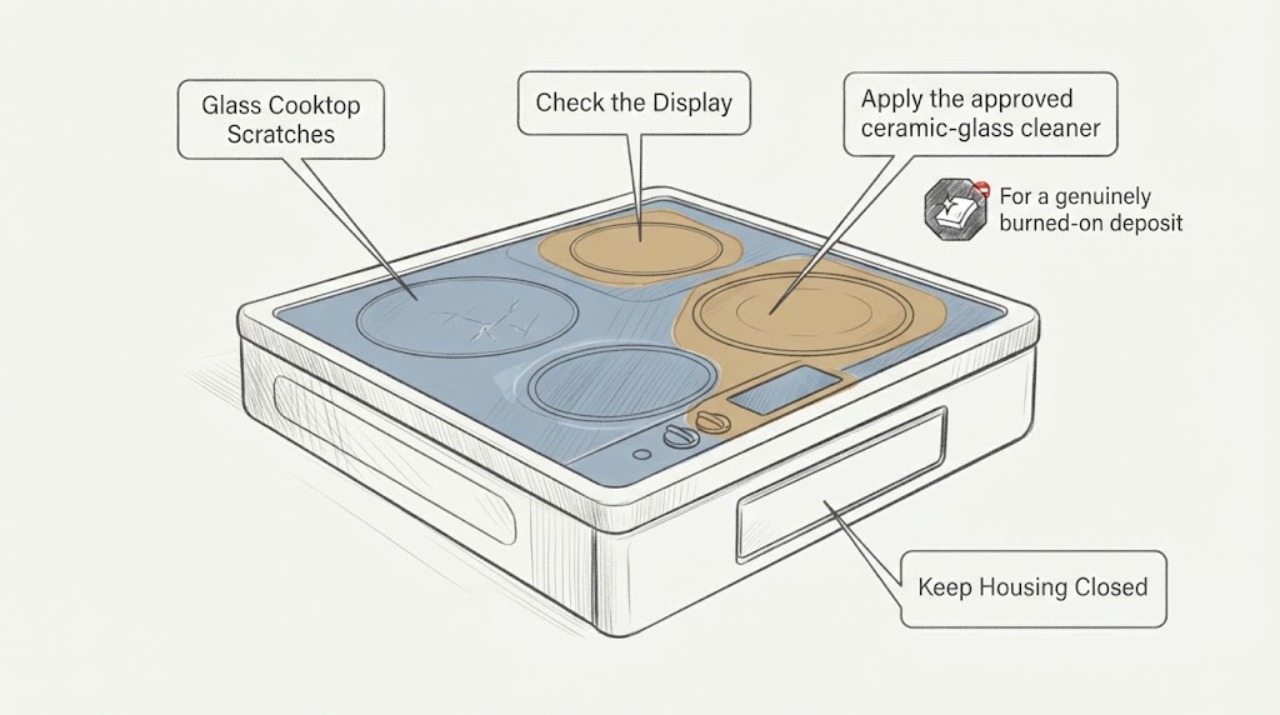
Turn the cooktop off and let it cool before deciding that a line is a scratch. GE says some apparent scratches are removable pan residue, metal transfer, or mineral deposits; use only an approved ceramic-glass cleaner and the recommended pad or paper towel on a cool surface. A deep scratch will not be removed by cleaning. If the glass is cracked, pitted, indented, or the line catches a fingernail, stop using the cooktop and arrange service rather than polishing harder or heating it to test it.
Before you begin
Safety first
- Do not use the cooktop with cracked or pitted glass, do not use the range oven until a cracked cooktop is repaired, and do not open, glue, polish aggressively, or heat-test damaged glass.
Work through in order
Diagnostic checks
Use only checks that match the exact appliance or system and its official guide.
-
Check 1
Turn every surface control off, remove cookware safely, and let the glass cool fully before touching or judging the mark.
Expected result: In good light, the mark is only a surface sheen or streak, or the glass shows a branching line, chip, pit, indentation, or a line that catches a fingernail.
Next step: If there is a crack, chip, pit, indentation, or other loss of glass, keep the cooktop off and use the service path. If the glass is intact, continue with the cool-surface cleaning check.
Why this matters
Why: A removable-looking mark can be residue or metal transfer, but a crack or loss of glass surface is structural damage. Heating the top to test it can make a damaged surface less safe.
-
Check 2
Apply the approved ceramic-glass cleaner named by GE, such as CeramaBryte or Weiman, to the cool surface and use the recommended paper towel or pad; remove all cleaner before heating.
Expected result: The line or sheen fades or disappears, only a metallic-looking film lifts, or the mark remains after the approved cleaning method.
Next step: Use normal cooking only after residue and cleaner are gone. If the mark remains, stop escalating the cleaning method and assess it as a possible permanent scratch or service issue.
Why this matters
Why: A mark that lifts is consistent with pan residue, metal transfer, or mineral deposit. A mark that remains is not proven to be removable, and repeated abrasion can damage the surface.
-
Check 3
For a genuinely burned-on deposit, follow GE's limited scraper guidance with a new, sharp, single-edge razor held at about a 45-degree angle together with the ceramic-glass cream; do not use this on a crack or with a dull or nicked blade.
Expected result: The deposit lifts without leaving a pit or indentation, or the surface reveals pitting, an indentation, hardened plastic, or a bonded area that will not release.
Next step: Stop scraping when the residue is gone or the glass is changing. Keep the cooktop off and arrange service for pitting, indentation, bonded material, or any crack; do not keep heating the area to burn material away.
Why this matters
Why: A deposit that lifts is surface contamination. Pitting or indentation means the glass has been damaged; GE says hardened plastic or porcelain bonded to the glass may require glass replacement or service.
-
Check 4
Inspect the cookware bottoms and the surface before the next use: remove trapped grit, confirm bottoms are smooth and flat, and lift pans instead of sliding them.
Expected result: A pan has a rough or warped base, coarse particles are trapped underneath, or sliding has been used; alternatively, the cookware and surface are smooth and clean.
Next step: Replace or stop using cookware that damages the surface, clean away grit, and follow the exact model owner's manual for cookware limits. Seek service if a deep scratch, crack, pit, or indentation remains.
Why this matters
Why: GE identifies rough bottoms, cast iron, trapped coarse particles, and sliding cookware as scratch risks. A clean, smooth setup reduces new marks but does not repair a deep scratch.
Use your observations
Decision map
Find the observation that best matches what you see, then follow the next safe action.
-
PATH 01Next step
What you see
The mark disappears or clearly fades with approved ceramic-glass cleaner while the surface remains smooth and unbroken.
Do this next
Remove all cleaner, let the surface dry, and return to use only after the surface is clean and intact; correct the cookware or grit source that caused the transfer.
Why this path and its safety boundary
Why it matters: The observation is consistent with residue, metal transfer, or mineral deposit rather than a confirmed structural crack.
-
PATH 02Next step
What you see
The line remains after the approved cleaning method, but the glass is smooth with no crack, chip, pit, or indentation.
Do this next
Stop using increasingly abrasive products or generic polishing compounds. Record the location and ask GE or a qualified service provider whether the model's glass should be evaluated, especially if the line grows or catches a fingernail.
Why this path and its safety boundary
Why it matters: A permanent cosmetic scratch is more likely; GE states that deep scratches cannot be removed by cleaning.
-
PATH 03Next step
What you see
A fingernail catches, or there is a crack, chip, pit, indentation, or a line that branches through the glass.
Do this next
Stop using the cooktop until it is repaired. If it is a range, do not use the oven either; arrange GE or qualified appliance service and do not try to polish, glue, or heat the damage.
Why this path and its safety boundary
Why it matters: This is a glass-damage condition rather than ordinary removable residue. GE says cracked or pitted ceramic glass requires service.
-
PATH 04Next step
What you see
Sugar or melted plastic is bonded to the surface, or a cleaning attempt leaves a pit or indentation.
Do this next
Keep the affected area out of use and obtain service or glass replacement guidance. Do not continue heating the deposit or use a damaged blade, abrasive powder, or unapproved solvent.
Why this path and its safety boundary
Why it matters: The contamination or heat damage may have altered the glass; GE's user cleaning guidance does not treat bonded material or pitting as a routine polish-and-use condition.
Helpful context
Understand the symptom
Start by separating a surface mark from structural damage. GE describes its ceramic glass as scratch-resistant rather than scratch-proof, and notes that coarse particles trapped between cookware and the top, rough cookware bottoms, and sliding pans can create real scratches. The same surface can also show metal transfer, mineral deposits, or cooked-on residue that looks like a scratch.
Clean only after the cooktop is cool
For an intact surface, use the approved ceramic-glass cleaner named in the GE guidance, such as CeramaBryte or Weiman, with the specified paper towel or pad. Remove the cleaner completely before heating the surface. Avoid abrasive powders, rough sponges, and unapproved cleaners because they can damage the glass or create a new mark that is harder to interpret.
Know when a mark is no longer a cleaning problem
A mark that fades or disappears with the approved cleaner is consistent with transfer or residue. A line that remains but leaves the surface smooth may be a cosmetic scratch; GE says deep scratches are not removable. A crack, pit, indentation, or line that catches a fingernail is a service boundary. Do not keep rubbing, use a generic scratch-removal compound, or heat the cooktop to see whether the mark changes.
Prevent the next scratch
Before the next use, check that pan bottoms are smooth and flat, wipe away grit, and lift cookware instead of sliding it. Cast iron and other rough-bottom cookware can scratch the surface. The exact owner's manual still controls cookware and cleaning details for the unidentified GE model.
When checks do not resolve it
Need a professional?
Call GE or qualified appliance service when the glass is cracked, chipped, pitted, indented, bonded with hardened plastic or porcelain, or when a persistent scratch needs model-specific evaluation. Keep a cracked or pitted cooktop off until repaired.
Safety scope: Do not use the cooktop with cracked or pitted glass, do not use the range oven until a cracked cooktop is repaired, and do not open, glue, polish aggressively, or heat-test damaged glass.
Have this ready
- The exact model from the rating label, a clear photo of the mark in good light, whether a fingernail catches, whether the mark changes after approved cleaning, and whether there is any crack, chip, pit, indentation, sugar, or melted plastic.
Common questions
FAQ
Can a GE glass cooktop scratch be polished out?
Only surface residue, metal transfer, or mineral deposits may come off with the approved ceramic-glass cleaning method. GE says deep scratches are not removable; do not use generic abrasive polish or keep scraping the glass.
How can I tell a pan mark from a real scratch?
Let the surface cool and use the approved cleaner first. A mark that lifts is consistent with residue or transfer. A line that remains, catches a fingernail, or accompanies a crack, pit, or indentation needs a more cautious service decision rather than more abrasion.
Can I use a razor scraper on the glass?
GE's cleaning guidance limits a razor scraper to burned-on residue, with cream and a new sharp single-edge blade held at about 45 degrees. Do not scrape a crack, use a dull or nicked blade, or treat pitting as residue.
Is it safe to cook on a cracked GE cooktop?
No. GE says cracked or pitted ceramic glass requires service and the cooktop should not be used until repaired. On a range, do not use the oven until the cooktop is fixed either.
Read the exact guide
Official sources
- Electric Range & Cooktop - Scratches on Glass CooktopGE Appliances · GE's family-level guidance for apparent scratches, scratch causes, cookware surface risks, and the limit that deep scratches are not removable; the assigned task has no model.
- Cooktop - Glass CrackedGE Appliances · GE safety and service guidance for cracked or pitted ceramic glass across radiant, induction and gas-on-glass cooktops; it is used only for the stop-use and service boundary, not for a model-specific part.
- Recommended Ceramic Glass Cooktop CleanersGE Appliances · GE's recommended cleaner and accessory guidance used to avoid transferring an unapproved abrasive or damaged scraper to an unidentified GE model.
- How to Clean a Glass CooktopGE Appliances · GE user-level cleaning guidance for cool surfaces, approved cream/pads, metal marks, mineral deposits, burned-on residue, sugar or melted plastic, and pitting/service boundaries.
Community feedback
Share a repair observation
Share a plain-text repair observation. Accepted observations are published automatically; this page may take a moment to update.