
On this page
Start here
Quick answer
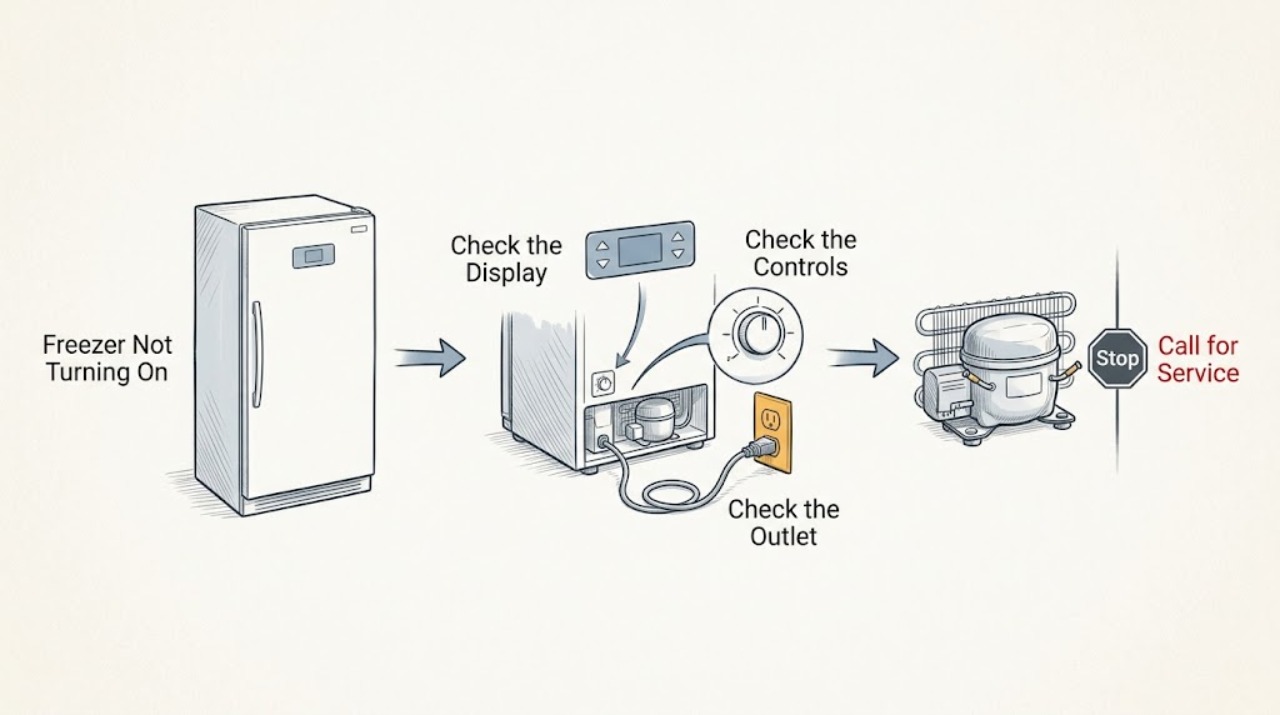
If a GE freezer appears not to turn on, first check whether the outlet has power and whether the temperature control is set to a cooling position rather than Off. With the control set correctly, wait briefly for the compressor to start, then test the outlet with a small lamp or other low-risk appliance. Keep the freezer door closed to protect the food while you troubleshoot. If the outlet works but the freezer remains inactive, or if a breaker trips again, the cord is damaged, there is smoke or a burning smell, or the cabinet is warming, stop and arrange qualified service without opening the appliance.
Work through in order
Diagnostic checks
Use only checks that match the exact appliance or system and its official guide.
-
Check 1
Check the freezer's visible state without opening panels: note whether an interior or power light is present, whether the control display responds, whether the temperature control is at Off, and whether the cabinet is cold or warming.
Expected result: No light or display may simply reflect a model without a dedicated power indicator. A control at Off prevents cooling, while a responsive control with a warming cabinet points toward the cooling system or control rather than an entirely dead outlet.
Next step: Move the temperature control to a normal cooling setting only if the control operates normally, then continue to the compressor and outlet checks. Stop for smoke, odor, damaged wiring, or a hot cord.
Why this matters
Why: GE notes that many upright and chest models do not have a designated Power On light, so the symptom must be interpreted with the control and cabinet temperature.
-
Check 2
Set the temperature control to a cooling setting rather than Off and wait briefly to see whether the compressor starts, as directed for the model.
Expected result: A compressor that starts after the control is corrected suggests the appliance was switched off or waiting normally. If it remains silent and the cabinet is warming, continue with the outlet test; if it starts but does not cool, the issue is no longer only a power-on symptom.
Next step: Do not repeatedly cycle the control. If the compressor does not start after the brief wait, test the outlet without touching internal wiring.
Why this matters
Why: The control position is a simple, reversible cause of a freezer that appears inactive, but a running compressor with poor cooling requires a different diagnosis.
-
Check 3
With the freezer plug fully seated and the area dry, plug a small lamp or other low-risk appliance into the same outlet to check whether the receptacle is supplying power.
Expected result: If the lamp also stays off, the outlet, circuit breaker, fuse, or household wiring is the likely supply-side issue. If the lamp works but the freezer remains inactive, power is reaching the receptacle and the freezer needs appliance-level diagnosis.
Next step: For a dead outlet, check the household breaker or fuse only from its normal user-accessible location and call an electrician when needed. Do not open the freezer or use a damaged extension cord.
Why this matters
Why: GE uses an independent small appliance as the outlet check so the freezer itself is not assumed to be the source of the electrical test result.
-
Check 4
Inspect the plug and cord visually for looseness, cuts, scorching, or heat damage while the freezer is disconnected; do not remove the rear cover or test internal components.
Expected result: A secure, undamaged cord with a working outlet supports an internal freezer fault if the appliance remains inactive. Any damaged insulation, scorching, hot plug, or loose receptacle makes continued operation unsafe.
Next step: Stop using the freezer and arrange qualified electrical or appliance service for damage, heat, or a loose outlet. If the external supply is safe, continue only with the model's user controls and the service boundary.
Why this matters
Why: External cord and receptacle checks can identify a supply hazard without exposing the user to live circuitry.
-
Check 5
If the outlet works, confirm that no model-specific cooling-off control or fault indication is active, then allow one normal start attempt while keeping the door closed and watching for compressor activity.
Expected result: Control lights with no compressor can be consistent with an Off setting, failed temperature or defrost control, relay problem, wiring fault, or compressor fault. GE lists these as possible causes when controls work but the freezer does not cool.
Next step: If the freezer remains inactive or warming despite a working outlet and correct control setting, keep it closed and schedule qualified service. Do not remove a relay, open the sealed system, or bypass a control.
Why this matters
Why: A lit control panel does not prove that the sealed cooling system is operating, and these components are not user-serviceable checks.
-
Check 6
If a power outage is the trigger, keep the door or lid closed, use regular ice if available, and move food to a suitable cooler when a longer outage is expected; handle dry ice only with protection and ventilation.
Expected result: A closed freezer retains cold longer than repeated opening. Ice or a cooler can slow warming while power is unavailable, but the appliance is not repaired until power and cooling return.
Next step: Once power is restored, verify the freezer starts normally without repeatedly opening it. If it does not resume or the temperature continues rising, keep the door closed and use qualified service; follow appropriate food-safety guidance for any thawed food.
Why this matters
Why: Food protection is time-sensitive and should continue while the electrical cause or service appointment is being handled.
Use your observations
Decision map
Find the observation that best matches what you see, then follow the next safe action.
-
PATH 01Next step
What you see
The outlet is dead when tested with a small lamp or other low-risk appliance.
Do this next
Check the breaker or fuse from its normal user-accessible location and use an electrician for a continuing supply problem. Leave the freezer closed while power is unavailable.
-
PATH 02Next step
What you see
The outlet works, but the freezer's control is Off or the model's cooling control is disabled.
Do this next
Restore the normal cooling setting according to the model manual and allow one normal start attempt.
-
PATH 03Next step
What you see
The outlet works and controls respond, but the compressor never starts or the cabinet warms.
Do this next
Keep the door closed and arrange qualified service for the control, relay, wiring, compressor, or cooling system. Do not open the appliance.
-
PATH 04Next step
What you see
A power outage is ongoing or food is already warming.
Do this next
Keep the door shut, use regular ice or a suitable cooler strategy, and follow food-safety guidance. Treat dry ice as a burn hazard.
-
PATH 05Next step
What you see
The cord or plug is hot or damaged, the breaker trips again, smoke or burning odor appears, or water reaches electrical parts.
Do this next
Stop immediately, disconnect power only when safe, keep the freezer out of service, and contact qualified electrical or appliance service.
Helpful context
Understand the symptom
What ‘not turning on’ means on a freezer
A GE chest or upright freezer may not have a dedicated power light, so a dark exterior does not prove that the appliance has no power. Separate a supply problem from a cooling problem: check the outlet and control first, then listen for the compressor. If the controls or lights work but the freezer is warming, the cooling system—not just the wall outlet—needs to be considered.
Protect the food while checking the appliance
Keep the door or lid closed as much as possible. GE recommends using bags of regular ice to help keep food frozen during a power outage; if a longer outage is expected, food can be moved to a cooler with regular or dry ice. Dry ice can cause freezing burns, so use appropriate hand protection and ventilation, and follow the product and local food-safety guidance.
Stop conditions
Do not remove the electrical cover or probe live parts. Stop immediately for smoke, a strong burning odor, a hot or damaged cord, water near electrical connections, repeated breaker trips, or a cabinet that is rapidly warming. Disconnect power only when it is safe and arrange qualified service.
When checks do not resolve it
Need a professional?
Use qualified service when a working outlet and correct control setting do not restore operation, or whenever there is an electrical, compressor, control, or cooling-system warning.
Common questions
FAQ
Why is my GE freezer dark even though it may have power?
Many GE upright and chest freezers do not have a dedicated Power On indicator. Check the temperature control and test the outlet with a small lamp before concluding that the freezer has no power.
What should I do if the outlet works but the freezer does not start?
Confirm the control is set to cool, allow one normal start attempt, and keep the door closed. If the freezer remains inactive with power present, GE recommends service rather than internal troubleshooting.
How can I protect food during a freezer power outage?
Keep the door closed and use bags of regular ice. If the outage is expected to last, use a suitable cooler strategy; dry ice requires protection because it can cause freezing burns.
Should I open the back of a GE freezer that will not turn on?
No. User-level checks are limited to the control, outlet, visible cord and plug, and safe outage steps. A freezer that has power but remains inactive needs qualified service, especially if it is warming or shows electrical warning signs.
Read the exact guide
Official sources
- Upright & Chest Freezer - Power Outage TipsGE Appliances · GE upright and chest freezers during power outages
- Upright & Chest Freezer - How to Confirm Power to the FreezerGE Appliances · GE upright and chest freezers; exact controls vary by model
- Upright & Chest Freezer - Not WorkingGE Appliances · GE upright and chest freezers; component diagnosis is model-specific
Community feedback
Share a repair observation
Share a plain-text repair observation. Accepted observations are published automatically; this page may take a moment to update.