
On this page
Start here
Quick answer
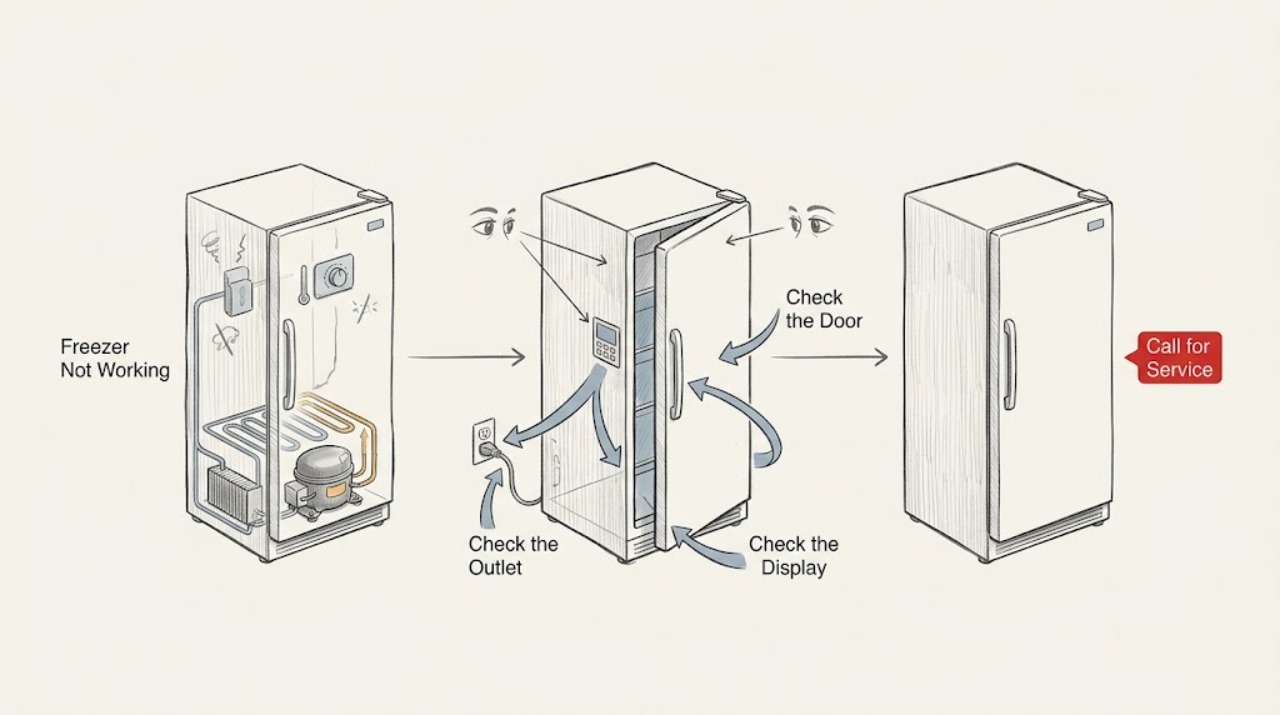
If a GE freezer is not working, first determine whether it is completely dark, has lights but is not cooling, or is temporarily quiet during a defrost cycle. Confirm the plug, outlet, and temperature control, and check the display for Demo Mode or a fault code. Keep the door closed to protect the food while you diagnose the problem. If the freezer remains warm, the compressor does not restart after the normal delay, a breaker trips again, wiring is damaged, or food has begun to thaw, stop unsafe electrical checks and arrange qualified GE service while following food-safety guidance.
Work through in order
Diagnostic checks
Use only checks that match the exact appliance or system and its official guide.
-
Check 1
Keep the freezer door closed while you identify the failure. Look from a safe position for smoke, burning odor, water near electrical parts, melted wiring, or a breaker that has tripped; do not touch damaged components or open the cabinet.
Expected result: There is an electrical or water hazard, or there is no immediate hazard and the door can remain closed.
Next step: For smoke, burning odor, damaged wiring, or water near electricity, leave the freezer off and arrange qualified service. Otherwise keep the door closed and continue with the power and control checks.
Why this matters
Why: A safety hazard takes priority over cooling diagnosis. With no hazard, keeping the door shut preserves cold air and gives the freezer the best chance of protecting food while external checks are made.
-
Check 2
Check whether the interior light or control display works, confirm the plug is fully seated, and test the outlet from a dry, safe position with a small device. Inspect only the visible power cord for damage; do not open the freezer or change wiring.
Expected result: The freezer is dark and the outlet has no power, the outlet works but the freezer is dark, or the lights and display work normally.
Next step: Restore a tripped household supply only if safe and do not use a damaged cord. If the outlet works but the freezer remains dark, request service; if it is lit, continue with Demo Mode and temperature checks.
Why this matters
Why: A dead outlet or dark appliance points to the household supply, plug, cord, or internal power circuit. Normal lights show that some power is present, so the fault is more likely a control, cooling, or temperature problem.
-
Check 3
Read the temperature control and display without guessing model-specific button combinations. Confirm the temperature control is On and check for GE Demo Mode, Showroom Mode, or a displayed fault code; use the exact model manual for clearing a mode or interpreting a code.
Expected result: The control is Off, Demo Mode is shown, a fault code is present, or the control appears normal.
Next step: Clear Demo Mode or adjust the control only using the documented model procedure, then allow the appliance to stabilize. Record any fault code exactly; if it returns or the freezer stays warm, arrange service.
Why this matters
Why: GE says Demo Mode can leave lights and controls working while disabling cooling. A fault code can identify a defrost or control problem, while a normal control makes the compressor, airflow, or sealed system more likely.
-
Check 4
Listen from outside the cabinet for the compressor or fans and note when the freezer last ran. If the problem followed a short power interruption or a recent unplug/replug, wait for the appliance's normal protective delay instead of cycling the plug repeatedly; compare the symptom with the model manual's defrost guidance.
Expected result: The freezer is quiet during a documented defrost or protective delay, or it remains quiet and warm after the expected period.
Next step: Allow the documented cycle or protective delay to finish with the door closed. If cooling does not return, do not test the relay or compressor yourself; request qualified service.
Why this matters
Why: GE explains that compressor and fans stop during defrost, and that compressor overload protection can delay restart after a short outage. A freezer that remains warm and inactive afterward points toward a control, relay, compressor, wiring, or sealed-system fault.
-
Check 5
Use an appliance thermometer if available and observe the temperature between food packages without leaving the door open. Note whether food still has ice crystals, whether packages are soft or thawed, and whether the freezer is a standalone unit or part of a refrigerator.
Expected result: The freezer is at a safe frozen temperature, rising but still cold, or food has thawed and the appliance is not recovering.
Next step: Keep the door closed and move food to a suitable cold-storage option if the freezer cannot maintain temperature. Discard food that fails the applicable food-safety guidance, and arrange GE service for a freezer that remains warm.
Why this matters
Why: The temperature trend separates a temporary control or cycle condition from a continuing cooling failure. USDA uses ice crystals and a 40-degree-Fahrenheit threshold as part of its frozen-food safety guidance, but a warm freezer still needs appliance diagnosis.
Use your observations
Decision map
Find the observation that best matches what you see, then follow the next safe action.
-
PATH 01Next step
What you see
There is smoke, a burning odor, damaged wiring, water near electrical parts, or a breaker trips again.
Do this next
Stop using it and disconnect power only from a dry, safe position. Do not open panels or touch damaged parts; arrange qualified service and protect food separately.
-
PATH 02Next step
What you see
The interior light and display are off, and the outlet has no power.
Do this next
Restore the household supply only if safe and avoid using a damaged cord. If the outlet remains without power, use an electrician; if the outlet works but the freezer remains dark, request appliance service.
-
PATH 03Next step
What you see
Lights work but Demo Mode, an Off control, or a fault code appears.
Do this next
Use the exact model manual to clear the setting or interpret the code. If cooling does not return or the code comes back, arrange GE service.
-
PATH 04Next step
What you see
The freezer is quiet immediately after an outage, unplugging, or at a normal defrost interval.
Do this next
Keep the door closed and allow the documented cycle or protective delay to end. If the freezer remains warm and silent, request service rather than cycling power repeatedly.
-
PATH 05Next step
What you see
Power, controls, and normal-cycle checks are normal but the freezer remains warm or the compressor does not restart.
Do this next
Leave the appliance in the condition that best preserves the diagnostic symptom and arrange qualified GE service. Do not test live components, open the sealed system, or replace a part based only on the symptom.
Helpful context
Understand the symptom
A GE upright or chest freezer and a GE refrigerator freezer compartment can show different symptoms. A dark interior points toward power; lights with rising temperature point toward controls, defrost, airflow, or the sealed cooling system; a quiet compressor may simply be in a defrost or protective delay. Record the model number and symptom before changing settings or moving food.
Protect the food while troubleshooting: keep the door closed as much as possible and do not taste thawed food to decide whether it is safe. Do not remove electrical covers, bridge a relay, handle refrigerant tubing, or repeatedly cycle power after a breaker trips. If there is smoke, a burning smell, damaged wiring, or water near electricity, stop immediately and get qualified help.
Only after diagnosis
Potential parts
- GE freezer temperature or defrost control
Consider this only after service testing confirms a failed control; an Off setting, Demo Mode, or normal defrost cycle can look similar.
Confirm the complete GE model and authorized fit information before ordering any component. - GE freezer start relay or compressor component
Consider this only when a qualified technician confirms a start-circuit or compressor fault; do not infer failure from a quiet cabinet alone.
Use the full model identification and authorized parts information; compressor and relay work is not a user-level repair. - GE freezer fan or wiring component
Consider this only after service identifies a failed fan or wiring path rather than a power, control, or defrost condition.
Confirm exact model compatibility before replacement and keep electrical diagnosis with a qualified technician.
When checks do not resolve it
Need a professional?
Request service when the GE freezer remains warm or unresponsive after the external power, control, Demo Mode, and normal-cycle checks, or when an internal electrical, compressor, defrost, or sealed-system fault is suspected.
Have this ready
- Provide the complete model number, freezer type, whether lights and controls work, outlet and breaker behavior, displayed mode or code, temperature trend, last time the compressor or fan ran, outage or defrost context, and the condition of the stored food.
Common questions
FAQ
Why is my GE freezer not working?
Check power, the temperature control, Demo Mode or a fault code, and whether the freezer is temporarily in defrost or compressor-protection delay. If it remains warm or dark, service may be needed.
Why is my GE freezer quiet but the lights still work?
GE says a defrost cycle or protective delay after a short outage can temporarily stop the compressor and fans. If the freezer stays warm after that period, arrange service.
What should I do with food if my GE freezer stops working?
Keep the door closed, monitor temperature if possible, and use official food-safety guidance. Do not taste food to test it; ice crystals or a measured safe temperature are more useful indicators.
Should I replace the GE freezer compressor myself?
No. Compressor, relay, sealed-system, wiring, and refrigerant work require qualified service. Do not open the cabinet or test live components based only on a quiet freezer.
Read the exact guide
Official sources
- Keep Your Food Safe During Emergencies: Power Outages, Floods & FiresUSDA Food Safety and Inspection Service · Household frozen food during appliance failure or power outage
- Upright & Chest Freezer - Not WorkingGE Appliances · GE upright and chest freezers with lights working but inadequate cooling
- Refrigerator - Does Not Run or CoolGE Appliances · GE refrigerator-freezer models; use the exact owner manual for settings
- Refrigerator - Not RunningGE Appliances · GE refrigerator-freezer models; controls and Demo Mode procedures vary by model
- Refrigerator - Error, Fault or Function CodesGE Appliances · GE refrigerator models with electronic dispenser controls; code meanings vary by model
- Freezing and Food SafetyUSDA Food Safety and Inspection Service · Frozen food after a freezer failure, power outage, or door left ajar
Community feedback
Share a repair observation
Share a plain-text repair observation. Accepted observations are published automatically; this page may take a moment to update.