
On this page
Start here
Quick answer
Stop using a GE gas oven immediately if you smell gas, see an unusually large or unstable flame, see smoke or fire, or the oven is heating with the control off. Leave a building with a suspected gas leak and call the gas supplier or emergency services from a safe location; do not operate switches or the appliance. If there is no gas or fire hazard, first confirm that the oven is actually running too hot rather than cycling normally: use the correct mode and setting, allow a full preheat, check pan and rack placement, and compare repeatable results. If the temperature remains excessive, use only the exact model's thermostat-calibration instructions; a gas flame, sensor, valve, or control fault requires qualified service.
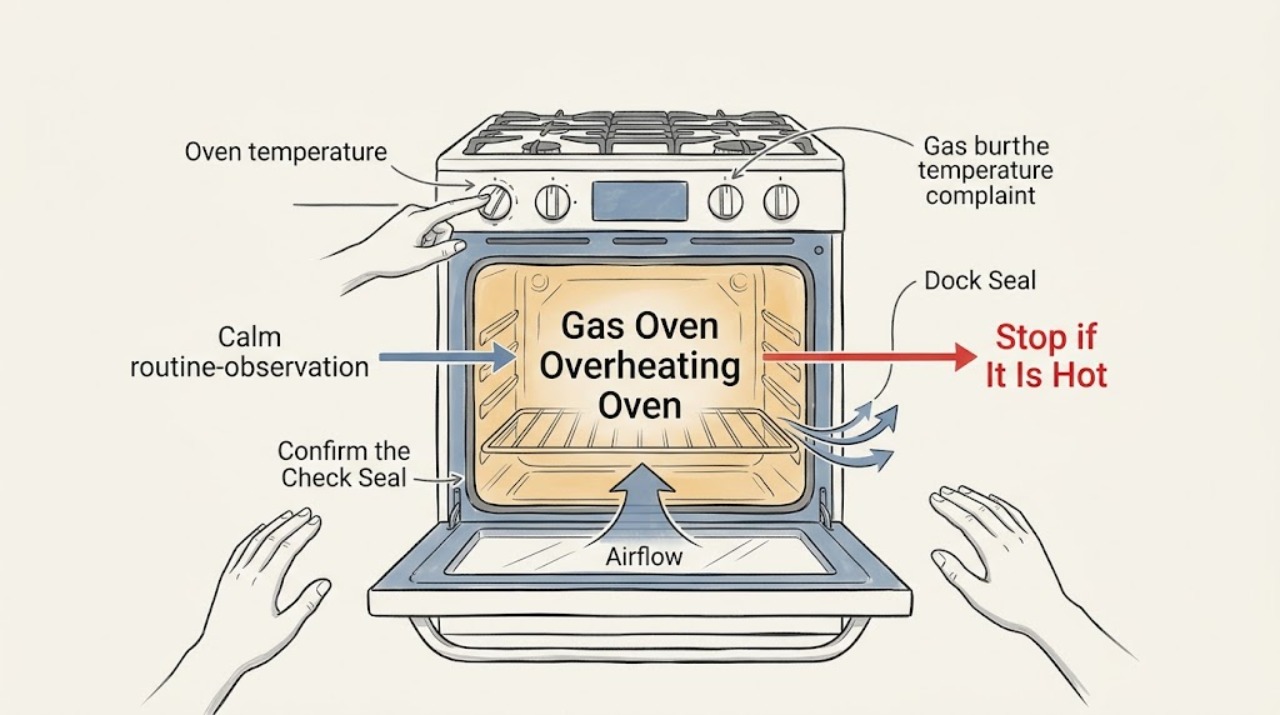
Work through in order
Diagnostic checks
Use only checks that match the exact appliance or system and its official guide.
-
Check 1
Check for an immediate gas, fire, or uncontrolled-heating hazard before touching the controls.
Expected result: Look only from a safe position for a gas odor, hissing, smoke, flames outside the burner area, an unusually large or uneven flame, or continued heating after the control is off.
Next step: If gas is suspected, leave the building immediately and contact the gas supplier or emergency services from outside. If there is smoke or fire, leave and use emergency help. If the oven continues heating with the control off, keep clear and arrange qualified appliance service.
Stop if: Do not light a match, use a phone inside, turn on a light or switch, move the range, or attempt to relight or adjust a gas component when a leak is suspected.
Why this matters
Why: Any of these signs can indicate a fuel, combustion, or control problem rather than a recipe or calibration issue. A gas odor is an emergency boundary, not a troubleshooting step.
-
Check 2
Confirm the temperature complaint with a repeatable bake observation after selecting the intended mode and allowing a full preheat.
Expected result: Record the set temperature, mode, preheat indication, rack position, cookware, and cooking result. Compare more than one consistent bake rather than judging from one reading immediately after a burner cycle.
Next step: If the result is normal when the mode, preheat, rack, and cookware are corrected, continue using the model's cooking guide. If it remains too hot, continue with the airflow and door checks, then consult the exact model manual for calibration or service.
Stop if: Stop the test if the oven heats while off, produces smoke, shows an abnormal flame, or creates a gas odor.
Why this matters
Why: Gas ovens cycle on and off, so the air temperature naturally rises and falls. A repeatable pattern of over-browning or overcooking after correct preheat and settings is more meaningful than a single momentary peak.
-
Check 3
Inspect the accessible cooking setup for blocked heat circulation, incorrect rack position, foil covering, or a door that cannot close and seal normally.
Expected result: Check that pans are not crowding the oven walls, that a rack is not installed backward, and that foil is not covering an entire shelf or blocking the vent. Look at the gasket for a rip or tear and verify the door closes evenly without forcing it.
Next step: With the oven cool, correct only the accessible pan, rack, and foil arrangement. Do not remove panels or replace the gasket yourself unless the exact instructions and required skill are present. If the gasket is damaged or the door does not seal, keep the oven out of service and request repair.
Stop if: Do not continue cooking if the door will not close, the gasket is torn, the vent is blocked by a fixed obstruction, or the cabinet or controls become abnormally hot.
Why this matters
Why: Blocked circulation and a leaking door can make food cook unevenly or make the oven appear to have the wrong temperature. GE identifies a torn gasket as a service condition, not an adjustment opportunity.
-
Check 4
Observe the oven's gas flame only during ordinary operation from the normal viewing position, without opening panels or reaching into the burner area.
Expected result: A flame that is visibly too high, unstable, or uneven, especially after a natural-gas to LP conversion or installation change, is different from the normal burner cycling sound. Do not use a flame appearance alone to identify a nozzle, regulator, or air-shutter adjustment.
Next step: Turn the oven off if it can be done normally and safely, keep it out of service, and arrange a qualified gas-appliance inspection. Do not move the range or attempt to adjust the gas system.
Stop if: Stop immediately for gas odor, soot, flame outside the intended burner area, repeated ignition attempts, or any need to remove a cover or move the appliance.
Why this matters
Why: GE says an unusually high or uneven oven flame may indicate an incorrect fuel conversion. That condition can affect temperature and combustion and needs the installer, gas company, or qualified appliance professional.
-
Check 5
If the oven is otherwise safe but consistently cooks too hot, identify the control style and consult the exact GE owner manual before making one calibration adjustment.
Expected result: The control may have a Settings menu, a temperature knob, or another model-specific adjustment method. A calibration option changes the displayed-versus-actual cooking preference; it does not repair a burner that stays on, an abnormal flame, a failed sensor, or a control that ignores the setting.
Next step: Use the model number to retrieve the owner's manual. If calibration is unavailable, does not hold, or the oven remains too hot afterward, stop using the oven and arrange service for the temperature-sensing, gas-valve, burner, or control system.
Stop if: Do not calibrate or continue testing if the oven heats while off, the flame is abnormal, gas is suspected, smoke is present, or the complaint requires electrical or gas measurements.
Why this matters
Why: GE provides different calibration procedures for different control panels and says the owner's manual supplies model-specific directions. Calibration is appropriate only after a safe, repeatable setup check and only when the oven cycles normally.
Use your observations
Decision map
Find the observation that best matches what you see, then follow the next safe action.
-
PATH 01Next step
What you see
There is a gas odor, hissing, smoke, fire, or a flame outside the intended burner area.
Do this next
Leave immediately, avoid switches and ignition sources, and contact the gas supplier or emergency services from a safe location. Do not return to test the oven until professionals say it is safe.
-
PATH 02Next step
What you see
The flame is unusually high or uneven, particularly after fuel conversion or installation work.
Do this next
Stop using the oven and contact the installer, gas company, or qualified appliance professional. Do not move the range or adjust the gas system.
-
PATH 03Next step
What you see
The flame cycles normally and the issue disappears after correct preheat, rack, cookware, and airflow checks.
Do this next
Use the exact model cooking guide and monitor the next suitable bake. If the problem returns, stop cooking and document the mode, setting, rack, cookware, and result for service.
-
PATH 04Next step
What you see
The oven repeatedly cooks too hot despite a correct setup, or it heats when turned off.
Do this next
Keep the oven out of service. Follow only the exact model's calibration guidance if the burner cycles normally; otherwise arrange qualified service for the sensor, thermostat, gas valve, burner, or control.
Helpful context
Understand the symptom
Overheating can mean two different problems
A gas oven is designed to cycle its burner to maintain an average temperature, so a brief rise above the setting is not by itself proof of a failed control. Treat it as a fault when food consistently burns despite correct settings, the oven keeps heating after it should stop, the flame looks abnormally large or uneven, the door or controls become unusually hot, or a safety odor or smoke appears. Do not use the oven to heat the room.
Do not move the range to inspect the gas connection
A gas range's connector is not a user diagnostic point. If you smell gas, hear hissing, or suspect a fuel leak, leave immediately and get help from outside the area. Do not move the range, remove panels, relight a pilot, or try to adjust the gas burner. The gas-supply and combustion checks belong to a qualified professional.
Separate a cooking setup issue from a control fault
Before calling a technician for a non-emergency temperature complaint, record the selected mode and setting, whether the oven was fully preheated, the rack position, the pan type, and when the food overcooked. GE notes that dark cookware, blocked circulation, a door that does not seal, and misplaced racks can change results. If the same symptom persists across more than one suitable test, stop using the oven and give those observations to service.
Only after diagnosis
Potential parts
- oven temperature sensor or thermostat control
Consider this category only after a qualified diagnosis confirms inaccurate temperature sensing or thermostat control behavior and rules out calibration, cookware, airflow, and door-seal causes.
Confirm the exact GE model and the manufacturer's fit information; gas-oven controls are not interchangeable by appearance. - gas oven burner or gas valve assembly
Consider this category only when a qualified gas-appliance professional confirms an abnormal burner, valve, or ignition condition.
Gas components require exact model matching and professional installation; do not order from flame appearance alone. - oven door gasket
Consider this category only when the gasket has a confirmed rip or tear or the door fails to seal and heat loss is part of the observed problem.
Confirm the exact model and gasket design before ordering and follow the model-specific service instructions.
When checks do not resolve it
Need a professional?
Stop and call qualified service for a gas odor, hissing, smoke, fire, abnormal flame, heating while the control is off, a torn gasket or door that will not seal, repeated overheating after setup checks, or any diagnosis requiring panels, gas adjustments, electrical measurements, or moving the range.
Common questions
FAQ
Is a brief temperature rise above the setting always a failure?
No. GE explains that the oven cycles its burner and the temperature naturally rises and falls around the selected setting. Repeated overcooking after a correct preheat and setup, or heating while the control is off, is more concerning.
Can I adjust the gas oven flame myself if it looks too high?
No. GE links an unusually high or uneven flame to possible fuel conversion or burner conditions and directs conversion concerns to the installer or gas company. Do not move the range or adjust gas components yourself.
What should I check before calibrating the thermostat?
Confirm the mode and setting, allow a full preheat, check rack and pan placement, make sure airflow is not blocked, and check that the door gasket and door seal normally. Use calibration only as described for the exact control panel and model.
What should I do if I smell gas while the oven is overheating?
Leave the building immediately. Do not use a phone, light, switch, match, or other electrical equipment inside; contact the gas supplier or emergency services from a safe location.
Read the exact guide
Official sources
- Range & Wall Oven - Oven Temperature Is Not CorrectGE Appliances · GE range and wall oven temperature behavior, setup checks, airflow, cookware, rack placement, and door gasket guidance
- Certain Older Gas Connectors May Be DangerousU.S. Consumer Product Safety Commission · Gas-appliance connector safety, no-movement warning, and emergency response to suspected gas leaks
- Gas Range & Cooktop - Burner or Oven Flame Too High or UnevenGE Appliances · GE gas range and oven flame appearance, fuel conversion concerns, and professional follow-up
- Range & Wall Oven - Calibrating Oven Using Settings and Options on ControlGE Appliances · GE model-specific oven thermostat calibration guidance for control panels with a Settings menu
Community feedback
Share a repair observation
Share a plain-text repair observation. Accepted observations are published automatically; this page may take a moment to update.