
On this page
Start here
Quick answer
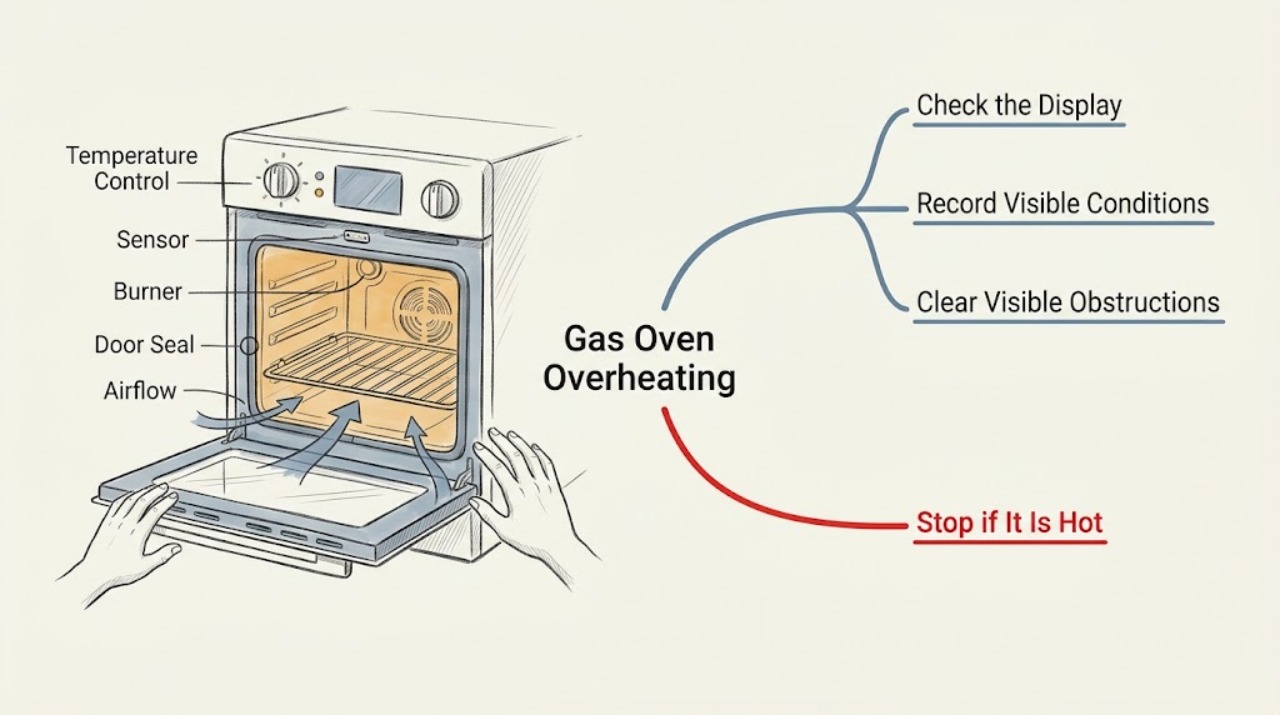
A Wolf gas oven can feel hotter than its setpoint while it cycles, and food can cook hot because of the selected mode, rack position, pan material, or temperature setting. That is different from continuous heating after the control is off, an abnormal flame, smoke, a carbon-monoxide alarm, a gas odor, a burning odor, or surfaces becoming dangerously hot. If heating appears uncontrolled or any gas, fire, smoke, CO, electrical, or burn warning is present, stop using the oven and leave or isolate the area as appropriate. Do not relight, adjust gas pressure, open the burner or control system, or use a high-heat test. Check only cold, external settings and airflow, then arrange qualified Wolf service for a repeated or unexplained overheat.
Work through in order
Diagnostic checks
Use only checks that match the exact appliance or system and its official guide.
-
Check 1
Stop using the Wolf gas oven and, from a safe position, note whether heating continued after the control was turned off, an abnormal flame was seen, smoke or a burning odor appeared, a gas odor persisted, a carbon-monoxide alarm activated, or anyone was burned or unwell.
Expected result: One or more immediate gas, fire, carbon-monoxide, electrical, or burn warnings is present; or the oven only seemed hotter during ordinary cooking with no warning sign.
Next step: For any warning sign, leave or isolate the area as safety permits and contact emergency services or the gas utility from a safe location; do not touch or relight the oven. Otherwise keep it off until the cold external checks are complete.
Why this matters
Why: Uncontrolled heating, abnormal combustion, smoke, persistent gas odor, CO, or injury can indicate an urgent hazard. A hot cooking result without those signs may still be a setting, mode, pan, or temperature-control issue.
-
Check 2
When the oven is cold and safe, record the mode, selected setting, rack level, pan material and size, preheat status, and whether the overcooking was even throughout the cavity or concentrated on one side.
Expected result: The result occurred in convection or another special mode, with a dark or large pan, without full preheat, at one rack position, or across all settings and positions.
Next step: For a clear setting or pan explanation, follow the exact Wolf Cooking Guide without adding a high-heat test. If the same overheat persists across normal documented use, stop user troubleshooting and request factory-certified service.
Why this matters
Why: Wolf lists mode, pan, rack, and preheat as factors that can make food appear to cook hot or unevenly. A result that persists across appropriate settings is more consistent with a temperature-control or service issue.
-
Check 3
From outside the cold appliance, look for a flattened or damaged door gasket, a door that does not close normally, blocked intake or exhaust openings, foil or a tray on the cavity floor, or visible obstruction around the oven; do not remove panels or reach into the burner area.
Expected result: A gasket, door, vent, foil, tray, or other obstruction is visibly abnormal, or the external airflow and door appear normal.
Next step: Do not force the door or move internal components. Remove only a plainly accessible, cold, user-removable obstruction if the exact Wolf guide permits it; otherwise photograph it and request service.
Why this matters
Why: A poor door seal or blocked airflow can change temperature performance and heat around the appliance. A normal external view cannot rule out a sensor, thermostat, valve, control, or combustion fault.
-
Check 4
Review the exact Wolf model guide for the gas-oven temperature range, indicator behavior, calibration policy, and any displayed error; record the model and message without changing an offset or opening the control area.
Expected result: The guide describes normal cycling, a model-specific calibration or temperature limit, a door or airflow condition, or an error that calls for service.
Next step: Follow only documented cold, user-level guidance. If the oven still overheats or the guide calls for service, keep it off and request a qualified Wolf technician; do not alter calibration or gas settings yourself.
Why this matters
Why: Wolf temperature behavior and calibration boundaries vary by product. A display or setting cannot identify a burner, valve, sensor, thermostat, or control failure by itself.
-
Check 5
Write down the sequence from the last safe use: preheat completion, selected mode and setting, when overheat was noticed, whether the burner cycled or stayed on, whether the oven cooled after being turned off, odors or smoke, flame appearance already seen, and any error.
Expected result: The oven cycled normally but cooked hot, stayed hot after shutoff, showed a continuous flame or heat, or produced a gas, smoke, CO, or burning warning.
Next step: Give this timeline to qualified Wolf service. If a gas, smoke, CO, or fire warning is current, leave and contact emergency or gas-utility help from a safe location instead of approaching the appliance.
Why this matters
Why: Normal cycling with a cooking mismatch points toward documented settings or service diagnosis. Heat that does not stop, abnormal combustion, smoke, gas odor, or CO raises the urgency and rules out further use.
-
Check 6
Prepare a service handoff with the Wolf model, gas configuration, mode and setting, rack and pan, preheat behavior, external gasket or vent observations, exact error text, and every heat, odor, smoke, flame, CO, or injury warning already observed.
Expected result: The evidence supports normal temperature cycling, a cooking-setup issue, a persistent temperature-control problem, or an urgent gas or fire concern.
Next step: Request qualified Wolf gas-oven temperature and safety diagnosis. Keep the oven out of use until the technician or gas professional clears it; use emergency services for smoke, fire, CO, or immediate danger.
Why this matters
Why: A complete history helps the technician distinguish cooking variables from sensor, control, burner, valve, or combustion service needs without a hazardous repeat run.
Use your observations
Decision map
Find the observation that best matches what you see, then follow the next safe action.
-
PATH 01Next step
What you see
The oven cycles, stops heating normally, and the hot result is associated with mode, pan, rack, setting, or incomplete preheat without a safety warning.
Do this next
Use the exact Wolf Cooking Guide for the mode and pan. If the result persists across normal documented use, request factory-certified service instead of increasing or testing heat.
Why this path and its safety boundary
Why it matters: The result may be a documented cooking-performance issue rather than uncontrolled gas heating.
-
PATH 02Next step
What you see
The oven repeatedly overheats across appropriate settings, stays hot after it should stop, or appears to keep heating continuously.
Do this next
Keep the gas oven off and request qualified Wolf service. Do not change calibration, open the control area, adjust gas pressure, or run another cycle.
Why this path and its safety boundary
Why it matters: A temperature sensor, thermostat, valve, control, or combustion issue is possible and cannot be identified safely by a user.
-
PATH 03Next step
What you see
Gas odor persists or is excessive, ignition is abnormal, smoke or flame is excessive, a CO alarm sounds, or anyone feels unwell.
Do this next
Leave the area, avoid flames and electrical switches in the odor area, and contact emergency services or the gas utility from a safe location. Do not move, relight, or inspect the range.
Why this path and its safety boundary
Why it matters: This is an urgent gas, combustion, fire, or carbon-monoxide hazard, not a temperature calibration problem.
-
PATH 04Next step
What you see
A cold external check finds a damaged gasket, abnormal door closure, blocked airflow, foil, a tray on the cavity floor, or visible foreign material.
Do this next
Follow only the exact Wolf guide when the oven is cold and safe. Do not force the door, disturb the burner, or use a high-heat clearing cycle; request service if the condition or overheat remains.
Why this path and its safety boundary
Why it matters: A user-removable cooking or airflow issue may affect heat, but damage or an obstruction near gas components needs service evaluation.
Helpful context
Understand the symptom
Overheating has two very different meanings
Wolf ovens cycle heat to maintain a set temperature, so a temperature reading or oven surface can vary during normal use. Food can also brown quickly because of a dark pan, rack position, mode, or an overly high setting. A gas oven that continues heating after it should stop, produces an abnormal flame, or creates smoke, burning odor, gas odor, or a carbon-monoxide alarm is a safety event, not a cooking adjustment.
Use the cold, external checks first
Once the oven is fully cool and no gas or fire hazard is present, record the mode, setting, rack, pan, recipe result, and whether the door and visible vents look normal. Wolf identifies preheat, mode, rack placement, door gasket condition, and unobstructed airflow as relevant to temperature performance. Do not block vents, use foil on the cavity floor, or open the appliance to inspect a sensor or burner.
Calibration and burner work are service decisions
A setpoint difference does not establish that calibration is needed, and the permissible behavior depends on the exact Wolf model. Gas burner, thermostat, sensor, valve, and control faults cannot be safely separated by a homeowner's internal test. If the safe external checks do not explain the result, keep the oven out of use and give a qualified technician the complete sequence.
Safety boundary
Stop conditions
- Stop using the oven immediately for continuous heating, an abnormal flame, excessive or persistent gas odor, smoke, a carbon-monoxide alarm, a burning odor, visible fire, a hot or damaged control or door area, a shock, or a tripped circuit.
- Do not relight or repeatedly run the oven, change calibration offsets, adjust gas pressure, open the burner or control system, move the range, search for a gas leak, or perform an internal electrical or combustion test.
- If gas odor, smoke, flame, CO, illness, or immediate fire danger is present, avoid flames and electrical switches in the area, leave, and contact emergency services or the gas utility from a safe location.
When checks do not resolve it
Need a professional?
Call qualified Wolf service when the gas oven overheats across correct documented settings, stays hot or heats continuously after shutoff, shows an error, or has a door, gasket, airflow, burner, or control concern. Treat gas odor, abnormal flame, smoke, CO, or fire as an emergency and contact the gas utility or emergency services from a safe location. Do not resume use until cleared.
Common questions
FAQ
Is it normal for a Wolf gas oven to get hotter than the set temperature?
Wolf says oven temperature normally cycles above and below the setpoint. A hot cooking result can also depend on the mode, rack, pan, setting, or preheat. Continuous heating, abnormal flame, smoke, gas odor, CO, or unsafe heat is not a normal cooking adjustment issue.
Should I recalibrate a Wolf gas oven that overheats?
Do not change a calibration offset based only on a hot result. Wolf's calibration guidance is model-specific and directs temperature issues to factory-certified service; first document the mode, setting, rack, pan, preheat, and safety symptoms.
What if the Wolf oven smells like gas while it is overheating?
Stop using it immediately. Avoid flames and electrical switches in the odor area, leave, and contact the gas utility or emergency services from a safe location. Do not relight, move the range, search for a leak, or run another cycle.
Read the exact guide
Official sources
- Wolf Oven Temperature Is Too HotSub-Zero, Wolf, and Cove · Wolf support guidance for oven temperature and cooking performance; exact behavior depends on model and use-and-care instructions.
- Electric Oven Temperature CalibrationSub-Zero, Wolf, and Cove · Wolf calibration guidance is specifically labeled for electric ovens; this article uses it only for the caution that calibration and model boundaries require service, not as a gas procedure.
- Smoke or Flames Coming from OvenSub-Zero, Wolf, and Cove · Wolf cooking-product safety guidance; the user should not infer that a normal small ignition flame clears an excessive or abnormal flame.
- Wolf Oven Temperature IssueSub-Zero, Wolf, and Cove · General Wolf residential oven temperature guidance; model-specific manuals and gas configuration control the exact procedure.
- Gas Odor When Unit in UseSub-Zero, Wolf, and Cove · Wolf support guidance for gas-burning products; actual model, installation, and local gas-emergency procedures control.
Community feedback
Share a repair observation
Share a plain-text repair observation. Accepted observations are published automatically; this page may take a moment to update.