
On this page
Start here
Quick answer
If a Wolf gas oven smells strongly of gas, the odor persists, the burner did not ignite, ignition was delayed, or a carbon-monoxide alarm is active, stop using the oven immediately. Do not light anything, operate electrical switches or a phone in the odor area, move the range, search for a leak, or relight the burner to test it. Leave the area and contact the gas utility or emergency services from a safe location; arrange qualified Wolf appliance service after the situation is declared safe. A brief odor during normal ignition or first use can have a different explanation, but only a professional should decide whether the appliance is safe when the smell is excessive or unexplained.
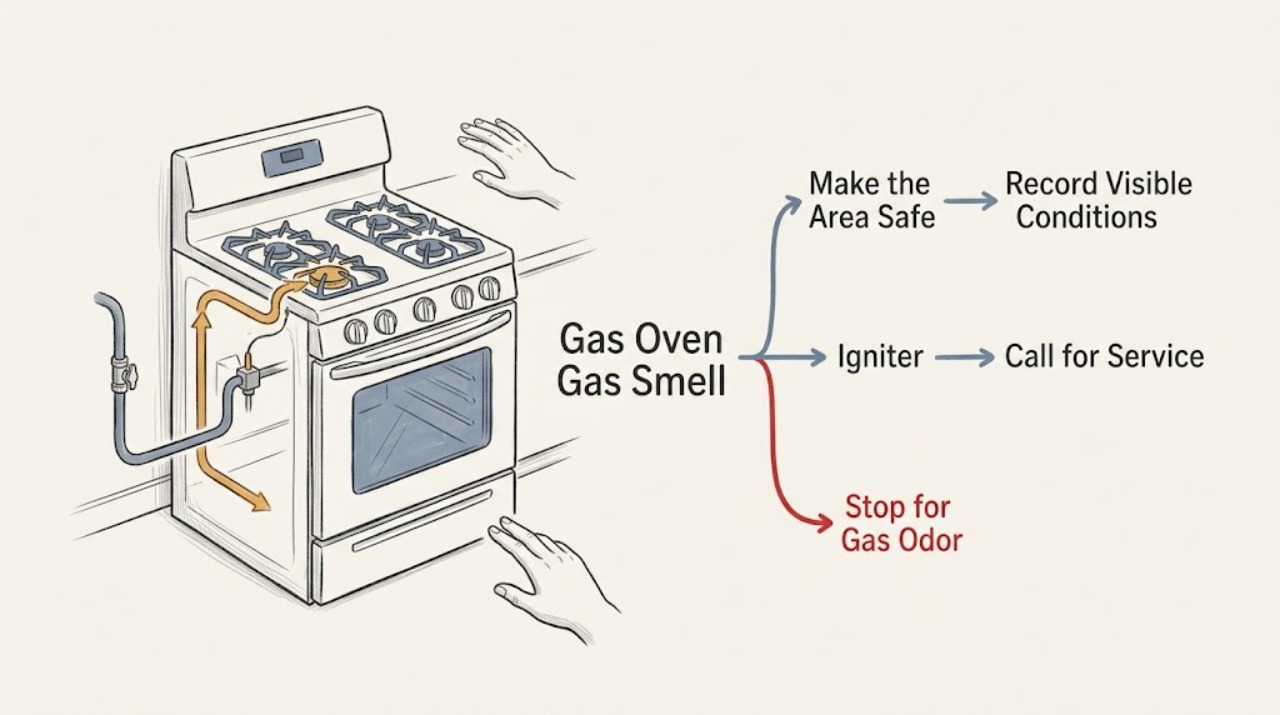
Work through in order
Diagnostic checks
Use only checks that match the exact appliance or system and its official guide.
-
Check 1
Stop using the Wolf gas oven immediately and, from a safe position without operating switches or creating a spark, note whether the odor is strong or persistent, whether smoke or flame is visible, and whether a carbon-monoxide alarm or illness is present.
Expected result: There is strong or persistent gas odor, smoke, flame, a carbon-monoxide alarm, dizziness, nausea, or another sign of immediate danger; or the odor was brief and no danger sign remains.
Next step: For any danger sign, leave immediately and contact emergency services or the gas utility from a safe location. Do not use the oven again. For a brief but unusual odor, keep the oven off and arrange qualified Wolf service rather than testing it again.
Why this matters
Why: Persistent odor, combustion warning, carbon monoxide, or symptoms can indicate an urgent gas or combustion hazard. A brief odor is not enough to prove that an oven is safe if the ignition was abnormal or the cause is unknown.
-
Check 2
Without relighting, searching for a leak, moving the range, or touching gas fittings, record whether the smell began with oven ignition, remained after the oven was turned off, or was present when the appliance was not being used.
Expected result: The smell occurred only briefly during ignition, continued while the oven was operating, remained after shutdown, or was present with the oven off.
Next step: Keep the appliance off and report the timing to the gas utility and qualified appliance service. Do not perform another ignition, move the oven, or use a flame or electrical device to locate the source.
Why this matters
Why: Wolf notes that some odor can occur during burner ignition, but an odor that is excessive, does not subside, or is present without ignition requires the appliance to remain out of service. Odor with the oven off can indicate a wider gas-supply concern.
-
Check 3
From a safe distance, record only what was already seen or heard during the event: delayed ignition, repeated clicking, a whoosh or bang, an uneven or abnormal flame, or gas odor without visible ignition; do not recreate any of these conditions.
Expected result: Ignition was delayed, the burner clicked without lighting, a bang occurred, the flame looked abnormal, or no abnormal burner event was observed.
Next step: Stop using the oven and request qualified Wolf service. If odor, bang, smoke, flame, or a carbon-monoxide alarm is present now, leave and use emergency or gas-utility help; do not open the burner area.
Why this matters
Why: Delayed or failed ignition can allow gas to accumulate, while a bang or abnormal flame is not a user-adjustment problem. No observed flame event does not clear an unexplained smell.
-
Check 4
Once the gas utility or emergency responders have declared the area safe, and without heating the oven, look only at the cold oven cavity for food spills, plastic cookware, packaging, or foreign material that was already present; do not use a cleaning or high-heat cycle to prove the source.
Expected result: Food, a spill, plastic, or another foreign item clearly explains the odor, or the cavity is clean and the odor remains unexplained.
Next step: If the item is safely removable while the oven is cold and the area is cleared, follow the exact Wolf cleaning guidance; otherwise leave it alone. For any persistent or unexplained odor, keep the oven off and arrange factory-certified appliance service.
Why this matters
Why: Wolf identifies food, spills, plastic cookware, and foreign material as possible non-gas oven odors. A clean cavity does not rule out gas, combustion, electrical, or hidden component trouble.
-
Check 5
Prepare a service handoff with the Wolf model if readable without moving the appliance, fuel configuration, oven mode, ignition sequence, odor timing and location, flame or sound already observed, carbon-monoxide alarm, recent cleaning or spill, and the gas utility or emergency response already taken.
Expected result: The record points to a brief expected ignition odor, a persistent gas or combustion concern, a non-gas cavity odor, or an unresolved source.
Next step: Request qualified Wolf appliance service for the oven and use the gas utility or emergency services for a suspected supply or immediate safety hazard. Keep the appliance out of use until cleared.
Why this matters
Why: A detailed sequence helps the gas utility and technician select the right safety response without a dangerous relight, leak search, or range movement.
Use your observations
Decision map
Find the observation that best matches what you see, then follow the next safe action.
-
PATH 01Next step
What you see
The odor is excessive, does not subside, is present with the oven off, or occurs without ignition.
Do this next
Leave the area, avoid flames and electrical switches, and contact the gas utility or emergency services from a safe location. Arrange appliance service after the area is safe.
Why this path and its safety boundary
Why it matters: Wolf treats this as a reason not to use the unit; it may indicate unburned gas or a wider gas-supply problem.
-
PATH 02Next step
What you see
The oven took unusually long to light, clicked without ignition, made a bang, or showed an abnormal flame.
Do this next
Keep the oven off and request qualified Wolf service. Do not relight, adjust, move, or open the burner system.
Why this path and its safety boundary
Why it matters: Gas may not be burning as intended, and repeated ignition can increase risk.
-
PATH 03Next step
What you see
The odor was brief, no gas odor remains, the burner ignited normally, and no alarm, smoke, abnormal flame, or illness occurred.
Do this next
Do not add a test cycle. Document the event and arrange qualified service if it recurs or was unusual; use the gas-safety branch immediately if any warning sign returns.
Why this path and its safety boundary
Why it matters: A small ignition-related odor is described by Wolf, but the event still warrants caution if it was new, stronger than usual, or repeated.
-
PATH 04Next step
What you see
Responders have declared the area safe and a cold cavity visibly contains food, spill residue, plastic, packaging, or foreign material.
Do this next
Follow only the exact Wolf cleaning guidance when the oven is cold and safe. If odor remains, stop and request factory-certified service rather than using high heat to test it.
Why this path and its safety boundary
Why it matters: Wolf lists these as possible oven-odor sources, but a non-gas explanation must not be used to dismiss persistent gas or combustion symptoms.
Helpful context
Understand the symptom
Gas odor is the first branch, not the last test
A Wolf gas oven can produce a small, brief odor around ignition, and a new appliance can have an initial odor. That does not make a strong, persistent, or unexplained smell safe. The same symptom can also be a delayed ignition, gas flowing without flame, a combustion problem, a connection issue, or an odor from food or plastic. Do not distinguish these by trying the oven again.
Leave before investigating
If the odor is strong or does not quickly clear, do not use lights, switches, plugs, phones, matches, or other possible ignition sources in the area. Do not move the range or look behind it for the connector. Leave and contact the gas utility or emergency services from outside or another safe location. If there is smoke, flame, a carbon-monoxide alarm, illness, or an explosion risk, treat it as an emergency.
Only a qualified professional clears the appliance
After the immediate hazard is handled, give the gas utility and service professional the sequence: oven on or off, burner ignition or no ignition, delay, odor strength and duration, flame behavior if already observed, carbon-monoxide alarm, and whether the smell remained after the appliance was isolated. Do not adjust gas pressure, open the burner or valve system, or perform a relight test.
Safety boundary
Stop conditions
- Stop immediately and leave for strong or persistent gas odor, gas odor with the oven off, delayed ignition, a bang, abnormal flame, smoke, flame outside the normal burner area, a carbon-monoxide alarm, illness, or suspected fire.
- Do not operate lights, switches, plugs, phones, or other possible ignition sources in the odor area; do not light a match, move the range, search for a leak, relight the burner, or perform a repeat test.
- Do not open the burner or valve system, adjust gas pressure, disconnect the gas connector, or attempt an internal electrical or combustion repair. Use a qualified gas professional or Wolf appliance technician after the immediate hazard is handled.
When checks do not resolve it
Need a professional?
For strong, persistent, or unexplained gas odor, leave and contact the gas utility or emergency services from a safe location. For any delayed ignition, failed ignition, abnormal flame, repeated odor, or unresolved cavity odor, keep the Wolf gas oven off and request qualified appliance service. Do not resume use until the responsible professional clears it.
Common questions
FAQ
Is a small gas smell during Wolf oven ignition normal?
Wolf says some odor may be noticed during use or burner ignition, but excessive or persistent odor, odor without ignition, delayed ignition, or an active carbon-monoxide alarm means stop using the unit and arrange professional help. Do not test it by relighting.
What should I do if I smell gas from the Wolf oven?
Stop using the oven, avoid flames and electrical switches in the odor area, leave, and contact the gas utility or emergency services from a safe location. Do not move the range, search for the leak, or relight the burner.
Could food or plastic cause an odor inside the Wolf oven?
Yes, Wolf lists food, spills, plastic cookware, and foreign material as possible cavity-odor sources. Only consider that explanation after the immediate gas and combustion safety concern is cleared, and use the exact Wolf cleaning guidance without a high-heat test.
Read the exact guide
Official sources
- Gas Odor When Unit in UseSub-Zero, Wolf, and Cove · Wolf support guidance for gas-burning products; actual model, installation, and local gas-emergency procedures control.
- Gas Oven Bake Burner Not WorkingSub-Zero, Wolf, and Cove · Wolf gas oven support guidance; burner behavior and user-level controls vary by model.
- Certain Older Gas Connectors May Be DangerousU.S. Consumer Product Safety Commission · General gas-appliance safety guidance; it is not a user repair procedure and local emergency instructions also apply.
- Odor Inside an OvenSub-Zero, Wolf, and Cove · Wolf support guidance for non-gas cavity odors; it does not clear a gas or combustion odor.
Community feedback
Share a repair observation
Share a plain-text repair observation. Accepted observations are published automatically; this page may take a moment to update.