
On this page
Start here
Quick answer
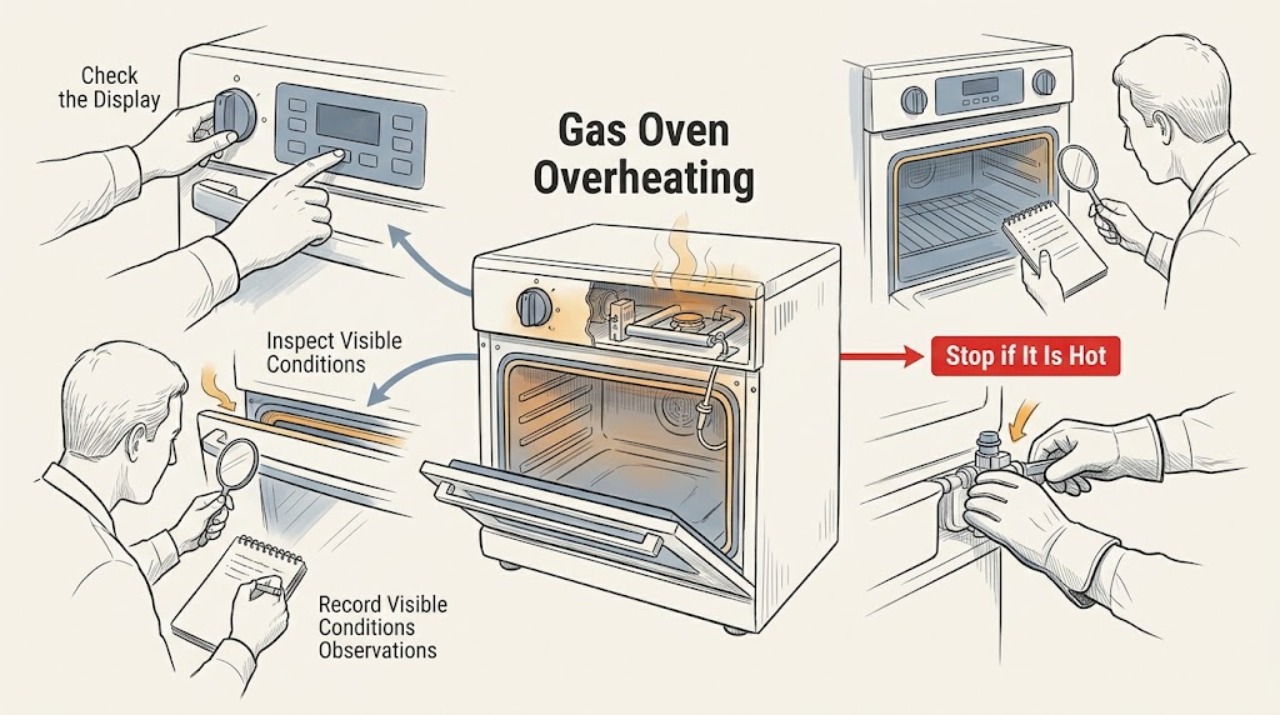
First distinguish normal gas-oven heat cycling from a true overheat. An oven can feel hotter near the vent or cycle the burner while it regulates, but food burning, a temperature that keeps rising, a burner that stays on after the set point, an abnormal flame, smoke, a gas odor, or a carbon-monoxide alarm is not a calibration problem. Stop using the oven if there is smoke, a burning smell, an abnormal flame, uncontrolled heating, or a carbon-monoxide warning; leave and seek emergency help for a gas or CO concern. When the oven is cool and no warning is present, record the mode, set temperature, model, and when the symptom occurs. Check only user-accessible settings, door and vent conditions, and visible residue. A model manual may permit a temperature-offset adjustment for a consistent, measured cooking error, but calibration cannot correct a stuck valve, failed sensor, blocked combustion air, damaged seal, or unsafe combustion. Do not remove gas parts, adjust regulators, cover the oven bottom with foil, or make repeated high-heat runs to compare results.
Work through in order
Diagnostic checks
Use only checks that match the exact appliance or system and its official guide.
-
Check 1
Stop the oven and, without touching a suspected hot surface or gas component, identify whether there is smoke, a burning or gas odor, an abnormal flame, continuous heating after the control is off, a carbon-monoxide alarm, or symptoms such as headache, dizziness, nausea, or shortness of breath.
Expected result: Any warning sign or uncertainty about gas or combustion is present, or the oven is simply cooking hotter than expected without a warning sign.
Next step: For gas odor, smoke, abnormal combustion, CO alarm, symptoms, or uncontrolled heat, leave the area and contact emergency or gas-safety help from a safe location; do not operate switches, relight, or search for a leak. Otherwise continue only after the oven is cool.
Why this matters
Why: A warning sign keeps gas, combustion, electrical, or uncontrolled-heating faults in focus and is not safely explained by calibration. A repeatable cooking offset without a warning may be a settings or calibration question.
-
Check 2
With the appliance cool and not running, record the exact model, fuel type, selected mode, set temperature, rack position, preheat behavior, and the point in the cycle when overheating appears; do not repeat a high-heat cycle solely to create another symptom.
Expected result: The problem occurs only in one mode, during preheat, after reaching the set point, during broil or self-clean, or after the control is turned off.
Next step: Use the exact manual for that mode and keep the oven out of service for continuous or unexplained heating. Provide the model and phase information to a qualified appliance technician rather than changing gas settings.
Why this matters
Why: A mode- or phase-specific symptom can point to a control, sensor, burner, or model feature that differs from a consistent bake-temperature offset. Heat that continues after shutoff is an unsafe control or gas issue until inspected.
-
Check 3
From outside the cool oven, look for a visibly displaced door seal, a door that does not close normally, an obstructed external vent area, or foil, a liner, or other material covering the oven bottom; do not remove burner covers, panels, seals requiring disassembly, or gas components.
Expected result: A seal is visibly out of place, the door does not close normally, an external opening is obstructed, foil or a liner is present, or nothing obvious is found.
Next step: Remove only a loose, user-placed item when the oven is completely cool and the manual permits it; do not disturb gas or combustion parts. Keep the oven unused and arrange service for a damaged seal, obstructed vent, abnormal flame, or persistent overheating.
Why this matters
Why: A door or airflow problem can change heat distribution, while covering a gas oven bottom can interfere with combustion air. No visible issue does not rule out a valve, sensor, thermostat, control, burner, or vent fault.
-
Check 4
If there is no safety warning and the symptom is a consistent baking-temperature mismatch, read the exact owner manual for the model's calibration feature and determine whether the control explicitly supports an oven-temperature adjustment; do not copy another brand's keypad sequence or use calibration to mask runaway heating.
Expected result: The manual documents calibration for this control, the manual does not document it, or the oven shows uncontrolled heating or an abnormal flame.
Next step: Apply only the manual's user-level adjustment if the oven otherwise behaves normally, then stop if the symptom remains. For any runaway, continuous, combustion, or unexplained problem, request qualified gas-appliance service.
Why this matters
Why: A documented calibration feature may address a stable offset. An undocumented control or a safety symptom needs model-specific diagnosis rather than a guessed setting.
-
Check 5
Observe the burner only from the normal user position and only during ordinary, safe operation if no stop condition exists; note whether the flame is even and stable rather than yellow, noisy, lifting, sooting, or visibly abnormal, and do not relight or disassemble anything to compare.
Expected result: The flame is abnormal, the burner does not stop as expected, ignition is delayed or loud, or no abnormal flame is visible.
Next step: Turn the oven off and keep it out of service for abnormal flame, delayed ignition, loud ignition, gas odor, or continuous heating; request a trained gas-appliance technician. Do not adjust air shutters, pressure, regulator, or burner alignment.
Why this matters
Why: An abnormal flame or delayed ignition indicates a gas, air, ignition, or burner-service concern, not a user calibration adjustment. A normal-looking flame does not prove the sensor or valve is working.
-
Check 6
Before requesting service, record the model, fuel type, symptom timing, control setting, visible flame result, door and vent observations, any recent cleaning or installation change, and whether a CO alarm or breaker event occurred; do not open the control area or attempt live electrical measurements.
Expected result: The issue remains after safe user-level checks, returns after a documented calibration, or affects more than one mode or continues after shutoff.
Next step: Keep the oven out of service and give the technician the recorded observations. If CO is suspected or an alarm sounds, follow emergency evacuation guidance and do not reuse the appliance until trained personnel clear it.
Why this matters
Why: Persistence, recurrence, multi-mode behavior, or post-shutoff heating increases the likelihood of a sensor, thermostat, valve, control, airflow, venting, or installation problem requiring professional diagnosis.
Use your observations
Decision map
Find the observation that best matches what you see, then follow the next safe action.
-
PATH 01Next step
What you see
There is a gas odor, smoke, abnormal flame, loud or delayed ignition, a CO alarm, symptoms, or heat that continues after the oven is turned off.
Do this next
Stop using the oven, leave the area, and contact emergency, gas-safety, or fire-response help from a safe location. Do not operate switches, relight, search for a leak, or re-enter until responders or qualified personnel say it is safe.
-
PATH 02Next step
What you see
Food consistently overcooks but there is no warning sign, the burner cycles normally, and the exact manual documents temperature calibration.
Do this next
Follow only that model's calibration instructions and save the original setting. If the result is not stable or the oven then behaves abnormally, undo the change if the manual permits and request service.
-
PATH 03Next step
What you see
Foil, a liner, or another user-placed material covers the oven bottom or an air path.
Do this next
Keep the oven cool and remove only the loose material that the exact manual permits the user to remove. Do not cover the bottom again; arrange service if overheating, soot, unusual flame, or odor remains.
-
PATH 04Next step
What you see
The oven is too hot in more than one mode, the setting does not change the behavior, or the temperature continues rising.
Do this next
Treat the condition as a control, sensor, thermostat, valve, airflow, or combustion service issue. Keep the oven unused and call a qualified gas-appliance technician; do not adjust gas pressure or open the control area.
Helpful context
Understand the symptom
Treat unsafe heat as a stop condition
Do not keep operating a gas oven that continues heating after being turned off, produces smoke or a strong burning odor, shows an abnormal yellow or noisy flame, smells of gas, or triggers a carbon-monoxide alarm. Move people away and use emergency or gas-safety help from a safe location when a gas or CO hazard is possible. Carbon monoxide has no smell, so the absence of a gas odor does not clear a malfunctioning fuel appliance.
Normal cycling versus genuine overheating
A burner cycling during preheat and baking is part of temperature regulation, and nearby surfaces or the vent can feel very hot. The useful distinction is what happens to the food and temperature over time: a consistent but modest cooking offset may be a model-specific calibration issue, while a runaway temperature, continuous burner, scorched food at ordinary settings, or heat that does not stop points to control, sensing, gas, airflow, or mechanical service. Do not infer a fault from one brief reading or one recipe alone.
Keep combustion air and the vent path clear
Do not line the oven bottom or cover combustion openings with foil, mats, or other material. CPSC warns that foil in a natural-gas or propane oven can block combustion air and produce carbon monoxide. From a cool, safe position, look for an obvious external obstruction or a door seal that is visibly displaced, but do not remove panels or reach into burner and gas-control areas.
Calibration is model-specific and limited
Whirlpool and GE both describe user calibration for some gas ovens, but their procedures vary with the control design and exact model. Calibration changes the target offset; it is not a repair for a gas valve that does not close, a sensor or thermostat fault, an abnormal flame, blocked air, a damaged door, or a failed control. Use the exact owner manual only after the oven is otherwise behaving safely, and stop if the manual does not clearly cover the control.
Safety boundary
Stop conditions
- Stop immediately for gas odor, smoke, an abnormal or delayed flame, loud ignition, a carbon-monoxide alarm, headache, dizziness, nausea, or any concern about combustion. Leave and seek emergency help from a safe location.
- Stop using the oven if it continues heating after the control is off, food or surfaces scorch unexpectedly, or the temperature appears to run away. Do not repeatedly relight or run another high-heat cycle.
- Do not remove gas parts, adjust a regulator or air shutter, open the control area, take live electrical measurements, bypass a safety control, or repair a burner, valve, sensor, thermostat, or vent yourself.
- Do not climb, reach into a hot cavity, block a vent, or cover the bottom of a gas oven with foil or a liner. Keep children, pets, and people with symptoms away from the appliance.
Only after diagnosis
Potential parts
- temperature sensor or thermostat
Only consider this category after a qualified diagnosis confirms a sensing or temperature-control fault rather than calibration, airflow, gas, or door conditions.
Confirm the exact model, fuel configuration, and manufacturer fit information before any part decision. - gas valve or burner-control assembly
Only a qualified gas-appliance technician should determine whether a valve or burner-control fault is causing continuous heating, abnormal flame, or delayed ignition.
Do not select, adjust, or install a gas component from a generic description; model and fuel configuration must be confirmed by the technician.
When checks do not resolve it
Need a professional?
Call a qualified gas-appliance technician when overheating persists after safe model-specific checks, occurs in more than one mode, continues after shutoff, follows a documented calibration without improvement, or involves a damaged seal, abnormal flame, venting concern, gas odor, or control fault. A CO alarm or symptoms require emergency response first and the appliance must remain unused until trained personnel clear it.
Common questions
FAQ
How can I tell whether a gas oven is cycling normally or overheating?
Look at the behavior rather than one brief temperature impression. A stable bake with normal cycling and a consistent cooking offset may fit model-specific calibration. A burner that stays on after shutoff, rising uncontrolled heat, scorching at ordinary settings, smoke, abnormal flame, gas odor, or a CO alarm requires stopping use and service or emergency response.
Can calibration fix a gas oven that is too hot?
It may address a stable temperature offset only when the exact model manual documents a calibration feature and the oven has no safety symptoms. It cannot fix a stuck valve, failed sensor, abnormal flame, blocked combustion air, damaged seal, or heating that continues after shutoff.
Is foil on the bottom of a gas oven related to overheating?
It can interfere with combustion air. CPSC warns that covering the bottom of a natural-gas or propane oven with foil can produce carbon monoxide. Keep the bottom and required air paths clear according to the exact manual.
What should I do if a gas oven is overheating and the flame looks abnormal?
Stop using it and do not adjust the burner, gas pressure, regulator, or air mixture. If there is gas odor, smoke, loud ignition, a CO alarm, or symptoms, leave and contact emergency or gas-safety help from a safe location. Otherwise keep the oven off and arrange qualified gas-appliance service.
Read the exact guide
Official sources
- Oven Too Hot - Needs Calibration - RangeWhirlpool Product Help · Manufacturer help page for Whirlpool range and oven controls; calibration method varies by exact model and is not a generic gas-component repair.
- STANDARD CLEANING GAS RANGE Use & Care GuideWhirlpool Corporation · Opened manufacturer gas-range manual used for general safety boundaries about abnormal burner flames, oven temperature concerns, and trained service; exact model instructions control.
- Carbon Monoxide Fact SheetU.S. Consumer Product Safety Commission · Government safety guidance for gas and propane appliances, combustion air, CO symptoms, alarms, evacuation, and qualified service.
- Range & Wall Oven - How to Calibrate My OvenGE Appliances · Manufacturer support page showing that gas and electric oven calibration depends on the control type and exact owner manual.
Community feedback
Share a repair observation
Share a plain-text repair observation. Accepted observations are published automatically; this page may take a moment to update.