
On this page
Start here
Quick answer
If a Wolf gas oven is not heating, first stop for gas odor, delayed ignition, a boom, an abnormal flame, smoke, carbon-monoxide concern, arcing, or a breaker trip. Otherwise record the exact model and display, confirm the oven is in the intended mode and has electrical power, and allow the model's normal preheat period. Wolf says its gas ovens may take about 30–45 seconds to light and that natural gas versus propane affects preheat time, but a gas odor without ignition or ignition that takes longer than the model guidance is a stop-and-service condition. Verify only the safe, externally accessible gas and power conditions described in the Use and Care or Installation Guide; do not move the range, look for a leak, light the burner manually, or remove panels. Persistent no heat, a returning error, or an abnormal flame needs Wolf Factory Certified Service.
Before you begin
Safety first
- Keep the oven off for gas odor, delayed ignition, abnormal flame, smoke, carbon-monoxide concern, burning or electrical odor, arcing, uncontrolled heating, hot connections, or repeated trips. Do not move the range, bypass an interlock, or perform internal gas or electrical work.
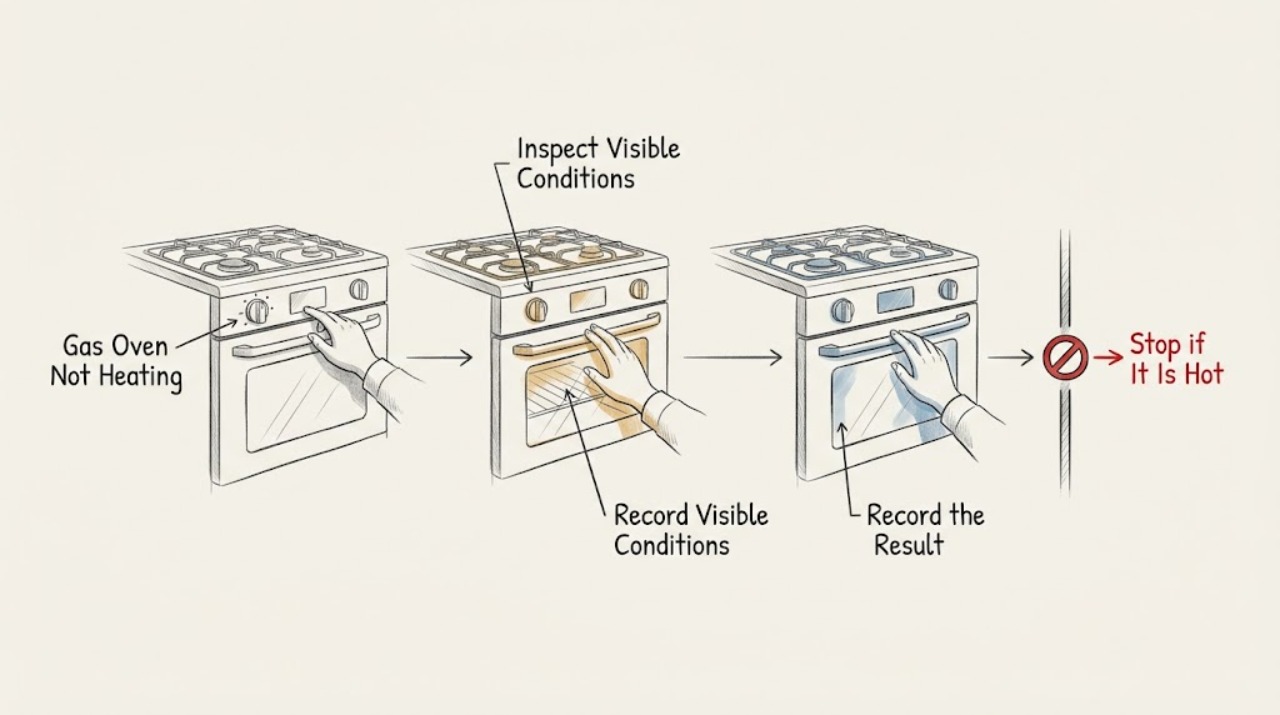
Work through in order
Diagnostic checks
Use only checks that match the exact appliance or system and its official guide.
-
Check 1
Stop the oven and observe from a safe position for gas odor, hissing, delayed ignition, a boom, an abnormal yellow or noisy flame, smoke, carbon-monoxide symptoms or alarm, visible arcing, a hot connection, or a breaker that trips again. Do not make another ignition attempt while any warning sign is present.
Expected result: No warning sign is present, or gas odor, delayed ignition, a boom, abnormal flame, smoke, carbon-monoxide concern, arcing, heat, or a repeated trip is present.
Next step: If a warning sign is present, leave the area, avoid switches, flames, and phones inside, and contact emergency or gas professionals from a safe location. If there is no warning sign, continue with the identity and power checks.
Stop if: Stop immediately for gas odor, delayed ignition, a boom, abnormal flame, smoke, carbon-monoxide concern, visible arcing, a hot connection, or repeated breaker trips; do not restart to reproduce it.
Why this matters
Why: A warning sign is a gas, fire, electrical, or combustion event rather than an ordinary preheat problem.
-
Check 2
Record the exact model and serial information, fuel type, oven cavity, selected mode and temperature, preheat indication, complete error text, whether the surface burners work, and whether the oven fan or light responds. Use the model-specific Wolf Use and Care Guide for control sequences and do not apply a code meaning from another series.
Expected result: The display is blank, the controls respond but no heat is requested, a preheat indication appears, the surface burners work while the oven is cold, or a repeatable error is displayed.
Next step: Follow only the matching branch below and retain the complete display text and model for service if the symptom persists.
Stop if: Stop if the display or control is accompanied by smoke, burning odor, arcing, uncontrolled heat, or repeated breaker trips.
Why this matters
Why: These observations distinguish supply or control problems from a gas ignition or temperature problem and identify the evidence a technician needs.
-
Check 3
From a safe, dry position, confirm that the range or oven has electrical power: observe the display or indicators, the known appliance circuit, and whether a safe nearby outlet or light is affected. If the model permits a single reset and there is no hazard, follow the exact Installation or Use and Care Guide; do not repeatedly reset a breaker or handle wiring.
Expected result: The display is dead, the breaker is abnormal, the control returns after one model-authorized reset, power is present but the oven still does not request heat, or the breaker trips again.
Next step: Leave the oven off and arrange an electrician or qualified Wolf technician for a dead display, recurring trip, or uncertain supply. If power is present, continue to the mode, door, and preheat checks.
Stop if: Stop for a hot or damaged plug, smoke, burning odor, arcing, water near electrical parts, or any repeated breaker trip; do not use an adapter or extension cord.
Why this matters
Why: The gas igniter and control depend on the correct electrical supply. A recurring trip or a failed supply is an electrical service issue, not evidence to replace a gas part.
-
Check 4
With the oven cool, confirm the correct gas-oven mode and the correct oven temperature control for the cavity. For an R or GR range with multiple knobs, compare the knob position and labels with the model guide; then allow the oven to preheat fully before judging heat, without opening the door repeatedly.
Expected result: The wrong knob or mode was selected, the control requests preheat, the preheat indication completes and heat is present, or the oven remains cold or the indication never completes.
Next step: Correct only the clearly mismatched setting using the model guide. If the oven remains cold or temperature performance is substantially changed, stop using it and request Factory Certified Service.
Stop if: Stop for smoke, burning odor, uncontrolled heating, a flame that does not shut down as commanded, abnormal flame, or a hot control.
Why this matters
Why: Wolf identifies mode or knob selection and incomplete preheat as possible explanations for underheating; a completed preheat indication with a cold cavity or no improvement after the correct selection points to service.
-
Check 5
Observe the cool oven door and visible seal area for an obstruction, misalignment, or damage, and make sure the door closes normally. Do not force the latch or remove the door. If the oven starts a normal preheat only after the door is correctly closed, use the model guidance for the interlock and monitor without repeated opening.
Expected result: The door is not fully closed, the seal or latch area is damaged, the oven responds after a normal close, or the door is correct but the cavity remains cold.
Next step: Remove only a plainly visible cool obstruction and close the door normally. If damage, poor alignment, or no heat remains, leave the oven off and request qualified service.
Stop if: Stop for broken glass, a hot or jammed door, a damaged latch, smoke, abnormal flame, or any need to force or defeat the door mechanism.
Why this matters
Why: Door position and seal condition can allow heat loss or inhibit a model-specific operating sequence; a damaged latch or persistent no-heat condition needs service.
-
Check 6
For a gas oven with no heat or no ignition, observe the preheat indicator and ignition sound only from outside the closed oven. Without gas odor and without moving the range, confirm only the externally accessible fuel-supply control state described by the model installation guidance; do not inspect a connector, search for a leak, adjust a regulator, or manually light the burner.
Expected result: The preheat indicator calls for heat but no flame establishes, ignition occurs within the model's normal window but heat is weak, the gas supply state is clearly off, or an odor, delayed ignition, or abnormal flame occurs.
Next step: If a clearly accessible supply control is off and there is no odor or hazard, follow the model installation guidance or have a qualified person correct it. For no ignition, weak heat, delayed ignition, or any uncertain gas condition, keep the oven off and request certified service.
Stop if: For any gas odor, ignition taking longer than the model guidance, a boom, flame rollout, yellow or noisy flame, smoke, carbon-monoxide concern, or continuous clicking, leave the area and contact gas or emergency professionals; do not retry.
Why this matters
Why: Wolf lists no power, no gas, ignition components, thermostat, and connections as possible causes. A surface burner working does not prove that the oven ignition path is safe or functional.
-
Check 7
Compare the symptom with Wolf's temperature guidance after the oven has had a complete, model-appropriate preheat: note whether preheat completes, whether food is merely slow or remains raw, whether temperature changes with the correct control, and whether a code returns. Do not calibrate or replace an internal part based on a single cooking result.
Expected result: Preheat completes and results are normal, the oven never reaches the set temperature, the control or temperature does not change as expected, or the problem occurs in one mode or all modes.
Next step: Record the mode, time, temperature indication, and result; then arrange Factory Certified Service for persistent or repeatable no-heat. Do not open the appliance or perform gas or electrical measurements.
Stop if: Stop for uncontrolled heating, smoke, burning odor, abnormal flame, arcing, a hot control, or a breaker trip.
Why this matters
Why: Wolf distinguishes ordinary temperature cycling and preheat variation from a persistent temperature issue. A repeatable no-heat or mode-specific failure after correct settings needs diagnosis of the thermostat, ignition, valve, sensor, or control path.
Use your observations
Decision map
Find the observation that best matches what you see, then follow the next safe action.
-
PATH 01Next step
What you see
The display is blank, power is absent, or a breaker trips again.
Do this next
Leave the oven off and arrange an electrician or Factory Certified Service. Do not repeatedly reset protection or open the appliance.
Why this path and its safety boundary
Why it matters: Start with the household supply and qualified electrical diagnosis; gas ignition cannot be judged until safe power is available.
-
PATH 02Next step
What you see
The controls respond, but the wrong mode or oven knob, a lockout, or another model-specific control state is present.
Do this next
Use the exact Wolf guide to select the correct cavity, mode, and temperature once. If the control state returns or the oven still does not request heat, request service.
Why this path and its safety boundary
Why it matters: The oven may not be requesting heat even though the control is lit.
-
PATH 03Next step
What you see
The oven calls for heat but the cavity stays cold, or the preheat indication completes without heat.
Do this next
Keep the oven off and arrange Factory Certified Service to diagnose the model-specific ignition, gas valve, thermostat, sensor, or control path.
Why this path and its safety boundary
Why it matters: This is a persistent no-heat symptom, not normal temperature cycling or a short preheat delay.
-
PATH 04Next step
What you see
The door does not close normally, the latch or seal is damaged, or the oven heats only after an abnormal door movement.
Do this next
Do not force the door. Keep the oven off and request qualified service for the door, latch, seal, or interlock.
Why this path and its safety boundary
Why it matters: A door or interlock fault can prevent correct operation and should not be bypassed.
-
PATH 05Next step
What you see
The gas oven has no ignition, ignition is delayed, the flame is weak or abnormal, or gas odor occurs without normal ignition.
Do this next
Stop using the oven. Leave the area for gas odor or combustion danger and contact gas or emergency professionals from a safe location; otherwise arrange Factory Certified Service.
Why this path and its safety boundary
Why it matters: Wolf treats failed or delayed ignition and gas odor without ignition as a service condition; the gas path must not be tested by the user.
-
PATH 06Next step
What you see
The oven heats but cooking remains substantially slow or inaccurate after correct mode selection and full preheat.
Do this next
Record the exact mode, setpoint, preheat state, and result, then contact Factory Certified Service.
Why this path and its safety boundary
Why it matters: Wolf identifies persistent temperature performance as a service issue rather than a reason for speculative calibration or part replacement.
Helpful context
Understand the symptom
Separate slow preheat from no heat
A Wolf gas oven can take time to ignite and can cycle its burner while holding temperature. A cold cavity after the model's preheat guidance, a preheat indicator that never completes, a flame that does not establish, or heat that is far below the setting is a different symptom. Write down the model and serial information, fuel type, selected mode, preheat indication, exact error text, and whether surface burners work. Controls, timing, and service boundaries vary by Wolf series.
Keep gas work professional
The user checks here are limited to visible controls, door position, safe power indications, and the external supply state when there is no gas odor. Do not move a gas range to inspect its connector, open the oven cavity or control area, bypass a safety lockout, or test an ignition failure with a flame. A qualified technician must diagnose the gas valve, igniter, thermostat, wiring, or burner when the safe checks do not resolve the symptom.
Safety boundary
Stop conditions
- Stop immediately for gas odor, delayed ignition, a boom, an abnormal yellow or noisy flame, flame rollout, smoke, carbon-monoxide concern, or continuous clicking. Leave the area, avoid switches, flames, and phones inside, and contact gas or emergency professionals from a safe location.
- Stop for visible arcing, a burning or electrical odor, a hot or damaged connection, water near electrical parts, uncontrolled heating, or a breaker that trips again. Keep the oven off and arrange qualified electrical or appliance service.
- Do not move the gas range to inspect its connector, look for a leak, manually light the burner, adjust gas pressure, remove panels, touch internal wiring, or bypass a door or safety interlock.
- Stop for broken glass, a forced or jammed door, a sagging or damaged control, or any condition that makes the oven unsafe to approach.
Only after diagnosis
Potential parts
- gas oven ignition component
Only consider this class after a certified diagnosis confirms a failed ignition component on the exact Wolf gas-oven model and rules out safe supply and control conditions.
Confirm the complete model and series through Wolf documentation; do not select a gas part from a no-heat symptom. - gas oven valve or thermostat
Only consider this class when qualified service identifies a valve or temperature-control fault after confirming the ignition and supply path.
Gas-path compatibility and installation must be confirmed by Wolf documentation and qualified service. - oven temperature sensor
Only consider this class when the exact model evidence and professional diagnosis show a sensing fault rather than normal preheat or temperature cycling.
Confirm the model-specific part and service procedure; do not open the appliance for speculative replacement.
When checks do not resolve it
Need a professional?
Arrange service for persistent no heat, no ignition, delayed ignition, weak or abnormal flame, a returning error, a failed door or control interlock, or a repeatable temperature problem after safe external checks.
Safety scope: Keep the oven off for gas odor, delayed ignition, abnormal flame, smoke, carbon-monoxide concern, burning or electrical odor, arcing, uncontrolled heating, hot connections, or repeated trips. Do not move the range, bypass an interlock, or perform internal gas or electrical work.
Common questions
FAQ
How long should a Wolf gas oven take to ignite?
Wolf says a gas oven normally takes about 30–45 seconds to light, with a new unit potentially taking longer during initial ignition. If ignition takes longer than the model guidance, fails, or leaves a gas odor, stop using the oven and arrange service rather than retrying.
Why does my Wolf gas oven preheat slowly?
Preheat time varies by Wolf product, oven size, and whether the fuel is natural gas or propane. Confirm the correct mode and knob, allow a complete preheat, and request service if the oven never reaches temperature or the change is substantial and repeatable.
Why do the surface burners work but the Wolf oven does not heat?
The oven has its own ignition and temperature-control path. Wolf lists power, gas supply, ignition components, thermostat, and connections as possible causes, so surface-burner operation does not clear the oven branch. Keep the oven off and request certified service for persistent no heat.
What should I do if I smell gas while the Wolf oven is not heating?
Do not light or retry the oven. Leave immediately, avoid lights, switches, flames, and phones inside, and contact gas or emergency professionals from a safe location. Do not move the range or inspect its connector yourself.
When does a Wolf gas oven not-heating problem need service?
Request Factory Certified Service for persistent no heat, failed or delayed ignition, an abnormal flame, a returning error, a door or control problem, or temperature that remains wrong after correct mode selection and full preheat. Use an electrician for supply or repeated-breaker symptoms.
Read the exact guide
Official sources
- Gas Oven Bake Burner Not WorkingSub-Zero, Wolf, and Cove · Wolf gas ovens; model and fuel installation details vary by series.
- Wolf Oven PreheatSub-Zero, Wolf, and Cove · Wolf ovens and gas ranges; preheat varies by product, size, and fuel.
- Certain Older Gas Connectors May Be DangerousU.S. Consumer Product Safety Commission · General residential gas-appliance safety; it is not a Wolf repair manual.
- Wolf Gas Range Use and Care GuideWolf · Wolf GR and related gas-range guidance in the linked manual; exact model series must be confirmed.
- Wolf Does Not Operate in One or All ModesSub-Zero, Wolf, and Cove · Wolf products including gas ranges; exact controls and installation requirements vary by model.
- R or GR Series Gas Range Oven Temperature IssueSub-Zero, Wolf, and Cove · Wolf R and GR Series Gas Ranges; other series may use different controls.
Community feedback
Share a repair observation
Share a plain-text repair observation. Accepted observations are published automatically; this page may take a moment to update.