
On this page
Start here
Quick answer
Treat a GE JES1072SH1SS that sparked and then went dead as a stop-use event, not as a normal no-start reset. GE's official pages document a closely matching JES1072SHSS countertop model, but the assigned string includes an extra '1', so photograph the rating label and confirm the complete model before using its manual; do not silently substitute the near-match. If the area is dry and the plug and outlet are cool and undamaged, disconnect power from the accessible plug or switch once. If the plug or outlet is hot, scorched, wet, smoking, or arcing, do not touch it; keep clear and isolate the circuit only from a safe accessible control. From outside the unplugged oven, look only for food/metal/foil, a turntable or interior coating mark, a hole, or continuing smoke or odor. Do not reconnect it to see whether it works, replace a fuse, open the cover, remove a magnetron or diode, bypass a door interlock, or run a water-cup test. GE says arcing can severely damage the cavity, and electrical or mechanical popping calls for service. Arrange qualified microwave service, and use an electrician when the outlet or breaker is implicated.
Before you begin
Safety first
- Keep the microwave unplugged or isolated after the spark-plus-power-loss event. Do not reconnect for a test, run it empty or with a water cup, open the case, remove a fuse or waveguide cover, discharge a capacitor, test live wiring, replace high-voltage parts, bypass the door interlock, scrape or repaint the cavity, or operate with a damaged door or cavity.
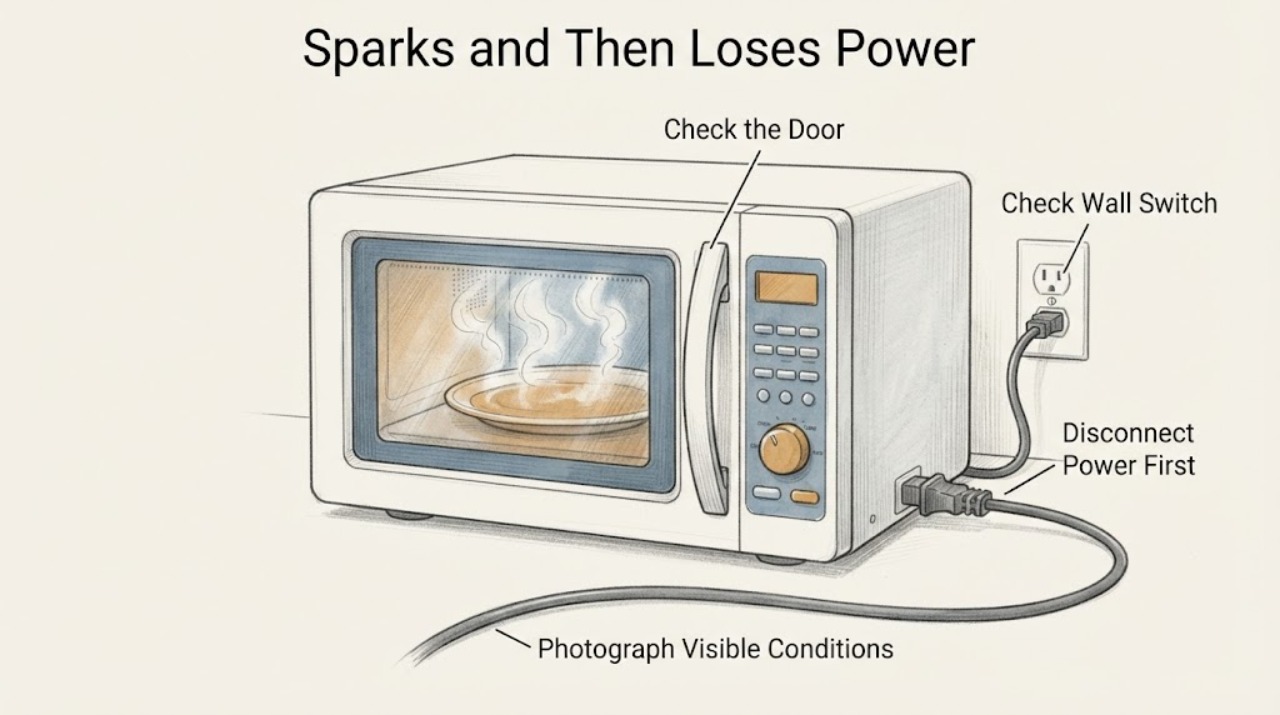
Work through in order
Diagnostic checks
Use only checks that match the exact appliance or system and its official guide.
-
Check 1
Do not press Start or reconnect the microwave. From a dry, stable position, record the exact event: whether the spark was a brief flash or repeated arc, whether it came from food/container or the cavity wall, whether the display went dark immediately, and whether the breaker or outlet also changed. Photograph the rating label without opening or moving the appliance.
Expected result: The display is dark and the household breaker or outlet is also off; the display is dark but the accessible supply appears normal; or the display remains lit but cooking is unavailable. The label reads JES1072SH1SS, JES1072SHSS, or another model.
Next step: Keep the oven out of service and preserve the display, breaker, outlet, label, and cavity evidence for the provider. Use the exact model manual only after the identity is confirmed; do not borrow a reset or parts diagram from the near-match.
Stop if: Stop immediately and keep clear for smoke, flame, active arcing, a hot/scorched/wet plug or outlet, damaged cord, repeated breaker operation, or a damaged door or cavity.
Why this matters
Why: A supply interruption and an appliance failure are different service paths. GE's opened support record is for JES1072SHSS, while the assigned JES1072SH1SS identity is not confirmed there; the complete label and power-state sequence therefore matter before any manual or code is applied.
-
Check 2
If and only if the plug and outlet are dry, cool, intact, and ordinarily reachable, disconnect the countertop microwave from that plug or use its accessible wall switch once. If the plug or outlet is scorched, wet, hot, smoking, or making noise, do not touch it; leave the area and isolate the circuit only from a safe accessible breaker or switch if that can be done without approaching the hazard.
Expected result: Power is safely disconnected without touching damaged equipment; the breaker will not hold; the outlet or cord is visibly damaged; or the appliance is disconnected but the cavity has smoke, burning odor, or a burn mark.
Next step: Leave the microwave unplugged. Arrange an electrician for a damaged or repeatedly tripping household supply and qualified appliance service for the microwave; tell both providers that sparking preceded the power loss.
Stop if: Do not reclose a tripping breaker repeatedly, use an extension cord or improvised adapter, open the outlet, or reconnect the microwave for a test.
Why this matters
Why: This establishes a safe stop boundary, not a repair. A repeat breaker trip or damaged supply needs electrical assessment. A cavity mark, odor, or smoke after arcing needs qualified microwave service even if the display later appears normal.
-
Check 3
With power disconnected and the cavity cool, inspect only from the open door for a metal utensil, foil, twist tie, metal-trimmed dish, spilled food, a loose or incorrectly seated rack, a chipped or peeling interior coating, a burn mark, or a hole in the cavity wall. Remove only an obvious loose item or wipe a cool, accessible spill with a dry or manual-approved method; do not scrape, sand, paint, or remove the waveguide cover.
Expected result: The spark source was an obvious removable metal item or spill with no cavity damage; the coating is chipped, peeling, or burned; there is a hole; or no cavity cause is visible.
Next step: Even after removing a loose item, do not power the microwave after a spark-plus-death event. Photograph any mark and request service; disclose whether the damage is on the cavity wall, floor, ceiling, door screen, or waveguide-cover area.
Stop if: Do not touch sharp fragments, scrape the cavity, patch or repaint it, remove the waveguide cover, open the cabinet, or operate with a damaged door or cavity.
Why this matters
Why: GE lists metal, foil, food spills, and rack placement as possible arcing causes, but says arcing can severely damage the interior. A hole or actively peeling coating changes the event to a non-user-repairable cavity condition; no visible cause leaves an electrical or internal fault unresolved.
-
Check 4
From outside the unplugged, cool appliance, record whether the display, interior light, and buttons were all dead, and whether any burning or chemical odor came from the food, cavity, cord, or outlet. Do not use a cup of water, another food load, a continuity meter, or a replacement fuse as a test.
Expected result: Only the cavity has a food-related scorch; there is an electrical odor or scorch near the cord/outlet; the breaker tripped; or the complete appliance remains dead with no accessible supply damage.
Next step: Keep it isolated and provide the sequence and photos to qualified service. Use an electrician for the wall supply and appliance service for the microwave; do not name or purchase a fuse, magnetron, capacitor, diode, transformer, or control from this observation.
Stop if: Do not sniff closely, touch a scorched area, remove a fuse, open the cover, discharge a capacitor, or reconnect the unit to see whether the odor or dead display clears.
Why this matters
Why: A food spill or metal item can explain the visible arc, but an electrical odor, supply damage, or full loss of power adds a supply or appliance electrical fault. GE's odor guidance says to stop for an electrical or chemical smell and have the microwave checked; a dead appliance does not identify its internal protective or high-voltage component.
-
Check 5
Prepare the service handoff without further operation: provide the complete model and serial label, market, time and duration of the cooking event, food/container used, exact spark location, display and breaker state, odor or smoke, visible cavity damage, and whether the microwave was countertop or otherwise installed. Keep the appliance unplugged until inspected.
Expected result: The model matches JES1072SHSS, the assigned JES1072SH1SS string cannot be confirmed, or a different model/market is shown; the provider also has photos of the spark and power-loss sequence.
Next step: Request model-matched qualified microwave service and, where the outlet or breaker is implicated, qualified electrical service. Ask for the cavity, door safety system, power path, and high-voltage section to be assessed by trained personnel rather than selecting a part remotely.
Stop if: Do not authorize a live test, cabinet opening by an unqualified person, high-voltage component replacement, interlock bypass, or repeated restart merely to reproduce the spark.
Why this matters
Why: GE's official records and manuals are selected by exact model, while the near-match cannot establish the assigned identity. The event history helps the provider separate removable cavity contamination, cavity damage, supply protection, and internal electrical failure without unsafe user testing.
Use your observations
Decision map
Find the observation that best matches what you see, then follow the next safe action.
-
PATH 01Next step
What you see
The microwave sparked during cooking and then the breaker tripped, the outlet is damaged, or the plug/cord is hot or scorched.
Do this next
Keep the circuit and microwave off. Use qualified electrical service for the outlet, cord, or breaker and qualified microwave service for the appliance; do not reset and retry.
Why this path and its safety boundary
Why it matters: The immediate branch is household electrical safety or an appliance fault that operated protection, not a normal control setting. The spark history makes repeated energizing unsafe.
-
PATH 02Next step
What you see
The cavity contains a hole, active peeling or burned coating, or a visible mark at the location of the arc, even though the household supply appears normal.
Do this next
Leave the microwave unplugged, isolate sharp fragments, photograph the location, and arrange qualified GE or microwave service for the exact model. Do not patch, repaint, scrape, or power it again.
Why this path and its safety boundary
Why it matters: GE says a hole through the cavity is non-repairable and active peeling or paint damage requires discontinuing use. This is a cavity-safety/service decision, not proof of a replaceable high-voltage part.
-
PATH 03Next step
What you see
The visible arc came from a removable metal item or food spill, the cavity is intact, but the microwave became completely dead afterward.
Do this next
Keep it disconnected and arrange qualified microwave service after documenting the item and cavity. Do not reconnect for a water-cup or empty-cavity test and do not replace an internal fuse yourself.
Why this path and its safety boundary
Why it matters: The object or spill may explain the arc but does not explain away the subsequent loss of power. The shutdown can involve a household protective device or an internal appliance fault that a user cannot distinguish safely.
-
PATH 04Next step
What you see
The display or light remains available, but the keypad or Start control does not operate after the spark event, or an electrical/chemical odor remains.
Do this next
Do not use the controls to test cooking. Keep the unit isolated and request qualified service; report whether the odor was in the cavity or at the supply.
Why this path and its safety boundary
Why it matters: A partial control or power-path failure is still a service condition. GE directs users to stop for an electrical odor and its model support page lists panel and arcing support topics without selecting an internal component from the symptom.
-
PATH 05Next step
What you see
The rating label does not exactly match JES1072SHSS or cannot confirm the assigned JES1072SH1SS string, or the market differs from the opened GE record.
Do this next
Keep the microwave off after the spark event and obtain the exact model manual or qualified service route using the full label. Do not copy reset sequences or part numbers from JES1072SHSS or another GE microwave.
Why this path and its safety boundary
Why it matters: The available official manual/support evidence is not proven applicable to that identity. A near-match cannot establish the model's cavity construction, controls, protective devices, or part fit.
Helpful context
Understand the symptom
A microwave that sparks and then loses power has two separate questions: what was visibly arcing in the cavity, and why the appliance or household protective device is now off. Metal, foil, a spill, or an incorrectly positioned rack can produce arcing, but the same event can also damage the cavity or reveal an electrical fault. Because a microwave retains hazardous high voltage even after it is unplugged, the useful user-level response is to stop, isolate power only safely, document visible evidence, and arrange service.
The official GE support page opened for the near-matching model is JES1072SHSS. It does not establish that the assigned JES1072SH1SS is a valid complete model, so the extra character must be checked on the rating label before any model-specific manual instruction is applied. This article deliberately does not identify a fuse, magnetron, diode, transformer, control, or door switch from the symptom.
When checks do not resolve it
Need a professional?
Request model-matched qualified microwave service for any post-spark loss of power, visible cavity damage, persistent odor, dead display with a sound outlet, or control that remains unavailable. Request qualified electrical service for a dead or damaged outlet, cord, circuit, or breaker that trips again. The extra character in JES1072SH1SS was not confirmed by the opened GE JES1072SHSS record, so provide the rating-plate identity before service uses a manual.
Safety scope: Keep the microwave unplugged or isolated after the spark-plus-power-loss event. Do not reconnect for a test, run it empty or with a water cup, open the case, remove a fuse or waveguide cover, discharge a capacitor, test live wiring, replace high-voltage parts, bypass the door interlock, scrape or repaint the cavity, or operate with a damaged door or cavity.
Have this ready
- Provide the complete model and serial label, market, countertop or installation context, food and container, exact spark location, cavity photos, display and interior-light state, breaker/outlet behavior, cord or outlet temperature/damage, odor or smoke, and whether the event was one flash or repeated arcing.
Common questions
FAQ
Can I plug the GE JES1072SH1SS back in to see if the spark was only metal in the food?
No. A spark followed by loss of power is a stop-use event. Remove only an obvious loose item from the cool, unplugged cavity if safe, photograph any marks, and arrange qualified service. Do not run an empty-cavity or water-cup test.
Does finding foil or a metal utensil mean the microwave's fuse is fine?
No. Metal or foil can cause arcing, but it does not explain or safely diagnose the subsequent power loss. A breaker, cord, control, protective device, or internal high-voltage fault may still be involved. Do not remove or replace a fuse yourself.
What if the JES1072SH1SS cavity has a burn mark or peeling paint?
Keep it unplugged. GE says arcing can severely damage the cavity, and its cavity guidance says a hole is non-repairable while active peeling or paint damage requires discontinuing use. Do not scrape, patch, repaint, or test the oven.
Is JES1072SH1SS the same model as GE JES1072SHSS?
The opened official GE support record is for JES1072SHSS and does not confirm the extra '1' in JES1072SH1SS. Read the full rating label and market, then use the exact manual; do not assume a near-match has the same controls, cavity, or parts.
Read the exact guide
Official sources
- User Manual & Care for JES1072SHSSGE Appliances · Official GE owner-support record for the closely matching JES1072SHSS countertop microwave, used to establish the model-identity mismatch and the available manual/support route, not to silently prove JES1072SH1SS equivalence.
- Troubleshooting for JES1072SHSSGE Appliances · Official GE support index for the opened JES1072SHSS record; used only for support-routing and the model-specificity boundary.
- Microwave Arcing In CavityGE Appliances · Official GE microwave guidance for identifying only visible, accessible potential arcing sources after safe power isolation.
- Microwave - Arcing or Making SoundsGE Appliances · Official GE microwave guidance for interpreting the spark event without live testing or part selection.
- Microwave - Cavity Repair Needed Due to Arcing, Chipping, Peeling or ScorchingGE Appliances · Official GE microwave guidance for safe post-arcing cavity observation; it does not authorize cabinet or high-voltage repair.
- Microwave - OdorsGE Appliances · Official GE microwave guidance for electrical or chemical odor after arcing and for the safe stop boundary around a damaged outlet or cord.
Community feedback
Share a repair observation
Share a plain-text repair observation. Accepted observations are published automatically; this page may take a moment to update.