
On this page
Start here
Quick answer
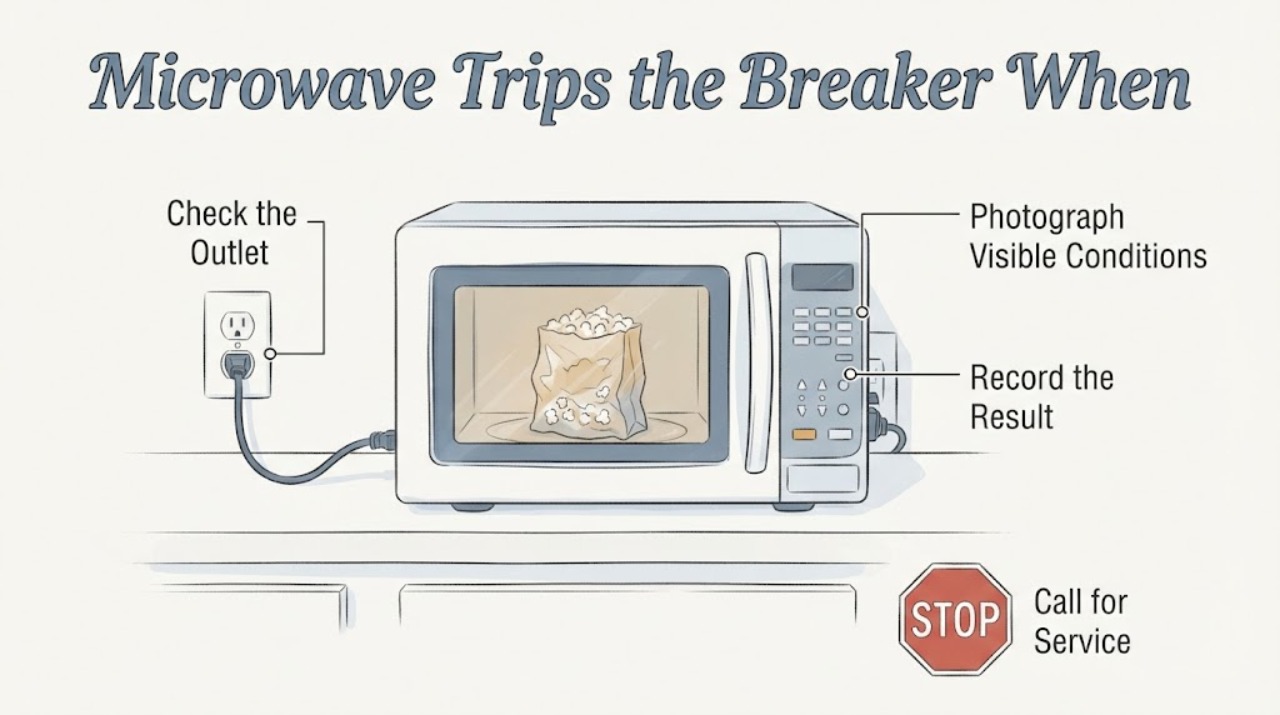
If a Panasonic microwave described only as a Genius 1200W trips the household breaker as soon as it is plugged in, stop trying to power it and do not start the popcorn cycle. The supplied label is not a complete model number: Panasonic's manual lookup requires the model number, and its official product page shows that Genius Sensor 1200W branding is used on a specific model, so do not borrow that model's manual or electrical rating. From a dry, safe position, leave the microwave disconnected, record the full rating-plate model and exactly when the breaker trips, and look only for visible cord, plug, outlet, moisture, scorching, smoke, or burning odor. Panasonic says microwaves should use the model-specified grounded circuit and that a shared circuit can trip a breaker, but an immediate repeat trip can also require service. Do not repeatedly plug it in, reset the breaker to test it, move it to another circuit, use an extension or adapter, remove the cabinet, bypass a door or safety switch, or make live or high-voltage measurements. Arrange qualified appliance service for a repeat appliance-side trip; use a qualified electrician for outlet, breaker, cord, or building-wiring damage.
Work through in order
Diagnostic checks
Use only checks that match the exact appliance or system and its official guide.
-
Check 1
Do not plug the microwave back in. From a dry, safe position, photograph the rating plate and record every model character, the Genius/1200W wording, whether the breaker trips at insertion or only after a control is pressed, and whether the display ever lights.
Expected result: The plate supplies a complete model, the model remains partial, the display is dead, or the trip occurs before any cooking command.
Next step: Use the complete model and serial information for the matched manual and service request. If the plate cannot be read, keep the microwave out of use rather than trying a guessed model procedure.
Stop if: Stop all electrical testing when the model is incomplete, the plate is damaged, or the trip occurs immediately; do not infer an internal part from the label.
Why this matters
Why: Panasonic's manual lookup is model-number based, and its support says power requirements vary by model. A partial Genius 1200W label cannot establish the correct manual, circuit rating, or failed component.
-
Check 2
With the microwave left disconnected, inspect only the visible plug, cord, outlet face, and nearby counter for looseness, moisture, scorching, melting, smoke residue, or a burning smell. Do not touch a hot, wet, charred, loose, or arcing connection.
Expected result: The cord or outlet is cool and undamaged, or there is heat, discoloration, water, smoke, odor, arcing, or physical damage.
Next step: Keep the affected circuit off when there is damage or repeated tripping and contact a qualified electrician. Arrange appliance service for the microwave; do not reconnect it for a comparison.
Stop if: Stop immediately for smoke, flame, active arcing, burning odor, a hot or melted plug/outlet, or water near the connection.
Why this matters
Why: Visible damage or moisture moves the problem into an outlet, cord, or electrical-safety branch; an undamaged exterior does not clear the microwave's internal input or safety circuit.
-
Check 3
Without moving or reconnecting the microwave, note whether the outlet is known to share a circuit with other appliances and whether the breaker trips only when this appliance is connected. Do not reset the breaker repeatedly, move the microwave to another circuit, use an extension cord or adapter, or substitute a different fuse.
Expected result: The outlet is known to be shared, the circuit trips again with the microwave isolated from use, or the building-side breaker and outlet are stable when the microwave remains disconnected.
Next step: Ask a qualified electrician to evaluate a shared, damaged, or repeatedly tripping circuit; ask authorized appliance service to evaluate the microwave. Do not conduct an alternate-outlet experiment yourself.
Stop if: Stop if the breaker trips again, the outlet or panel is hot or damaged, or the building wiring is uncertain; leave the appliance disconnected.
Why this matters
Why: Panasonic identifies a shared circuit as one possible cause of a tripped microwave breaker and requires the model-specified grounded supply, but that general guidance cannot distinguish a supply fault from an appliance fault without qualified electrical evaluation.
-
Check 4
Record the attempted use context without repeating it: popcorn bag or other load, any metal trim or twist tie, whether the cavity was empty, and whether smoke, sparks, odor, or heat occurred before the breaker opened. Do not resume the popcorn attempt while the power fault is unresolved.
Expected result: The trip happened before heating, or it followed a spark, smoke, metal contact, an empty cavity, or a damaged food container.
Next step: Discard damaged food or packaging, keep the microwave out of service, and provide this history to service. After repair only, follow the exact manual and popcorn package; Panasonic says to stay nearby and stop when popping slows.
Stop if: Stop for smoke, fire, repeated arcing, a scorched cavity, or any smell that remains after the appliance is disconnected; seek urgent professional help for an active fire.
Why this matters
Why: A trip at plug-in points toward supply or appliance input protection rather than popcorn timing. Sparks, smoke, or an unsafe container add a separate fire or cavity-damage concern and are not safe tests of the microwave.
-
Check 5
Prepare a service record instead of selecting a replacement part: complete rating-plate model and serial, exact trip timing, breaker behavior, plug/outlet observations, display status, load and cookware details, and any smoke, sparks, odor, heat, or moisture.
Expected result: The breaker trip repeats, the model remains incomplete, the outlet is damaged, or any smoke, odor, heat, or arcing accompanied the event.
Next step: Keep the microwave disconnected and request qualified appliance service; use a qualified electrician for the outlet, breaker, cord, or building circuit. Do not order parts or ask for a live internal test from this symptom alone.
Stop if: Do not remove the cabinet, bypass a safety switch, replace an internal fuse, enter service mode, or make live or high-voltage measurements.
Why this matters
Why: The combined record helps separate an electrical-supply issue from an appliance-side failure without exposing the reader to the microwave's internal high-voltage section. A 1200W label alone cannot identify a fuse, capacitor, magnetron, board, or door interlock.
Use your observations
Decision map
Find the observation that best matches what you see, then follow the next safe action.
-
PATH 01Next step
What you see
The breaker trips as soon as the plug is inserted, before a cooking command, with no confirmed shared-circuit explanation.
Do this next
Leave the microwave disconnected and arrange qualified appliance service, with an electrician checking the outlet or circuit if any building-side damage or repeat trip is present.
Why this path and its safety boundary
Why it matters: The symptom is an appliance-side or supply-side power fault, not a popcorn timing or sensor-setting problem; the incomplete model prevents a model-specific diagnosis.
-
PATH 02Next step
What you see
The outlet, cord, or breaker is hot, wet, charred, loose, arcing, or repeatedly trips even while the microwave remains out of use.
Do this next
Keep the affected circuit off if safe and contact a qualified electrician. Use emergency procedures for active smoke or fire, and do not handle damaged electrical parts.
Why this path and its safety boundary
Why it matters: This is an immediate electrical or fire-safety branch; resetting or reconnecting can worsen a building-wiring or connection fault.
-
PATH 03Next step
What you see
The circuit is known to be shared, while the microwave's plug and outlet show no visible damage and the appliance remains disconnected.
Do this next
Have a qualified electrician assess the circuit and model-specific requirements; do not move the microwave to another circuit as a test or resume cooking.
Why this path and its safety boundary
Why it matters: A shared circuit is a plausible supply-side contributor because Panasonic warns that other appliances can make the microwave branch breaker trip, but it does not prove the microwave is sound.
-
PATH 04Next step
What you see
The rating plate is partial, Genius 1200W is only a marketing label, or the full model cannot be matched to Panasonic's operating manual.
Do this next
Photograph the plate and display, retrieve the exact manual by model number, and give both to qualified service. Do not select a part or diagnostic procedure from the Genius 1200W label.
Why this path and its safety boundary
Why it matters: Model-specific circuit, popcorn, and safety instructions remain unresolved. Panasonic's public 1200W product page is for a named model and cannot be substituted for the user's missing model.
Helpful context
Understand the symptom
This is an electrical stop condition, not a popcorn-setting problem. A breaker that trips at plug-in happens before a safe cooking comparison can establish anything about popcorn, the Popcorn pad, or heating performance. Keep the incomplete model identity visible in the service request and do not translate the symptom into a magnetron, fuse, board, or door-switch diagnosis.
Once the microwave is confirmed safe and repaired, Panasonic's popcorn guidance is model-dependent: follow the package and matched operating instructions, use one bag at a time, stay nearby, and stop when popping slows. Those cooking precautions do not justify reconnecting a unit that trips the breaker immediately.
When checks do not resolve it
Need a professional?
Arrange appliance service for any immediate or repeated breaker trip involving the microwave. Arrange electrical service when the outlet, breaker, cord, or building wiring is damaged or also trips without the microwave.
Have this ready
- Provide the complete rating-plate model and serial, the full display state, exactly when the breaker opened, whether it happened at plug-in or after a button, the breaker and outlet observations, the popcorn or cookware context, and any smoke, sparks, odor, heat, moisture, or visible damage.
Common questions
FAQ
Is Genius 1200W the full Panasonic microwave model number?
No model-specific conclusion should be drawn from that label alone. Panasonic's manual lookup asks for the model number, and its official product page shows Genius Sensor 1200W on a named model; read the complete rating-plate identifier before using a manual or discussing parts.
Why does the breaker trip as soon as I plug in the microwave?
Panasonic lists a shared circuit as one possible cause of a microwave breaker trip and says power requirements vary by model. An immediate or repeated trip can also be an appliance or supply fault, so leave it disconnected and have the correct professional evaluate it instead of reconnecting it to find out.
Can I try another outlet or reset the breaker once?
Do not use another circuit as a test and do not repeatedly reset the breaker. Panasonic's general installation guidance requires a model-specified grounded supply; with an immediate plug-in trip, the safe next step is external visual documentation and qualified service.
Could the popcorn bag have caused the breaker to trip?
If the breaker opened at plug-in before cooking started, popcorn timing is not a supported explanation. After repair, Panasonic says to follow the package and matched model instructions, pop one bag at a time, stay nearby, and stop when popping slows; do not resume a microwave that trips the breaker.
Read the exact guide
Official sources
- 1.2 cu. ft. Countertop Genius Sensor Microwave Oven, 1200W - NN-SN66KBPanasonic · Panasonic named NN-SN66KB product page showing Genius Sensor 1200W branding; not the user's exact model
- Panasonic Operating Manual LookupPanasonic Consumer Support · Panasonic operating-manual lookup by complete model number
- Panasonic - Specifications - Recommended electrical connection requirements for MicrowavesPanasonic Consumer Support · Panasonic microwave dedicated-circuit, grounded-outlet, voltage, and adapter/ground-prong safety guidance
- Panasonic - How to cook popcornPanasonic Consumer Support · Panasonic model-specific popcorn settings and safe-popcorn precautions
- Panasonic - Troubleshooting - Microwave power, fan or motor problemsPanasonic Consumer Support · Panasonic consumer microwave power failure, circuit-breaker trips, dedicated-circuit guidance, and service escalation
Community feedback
Share a repair observation
Share a plain-text repair observation. Accepted observations are published automatically; this page may take a moment to update.