
On this page
Start here
Quick answer
If a GE gas oven does not ignite, stop trying immediately if you smell unburned gas, hear a boom, see the door move, or notice a delayed ignition. Do not operate electrical switches or use a flame; leave the area and contact the gas supplier or emergency services from outside. If there is no gas odor or other danger sign, confirm the Bake or Broil control and power supply, then use the model manual to identify whether the oven uses a glow-bar igniter or a standing pilot. Do not remove gas parts, bypass safety controls, or keep repeating ignition attempts; a persistent no-ignition fault needs qualified appliance or gas service.
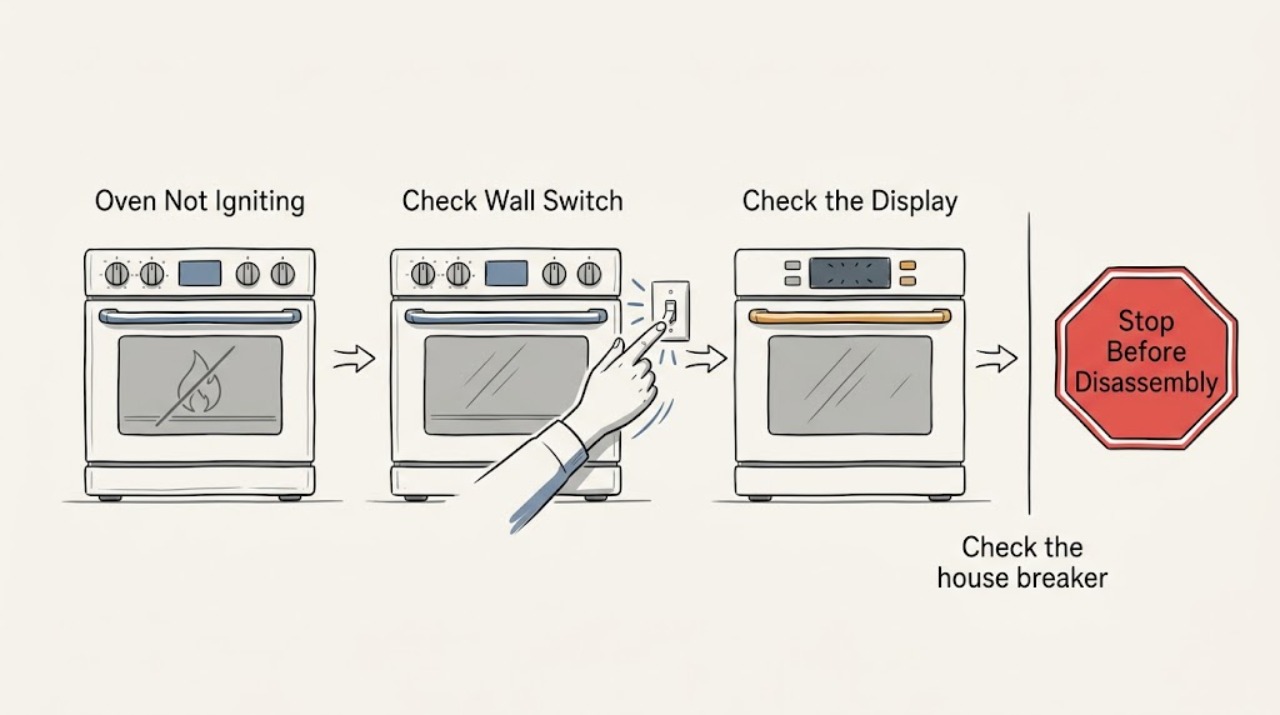
Work through in order
Diagnostic checks
Use only checks that match the exact appliance or system and its official guide.
-
Check 1
Stop the ignition attempt and assess the area before touching any control. If you smell unburned or rotten-egg-like gas, hear a boom, see the oven door move, or see smoke or flame outside the burner area, do not operate electrical switches or use a flame.
Expected result: A gas odor, delayed boom, door movement, smoke, or an abnormal flame is present.
Next step: Leave the area, extinguish open flames only if this can be done without risk, and contact the gas supplier or emergency services from outside. Do not return to repeat the test until the appliance is cleared.
Why this matters
Why: Unburned gas or delayed ignition may be present; the oven is outside a safe homeowner troubleshooting path.
-
Check 2
If there is no gas odor or abnormal sound, set the oven function and temperature controls to the intended Bake or Broil positions exactly as shown in the GE manual. Do not turn a gas control on and off repeatedly to force ignition.
Expected result: The controls were mis-set, a knob was in the wrong location after cleaning, or the oven remains unresponsive with the correct setting.
Next step: If the setting was correct and there is still no ignition, continue only with the external power check; do not remove the control panel.
Why this matters
Why: A control-setting issue can prevent a start, but correct settings with no ignition point to the power, ignition, gas, or control system and do not identify a replacement part.
-
Check 3
Check the house breaker or fuse status without removing a panel cover. If it is safe and the appliance has no gas odor, confirm the range power cord is fully seated at the accessible receptacle; disconnect the circuit before handling the cord.
Expected result: The breaker is tripped, a fuse is open, or the cord is loose; or the electrical supply appears normal but the oven still will not ignite.
Next step: Correct only an obvious power interruption according to the model instructions. If the breaker trips again or the oven remains unlit, leave it off and arrange service rather than repeatedly resetting it.
Why this matters
Why: The oven's ignition controls need electricity on many models, but a restored breaker does not prove that a gas or ignition fault is safe to operate.
-
Check 4
Identify the oven's ignition type from its exact model manual. On a model with a visible glow-bar procedure, use only the manual's permitted external observation; on a standing-pilot model, follow the manual's model-specific safety directions or call a gas professional. Do not remove the oven bottom, reach near the burner, open gas tubing, or test an igniter with live wiring.
Expected result: The manual identifies a glow-bar igniter, a standing pilot, or no user-accessible ignition check; the expected glow or pilot condition is absent.
Next step: Stop the test and provide the model number and ignition observation to a qualified appliance technician or gas professional.
Why this matters
Why: The ignition component, control, or pilot system may need diagnosis, but the observation cannot establish a safe part replacement or gas adjustment.
-
Check 5
If the oven has no gas odor, boom, smoke, or repeated breaker trip, read the model manual for any documented electronic-control reset and perform it only with the circuit safely de-energized. Do not use a reset as a substitute for diagnosing gas flow or delayed ignition.
Expected result: The model supports a documented reset and the oven returns to normal ignition, or the fault remains after the reset.
Next step: Do not repeat resets or ignition attempts. Keep the oven off and schedule repair if it does not ignite normally after the documented procedure.
Why this matters
Why: A reset may clear a temporary control state on models that support it, but continued no-ignition indicates a fault requiring service.
-
Check 6
Record whether you hear a click, see a glow, smell gas, see a flame, or hear a delayed ignition, along with the selected mode and model number. Contact GE support or a qualified repair provider instead of opening the gas system.
Expected result: No ignition occurs after the safe external checks, or ignition is delayed, erratic, or accompanied by an abnormal flame or odor.
Next step: Leave the oven unused until a qualified appliance or gas professional evaluates it; report any odor or boom before the appointment.
Why this matters
Why: A persistent failure can involve the igniter, valve, control, pilot, gas supply, or another model-specific part; safe diagnosis requires qualified equipment and instructions.
Use your observations
Decision map
Find the observation that best matches what you see, then follow the next safe action.
-
PATH 01Next step
What you see
You smell unburned gas, hear a boom, or the oven door moves during an ignition attempt.
Do this next
Stop immediately, avoid switches and flames, leave the area, and contact the gas supplier or emergency services from outside.
Why this path and its safety boundary
Why it matters: Treat the situation as possible unburned gas or delayed ignition.
-
PATH 02Next step
What you see
The controls are correctly set, but there is no ignition and the power supply is not available.
Do this next
Check only the accessible breaker, fuse, and cord condition as directed by the manual; stop if protection trips or the issue remains.
Why this path and its safety boundary
Why it matters: An electrical supply or control problem may be preventing ignition.
-
PATH 03Next step
What you see
Power is available, but the model's expected glow-bar or pilot condition is absent.
Do this next
Leave the oven off and call qualified appliance or gas service; do not remove burner components or gas lines.
Why this path and its safety boundary
Why it matters: The ignition or control system needs model-specific diagnosis.
-
PATH 04Next step
What you see
The model manual documents a standing-pilot design but the pilot is out or the oven will not come on.
Do this next
Use only the exact manual's instructions if the area is free of gas odor and you are confident the model matches; otherwise use a gas professional and do not improvise.
Why this path and its safety boundary
Why it matters: The pilot arrangement is model-specific and may require professional adjustment.
-
PATH 05Next step
What you see
The oven still does not ignite after correct settings and safe external checks.
Do this next
Keep the oven off and schedule qualified appliance repair, reporting any click, glow, odor, delay, or unusual flame.
Why this path and its safety boundary
Why it matters: The issue has reached the service boundary.
Helpful context
Understand the symptom
A GE gas oven can fail to ignite because its controls, power, gas supply, ignition system, or model-specific pilot arrangement is not operating as expected. The first decision is safety: an oven that is silent is different from one that releases gas without lighting, lights late with a boom, or causes the door to move. The latter symptoms are not a cue to keep testing.
GE models are not identical. Some use an electric glow-bar igniter and some older standing-pilot models have instructions specific to the listed model. Use the exact owner manual and treat the steps below as external checks only. Do not remove an oven bottom, open a gas connection, adjust a regulator, or improvise a match-lighting procedure for an unknown model.
When checks do not resolve it
Need a professional?
Call qualified appliance or gas service when the oven still will not ignite after safe external checks, when the expected glow or pilot condition is absent, or when ignition is delayed or erratic. Treat any unburned-gas odor, boom, door movement, smoke, damaged wiring, repeated breaker trip, or shock as an immediate stop condition.
Common questions
FAQ
Why does my GE gas oven click but not ignite?
The exact cause depends on the model and whether the expected glow or flame appears. Confirm the controls and power only when there is no gas odor or delayed-ignition sign, then use the model manual and arrange service if ignition does not occur normally.
Is a smell when a GE gas oven starts normal?
GE distinguishes a brief combustion odor at start-up from the rotten-egg-like odor of unburned gas. If the odor is unburned gas, do not touch electrical switches or use a flame; leave and contact the gas supplier from outside.
Can I light the GE oven manually if it will not ignite?
Do not improvise manual lighting. Some older standing-pilot models have model-specific instructions, while other GE ovens use a different ignition system. Verify the exact model manual or use a qualified gas professional, and never remove burner parts or open gas connections as a workaround.
Read the exact guide
Official sources
- Gas Range - Gas OdorsGE Appliances · GE gas odor safety guidance
- Gas Range - Oven Will Not Turn On - Pilot Light ModelsGE Appliances · GE standing-pilot oven model guidance
- Gas Range - What is Normal Operation vs What Requires ServiceGE Appliances · GE gas range operation and delayed-ignition warnings
- Gas Range & Wall Oven - Oven Will Not Come OnGE Appliances · GE gas oven no-start troubleshooting
Community feedback
Share a repair observation
Share a plain-text repair observation. Accepted observations are published automatically; this page may take a moment to update.