
On this page
Start here
Quick answer
First confirm whether the loud sound comes from the washer below or the dryer above, then note whether it occurs during washer spin, drain, or dryer tumble. GE's manual lists water-pump sounds, motor ramping, and some clicks as normal, but a very loud or harsh noise needs a stopped-appliance inspection. Redistribute a washer load only when it is clearly uneven, check the unit's external stability and visible hose or cabinet contact, and stop repeated testing if the sound remains with an empty basket, includes scraping or repeated impact, or makes the stacked unit move. A precise GUD27ESSM1WW community case reported noise with no load that became worse with a load and later became quiet after a motor replacement; that is a service clue, not proof that this appliance needs a motor.
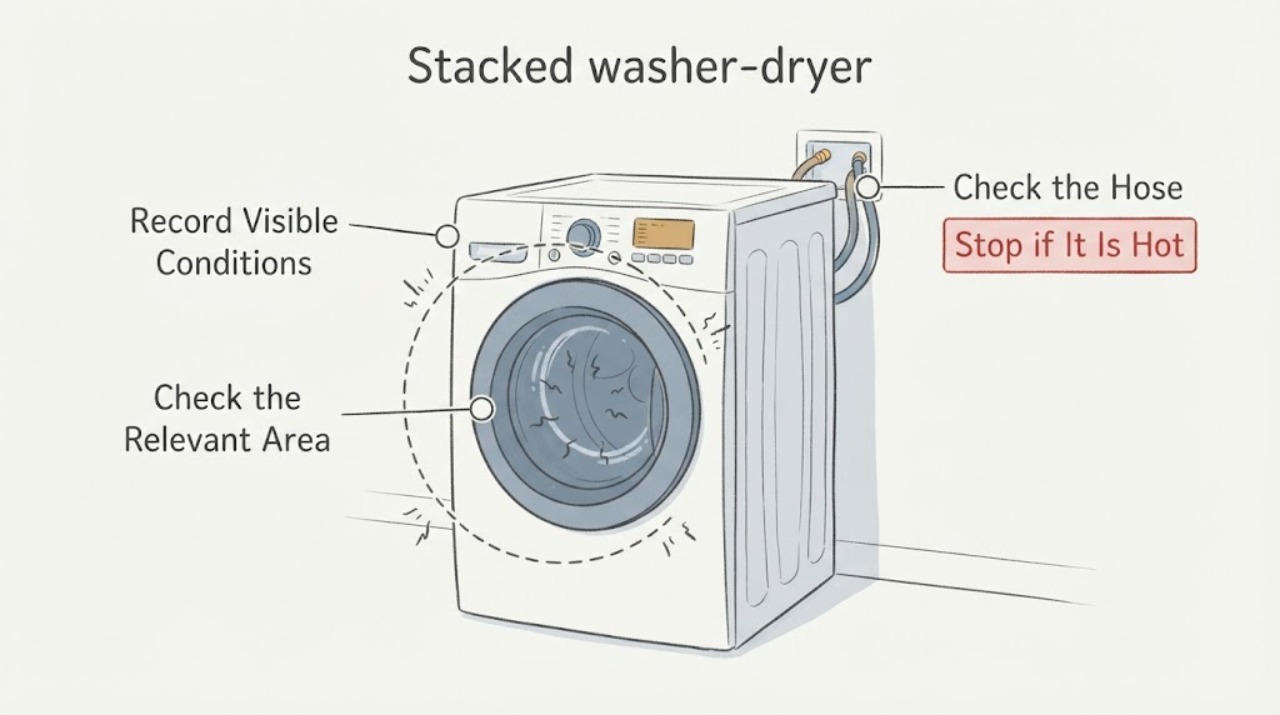
Work through in order
Diagnostic checks
Use only checks that match the exact appliance or system and its official guide.
-
Check 1
From a dry, safe position, localize the sound to the lower washer or upper dryer and record the exact phase: washer fill, agitation, drain, or spin; or dryer startup or tumble. Describe whether it is a brief click, water rush, hum, gurgle, thump, rattle, scrape, chirp, or grinding, and save one short recording only if doing so does not require approaching a moving part.
Expected result: GE's manual lists motor ramping during spin, a drain-pump hum or gurgle, agitation clicks, and some dryer shaking/noise as possible operating sounds. A persistent metal scrape, harsh grind, repeated impact, or sound clearly isolated to one section is a different observation from a brief cycle-linked sound.
Next step: Use the washer checks if the lower basket is the source and the dryer checks only if the upper drum is the source. If the source cannot be localized safely, stop use and request diagnosis.
Stop if: Stop immediately for smoke, sparks, burning odor, exposed wiring, water near electrical parts, violent movement, or a damaged cord.
Why this matters
Why: Localizing the section prevents applying washer load checks to a dryer noise or assuming that every spin-phase sound is a suspension or motor failure. The sound description narrows the service handoff but does not identify a part.
-
Check 2
With the washer stopped and the basket fully still, record whether the loud spin noise is present with no clothes, with a balanced ordinary load, or only with one heavy or tightly bunched load. Do not remove a belt, run the machine with covers off, or repeat high-speed spins solely to compare sounds.
Expected result: A quiet empty basket that becomes noisy only with one-sided or heavy laundry supports a load-distribution path. Noise already present with no load, especially when it becomes louder under load, is not safely explained by load balance alone.
Next step: If the noise is load-only and the appliance stays stable, redistribute the load and use the normal cycle guidance once. If it remains with an empty basket or is harsh and worsening, stop using the washer and arrange model-matched service.
Stop if: Do not place hands in a moving basket, defeat the lid lock, hold the stacked unit during spin, or disassemble the drive system.
Why this matters
Why: For the exact GUD27ESSM1WW, an opened community report describes the unit as unnaturally loud without a load and worse with a load; a later comment reports that the poster replaced the motor and the unit then ran quietly. This is a reported case, not a diagnosis or a reason to order a motor first.
-
Check 3
With the unit idle, look from the front and sides for rocking, a leaning cabinet, a soft or uneven floor, damaged or loose accessible leveling feet, or the cabinet or hoses touching a wall, stand, or adjacent surface. Do not pull a connected stacked unit forward or lift it to inspect the rear.
Expected result: GE's installation instructions require the appliance to rest solidly on all four legs and be checked level side-to-side and front-to-back; they warn that damaged leveling legs can increase vibration. A cabinet that rocks or contacts another surface can transmit a loud thump, while a stable unit with empty-basket grinding points away from a simple leveling issue.
Next step: Follow the exact GE installation instructions for an accessible leveling adjustment only if the unit can remain safely in place. Otherwise arrange qualified installation or appliance service rather than moving the stack.
Stop if: Do not move the stacked unit alone, wedge unsafe objects beneath it, remove rear hardware by guesswork, or operate it while it walks.
Why this matters
Why: Installation and contact can amplify spin vibration without proving an internal component fault. A stable, correctly installed unit with persistent noise needs a different service branch.
-
Check 4
When the appliance is stopped, inspect only ordinary-access areas: the washer basket and lid area for a visible coin, fastener, or object; the dryer drum opening and lint-filter opening for a clearly visible loose item; and the exposed drain or fill hoses for a kink or contact point. Remove an object only if it is plainly reachable without sharp edges or concealed access.
Expected result: A visible loose object or a hose that strikes the rear only during fill or drain supports an external/object path. No visible object, a trapped object, a damaged seal, or a scrape that continues during drum rotation does not identify the internal source.
Next step: Correct only an obvious accessible object or clearance issue and stop if the sound remains. Request service for a trapped object, sharp opening, damaged seal, retained water, or any cabinet access.
Stop if: Do not remove the lint path, drum, lid, cabinet, pump, or hose connection; do not reach into a moving or sharp opening.
Why this matters
Why: The accessible finding can explain a rattle or contact noise, but a concealed object or persistent metal-on-metal sound can damage the appliance and requires service rather than deeper probing.
-
Check 5
If the sound is washer-side and tied to drain or spin, observe from outside whether water drains normally and whether the drain hose is kinked or displaced. Do not open a pump, reach for an impeller, or use an inaccessible filter procedure; this stacked unit's exact manual must govern any owner-access maintenance.
Expected result: GE describes a drain-pump hum or gurgle during pump-out and spin as possible normal operation. Slow or incomplete drainage, a persistent harsh pump hum, retained water, or a hose striking the rear is a different result from a normal drain sound.
Next step: Follow only the exact manual's user-accessible drain check. Stop repeated cycles and arrange qualified service if water remains, the sound persists, or access would require opening the cabinet.
Stop if: Stop for leaking water near electrical parts, a full tub that will not drain, a damaged hose, or any need to open the pump or cabinet.
Why this matters
Why: Drain timing can explain a sound without proving pump failure, while retained water or repeated harsh noise needs appliance or plumbing assessment. It cannot be used to select a motor, pump, belt, suspension, or transmission part.
Use your observations
Decision map
Find the observation that best matches what you see, then follow the next safe action.
-
PATH 01Next step
What you see
The sound is a brief, cycle-linked washer pump or motor sound, a normal dryer operating sound, or a load-only thump that disappears after safe redistribution while the stack remains stable.
Do this next
Continue ordinary use while monitoring; stop if it becomes harsher, persistent, louder, or is joined by movement, leakage, odor, or poor performance.
Why this path and its safety boundary
Why it matters: The observed pattern is more consistent with documented operation, load distribution, or a safe external condition than with a proven failed part.
-
PATH 02Next step
What you see
The exact GUD27ESSM1WW is loud with an empty washer basket, the noise becomes worse under load, or a balanced load does not change a harsh spin sound.
Do this next
Stop repeated spin tests and arrange qualified GE appliance service with the model, recording, load/no-load comparison, and any movement or visible damage. Do not order a motor or transmission first.
Why this path and its safety boundary
Why it matters: Load imbalance alone is not a sufficient explanation. An internal drive, motor, transmission, suspension, basket, or other mechanical issue is possible, but the exact part is not established by sound; the exact Reddit case is only a reported service clue.
-
PATH 03Next step
What you see
The noise comes from the dryer section, occurs only at startup or tumble, and a visible loose object, cabinet contact, or uneven support is found.
Do this next
Remove only the plainly accessible object or correct an exact-manual-approved external condition with the appliance stopped; escalate for a trapped object, drum damage, or persistent noise.
Why this path and its safety boundary
Why it matters: The dryer-side object or installation path is more likely than a washer spin fault, but a persistent scrape or thump can still require internal dryer service.
-
PATH 04Next step
What you see
The stack rocks or walks, a hose or cabinet strikes another surface, water leaks, or there is smoke, sparking, burning odor, exposed wiring, or a hot or damaged cord.
Do this next
Stop the appliance. Use a dry, safe, accessible shutoff only if it can be reached without contacting the hazard, and arrange qualified appliance, plumbing, or electrical service.
Why this path and its safety boundary
Why it matters: Installation, flood, fire, shock, and injury risks override further sound diagnosis.
Helpful context
Understand the symptom
The GUD27ESSM1WW is a unitized stacked washer-dryer, so a loud sound heard during spinning should not be assigned to the washer until its source is localized. A washer pump, motor, or load can sound different from the dryer drum, and the GE manual describes several brief clicks, hums, water sounds, and spin ramping sounds as normal. A harsh, worsening, or movement-producing sound is not identified by the word spin alone.
The checks below are deliberately external and low risk. Do not remove the cabinet, belt, tub, motor, suspension, or pump; do not reach through a lid lock or lint opening; and do not keep running a visibly unstable stacked unit just to record a louder sample.
When checks do not resolve it
Need a professional?
Arrange qualified GE appliance service when the loud sound remains with an empty or balanced washer basket, the stack rocks or walks, the dryer drum scrapes or thumps, a drain problem or retained water accompanies the noise, or any check requires moving the stacked unit or opening a panel. Treat smoke, sparks, burning odor, exposed wiring, a damaged cord, active leakage near electrical parts, or violent movement as urgent and do not restart the unit to reproduce the sound.
Common questions
FAQ
Should I assume the GE GUD27ESSM1WW needs a motor because it is loud during spin?
No. An exact-model Reddit poster reported a quiet result after replacing a motor, but that is one user outcome rather than a diagnosis. Verify the washer-versus-dryer source, load behavior, stability, and visible conditions first, then have service confirm the failed part.
Can I run the stacked washer empty to prove the load is not the cause?
Only a single ordinary, model-appropriate check is reasonable when the unit is stable and there is no hazard; do not repeat high-speed spins or run with covers removed. If the noise is already harsh, persistent, or causes movement, stop using the appliance and arrange service.
What does GE's manual call normal noise on this platform?
The opened manual describes motor ramping during spin, drain-pump humming or gurgling, agitation clicks, and some dryer shaking or noise as possible operating sounds. A persistent harsh scrape, grinding, repeated impact, or worsening noise is not cleared by that list.
Read the exact guide
Official sources
- GE combo stacked washer GUD27ESSM1WW making noiseReddit r/GEappliances · Opened the exact Reddit post. The poster names GUD27ESSM1WW, reports unnatural noise without a load that is worse with a load, and later reports that replacing the motor made it quiet. This is anecdotal and cannot prove a universal motor diagnosis or safe repair procedure.
- OWNER'S MANUALGE Appliances · The owner manual covers the GUD27ES washer family and describes this unitized washer-dryer platform's normal washer sounds, load and lid safety, and dryer noise guidance; the exact model identity is established by the GE parts record rather than by treating another model suffix as a separate diagnosis.
- Installation InstructionsGE Appliances · The installation document linked from GE's exact-model record covers leveling and stabilizing the appliance, drain routing, rear clearance, and qualified installation boundaries. It is installation guidance, not an internal noise diagnosis.
- Model Search | GUD27ESSM1WWGE Appliances Parts · Opened GE's exact-model parts record. It identifies GUD27ESSM1WW as a GE Unitized Spacemaker washer and electric dryer and links the owner's manual, installation instructions, and separate washer and dryer assemblies; it does not diagnose the reported noise.
Community feedback
Share a repair observation
Share a plain-text repair observation. Accepted observations are published automatically; this page may take a moment to update.