
On this page
Start here
Quick answer
For a GE washer-dryer that vibrates excessively, first pause it and redistribute the load, then compare the behavior with an empty rinse-and-spin or other model-approved test. Check that the unit is level on a solid floor with every rubber leg firmly contacting the floor and its lock hardware secure. If the problem began after installation or moving, verify the owner's instructions for shipping hardware and stacking or riser installation; do not unstack a pair yourself. On a GE combo, a clogged pump filter or inlet hoses striking the rear can also contribute to shaking or noise. Stop using the appliance for violent movement, a tipping cabinet, leaks, damaged cords or hoses, or vibration that remains after these external checks, and arrange qualified service.
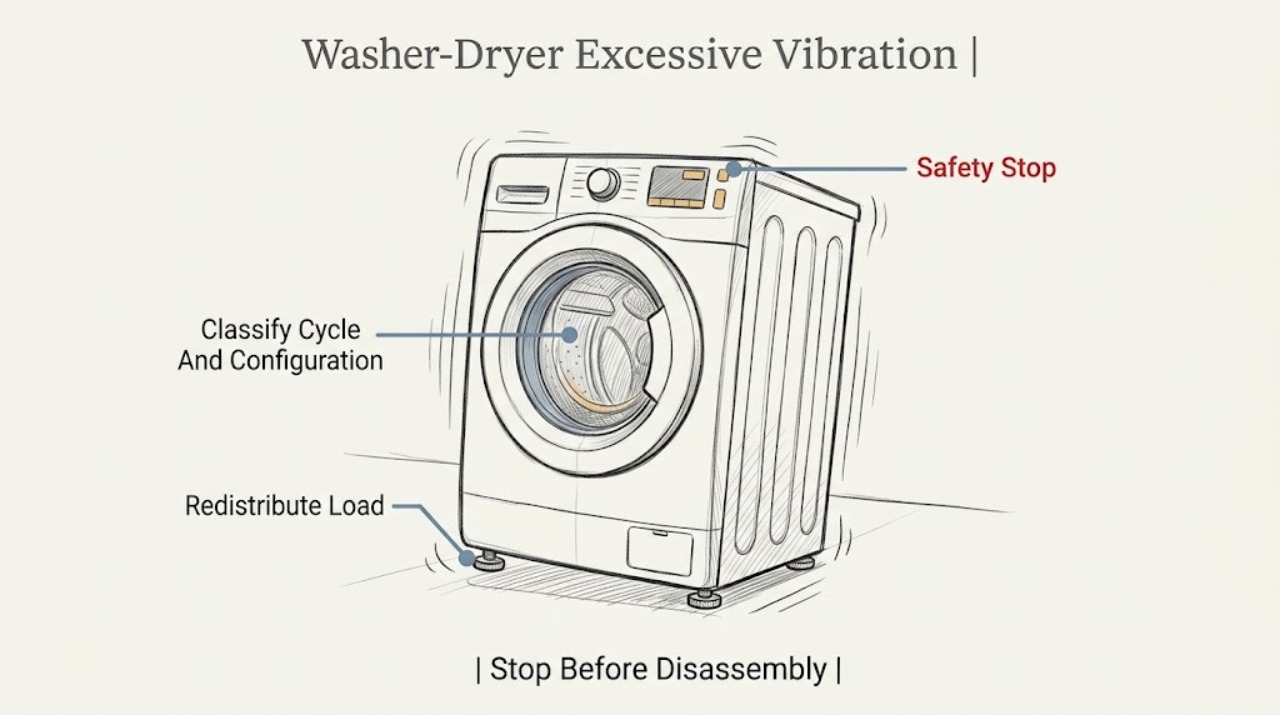
Work through in order
Diagnostic checks
Use only checks that match the exact appliance or system and its official guide.
-
Check 1
Pause the washer-dryer and stop using it for violent movement, a cabinet that lifts or tips, a door or lid that will not remain closed, water leaking onto the floor, a damaged power cord or hose, smoke, a burning smell, or repeated electrical trips. Keep people and pets clear while the drum is moving.
Expected result: The unit remains unstable or the safety symptom returns when a cycle is started again.
Next step: Leave the appliance out of service and arrange qualified appliance service or installation inspection. Do not hold the cabinet down, defeat the lid or door lock, or move a stacked unit while it is connected.
Why this matters
Why: This is a mechanical, water, electrical, or installation safety issue, not a normal load-balance adjustment.
-
Check 2
Note when the vibration occurs: filling, agitation, draining, or high-speed spin. Identify whether the appliance is a single washer-dryer combo, a permanently unitized laundry center, or a separately stacked washer and dryer, and record whether it was recently installed, moved, or put on a riser.
Expected result: The shaking appears only during spin, occurs with every phase, started after moving, or is accompanied by hose noise, poor draining, or a cabinet that rocks while empty.
Next step: Follow the load, level, installation, hose, and pump branches in that order. Use the model manual for the exact configuration and do not treat a separate stack as a single appliance for leveling or removal.
Why this matters
Why: Spin-only movement favors load balance, leveling, shipping hardware, or floor contact. All-phase noise can include hoses, installation contact, or a mechanical fault; a recent move raises installation checks first.
-
Check 3
Pause the cycle, open the door or lid only after the appliance allows it, and redistribute garments evenly. Avoid testing with one heavy absorbent item or an overloaded drum. Then run the model-approved empty rinse-and-spin or equivalent test, staying present.
Expected result: The appliance becomes stable with a redistributed load or empty basket, but vibrates with the original load; alternatively, it shakes even when empty.
Next step: Use balanced loads of similar items and do not overload or underload. If an empty test still shakes, continue with the installation checks rather than repeatedly restarting full loads.
Why this matters
Why: Normal empty operation with a shaking original load supports an imbalance caused by load size or distribution. Vibration with an empty basket shifts suspicion to leveling, shipping hardware, floor, pump, installation, or mechanical service.
-
Check 4
With the appliance empty and safe to inspect, place a level on top if the model's installation instructions permit it. Confirm the unit sits on a solid floor, every rubber leveling foot contacts the floor, the feet are not extended farther than necessary, and the lock nuts or leg hardware are secure. Do not adjust a dryer stacked above a washer or a cabinet that would need lifting.
Expected result: The cabinet rocks, a foot is off the floor, the floor is uneven or damaged, the legs are extended unevenly, or the appliance is level and firm.
Next step: For a standalone unit, make only the model-approved external leg adjustment and tighten the lock hardware. For a stacked or difficult-to-access installation, use an installer or technician; if the firm unit still shakes, arrange service.
Why this matters
Why: GE links excessive vibration with an unlevel unit, loose or extended legs, and an unsuitable floor. A level, firm cabinet with continued empty-basket vibration points beyond simple leveling.
-
Check 5
If the vibration started after first installation or a move, compare the installation to the exact model instructions. Check whether required shipping bolts, braces, spacers, or other transport hardware were removed as directed, and whether a separately stacked washer and dryer is secured with the correct model-compatible stacking kit. Do not remove a top appliance or reach behind a stack to improvise a fix.
Expected result: Transport hardware may still be installed, the stack or riser hardware is unknown or loose, or installation was completed without the model instructions.
Next step: Stop using the appliance and have the original installer or a qualified technician verify shipping hardware, stacking brackets, riser alignment, and leveling. Do not unstack or dismantle it as a home vibration test.
Why this matters
Why: GE says retained shipping material can make a washer or combo severely unbalanced, and a stacking kit is what secures compatible appliances. Installation errors can transmit large forces even with a good load.
-
Check 6
From outside the appliance, check that the water inlet hoses, drain hose, power cord, and cabinet are not pressed against a wall or frame. For a GE combo, pull it away only if it is safe and the model installation permits movement; keep hoses hanging free rather than striking the rear panel. Do not move a stacked pair without proper equipment.
Expected result: The noise changes when a hose is held away from the rear, the cabinet contacts the wall, a hose is kinked, or the sound persists with clearances normal.
Next step: Reposition only an accessible hose or clearance issue without stressing connections. If a hose, wall, cabinet, or stack is damaged or the vibration remains, stop and call service.
Why this matters
Why: GE notes that inlet hoses can move and hit the rear of a combo, creating a clunk or noise. Contact or a kink can make the vibration seem worse, but persistent cabinet movement needs a separate diagnosis.
-
Check 7
For a GE front-load combo or washer with a model-provided pump-filter access door, check the owner manual before cleaning. Disconnect power as the manual directs, prepare towels and a shallow container for residual water, and remove only the accessible filter according to those instructions. Do not open a sealed cabinet or force a filter.
Expected result: The filter contains debris, the appliance is slow to drain or leaves wet clothes, and vibration improves after the approved cleanout; alternatively, the filter is clear or the empty-basket shake remains.
Next step: Reinstall and close the accessible filter exactly as the manual requires, then run one approved test. If draining or vibration remains abnormal, arrange service; do not access the pump internally.
Why this matters
Why: GE identifies a clogged pump filter as a possible contributor to poor draining, unbalanced loads, and excessive vibration on its combo. A clear filter or persistent empty-basket shaking points to leveling, installation, or service.
-
Check 8
After one correction, run a supervised empty or balanced test and record the phase, load, cabinet movement, floor contact, hose noise, and any display message. Do not keep adding loads or restarting a unit that is walking, banging, leaking, or repeatedly stopping.
Expected result: The appliance is stable after a load or external installation correction, or it continues to vibrate with a balanced load and a firm, correctly installed cabinet.
Next step: Leave a persistent or hazardous fault out of service and arrange qualified GE appliance repair or installation service. Provide the model, cycle phase, load pattern, and checks already completed.
Why this matters
Why: A recovered result supports the corrected load or installation cause. Persistent vibration with the basic checks satisfied can involve suspension, bearings, drive, pump, cabinet, floor, or stacking hardware and cannot be identified safely by sound alone.
Use your observations
Decision map
Find the observation that best matches what you see, then follow the next safe action.
-
PATH 01Next step
What you see
The washer-dryer vibrates with one heavy or uneven load but is normal with a balanced or empty test.
Do this next
Redistribute items, avoid overloading or underloading, and use similar fabrics together. Call service if the same load repeatedly causes violent movement despite correct loading.
Why this path and its safety boundary
Why it matters: The load distribution or size is the most supported cause.
-
PATH 02Next step
What you see
The cabinet rocks, a foot is off the floor, or the legs are extended unevenly.
Do this next
Level a standalone unit using the model instructions and secure the leg hardware. Use an installer for a stacked or inaccessible unit.
Why this path and its safety boundary
Why it matters: The unit is not transferring spin forces evenly to a solid floor.
-
PATH 03Next step
What you see
Severe vibration began after installation or moving and transport hardware may still be fitted.
Do this next
Stop using the appliance and have the installation instructions followed by the installer or technician. Do not dismantle a stack yourself.
Why this path and its safety boundary
Why it matters: Shipping bolts, braces, or spacers can restrain the basket and create severe imbalance.
-
PATH 04Next step
What you see
The sound changes when an inlet hose is kept away from the rear, or the cabinet or hose contacts a wall.
Do this next
Correct only the accessible clearance or hose position. If the cabinet moves, connections are strained, or the noise persists, arrange service.
Why this path and its safety boundary
Why it matters: External contact is adding noise or vibration to the normal machine movement.
-
PATH 05Next step
What you see
A model-provided accessible pump filter is clogged and the combo also drains poorly or leaves wet clothes.
Do this next
Clean the filter exactly as the manual directs and run one test. Persistent vibration or poor draining needs service.
Why this path and its safety boundary
Why it matters: Poor draining can contribute to an unbalanced, heavy load during spin.
-
PATH 06Next step
What you see
A balanced or empty unit still vibrates after it is level, firm, clear of contacts, and correctly installed.
Do this next
Leave the appliance off and arrange qualified repair or installation service. Do not add pads, weights, or improvised braces until the cause is known.
Why this path and its safety boundary
Why it matters: Suspension, drive, bearing, pump, cabinet, floor, or stacking hardware may need professional diagnosis.
Helpful context
Understand the symptom
Normal motion versus excessive vibration
A washer-dryer may make some noise or move slightly while balancing a load, and a specific GE combo design may intentionally move to reduce force transmitted to the floor. Excessive vibration is different: the cabinet rocks, walks, bangs, repeatedly fails to balance, or threatens nearby walls and connections. The model and installation type matter, so use the matching manual rather than assuming a single movement limit applies to every GE unit.
Change one cause at a time
Record whether the vibration occurs during wash, drain, or high-speed spin; whether it happens with one load or an empty basket; and whether the appliance was recently installed, moved, stacked, or placed on a riser. That pattern separates load imbalance from leveling, shipping hardware, pump, hose, floor, or service issues. Keep all checks external and do not loosen the stack or cabinet.
Only after diagnosis
Potential parts
- rubber leveling foot or lock hardware
Consider this only if the model-specific installation check finds a damaged foot or lock hardware after confirming the floor and load are not the cause.
Confirm the complete model and manufacturer fit information before ordering; do not use a replacement foot to compensate for an unsafe floor or stack. - drain pump or pump filter component
Relevant only when poor draining, filter debris, or a technician's diagnosis connects the pump path to the unbalanced spin or vibration.
Verify the exact model and approved fitment; internal pump replacement should be performed by qualified service. - vibration-damping pad
Consider a model-approved damping pad only after load balance, leveling, floor, shipping hardware, and stacking installation are correct; it should not mask a mechanical fault.
GE notes that damping pads are typically used on compatible front-load models and can support some stacked pairs; confirm model and installation instructions before use. - suspension, bearing, or drive component
Consider this category only after a qualified technician confirms persistent empty-basket vibration with correct leveling and installation.
Confirm the complete model and professional diagnostic findings before ordering; these internal parts are not interchangeable by appearance.
When checks do not resolve it
What to give the technician
Provide the complete model information, whether the unit is a combo, unitized laundry center, or separately stacked pair, the phase when vibration occurs, the load type and size, whether an empty test also shakes, the installation or move date, the floor and leveling result, shipping or stacking-hardware status, hose contact, drain behavior, and any display message. Mention any leak, electrical odor, or damaged connection before the visit.
Common questions
FAQ
Why is my GE washer-dryer shaking during spin?
Start with load distribution, then compare a balanced load with an empty approved test. If the empty unit shakes, check level feet, solid-floor contact, shipping hardware, stacking or riser installation, hoses, and the pump path instead of repeatedly restarting full loads.
How do I tell whether the load is causing the vibration?
Pause and redistribute the garments, then run the model-approved empty rinse-and-spin or equivalent test. Normal empty operation with vibration only on the original load supports an imbalance; vibration with an empty basket points to installation, floor, pump, or service causes.
Can an unlevel GE washer-dryer cause walking?
Yes. GE recommends a level appliance on a solid floor with every rubber leg firmly touching and secured. Keep legs as short as the installation permits, and use an installer for a separately stacked pair rather than adjusting or lifting the stack yourself.
Could a clogged pump filter cause excessive vibration?
On the GE Profile UltraFast Combo, GE lists excessive vibration and poor draining among signs of a clogged pump filter. If your model has an accessible filter, follow its manual; persistent vibration or a sealed access path needs service.
Should I add anti-vibration pads to stop the shaking?
Only after the load, leveling, floor, shipping hardware, hoses, and stack installation are correct and the pads are approved for the exact model. Pads can reduce floor-transmitted vibration on some compatible front-load installations, but they should not hide a loose stack or mechanical fault.
Read the exact guide
Official sources
- FAQs | WashersGE Appliances · GE washers that walk, vibrate, stop, or become unbalanced during spin
- Front Load Washer - Stacked Washer and Dryer with Pedestals and RisersGE Appliances · GE front-load washer and dryer pairs installed stacked or with pedestals or risers
- GE Profile™ UltraFast Combo Washer/Dryer - Excessive Noise or ShakingGE Appliances · GE Profile UltraFast Combo units with excessive noise, shaking, movement, imbalance, pump, hose, or riser symptoms
- Front Load Washer - Walking, Vibrating, Shaking, or MovingGE Appliances · GE front-load washers that walk, shake, vibrate, or move
- GE Profile™ UltraFast Combo Washer/Dryer - Cleaning the Pump FilterGE Appliances · GE Profile UltraFast Combo units with poor draining, wet clothes, pauses, or excessive vibration associated with the pump filter
- Washer & Dryer - Anti-Vibration PadsGE Appliances · Compatible GE front-load washer or dryer installations where floor-transmitted vibration remains after correct installation
- Dryer - LevelingGE Appliances · GE dryer leveling when a washer-dryer installation includes a dryer component
Community feedback
Share a repair observation
Share a plain-text repair observation. Accepted observations are published automatically; this page may take a moment to update.