
On this page
Start here
Quick answer
Stop the cycle if the washer-dryer is walking, leaking, scraping, smoking, sparking, or producing a burning or electrical odor. When the area is safe, identify whether the vibration is load-related or present with an empty drum, then check load balance, shipping hardware after installation or moving, the floor and leveling feet, wall clearance, and any stacking kit. A machine that still vibrates with a balanced load or empty drum needs qualified service rather than repeated test runs.
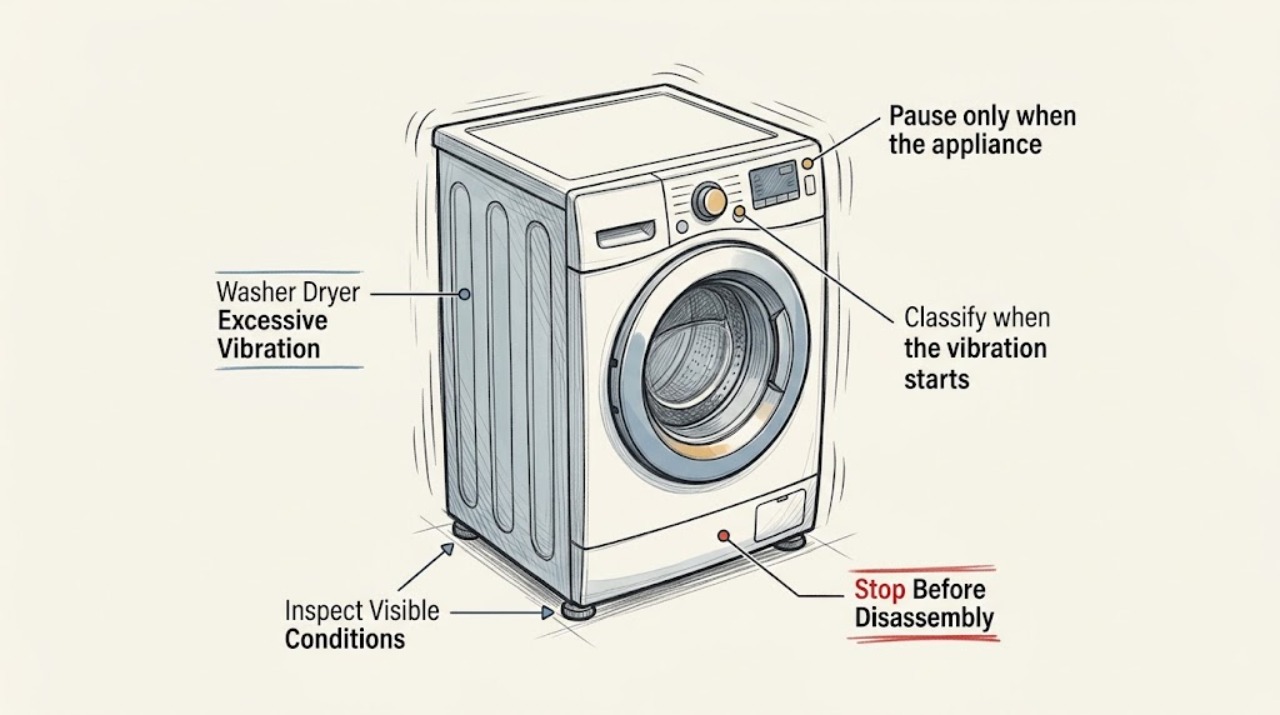
Work through in order
Diagnostic checks
Use only checks that match the exact appliance or system and its official guide.
-
Check 1
Stop the washer-dryer and look for immediate hazards before touching the controls or cabinet.
Expected result: Check from a safe position for walking or tipping, a leak, water near electrical parts, smoke, sparks, a burning or electrical odor, a damaged cord, or scraping that continues with drum movement.
Next step: If any hazard is present, stop using the appliance. If it is safe and the floor is dry, isolate power using the normal accessible control or disconnecting method; do not reach through water or a moving drum. Use the qualified-service path for help.
Why this matters
Why: These signs can involve fire, shock, flood, or a loose moving assembly. Continuing to run the appliance can increase the damage.
-
Check 2
Classify when the vibration starts and whether the drum is loaded.
Expected result: Record whether it occurs during wash or agitation, high-speed spin, drying, or every phase; note whether it began after installation, moving, a new floor arrangement, or a particular load.
Next step: Use the pattern to choose the next check, and record the phase, load type, and any displayed code for a technician. Do not keep repeating a hazardous cycle to reproduce the symptom.
Why this matters
Why: Vibration limited to a high-speed phase or a particular load is more consistent with balance or setup. Movement with an empty drum or in several phases makes a loose, damaged, or structural component more likely.
-
Check 3
Pause only when the appliance is stable and safely accessible, then redistribute the load.
Expected result: Remove a single heavy or bulky item, separate tangled items, and spread the remaining items around the drum. A modest mixed load is preferable to one item or a tightly packed bundle; do not exceed the appliance's own load guidance.
Next step: Run no more than the appliance's normal correction cycle when there is no stop condition. If vibration returns with ordinary balanced loads, stop testing and continue with installation checks or service.
Why this matters
Why: If the vibration drops after redistribution, the original load was likely unbalanced. If the cabinet still shakes or walks, the load was not the only cause.
-
Check 4
If the appliance was recently installed or moved, inspect the accessible rear and base area for shipping restraints or packing material without tilting the unit alone.
Expected result: Look for shipping bolts, a shipping block, or other transport packing that the installation instructions say should have been removed. Do not remove an unfamiliar fastener or reach behind an energized appliance.
Next step: Stop using the appliance and follow the exact model's installation instructions or arrange qualified installation service for removal. Get assistance for moving or unpacking a heavy unit; do not tip it alone.
Why this matters
Why: Transport restraints left in place can prevent normal tub movement and create severe vibration or damage. Their presence also means the installation is incomplete.
-
Check 5
Check external stability: floor, feet, lock nuts, and clearance, without opening the cabinet.
Expected result: With the drum empty and the appliance off, look for a flexing or sloped floor, a foot not contacting the floor, a loose lock nut, or a cabinet touching a wall or nearby object. A gentle diagonal rock test should not show cabinet movement; do not push a stacked unit or use improvised shims or weights.
Next step: Use only the external leveling adjustment described for the exact model, then secure the lock nuts. If the floor is flexible, the unit cannot be leveled, or a stacked arrangement has shifted, stop and arrange installer or qualified service support.
Why this matters
Why: A solid level floor and four contacting feet reduce cabinet movement. Wall contact, sliding feet, or an unstable floor can amplify normal vibration. A failed empty-drum stability check points to setup or service rather than another load adjustment.
-
Check 6
Perform a short manufacturer-approved test only after the appliance is stable and no hazard is present.
Expected result: Use the exact model's installation or test-cycle instructions with a light, normal load. Observe filling, vibration, and draining from outside; stop immediately if the unit leaks or vibrates excessively.
Next step: Record the phase, load, floor condition, and result. If vibration remains with a balanced load or empty drum, stop using the appliance and provide those observations to qualified service; do not disassemble it or bypass a safety control.
Why this matters
Why: A safe test can distinguish a corrected setup issue from vibration that persists under ordinary conditions. A failed test after load and leveling checks supports a service diagnosis.
Use your observations
Decision map
Find the observation that best matches what you see, then follow the next safe action.
-
PATH 01Safety boundary
What you see
Vibration appears only with one bulky, single, tangled, or uneven load.
Do this next
Pause safely, redistribute or remove the problematic item, and use the appliance's load guidance.
Why this path and its safety boundary
Safety stop: If ordinary balanced loads still move the cabinet, follow the level and empty-drum checks.
-
PATH 02Safety boundary
What you see
The symptom began after installation, relocation, or stacking.
Do this next
Stop repeated cycles and verify shipping restraints, floor stability, leveling, wall clearance, compatibility, and the required stacking kit from the exact installation instructions.
Why this path and its safety boundary
Safety stop: If the setup is correct but the machine still shifts, arrange service rather than moving a heavy or stacked unit alone.
-
PATH 03Safety boundary
What you see
The empty drum still produces strong vibration, grinding, scraping, or repeated knocking.
Do this next
Stop using the appliance and document the phase and sound from outside.
Why this path and its safety boundary
Safety stop: If the empty-drum check is quiet and stable, a load or external setup issue remains more likely.
-
PATH 04Safety boundary
What you see
The unit rocks diagonally, a foot slips, the floor flexes, or the cabinet touches a wall.
Do this next
Stop operation and correct only accessible leveling and clearance points allowed by the exact model instructions.
Why this path and its safety boundary
Safety stop: If external stability is sound, continue only with a safe manufacturer test and service escalation for persistent vibration.
-
PATH 05Safety boundary
What you see
A stacked washer-dryer shifts, lacks a known compatible kit, or cannot be moved safely.
Do this next
Do not push, separate, or re-stack the appliances alone; keep them out of service if they are unstable.
Why this path and its safety boundary
Safety stop: If the stack is stable and correctly installed, diagnose the load and leveling pattern while observing stop conditions.
-
PATH 06Safety boundary
What you see
Vibration is accompanied by leaking, water near electrical parts, smoke, burning odor, sparks, a damaged cord, or visible damage.
Do this next
Stop immediately and do not run another cycle or repeatedly reset power.
Why this path and its safety boundary
Safety stop: If no hazard is present, continue only with the low-risk external checks above.
Helpful context
Understand the symptom
Excessive vibration is most often a stability problem that changes with the load, installation, or floor. Treat a machine that moves across the floor as a stop condition, not as a noise to ignore. Never reach into a moving drum, hold the cabinet while it is spinning, or open the cabinet to inspect a moving part.
The useful dividing line is whether the vibration follows an uneven load or remains with the drum empty. Load-dependent movement points first to distribution and setup. Empty-drum vibration, new grinding or scraping, or a machine that has shifted after a move points toward a structural or mechanical fault that needs service.
Safety boundary
Stop conditions
- Stop immediately for walking, tipping, a leak, water near electrical parts, smoke, sparks, burning or electrical odor, a damaged cord, or visible cabinet, door, floor, or hose damage.
- Do not reach into a moving drum, hold the cabinet during spin, bypass a door or balance control, or repeat a hazardous cycle to reproduce the symptom.
- Do not tilt or move a heavy or stacked washer-dryer alone, open the cabinet, remove unfamiliar fasteners, work on live wiring, or handle refrigerant or gas components.
- Do not use improvised weights or shims, force a door or stack apart, or operate a stack that has shifted or lacks a verified compatible installation kit.
Only after diagnosis
Potential parts
- suspension or shock-absorber assembly
Consider only if vibration persists with a balanced or empty drum after safe installation checks and a technician confirms worn damping components.
Do not order by symptom alone; fit depends on the exact appliance model and revision. - drum support or bearing assembly
Consider only for persistent empty-drum movement, rough rotation, or grinding confirmed by qualified service.
A technician should identify the failed assembly and verify model compatibility before replacement. - leveling foot or approved stacking kit
A damaged foot or an incomplete stack installation can destabilize the cabinet, but floor and kit compatibility must be checked first.
Use only the part or kit specified for the exact model and configuration; do not substitute an improvised spacer.
When checks do not resolve it
Need a professional?
Call qualified appliance service when vibration persists with a balanced ordinary load or an empty drum, or when it is paired with grinding, scraping, repeated knocking, or a loose-feeling cabinet., Use installer or qualified service support for shipping-restraint removal, a flexing or unsuitable floor, an unstable stacked arrangement, or any task requiring the appliance to be moved or opened., Escalate urgently for smoke, sparks, burning or electrical odor, a damaged cord, flooding, or water near electrical parts; do not restart the appliance while waiting.
Have this ready
- The full model and serial information, if safely visible
- Whether the unit is standalone or stacked and whether it was recently installed or moved
- The cycle phase, load type, empty-drum result, and whether redistribution changed the symptom
- Floor and leveling observations, wall clearance, shipping-restraint status, displayed codes, leaks, sounds, and any visible damage
Common questions
FAQ
Why does my washer-dryer vibrate only during spin?
High-speed spin magnifies an uneven load and any leveling or floor problem. Pause only when stable, redistribute the load, and check the feet and floor. If a normal balanced load still makes the cabinet move, stop and arrange service.
Can shipping bolts cause severe vibration?
Yes. Shipping restraints or packing left after installation or a move can interfere with normal tub movement. Do not keep running the appliance; use the exact installation instructions or qualified installation support.
Should I run an empty cycle to test the vibration?
Only a short manufacturer-approved test is appropriate after the appliance is stable and no hazard is present. Stop immediately for a leak, strong movement, smoke, odor, sparks, or scraping, and do not repeat a dangerous test.
When is vibration a repair issue rather than a load issue?
Treat it as a repair or installation issue when it persists with an empty or balanced drum, begins after moving, includes grinding or scraping, or occurs with an unstable stacked arrangement.
Read the exact guide
Official sources
- LG Washer – Troubleshooting Vibration IssuesLG USA Support · Manufacturer guidance on washer and washer-dryer vibration, load balance, shipping hardware, and leveling
- LG Washer – How to Stack An LG Washer and DryerLG USA Support · Manufacturer guidance on stacked washer-dryer safety, floor stability, clearance, compatibility, and stacking kits
- [LG Front Load Washer] How do I run a test cycle after installation?LG USA Support · Manufacturer test-cycle and stop guidance for washer installation, vibration, and leaks
Community feedback
Share a repair observation
Share a plain-text repair observation. Accepted observations are published automatically; this page may take a moment to update.