
On this page
Start here
Quick answer
An LG washer dryer can vibrate excessively when shipping hardware is still fitted after installation, laundry is uneven or bulky, the appliance is not level, the floor is unstable, or the cabinet is touching something nearby. Pause the cycle, keep clear of the moving drum, check for an immediate safety hazard, redistribute the load when the drum has stopped, and check stability and visible installation hardware from the outside. Use the exact model instructions for any shipping-hardware check; do not remove covers or tilt a heavy appliance alone. If severe movement, smoke, a burning smell, a damaged cord, a leak near electrics, or persistent vibration remains after safe load and leveling checks, stop and arrange qualified service.
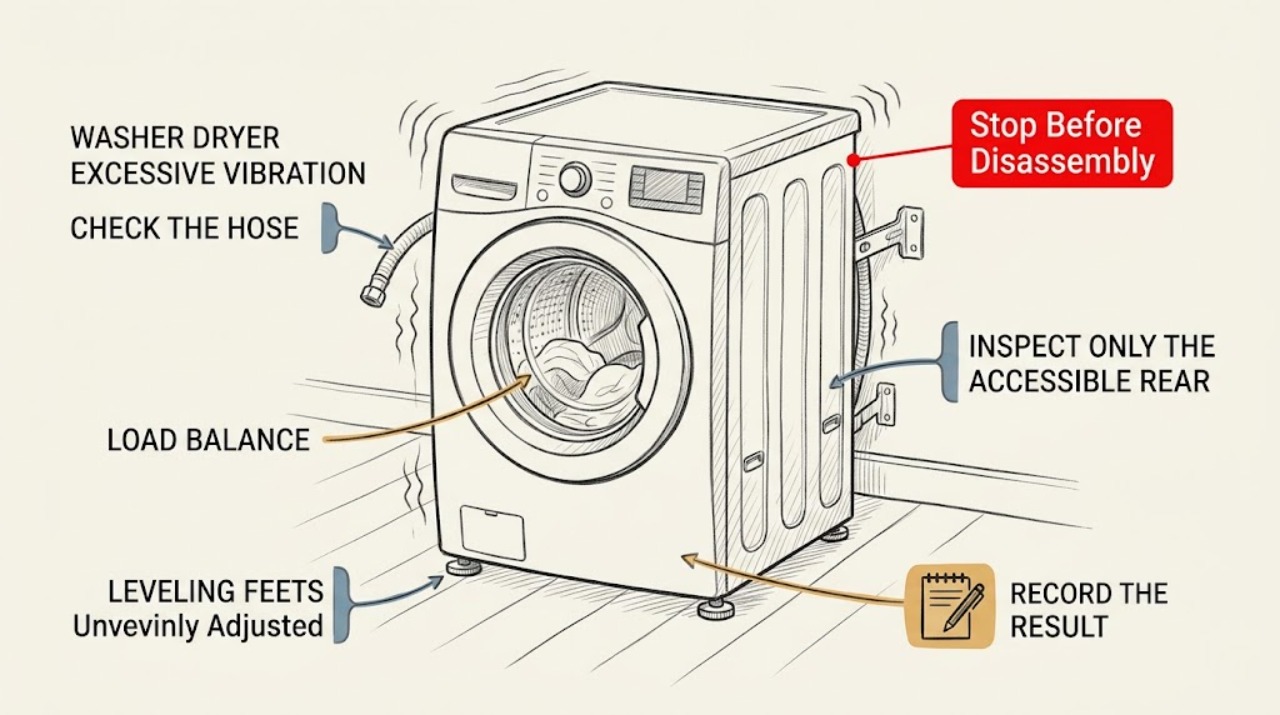
Work through in order
Diagnostic checks
Use only checks that match the exact appliance or system and its official guide.
-
Check 1
Pause the cycle and wait until the drum has completely stopped before approaching the appliance. From outside, check for smoke, a burning or electrical smell, a damaged cord or plug, a leak near electrical parts, a loose hose, or movement that has struck a wall or damaged the cabinet. Keep hands away from the drum and do not try to hold the machine still while it spins.
Expected result: A fire, electrical, water, hose, or severe-movement hazard is present, or the washer dryer is dry, intact, and safe to inspect externally.
Next step: If a hazard is present, stop using the appliance and isolate power or water only when this can be done without touching water or damaged parts; arrange qualified appliance or electrical service. If there is no hazard, continue with the installation and load checks below.
Why this matters
Why: A safety hazard takes priority over diagnosing an unbalanced load. Continuing a cycle or touching damaged parts can worsen the damage or expose someone to electricity or moving machinery.
-
Check 2
If the problem began after installation or a move, inspect only the accessible rear and packaging areas for shipping bolts, spacers, or packing material that the installation instructions say must be removed. Do not remove a cover or reach into the cabinet. Do not tilt or lift a loaded washer dryer alone; if the hardware cannot be identified or safely handled, stop and arrange installation or service help.
Expected result: Shipping hardware or packing is visibly still present, or the installation is complete and no such material is visible externally.
Next step: When the exact model instructions clearly identify the hardware and removal can be done safely, follow those instructions before another spin. Otherwise leave the appliance in place and arrange qualified help; do not improvise a removal method.
Why this matters
Why: Shipping restraints can prevent the tub from moving as designed and produce strong vibration after installation. If no restraint is present, the next high-value checks are level, floor, and load balance.
-
Check 3
With the washer dryer empty or safely stationary, press the cabinet gently at diagonal corners from the outside and look for rocking. Confirm all feet contact a solid, level floor and that no nearby cabinet, wall, drain hose, or loose object is touching the machine. Adjust leveling feet only as described by the model instructions, then secure any lock nuts if the instructions specify them.
Expected result: The cabinet rocks, a foot is not firmly planted, the floor flexes, or a nearby contact is visible; alternatively, the cabinet is stable and clear.
Next step: Correct only a safe, accessible external contact or leveling adjustment allowed by the model instructions. If the floor cannot support the appliance or leveling would require unsafe lifting or tilting, stop and arrange qualified help; if stable, proceed to the load check.
Why this matters
Why: An unlevel or unstable installation can amplify spin forces and make normal drum movement appear as banging or walking. A stable, clear cabinet makes load distribution and internal service causes more likely.
-
Check 4
When the drum is stopped, open the door and inspect the load. Look for one heavy item, a single bulky item, waterproof material, or clothes twisted into one dense bundle. Remove or rearrange items according to the model instructions, keep the load appropriate for the selected cycle, and close the door before restarting.
Expected result: The load is concentrated, bulky, or tangled, or it is distributed and suitable for the selected cycle.
Next step: Redistribute or reduce the load, then use a suitable rinse-and-spin or comparable model-supported cycle while observing from a safe distance. If the same severe movement returns with a balanced light load, continue to the object and service checks.
Why this matters
Why: A one-sided or heavy load can keep the drum from balancing and cause vibration during spin. If the load is already suitable, rearranging it is unlikely to be the complete fix.
-
Check 5
If there is rattling or a repeated knock, stop the appliance, disconnect it before any cleaning or non-operating inspection, remove laundry, and turn the drum only by hand if it can be done without force. Check pockets and look for a visible foreign object or a safe external object touching the cabinet. Do not remove panels or reach behind the drum to retrieve a trapped object.
Expected result: A visible object or contact is found and the noise changes after it is safely removed, or no object is visible and the sound remains.
Next step: Remove only a loose, accessible object and keep the appliance disconnected until the inspection is complete. If an object is trapped, the noise is harsh, or the noise remains, stop troubleshooting and arrange service.
Why this matters
Why: Coins, fasteners, or other foreign objects can rattle and may prevent normal drum motion, but an object that is trapped behind a drum or panel requires a service procedure. Persistent noise without a visible cause is not proof of a particular part failure.
-
Check 6
After the safe external checks, run one model-supported light rinse-and-spin or test cycle only if there is no hazard and the appliance is stable. Observe whether the vibration follows a particular load stage, whether the cabinet remains in place, and whether the drain completes normally. Do not stand over the machine or bypass a lock or safety control.
Expected result: The test is stable after the load, level, or installation correction, or severe vibration returns despite those corrections.
Next step: If stable, monitor the next normal load and keep the installation instructions available. If vibration returns, stop using the washer dryer and request qualified service; provide the model identity, load, cycle, installation history, and checks that changed or failed.
Why this matters
Why: Improvement after a specific correction supports an installation or load-balance cause. Repeated severe vibration with a stable, correctly loaded unit suggests a suspension, damper, mounting, sensor, or control diagnosis that cannot be confirmed by sound or movement alone.
Use your observations
Decision map
Find the observation that best matches what you see, then follow the next safe action.
-
PATH 01Next step
What you see
The washer dryer was recently installed or moved and shipping bolts, spacers, or packing may remain
Do this next
Follow the exact model installation instructions or arrange qualified help to verify and remove the restraint safely. Do not tilt a loaded unit alone or improvise around an unidentified fastener.
-
PATH 02Next step
What you see
Vibration improves after a concentrated, bulky, or tangled load is paused and redistributed
Do this next
Use load and cycle guidance for future washes, avoid restarting an obviously one-sided load, and monitor whether the machine stays stable with a suitable load.
-
PATH 03Next step
What you see
The cabinet rocks, a foot is not firmly planted, or the machine touches a wall or another object
Do this next
Correct only the safe external contact or leveling adjustment allowed by the model instructions. Arrange qualified help if the floor or appliance cannot be stabilized without lifting or tilting.
-
PATH 04Next step
What you see
Rattling or knocking remains after laundry is removed, with no loose external object visible
Do this next
Keep the appliance disconnected for inspection and arrange service if the object is trapped or the noise persists. Do not open panels or diagnose a part from sound alone.
-
PATH 05Next step
What you see
Smoke, burning smell, damaged power parts, a leak near electrics, severe movement, or a loose hose is present
Do this next
Stop the cycle and stop using the appliance. Isolate power or water only when safe to do so without touching damaged or wet parts, then arrange qualified service.
-
PATH 06Next step
What you see
Shipping hardware, level, floor, load, and visible contact checks are satisfactory but severe vibration returns in a safe test
Do this next
Stop repeated test cycles and request qualified LG or appliance service. Give the technician the full model identity, installation history, cycle, load, and the observed result of each check.
Helpful context
Understand the symptom
What excessive movement usually means
A short, controlled movement during a spin can differ from a cabinet that walks, bangs, or repeatedly strikes a wall. For LG washer and washer-dryer products, the useful first split is whether the unit was recently installed, whether the load is concentrated or bulky, and whether the appliance rocks on its floor. Those observations change the next check; vibration alone does not identify a failed part.
Keep the check external and safe
Do not reach into a moving drum, pull a loaded appliance, remove cabinet panels, or perform live electrical tests. Stop for smoke, a burning or electrical smell, a damaged plug or cord, a leak near electrical connections, or movement severe enough to damage the hose, wall, or appliance. If the unit cannot be made stable without lifting or tilting it safely, use qualified help.
When a service diagnosis is the right next step
If shipping hardware, floor stability, leveling, load distribution, and visible external contacts have been checked but the washer dryer still vibrates severely, the remaining causes may involve suspension, damping, mounting, sensing, or control components. LG's guidance uses a test cycle as a confirmation step and directs the owner to service when vibration continues. Record what changed and give that information to the technician instead of selecting a part from the symptom alone.
Only after diagnosis
Potential parts
- leveling foot or lock-nut hardware
Consider this category only when the appliance cannot remain level after the model-directed external adjustment and qualified service confirms damaged or missing leveling hardware.
Feet and lock hardware vary by model and cabinet design. Confirm the full model identity and diagnosis before selecting a replacement. - drum suspension or damper assembly
Consider this category only after qualified service confirms abnormal tub movement with shipping hardware, level, floor, and load causes ruled out.
Suspension and damper assemblies are model-specific and may require cabinet access. Do not disassemble the appliance based on vibration alone. - vibration sensor or control diagnosis
Consider this category only when qualified service finds a sensing or control fault that causes repeated imbalance handling despite a stable installation and suitable load.
Sensor and control compatibility is model-specific. A service diagnosis and exact model information are required before any part decision.
When checks do not resolve it
Need a professional?
Stop and seek professional help for smoke, burning or electrical smell, damaged cord or plug, a leak near electrics, severe movement, a loose hose, an object trapped behind the drum, or vibration that returns after safe load, leveling, floor, and shipping-hardware checks.
Have this ready
- Provide the full model identity, whether the unit was recently installed or moved, the cycle and load, when vibration starts, whether the cabinet walks or strikes anything, floor and leveling observations, shipping-hardware result, any noise or leak, and what changed after redistribution or a test cycle. Do not remove covers or bypass safety controls.
Common questions
FAQ
Why does my LG washer dryer shake violently during spin?
The common safe checks are shipping hardware after installation, an uneven or bulky load, an unleveled or unstable floor, and contact with nearby objects. Pause until the drum stops, redistribute a suitable load, and check stability from the outside. Persistent severe movement needs service.
Should I remove the shipping bolts from an LG washer dryer?
Shipping restraints must be handled according to the exact model installation instructions. If the hardware is unidentified, inaccessible, or would require unsafe lifting or tilting, leave it in place and arrange qualified help rather than improvising.
Can an unbalanced load cause an LG washer dryer to vibrate?
Yes. A single heavy item, bulky item, or tangled bundle can concentrate weight on one side of the drum. Pause the cycle after the drum stops, rearrange or reduce the load according to the model instructions, and test only when the appliance is stable and hazard-free.
When should I stop troubleshooting excessive vibration?
Stop for smoke, burning smell, damaged power parts, a leak near electrics, severe movement, a loose hose, or an object trapped behind the drum. Also stop repeating test cycles when safe installation and load checks do not correct the vibration; arrange qualified service.
Read the exact guide
Official sources
- LG Washer – Troubleshooting Vibration IssuesLG USA Support · LG washers and washer-dryer combos; installation, floor, leveling, load, and shipping-material guidance
- LG Washer – Troubleshooting Vibration Issues on an LG Washing MachineLG USA Support · LG washers and washer-dryer combos; shipping bolts, load balance, leveling, and service guidance
- LG Washer - Troubleshooting Noises During the CycleLG USA Support · LG washers and washer-dryer combos; noise, foreign-object, load, and level checks
- [PS Guide] LG Washer - My Washing Machine Makes a Rattling Noise and the Tub Does Not SpinLG USA Support · LG washers; foreign-object checks and the boundary for requesting service
Community feedback
Share a repair observation
Share a plain-text repair observation. Accepted observations are published automatically; this page may take a moment to update.