
On this page
Start here
Quick answer
The GE GUD27ESSM1WW is a stacked laundry-center model in the GUD27ES family, and wet clothes after washing do not by themselves identify one failed part. The owner's manual says the washer may pause during spin while removing soapy water, but it also directs you to check the visible drain hose when water will not drain, use Drain & Spin for an out-of-balance wet load, and check the lid-lock indicator. First let the normal drain/spin transition finish without advancing the timer, then note whether water remains, whether the lid is closed and locked, and whether Spin or Rinse lights blink. If water remains, inspect only the visible hose routing and household drain; if the load is drained but wet, redistribute it and run Drain & Spin once. Stop and arrange qualified GE service if the lid will not register, the basket never spins after draining, a pump only hums, the unit bangs or walks, or the stacked appliance leaks or shows electrical damage.
Before you begin
Safety first
- Do not open the stacked cabinet, remove internal hoses, test live terminals, bypass the lid lock, reach into a moving basket, or move the unit alone to access the rear. Disconnect power before any qualified service; pressing Power or Start does not isolate the appliance.
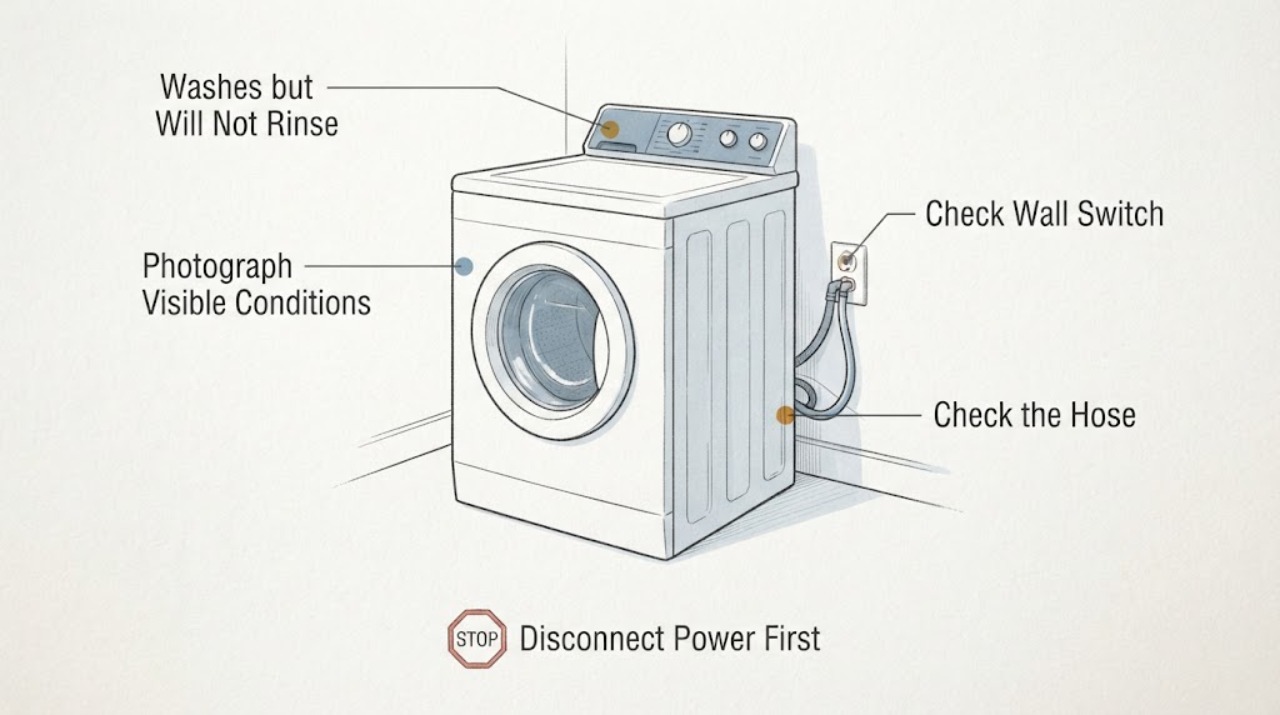
Work through in order
Diagnostic checks
Use only checks that match the exact appliance or system and its official guide.
-
Check 1
Stop changing the selector while the washer is transitioning from wash or rinse. Wait until the basket is still and the normal drain/spin phase has had time to operate, then photograph the exact model label, the selected cycle, and every illuminated or blinking status light. Do not reach into the basket while it moves.
Expected result: The washer resumes spinning after a pause; Spin remains lit or blinking; Rinse and Spin blink together; the lid-locked light is active; or the cycle stops with water still present.
Next step: Record the pattern before selecting another cycle. If the washer completes spin, monitor one load; if it stops with water or a recurring light pattern, continue with the visible drain and lid checks below.
Stop if: Do not manually advance the timer, open the lid while locked, or repeatedly restart a washer that remains full.
Why this matters
Why: The manual describes pauses during spin as potentially normal, but a persistent light pattern or retained water changes the next check from timing to drain, balance, water-entry, or lid-lock evidence. A matching report for this model also describes Rinse/Spin blinking with a failed drain attempt.
-
Check 2
With the washer off and the basket still, look at the visible drain hose behind the stacked unit without moving the appliance. Check for a sharp kink, crushing, a hose lying under the unit, an unsecured end, or a standpipe arrangement that does not match the installation instructions. Observe the household drain for backup; do not disconnect a hose containing water.
Expected result: The hose is kinked or crushed, the standpipe or drain backs up, the hose routing looks correct, or water remains even though the external path looks clear.
Next step: Correct only a plainly visible routing problem without pulling the stacked unit, then use one model-approved Drain & Spin observation if the floor is dry. If water remains or the household drain backs up, stop and arrange appliance or plumbing service.
Stop if: Do not enter standing water, pull the stacked unit away from the wall alone, remove internal hoses, or open the cabinet to reach the pump.
Why this matters
Why: GE's manual lists a kinked or improperly connected drain hose as a cause of failure to drain and separately says a clogged household drain may require a plumber. A clear visible hose does not rule out a pump, internal hose, lid-lock, or control problem.
-
Check 3
Check the lid and its visible closure area. Confirm the lid is fully closed and the Lid Locked light responds normally; look only for a garment or debris preventing closure and do not press, tape, or hold the lock switch. If the Lid Locked light has flashed after three cycles without the lid being opened, open and close the lid normally before starting another cycle.
Expected result: The lid closes and locks, the Lid Locked light stays lit or flashes, the lid does not register, or the bumper/strike appears damaged.
Next step: Clear only a visible obstruction and close the lid normally. If it still will not lock or the problem returns, keep the washer out of service and arrange qualified GE service rather than bypassing the interlock.
Stop if: Do not run with the lid open, hold the lid switch down, pry the lid, or remove the lid-lock mechanism.
Why this matters
Why: The manual says the lid must be closed for agitation and spinning, and specifically says a flashing Lid Locked light after three cycles can prevent another cycle until the lid is opened and closed. A lid that looks closed but does not register leaves the interlock and control path for service diagnosis.
-
Check 4
If the basket has drained and the lid opens normally, remove or redistribute only the load you can safely handle. Separate one heavy or tangled item from the rest, load clothes loosely below the basket's top row of holes, and select the model's Drain & Spin cycle once. Do not add more clothes to force balance.
Expected result: The basket reaches a stable high-speed spin after redistribution; Spin remains blinking or lit at the end; the washer bangs or walks; or the clothes remain wet although water leaves.
Next step: If one balanced Drain & Spin resolves the wet load, use the correct load size and cycle next time. If the condition recurs, stop repeating cycles and request service for suspension, sensing, drive, or control diagnosis.
Stop if: Stop immediately for violent movement, impact, damaged hoses, a leak, metal scraping, or a stacked unit that shifts.
Why this matters
Why: GE's manual identifies an out-of-balance condition as a reason Spin may blink and says a wet load should be redistributed and run through Drain & Spin. Repeated imbalance, severe movement, or wet clothes after confirmed draining points beyond a simple load correction.
-
Check 5
If the washer fills or washes but appears not to rinse, check the two household water valves and the visible inlet hoses from a dry position. Confirm both valves are open and hoses are not kinked, then note whether Wash and Rinse lights blink together or whether the washer never receives rinse water. Do not loosen pressurized connections or remove inlet screens as a first step.
Expected result: One valve is closed, a hose is kinked, Wash/Rinse lights blink with no water entering, or water enters but the washer later remains full and wet.
Next step: Correct only an obvious valve or hose position and wait out the documented lockout rather than unplugging to bypass it. If the washer still will not rinse or later will not drain/spin, arrange service with the light pattern and timing.
Stop if: Stop for a leaking or burst hose, water near electrical equipment, a valve that will not close, or any need to open the water system or cabinet.
Why this matters
Why: The manual associates Wash/Rinse blinking with water not entering and a temporary four-minute lockout; a normal fill shifts attention back to drain, lid, balance, or spin rather than the supply valves.
-
Check 6
If the controls appear frozen and the washer is empty of unsafe standing water, use the manual's single reset: disconnect the washer from power for 2 minutes, reconnect it, and press Start. In an apartment or stacked installation, do this only from a safe, dry access point; the Power or Start button alone is not a service isolation step.
Expected result: The washer completes one rinse/spin after the reset, remains unable to drain or spin, or repeats the same light pattern.
Next step: Do not keep resetting. Arrange qualified GE service and provide the model, cycle, light pattern, water observation, hose check, load condition, and reset result.
Stop if: Do not restore power for live testing, enter service mode, remove panels, or order a part from the symptom alone.
Why this matters
Why: A one-cycle recovery can clear a transient control state, but it does not prove the pump, lid lock, drive, wiring, or control is healthy. A repeated wet load after a reset is a service condition.
Use your observations
Decision map
Find the observation that best matches what you see, then follow the next safe action.
-
PATH 01Safety boundary
What you see
The washer is full or visibly retains water after wash/rinse, the pump only hums, or Rinse and Spin lights blink during the failed transition.
Do this next
Keep the washer off, inspect only the visible drain hose and household drain, and arrange appliance service if the path is clear or water remains. Use plumbing service when the household drain backs up.
Why this path and its safety boundary
Why it matters: This pattern puts incomplete draining ahead of a spin-part diagnosis. The matching model report describes the same rinse-to-drain failure pattern, but does not establish a confirmed repair.
Safety stop: No full-tub hose disconnection, pump removal, cabinet opening, or repeated Drain & Spin attempts.
-
PATH 02Next step
What you see
The washer drains, the lid locks normally, the load is visibly tangled or heavy, and one redistributed Drain & Spin cycle extracts the water without violent movement.
Do this next
Use the correct load size and distribute items loosely. Monitor the next normal cycle and request service if Spin lights recur or clothes remain wet after a balanced load.
Why this path and its safety boundary
Why it matters: The result is consistent with GE's documented out-of-balance wet-load branch rather than proof of a failed drive component.
-
PATH 03Next step
What you see
The lid does not register as closed, Lid Locked flashes after three cycles without an intervening lid opening, or the washer will not spin despite a drained, balanced load.
Do this next
Open and close the lid normally once if the manual's three-cycle indicator applies; otherwise keep the unit off and arrange qualified diagnosis. Do not bypass the lid lock.
Why this path and its safety boundary
Why it matters: The safety interlock or its feedback can block agitation or spin. A lid that appears closed is not enough to identify whether the lock, wiring, or control is at fault.
-
PATH 04Next step
What you see
Both water valves are open and the hoses are visibly sound, but Wash/Rinse lights continue blinking or rinse water never enters; or the washer repeatedly returns to rinse without completing drain/spin.
Do this next
Stop using the washer and give service the exact model, lights, timing, water level, and whether the pump hums or drains. Do not use a different GE diagnostic sequence.
Why this path and its safety boundary
Why it matters: The simple supply check did not explain the symptom. The remaining possibilities include inlet sensing, drain state, lid feedback, control, or another model-specific fault, and the light pattern alone does not select a part.
-
PATH 05Safety boundary
What you see
The washer bangs, walks, makes harsh mechanical noise, leaks near electrical equipment, smells burnt, trips power, or the stacked unit shifts.
Do this next
Stop the appliance and keep people clear. Isolate power or water only from a safe dry position and arrange urgent qualified appliance service; seek emergency help for active fire or immediate electrical danger.
Why this path and its safety boundary
Why it matters: The event has crossed the ordinary wet-load troubleshooting boundary and may create mechanical, water, fire, or electrical risk.
Safety stop: No restart, live test, panel removal, lid-lock bypass, or attempt to stabilize a moving stacked unit by hand.
Helpful context
Understand the symptom
This laundry center is a top-loading washer beneath a dryer, not a front-load washer. The GE manual identifies the GUD27ES family and shows Wash, Rinse, Spin, and Lid Locked status lights. A load that is full of water can therefore result from a drain path that did not clear, an out-of-balance response that prevented full-speed extraction, a lid-lock state, or a control/drive fault. The exact model label still matters because the linked manual notes that features can vary by model.
A matching public report for GUD27ESSM1WW describes a wash cycle that reached rinse, filled, sounded as if it was trying to drain, then stopped with Rinse and Spin lights blinking; the poster said Drain & Spin only hummed and that the water later drained after waiting. That is a useful symptom pattern, not proof of the cause or a confirmed repair. Treat the waiting behavior as evidence to record, not as a reason to keep restarting a full or non-draining machine.
When checks do not resolve it
Need a professional?
Call qualified GE appliance service for persistent no-rinse/no-spin, retained water, a pump that hums without draining, a lid-lock feedback problem, recurring imbalance, or a basket that does not spin after draining. Use plumbing service for a household drain backup and urgent service for leaks or electrical/mechanical hazards.
Safety scope: Do not open the stacked cabinet, remove internal hoses, test live terminals, bypass the lid lock, reach into a moving basket, or move the unit alone to access the rear. Disconnect power before any qualified service; pressing Power or Start does not isolate the appliance.
Have this ready
- Provide GUD27ESSM1WW, the country and rating-label details, selected cycle, exact status-light pattern, when wash ended, whether rinse water entered, whether the pump hummed, visible water level, drain-hose and household-drain observations, load type, lid-lock behavior, and whether one 2-minute power disconnect changed anything.
Common questions
FAQ
Why does my GE GUD27ESSM1WW wash but not rinse or spin?
Start by separating water entry from water removal. Check the status lights and whether water remains, then inspect the visible drain hose and lid closure. GE's manual also identifies an out-of-balance wet load and the wrong cycle as reasons clothes can remain wet. The symptom does not identify one replacement part.
What does a blinking Rinse and Spin light mean on this GE laundry center?
The manual specifically describes Spin and Rinse blinking as an out-of-balance response for this family, while a matching GUD27ESSM1WW report describes those lights during a rinse-to-drain failure. Check whether water remains and whether the load is balanced; use the exact model manual rather than assuming the light pattern proves one cause.
Can I run Drain & Spin with wet clothes?
Yes, when the lid opens and closes normally, the floor and connections are dry, the basket is safe to handle, and there is no uncontrolled water or severe movement. Redistribute the load first and run Drain & Spin once as the GE manual directs for a wet out-of-balance load. Stop if the washer remains full, only hums, bangs, walks, or leaks.
Should I replace the lid switch or pump first?
Not from this symptom alone. A lid that does not register can block spin, and a drain restriction or pump condition can leave clothes wet, but a matching test result is needed before selecting a part. Keep the unit off and provide the light pattern, water level, hose check, and cycle timing to qualified service.
Read the exact guide
Official sources
- GE washer will get stuck on rinse and then stopReddit r/appliancerepair · Exact Reddit post opened for the assigned model and symptom. It is used as an unconfirmed symptom pattern only, not as a diagnosis or repair result.
- Model Search | GUD27ESSM1WWGE Appliances Parts · Opened official GE Appliances Parts model page for the exact assigned GUD27ESSM1WW. It identifies the unit as a GE Unitized Spacemaker washer with electric dryer and links the owner manual, installation instructions, washer cabinet/lid, water system, tub/basket, and motor/drive sections.
- User Manual & Care for GUD27ESSMWW | GE AppliancesGE Appliances · Opened official GE Owner Center support page for the GUD27ESSMWW variant, which identifies the Unitized Spacemaker stacked washer/dryer and links the applicable owner manual; the manual's GUD27ES family includes the washer controls relevant to the assigned M1WW model.
- Owner's Manual: GE GUD27ES/GUD27EE/GUD27GE Unitized Washer-Dryer FamilyGE Appliances · Official manual opened from the GE model-support page. Its cover lists the GUD27ES family, and its washer sections document Drain & Spin, lid lock, blinking light meanings, drain-hose checks, wet clothes, and the two-minute reset.
Community feedback
Share a repair observation
Share a plain-text repair observation. Accepted observations are published automatically; this page may take a moment to update.