
On this page
Start here
Quick answer
A GE washer that appears stuck may be in a normal pause, correcting an unbalanced load, waiting to drain, or holding a control lock after an interruption. Note the stage, display message, water level, and whether the basket is spinning before changing anything. Check the lid or door, both water supplies, the drain hose, load balance, and accessible power; do not force a locked lid or door. If the model allows a control reset, follow its manual exactly and perform it only once. A recurring fault, standing water, repeated breaker trip, critical water-level message, burning smell, leak, or cycle that still stops after safe checks needs qualified service. Exact GE behavior and messages vary by model.
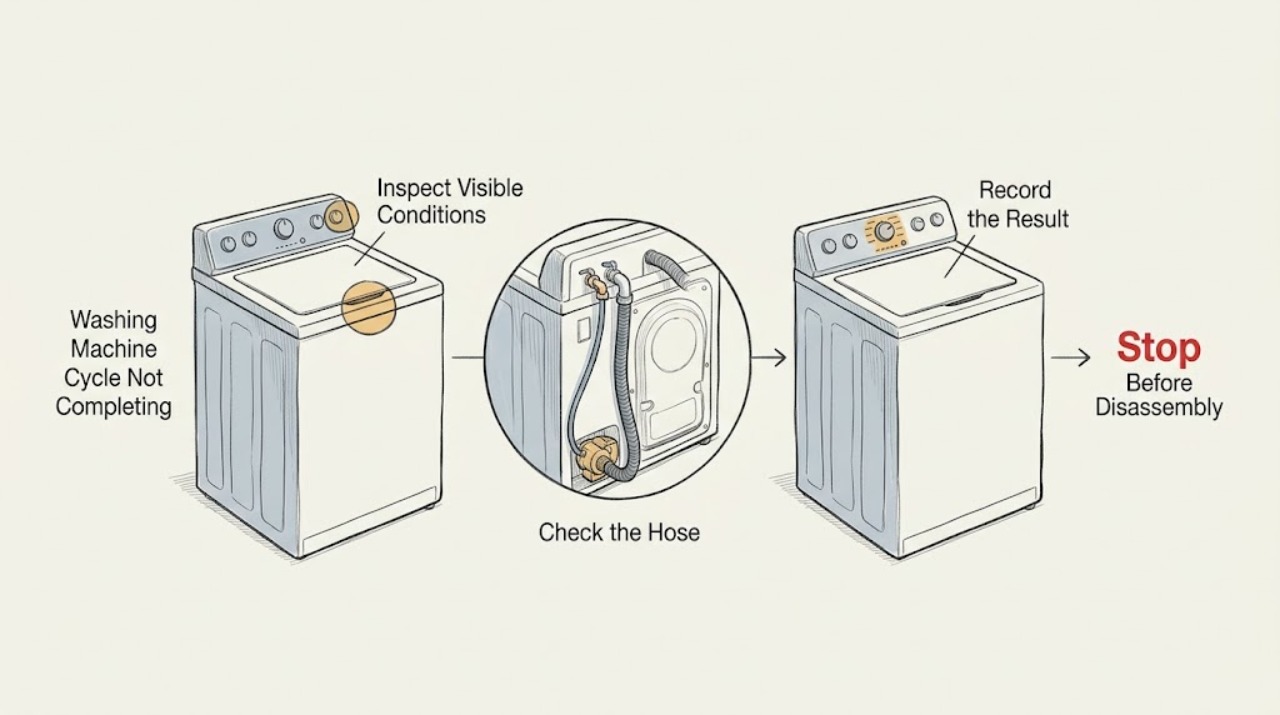
Work through in order
Diagnostic checks
Use only checks that match the exact appliance or system and its official guide.
-
Check 1
Observe the washer without opening a moving lid or door: record the selected cycle, the last stage shown, remaining time or indicator, whether water is visible, and whether the machine is silently paused, pumping, or attempting to spin; allow a model-normal pause to finish before intervening.
Expected result: The washer resumes after a short pause, repeatedly pumps and spins, remains paused with no change, or stops at the same stage every time.
Next step: Write down the exact stage and display state, then continue to the matching water, drain, lid, and load checks without manually advancing the timer.
Stop if: Stop for smoke, burning odor, a leak, a hot cord or outlet, exposed wiring, or a lid or door that is damaged or unsafe.
Why this matters
Why: A short pause can be part of normal sequencing, and repeated spin attempts can occur while the washer removes water or corrects balance. A repeatable stop at one stage is more consistent with a supply, drain, lid, load, or control problem.
-
Check 2
With the washer stopped, check that the hot and cold supply valves are open, inlet hoses are not kinked, the lid or door is fully closed and unobstructed, and the displayed state does not indicate a lid, door, lock, or water-supply condition; use only the model manual for any code meaning.
Expected result: A supply valve is closed, a hose is kinked, the lid or door does not latch, an indicator identifies an open lid or missing water, or the accessible supply and closure appear normal.
Next step: Correct an obvious valve, hose, obstruction, or closure issue and restart the documented cycle once; do not bypass a lock or safety interlock.
Stop if: Stop if the door or lid is cracked, the latch is loose, water sprays from a connection, the floor is wet near electrical parts, or the lock must be forced.
Why this matters
Why: The washer cannot fill or safely enter later stages when water is unavailable or its lid or door safety state is open. A normal accessible supply and closure shift attention toward drain, balance, power, or an internal control fault.
-
Check 3
If water remains or the washer stops before spin, unplug it only as the model instructions direct and inspect the accessible drain hose for kinks, crushing, or a visible clog; confirm the household standpipe or drain accepts water without overflow, and do not disconnect a full hose without controlling the water.
Expected result: The hose is kinked or clogged, the household drain backs up, the machine drains after the obstruction is corrected, or the tub remains full and only hums.
Next step: Restore only the documented hose position and drain condition, then use the model-approved Drain & Spin or resume control once; never force the lid or door open.
Stop if: Stop for a leaking hose, standing water near electrical connections, a pump that only hums, a hot smell, or any need to open the cabinet or reach into a pump.
Why this matters
Why: A washer may not complete because it cannot remove water, and some models pause or retry spin until the basket is empty. A clear external path with a full tub or humming pump points toward service rather than more resets.
-
Check 4
After the basket is safe and the lid or door is closed as directed, pause the cycle and redistribute an obviously bunched, oversized, or single heavy item; remove excess items only if the model permits, then select the documented Drain & Spin or resume function once.
Expected result: The load is gathered to one side, the washer shakes or retries spin, a balance indicator is shown, the load is too full, or the washer remains unable to spin with a balanced load.
Next step: Run one suitable, balanced load and observe whether the machine reaches spin and completes; avoid repeatedly forcing a high-speed spin.
Stop if: Stop for severe shaking, a washer that walks, a damaged tub or cabinet, a loose lid or door, or a load that cannot be safely removed without moving the appliance.
Why this matters
Why: An out-of-balance condition can make the washer stop or spend extra time correcting the load. If a balanced load still stops at spin, the remaining issue may be drain, lid, motor, sensing, or control related.
-
Check 5
Check the accessible plug, outlet, and breaker without using an extension cord or opening the washer; if there was a power interruption or the controls are unresponsive, follow the exact model manual's single reset procedure, including its required power-off interval and cycle re-selection.
Expected result: The outlet or breaker is abnormal, the controls show a pause or interruption state, the washer resumes after the documented reset, or the washer still stops with normal power and controls.
Next step: Correct only an accessible supply or control state described by the manual and run one supervised cycle; do not repeatedly cycle the breaker to make the washer continue.
Stop if: Stop for repeated breaker trips, a hot outlet, damaged plug or cord, water on electrical parts, smoke, or an error that returns immediately.
Why this matters
Why: A power event or interrupted cycle can leave electronic controls locked or the cycle selection incomplete. A normal supply and a failed documented reset shift the problem toward an internal control, sensor, latch, motor, pump, or wiring fault.
-
Check 6
Arrange qualified GE appliance service when the cycle repeatedly stops after supply, lid or door, drain, balance, and documented reset checks, and provide the model and serial information, cycle, stage, display message, water level, load, and what the washer did immediately before stopping.
Expected result: The failure is repeatable or intermittent, the washer leaves water, stops with a recurring indicator, will not unlock safely, trips power, or requires access to the pump, motor, lid or door lock, wiring, sensor, or control.
Next step: Keep the washer off when the symptom is unsafe, close the water valves if a leak is suspected, preserve the displayed message, and use the model-specific service route.
Stop if: Stop use for smoke, burning odor, electrical damage, uncontrolled filling, a critical water-level message, a leak, or a forced lid or door.
Why this matters
Why: The remaining fault is model-specific and may involve a safety interlock, drain or drive system, sensor, or electronic control. A symptom does not identify a safe replacement part.
Use your observations
Decision map
Find the observation that best matches what you see, then follow the next safe action.
-
PATH 01Next step
What you see
The washer resumes after a short pause or completes after its drain-and-spin sequence without a recurring fault.
Do this next
Arrange qualified service and follow the exact model guidance.
Why this path and its safety boundary
Why it matters: Treat the delay as model-dependent operation, record the stage, and consult the exact manual rather than manually advancing the timer.
-
PATH 02Next step
What you see
A supply valve or hose is abnormal, the lid or door is not latched, or the display identifies a water or lid condition.
Do this next
Arrange qualified service and follow the exact model guidance.
Why this path and its safety boundary
Why it matters: Correct only the accessible supply, hose, obstruction, or closure issue documented for the model and run one supervised cycle.
-
PATH 03Next step
What you see
Water remains, the drain hose or household drain is restricted, or the washer repeatedly stops while trying to pump out.
Do this next
Arrange qualified service and follow the exact model guidance.
Why this path and its safety boundary
Why it matters: Restore the safe external drain path if possible; service is required when the tub remains full or the pump only hums.
-
PATH 04Next step
What you see
The load is bunched or unbalanced, the washer shakes, or an imbalance indicator appears and the machine retries spin.
Do this next
Arrange qualified service and follow the exact model guidance.
Why this path and its safety boundary
Why it matters: Redistribute or reduce the load as the model permits and monitor one suitable Drain & Spin or complete cycle.
-
PATH 05Next step
What you see
A power interruption, pause event, or unresponsive control state preceded the incomplete cycle.
Do this next
Arrange qualified service and follow the exact model guidance.
Why this path and its safety boundary
Why it matters: Follow the model-specific control reset once; if controls remain stuck or the cycle fails again, arrange service.
-
PATH 06Next step
What you see
The washer leaks, overfills, trips power, smells hot, shows a critical water-level state, or has a damaged or forced lid or door.
Do this next
Arrange qualified service and follow the exact model guidance.
Why this path and its safety boundary
Why it matters: Stop use, turn off water or disconnect power only when safe, and obtain qualified service without bypassing safety devices.
Helpful context
Understand the symptom
Do not treat every pause as a failure
A washer can pause between fill, wash, drain, and spin stages while the timer advances or the pump removes water. Some models also stop and retry spin when the load is unbalanced or water remains in the basket. Record the last completed stage and allow the model's normal pause to finish before manually advancing a dial or restarting the cycle.
Protect against water and electrical hazards
Keep the lid or door closed while the basket moves and never force a lock. If water is present, turn off the supply before handling a hose; if there is a leak, a hot or damaged cord, smoke, a burning odor, or repeated breaker trips, stop the washer and disconnect power only if safe. Do not remove panels or test a pump, motor, lid switch, or control board as an ordinary user.
Safety boundary
Stop conditions
- The washer leaks, overfills, or shows a critical water-level condition.
- Smoke, burning odor, a hot or damaged cord or outlet, exposed wiring, or repeated breaker trips is present.
- The lid or door is damaged, remains locked with unsafe contents, or would need to be forced open.
- Standing water is near electrical connections or a hose must be disconnected without controlling the water.
- The pump, motor, lid or door lock, wiring, or control would require cabinet access or live testing.
- The washer shakes severely, walks, or has a loose or damaged tub or cabinet.
Only after diagnosis
Potential parts
- drain pump or drain-hose assembly
Consider only after the external hose and household drain are clear and qualified testing confirms a pump or drain-path fault.
Verify the exact GE model and service information; do not replace a pump by symptom alone or open the cabinet as an ordinary user. - lid or door lock assembly
Consider only when the machine cannot confirm a closed and latched lid or door after external obstruction and alignment checks.
Use exact model fitment and qualified installation; never bypass the interlock. - control board or cycle-sensing component
Consider only after supply, drain, balance, lid or door, and documented reset checks fail and service diagnosis identifies the control or sensing circuit.
Confirm exact model compatibility and electrical diagnosis through qualified service before replacement.
When checks do not resolve it
Need a professional?
The cycle repeatedly stops at the same stage after the safe external checks., Water remains, the drain path is clear, or the pump only hums., A recurring indicator, critical water-level message, or unresponsive control remains after the model reset., The washer repeatedly trips power, leaks, overfills, smells hot, or cannot latch safely., Diagnosis would require access to a pump, motor, lock, sensor, wiring, or control board.
Common questions
FAQ
Why does my GE washer stop before the cycle finishes?
It may be in a normal pause, correcting an unbalanced load, waiting to drain, detecting an open lid or door, losing water supply, or holding a control state after an interruption. Note the stage and display before checking the matching branch.
How long should I wait when a GE washer pauses?
The wait is model- and stage-dependent. GE support notes that pauses of a few minutes can occur between stages and during pump-out. Do not manually advance a timer while the washer may still be draining; use the exact manual for the model.
What should I check if the tub is full of water?
Check the accessible drain hose and household drain for kinks, crushing, or backup while controlling the water safely. If the tub remains full or the pump only hums after the external check, leave the washer off and arrange service.
Can I reset a GE washer that stopped mid-cycle?
Only follow the reset sequence in the exact model manual, including its power-off interval and cycle re-selection, and try it once. Repeated resets do not repair a drain, latch, motor, sensor, or control fault and can hide a safety symptom.
When should I call for GE washer service?
Call when the washer repeatedly stops after safe supply, lid or door, drain, balance, and manual reset checks, or when it leaks, overfills, trips power, leaves water, shows a recurring message, smells hot, or requires panel access.
Read the exact guide
Official sources
- Frequently Asked Questions About GE WashersGE Appliances · Official GE support used for general washer behavior and external checks; exact controls and indicators vary by model.
- Top Load Washer - Will Not DrainGE Appliances · Official GE top-load guidance used for external drain checks and escalation; front-load and other models require their own instructions.
- Washer - Spins and Stops RepeatedlyGE Appliances · Official GE support used to distinguish a drain-related spin retry from a constant drain or spin fault.
- Washer - Consumer Help IndicatorGE Appliances · Official GE support used for examples of model-varying indicators and safe remedies; do not infer a code for a model not identified.
- Washer - Resetting the Electronic ControlsGE Appliances · Official GE support used for a model-dependent reset boundary; the exact manual controls the applicable sequence.
Community feedback
Share a repair observation
Share a plain-text repair observation. Accepted observations are published automatically; this page may take a moment to update.