
On this page
Start here
Quick answer
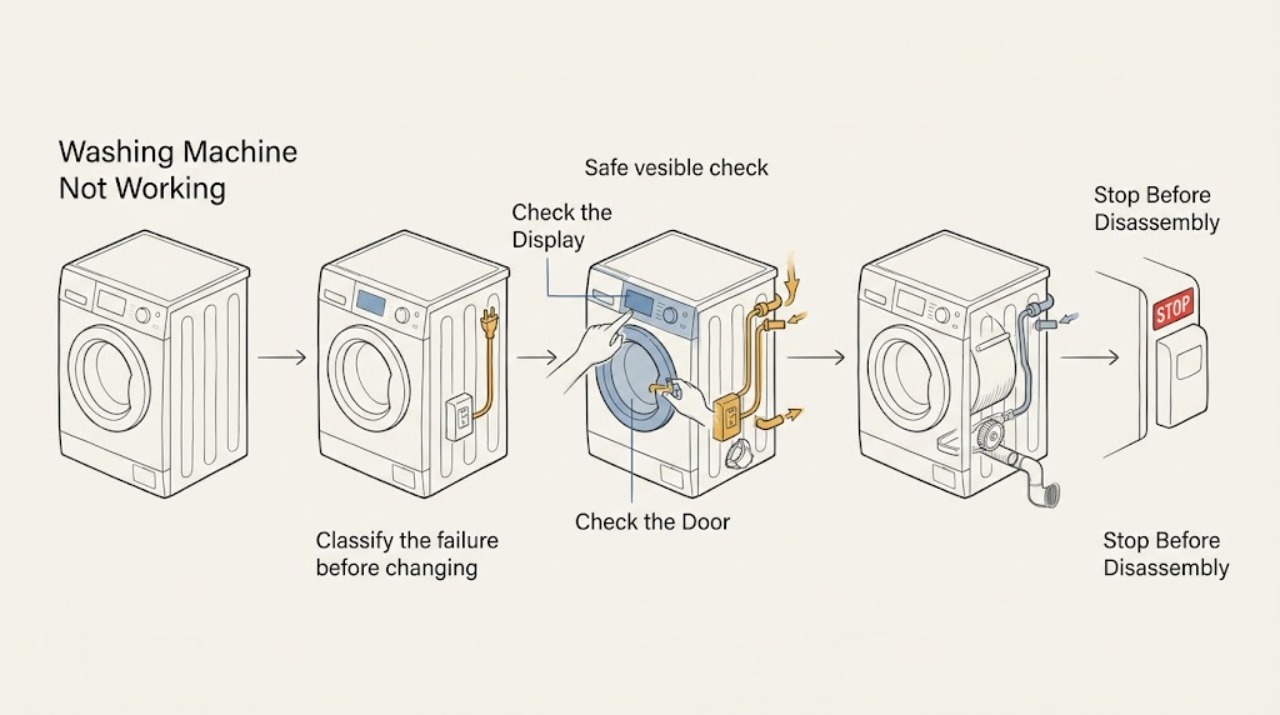
Separate a completely dead GE washing machine from one that has power but stops at a particular stage. From a dry, safe position, check the outlet, plug, breaker, controls, and lid or door closure. If it fills but does not wash, check whether the cycle is paused, the lid is closed, and the machine is level. If it will not drain, allow for a normal pause, then inspect the external drain hose and household standpipe; if it will not spin, check for a closed lid, a balanced load, and a drain problem. Stop and disconnect power when water is near an electrical connection, the cord or controls are hot or damaged, the washer leaks heavily, smells scorched, sparks, or trips the breaker again. Do not reach into a moving tub, bypass a lid or door lock, or open the cabinet.
Work through in order
Diagnostic checks
Use only checks that match the exact appliance or system and its official guide.
-
Classify the failure before changing settings
From a dry position, note whether the GE washer has any lights or display, whether it accepts button or knob input, and where the cycle stops: before filling, while filling, after filling, during agitation, during drain, or before spin. Also note whether it is top-load or front-load and whether water remains in the tub.
Expected result: The machine is completely dark, has power but will not begin, fills and stops, leaves water behind, or drains but will not agitate or spin.
Next step: Use the matching power, start, fill, drain, or movement check below. Do not run another cycle to reproduce a leak, electrical smell, violent movement, or other hazard.
Why this matters
Why: A dark machine points first to power or controls. A powered machine that stops at a stage points toward closure, water supply, drain, load balance, or drive conditions specific to that stage. Standing water makes drainage the next priority before spin diagnosis.
-
Check safe power and control response
With the washer and floor dry, confirm that the cord is firmly seated in its dedicated wall outlet and that the main control is not paused or locked. Check the household breaker or fuse visually and test the outlet only with a safe small appliance if there is no moisture or damage; do not use an extension cord or repeatedly reset a tripping breaker.
Expected result: The outlet is dead, the breaker or fuse has opened, the display stays dark despite confirmed power, or the display responds normally.
Next step: Restore a clearly switched-off breaker only once when the area and appliance are dry and there is no damage. If it trips again, the outlet is damaged, or the washer remains dead with confirmed supply, leave it disconnected and arrange qualified electrical or appliance service.
Stop if: Stop for water near the outlet, a hot or scorched cord, smoke, sparks, exposed wiring, or a breaker that trips again.
Why this matters
Why: A dead outlet or opened breaker can account for a completely unresponsive washer, while a second trip can signal an overload, short, or appliance fault. If power is present and controls respond, the failure is likely a cycle, closure, water, drain, or drive condition rather than a simple outlet problem.
-
Check the start, lid, door, and water-supply path
If the controls light, select a normal cycle and press Start or Start/Pause once. Make sure a top-load lid or front-load door is fully closed, and check that both hot and cold supply faucets are open and the inlet hoses are not visibly kinked. Do not defeat or bypass a lid or door lock.
Expected result: The washer starts filling, the controls remain paused, a lid or door does not latch, a fill indicator or water-supply message appears, or there is no water entering despite open faucets.
Next step: Correct only an obvious control or closure position and run one supervised test when there is no leak or electrical warning. If the latch will not engage, the fill fault returns, or water enters unexpectedly, stop and arrange qualified appliance or plumbing service.
Why this matters
Why: A pause, incomplete closure, or water-supply restriction can prevent a cycle from starting. A lock that will not engage is a safety-control issue. If the washer never fills while supply is available, an inlet screen, valve, control, or plumbing fault may need service.
-
If it fills but will not wash, check pause, level, and load
For a top-load washer that fills and stops, verify that the lid is closed and the cycle is not paused or in a soak period. Observe whether the washer is level and whether the load is piled heavily to one side or beyond the balance ring; redistribute the load only with the machine stopped and the lid or door open safely.
Expected result: The washer resumes after Start/Pause, the tub is visibly unbalanced, the machine rocks, the lid-sensing piece is damaged, or the motor and agitator remain silent after filling.
Next step: Level or redistribute only as described in the owner's manual, then run one appropriate cycle. If the washer still does not agitate or repeatedly stops, leave it off and arrange qualified appliance service.
Stop if: Stop if the washer shakes violently, bangs repeatedly, the lid or lock is damaged, or the tub or motor appears jammed.
Why this matters
Why: GE identifies a lid state, an unbalanced or improperly leveled machine, a paused cycle, and model-specific sensing as reasons a washer can stop before agitation or spin. A damaged lid-sensing part or silent motor after these checks is not a reason to reach inside or remove panels.
-
Separate a drain problem from a spin problem
If water remains, wait through the model's normal stage pause without manually advancing a timer. Then, with controls off, inspect the external drain hose for a kink or crushing and check whether the household standpipe or drain accepts water. On a front-load model, use the owner's manual to determine whether a pump-filter access door exists; do not open a filter or hose with a full tub unless the manual gives a safe procedure.
Expected result: The washer drains after a pause, the hose is kinked, the household drain is blocked, a front-load pump filter is accessible and blocked, or the tub stays full while the pump only hums.
Next step: Correct only an obvious external hose position or household drain issue, following the installation instructions. If water remains, the pump only hums, the filter is inaccessible, or the problem returns, keep the washer off and arrange qualified appliance or plumbing service.
Stop if: Stop for a leak, water near an electrical connection, a flooded floor, or any need to reach into a full tub or dismantle the pump path.
Why this matters
Why: A drain restriction can keep a washer from progressing to spin. GE notes that some pauses are normal, that hose or standpipe problems can stop operation, and that a full tub with only humming requires service. Pump-filter access and cleaning are model-dependent.
-
Check the no-spin conditions without touching moving parts
Once the tub is empty or the model has safely completed drain, check that the lid or door is closed, the selected cycle includes spin, and the load is not too large, too small, or gathered on one side. For a top-load display, record any SPIN, balancing, lid, or cancellation message; for a front-load model, note whether the dispenser drawer is fully closed.
Expected result: The washer pauses briefly and then spins, shows a balance or lid state, drains but the tub never turns, or the motor runs while the basket stays still.
Next step: Redistribute or adjust the load and restart once when the washer is stable and dry. If it still will not spin, keep clear of the tub and arrange qualified service.
Why this matters
Why: GE documents pauses, lid state, load balance, cycle selection, and power loss as common no-spin decision points. A motor that runs without basket movement, or a repeat no-spin condition after closure and balance checks, needs service rather than a belt or motor guess.
-
Record the model-specific message and hand off safely
Write down the exact model, washer style, displayed message or light pattern, water level, cycle stage, and what happened after each safe external check. Include whether there was a leak, wet electrical area, burning odor, smoke, spark, unusual noise, or breaker trip. Do not open the console or cabinet to identify a part.
Expected result: The same failure returns after power, control, closure, water, drain, and load checks, or a safety warning is present.
Next step: Leave the washer off and request qualified appliance service for an unresolved no-start, no-fill, no-drain, no-agitate, or no-spin fault. Use qualified electrical service for the outlet or breaker and qualified plumbing service for a blocked household drain.
Why this matters
Why: A repeatable stage-specific symptom and its display state help a qualified technician distinguish supply, lock, inlet, pump, motor, and control faults. A safety warning changes the task from troubleshooting to immediate isolation and professional inspection.
Use your observations
Decision map
Find the observation that best matches what you see, then follow the next safe action.
-
PATH 01Next step
What you see
The GE washer is completely dark, the outlet is dead, or the breaker or fuse will not remain on.
Do this next
Leave the washer disconnected and arrange qualified electrical or appliance service. Do not increase fuse protection or repeatedly reset the breaker.
-
PATH 02Next step
What you see
The controls work, but the cycle will not start and the lid or door will not latch.
Do this next
Do not bypass the safety lock. Check only that the lid or door is fully closed and unobstructed; if it still will not latch, arrange qualified appliance service.
-
PATH 03Next step
What you see
The washer shows a fill problem or no water enters while the controls work.
Do this next
Confirm both hot and cold faucets are open and the external hoses are not kinked. If the fill warning or no-fill condition persists, leave the washer off and arrange appliance or plumbing service.
-
PATH 04Next step
What you see
Water remains in the tub after the normal pause, the drain hose or household drain is restricted, or the pump only hums.
Do this next
Do not reach into the water or dismantle the pump path. Correct only a clearly visible external hose issue when safe; a full tub with humming, an inaccessible filter, or a recurring drain failure requires qualified service.
-
PATH 05Next step
What you see
The washer fills but stops before agitation, or it will not spin after draining.
Do this next
Check the pause or cycle state, lid or door closure, level, and load balance without touching moving parts. If the machine remains silent, moves violently, or repeatedly stops, arrange qualified service.
-
PATH 06Next step
What you see
The washer leaks heavily, the floor or electrical area is wet, the cord or controls are hot or scorched, there is smoke or a spark, or the breaker trips again.
Do this next
Stop the cycle and keep clear. Disconnect power only from a safe, dry location if possible; otherwise leave the area and use qualified electrical or appliance service. Do not run another test cycle.
Helpful context
Understand the symptom
Use the symptom at the point where the cycle stops
Not working is a broad symptom. A washer with no lights needs a power and control check; a washer with lights that will not start needs a setting, closure, or water-supply check; a washer that fills and stops needs an agitation or drive path check; and standing water changes the safe next step to drainage. GE notes that some models pause between stages, so a short pause is not by itself a failed cycle. Identify whether the machine is top-load or front-load before using model-specific checks.
Water and electrical safety come first
Keep the floor, plug, and controls dry. Do not pull a plug through standing water; if water is close to an electrical connection, use the electrical disconnect only when it can be reached safely and keep clear. Do not use a washer with a burning smell, smoke, sparks, a hot cord, a damaged outlet, a persistent leak, or a breaker that trips again. Internal pump, motor, wiring, lock, and control work requires qualified service.
Safety boundary
Stop conditions
- Stop if water reaches the outlet, plug, cord, controls, or another electrical connection, or if the floor is flooded.
- Stop for smoke, sparks, a burning or scorched odor, a hot or damaged cord, exposed wiring, or a breaker that trips again.
- Stop for a heavy leak, violent shaking, repeated banging, a damaged lid or door lock, a jammed tub, or a pump that only hums with water still inside.
- Do not reach into a moving or full tub, bypass a lid or door safety switch, open the cabinet, or work on the pump, motor, belt, wiring, or controls as a routine user check.
- Arrange qualified service when safe external power, control, closure, fill, drain, and load checks do not restore the cycle or the same failure returns.
Only after diagnosis
Potential parts
- lid or door lock assembly
Consider this only when a qualified diagnosis confirms that the washer has correct power and controls but the safety lock does not detect a properly closed lid or door.
Lock assemblies vary by washer style and exact model; confirm manufacturer fit information before ordering or installing. - water inlet valve
Consider this only if supply faucets and hoses are correct and a qualified diagnosis isolates a persistent no-fill condition to the appliance inlet valve.
Verify the exact model and inlet configuration; water and electrical connections require safe qualified installation. - drain pump or pump filter
Consider this only after a qualified diagnosis or the model manual identifies a blocked or failed pump path following safe hose and household-drain checks.
Filter access and pump parts differ by model; do not order or open a full-tub pump path without model-specific instructions. - motor or drive component
Consider this only when qualified testing confirms a drive fault after power, lid or door closure, drain, load balance, and cycle checks are correct.
Drive components are model-specific and may involve moving and electrical hazards; verify exact fit and use qualified service.
When checks do not resolve it
Need a professional?
Arrange qualified GE appliance service when the washer remains dead with confirmed supply, a lid or door will not latch, a fill fault persists with open faucets, water remains after safe drain checks, the pump only hums, the washer fills but will not agitate, or it drains but will not spin. Use qualified electrical service for a dead or repeatedly tripping circuit and qualified plumbing service for a blocked household drain. Provide the exact model, washer style, cycle stage, display or light pattern, water level, and observed safety symptoms.
Common questions
FAQ
Why is my GE washing machine completely dead?
Start with a dry, safe check of the cord, dedicated outlet, household breaker or fuse, and main control state. If the outlet is dead, the breaker trips again, the cord is hot or damaged, or the display stays dark with confirmed supply, leave the washer disconnected and use qualified electrical or appliance service.
Why does my GE washer fill and then stop?
A top-load GE washer may be paused, sensing the load, waiting for a closed lid, improperly leveled, or responding to an unbalanced load. Check the cycle and lid from outside, and redistribute a load only while the washer is stopped. Persistent no-agitation or violent movement requires service.
Why will my GE washer not drain or spin?
Allow for a normal pause, then check the external drain hose and household drain. A kink, clog, unbalanced load, open lid or door, or a model-specific pump-filter issue can stop the cycle. If water remains and the pump only hums, do not reach into the tub; arrange service.
Can I reset a GE washing machine that stopped working?
Use only the reset or restart procedure in the owner's manual for the exact model. Do not repeatedly reset a breaker, and do not reset or run the washer when the floor or electrical area is wet, a cord is hot, there is smoke or a burning odor, or the washer is leaking.
When should I stop troubleshooting a GE washing machine?
Stop for water near an electrical connection, flooding, a heavy leak, smoke, sparks, a scorched smell, a hot or damaged cord, repeated breaker trips, violent movement, a damaged lid or door lock, a jammed tub, or a pump humming with water inside. Keep clear and use qualified appliance, electrical, or plumbing service.
Read the exact guide
Official sources
- Top Load Washer - Does Not SpinGE Appliances · GE top-load washer power, lid, pause, error, balance, cycle, and no-spin troubleshooting
- Front Load Washer - Will Not Drain or Drains SlowlyGE Appliances · GE front-load washer pauses, drain hose, standpipe, pump filter, load balance, and no-drain troubleshooting
- Front Load Washer - TroubleshootingGE Appliances · GE front-load washer operational, drain, spin, hose, plumbing, pump-filter, and load-balance troubleshooting
- Top Load Washer - No FillGE Appliances · GE top-load washer no-fill and control lockout troubleshooting
- Top Load Washer - Fills But Will Not AgitateGE Appliances · GE top-load washer fill-then-stop, lid sensing, pause, soak, motor reset, and no-agitation troubleshooting
- Frequently Asked Questions About GE WashersGE Appliances · GE washer power, starting, filling, draining, spinning, pauses, controls, and general troubleshooting
Community feedback
Share a repair observation
Share a plain-text repair observation. Accepted observations are published automatically; this page may take a moment to update.