
On this page
Start here
Quick answer
If soap or detergent remains undissolved in a GE washing machine, first identify whether it is a powder, liquid, pod, sheet, or bulk-dispenser product and follow the exact model manual. GE says pods belong in the basket unless the washer has a dispenser designed for them; powder in a drawer may need the liquid insert or box removed, while liquid requires the insert to be in place. Clean a residue-filled dispenser drawer, verify the siphon caps or inserts are seated, use the package amount suited to the load and water hardness, and check that water enters with enough temperature and flow. A large load, cold water, a blocked dispenser port, or too much detergent can leave soap behind. Do not mix bleach, vinegar, ammonia, acids, or other cleaners; stop for flooding, exposed electrical parts, a damaged cord, or a leak that reaches the outlet, and arrange GE service when a cleaned dispenser still does not dispense.
Before you begin
Safety first
- This article supports product identification, dosage review, model-approved drawer cleaning, normal-cycle observation, and exterior checks only. Do not mix chemicals, enter a moving washer, remove the dispenser box, work on valves or wiring, unplug in standing water, or continue a leaking or electrically unsafe washer.
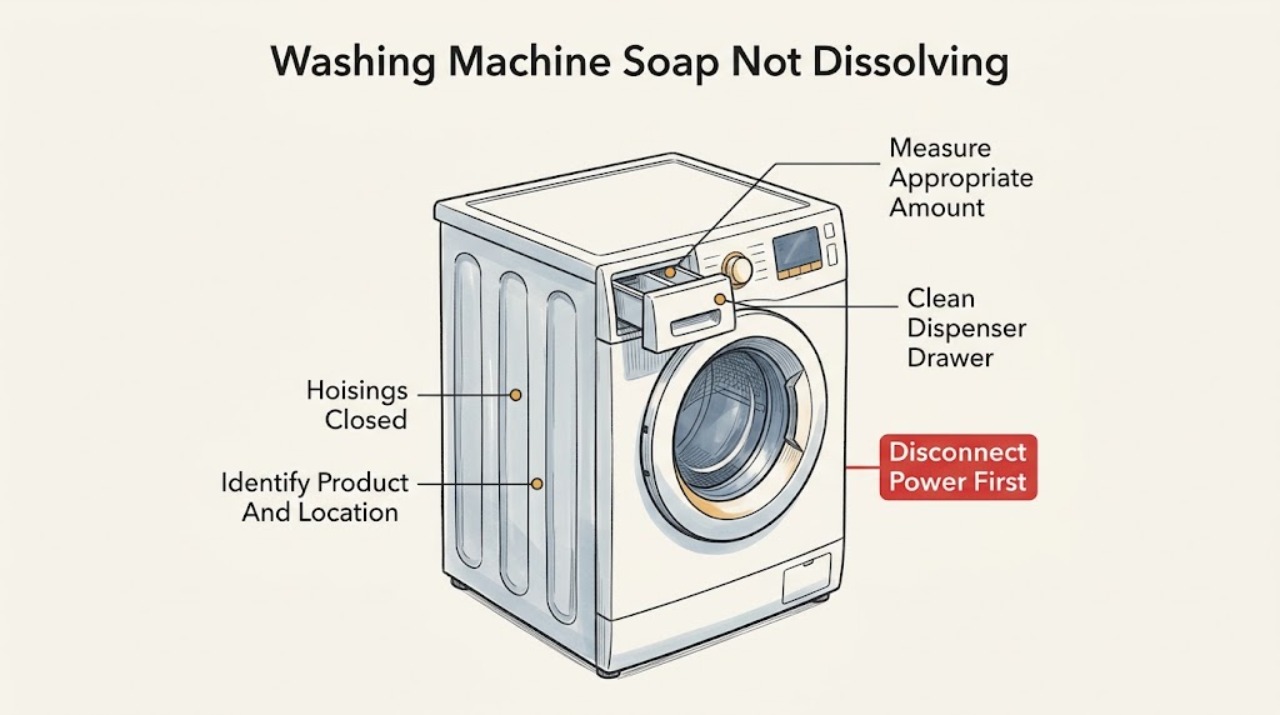
Work through in order
Diagnostic checks
Use only checks that match the exact appliance or system and its official guide.
-
Check 1
Before the next wash, identify the product as liquid HE detergent, powder, pod, sheet, or a bulk-dispense product, and record whether it was placed in the basket, a single-dose drawer compartment, or a tank; consult the exact GE manual.
Expected result: Record whether the product matches the washer's intended dispenser, whether a pod or sheet was placed in a drawer without a dedicated design, whether a powder insert is still installed, and whether a liquid insert or detergent box is missing.
Next step: Correct only the product placement and insert arrangement named by the model manual, then use a normal small load for the next observation.
Stop if: Do not place pods in an ordinary dispenser drawer, improvise a tank, mix products, or operate with a damaged drawer, insert, or lid.
Why this matters
Why: The wrong product location or insert arrangement can keep soap from mixing or dispensing. GE says pods and sheets belong in the basket unless a special dispenser is designed for them, and that liquid and powder drawer arrangements differ.
-
Check 2
Compare the detergent amount with the product label and GE manual, taking account of load size, soil level, water hardness, and whether the washer is a low-water HE model; do not add extra product to compensate for residue.
Expected result: Record whether the amount is above the label line, the load is small or lightly soiled, the water is soft or hard, and whether excess suds or a slick residue appears after the cycle.
Next step: Use the label and model-specific dosage guidance for one controlled load; if residue continues with the correct amount, investigate the drawer, water delivery, temperature, and cycle.
Stop if: Do not mix different detergents, add bleach or a cleaner to dissolve soap, or use homemade detergent in an HE washer when the manufacturer does not recommend it.
Why this matters
Why: Too much detergent can create excess suds and leave residue rather than improve dissolving. A quantity suited to the load and water is a more useful comparison than simply adding more.
-
Check 3
If the washer has a removable dispenser drawer, turn the washer off, remove the drawer only as the GE manual describes, wash it in warm soapy water, rinse it, and reinstall every siphon cap or insert fully; wipe the accessible dispenser box without trying to remove it.
Expected result: Record hardened detergent, softener residue, a blocked opening, a missing or loose siphon cap, a mis-seated liquid or powder insert, or a drawer that is clean and intact.
Next step: Run the model-approved normal cycle with the correct product placement and amount; arrange GE service if the drawer stays full or the detergent is never flushed out.
Stop if: Do not force the drawer, remove the dispenser box, use a sharp tool to clear ports, or continue if cleaning causes a leak or water reaches electrical parts.
Why this matters
Why: Residue or a missing cap can interrupt the water path and leave detergent behind. GE says the drawer and siphon caps can be cleaned, but the dispenser box is not removable under this guidance; a clean drawer with no dispensing still needs service.
-
Check 4
During a normal, supervised fill with no leak or electrical warning, observe whether water enters the detergent compartment or basket promptly and evenly; do not reach into the moving washer or open hoses or electrical covers.
Expected result: Record normal flow, slow or intermittent flow, no water over the detergent, a dispenser that fills and backs up, or a leak from the drawer or hose area.
Next step: Stop for a weak or abnormal fill and arrange service or follow only the model manual's external inlet-screen check; stop immediately for a leak or water near the outlet.
Stop if: Do not remove hoses, open the dispenser box, reach into the washer while it moves, or continue filling a leaking washer.
Why this matters
Why: Weak or absent water over the product can leave it undissolved and points toward an inlet, valve, screen, port, or control issue. A backup or leak suggests a blocked dispenser path and requires stopping before more water is added.
-
Check 5
Select a fabric-appropriate cycle and water temperature permitted by the care label and GE manual, then compare a correctly dosed small load with the earlier problem load; do not raise temperature beyond the product, fabric, or model instructions.
Expected result: Record whether the issue occurs only with cold water, a quick or low-water cycle, a specific compartment, a large soil-heavy load, or every cycle; note whether the product dissolves when the water temperature and cycle change within the instructions.
Next step: Keep the successful, fabric-safe cycle and dosage if the result improves; if the issue is cycle-independent or water remains abnormal, arrange GE service.
Stop if: Do not use a temperature that can damage fabric, add chemicals to force dissolving, or continue if suds, overflow, heat, or a leak develops.
Why this matters
Why: Water temperature and cycle water volume affect how detergent mixes, while a large or tightly packed load can keep product from dispersing. A problem in every cycle after a clean dispenser points more strongly toward water delivery or service.
-
Check 6
Check that clothes are loaded loosely enough for the selected GE cycle and load size, then inspect the completed wash for dry powder, a pod or sheet, residue in the drawer, undiluted product on fabric, excess suds, or a dispenser leak.
Expected result: Classify the result as product dissolved and clothes rinsed normally, product still in the drawer, product on clothing, excessive suds, or detergent residue with a correctly sized load.
Next step: Use the matching branch, change one variable at a time, and arrange service when the dispenser remains clean but fails to flush or when water or electrical symptoms appear.
Stop if: Do not run repeated loads with undissolved chemicals, use a larger dose, mix cleaners, or continue with flooding or a wet electrical connection.
Why this matters
Why: A loose load and correct cycle can separate a loading problem from a dispenser or water-path problem. Residue in the drawer implicates dispensing; residue on clothing or excess suds makes product amount, type, or placement more relevant.
Use your observations
Decision map
Find the observation that best matches what you see, then follow the next safe action.
-
PATH 01Safety boundary
What you see
A pod or sheet was placed in an ordinary drawer, powder was used with the liquid insert still installed, or the liquid insert is absent for liquid detergent.
Do this next
Use the product location and insert arrangement specified by the GE manual; pods and sheets generally belong in the basket unless the model has a dedicated dispenser.
Why this path and its safety boundary
Why it matters: The dispenser arrangement can prevent the soap from being released or dissolved as intended.
Safety stop: Do not force a product into a compartment not designed for it or operate with a broken or missing insert.
-
PATH 02Safety boundary
What you see
The drawer, siphon cap, insert, or visible port has detergent or softener buildup.
Do this next
Clean the removable drawer and caps with warm soapy water as GE directs, rinse and reseat them, then retry one correctly dosed cycle.
Why this path and its safety boundary
Why it matters: Residue can obstruct the water path and leave the product in the drawer or cause the drawer to back up.
Safety stop: Do not remove the dispenser box, gouge buildup with a sharp object, or continue if the drawer leaks.
-
PATH 03Safety boundary
What you see
Little or no water reaches the detergent compartment, the fill is slow or intermittent, or water backs up at the drawer.
Do this next
Stop adding water and arrange GE service or follow only a model-approved external inlet check; provide the flow and leak observations.
Why this path and its safety boundary
Why it matters: The issue is likely in the water-delivery or dispenser path rather than the detergent chemistry alone.
Safety stop: Stop for flooding, a hose leak, water near an outlet, exposed wiring, or a dispenser that overfills; do not remove hoses or panels.
-
PATH 04Safety boundary
What you see
The dispenser is clean and water delivery is normal, but the amount is high, the load is small, or excess suds and residue remain.
Do this next
Use the label and GE dosage guidance for the load, use HE detergent where required, and avoid adding extra product to solve residue.
Why this path and its safety boundary
Why it matters: Overdosing or a detergent not suited to the washer can leave residue even when dispensing works.
Safety stop: Do not mix detergents or cleaners, add unmeasured product, or use non-tested homemade detergent in an HE washer.
-
PATH 05Safety boundary
What you see
The problem occurs mainly with cold water, a short or low-water cycle, a large load, or tightly packed clothes and improves with a fabric-safe, model-approved cycle and load.
Do this next
Use the successful fabric-safe cycle and load size, keep dosing appropriate, and do not exceed the garment label or GE manual.
Why this path and its safety boundary
Why it matters: Water temperature, cycle water volume, and movement may be limiting how the detergent mixes with the load.
Safety stop: Stop if the change causes heat damage, overflow, persistent undissolved product, or a leak.
-
PATH 06Safety boundary
What you see
The correct product, insert, dosage, clean drawer, and supervised water entry are confirmed, but detergent remains in the drawer or is never dispensed.
Do this next
Stop experimenting and arrange GE service with the model, product type, cycle, drawer photos, and water-entry observation.
Why this path and its safety boundary
Why it matters: A valve, port, control, or dispenser-box fault remains possible and is not a safe user-level adjustment.
Safety stop: Do not remove the dispenser box, bypass a valve or control, or continue washing with a leaking or electrically unsafe washer.
-
PATH 07Safety boundary
What you see
Bleach, vinegar, ammonia, acids, or another cleaner was mixed; the washer floods; water reaches an outlet; or a cord, plug, or control is wet or damaged.
Do this next
Stop the cycle, turn the appliance off, keep clear of contaminated or wet areas, and arrange qualified appliance, plumbing, or electrical service as appropriate.
Why this path and its safety boundary
Why it matters: Chemical exposure, flooding, and electrical shock risk take priority over detergent troubleshooting.
Safety stop: Do not mix chemicals, unplug while standing in water, touch wet electrical parts, or restart a leaking washer.
Helpful context
Understand the symptom
Match the product to the GE washer's dispenser design
Undissolved soap can mean the product was placed in the wrong location, the drawer did not receive enough water, the product amount is too high for the load, or the water is too cold for the product and cycle. GE's support guidance treats pods differently from liquid or powder: pods and sheets normally go in the basket unless the specific washer has a pod dispenser, while a drawer's liquid insert or powder box must be arranged for the product being used. Read the model manual and product label before changing placement.
Residue in the drawer or ports changes the diagnosis
If a front-load drawer leaves soap behind, GE says detergent or softener residue may have built up and recommends removing and washing the drawer with warm, soapy water, rinsing it, and returning the siphon caps fully into place. GE also warns that a blocked dispenser tray or port can back up water and cause a leak. The dispenser box is not a user-removable part on that guidance; wipe accessible areas only and request service when cleaning does not restore dispensing.
Use the wash result to separate soap, water, and load causes
A clean dispenser does not prove that the water supply is adequate or that the load is suitable. GE guidance says detergent use may need adjustment for water temperature, water hardness, load size, and soil level, and its washer manual lists warmer water and a load that can move freely among checks for detergent that does not dissolve. If the washer fills slowly, a dispenser stream is weak, the inlet area is blocked, or a heavy load is packed tightly, the soap may remain in the drawer or on clothing. Avoid chemical experiments and keep the next change to one variable at a time.
Safety boundary
Stop conditions
- Do not mix chlorine bleach with ammonia, vinegar, acids, rust remover, or another cleaner; toxic gas or chemical injury can result.
- Stop for flooding, a dispenser backup, a hose leak, water near an outlet, a wet or damaged cord or plug, exposed electrical parts, or a control that is hot or damaged.
- Do not unplug while standing in water, reach into a moving washer, remove the dispenser box, open electrical covers, or work on valves or wiring.
- Do not put pods or sheets in a dispenser not designed for them, run without the correct insert, or add extra detergent to cure residue.
- Do not use a temperature that violates the garment label or model manual, and stop repeated washes when undissolved chemical product remains on clothing or in the machine.
Only after diagnosis
Potential parts
- GE detergent dispenser drawer or insert
Consider this category only when the exact model's drawer or insert is cracked, warped, missing, or unable to seat after cleaning and GE service confirms it as the cause.
Confirm the exact GE model and drawer configuration before ordering; do not substitute a generic insert or operate with a leaking or mis-seated drawer. - GE dispenser siphon cap
Consider this category only when a cleaning inspection finds a missing, damaged, or non-seating siphon cap that interrupts dispensing.
Confirm the exact model and cap design; reinstall only as the manual directs and do not use a missing cap if the dispenser backs up. - GE washer water inlet or dispenser valve
Consider this category only after correct detergent setup and a clean drawer, when supervised observation confirms weak or absent water delivery and a qualified diagnosis identifies the valve or inlet.
Confirm the exact model, water configuration, and technician diagnosis; installation involves water and electrical connections and is not a symptom-only replacement.
When checks do not resolve it
Need a professional?
Arrange GE appliance service when the correct product placement, dosage, clean drawer, seated inserts, and normal water entry do not restore dispensing; when the drawer backs up or leaks; when flow is weak or intermittent; or when a valve, port, control, or dispenser-box fault is suspected. Use qualified plumbing or electrical help for flooding, damaged hoses, water near an outlet, a wet or damaged cord, exposed wiring, or other electrical symptoms.
Safety scope: This article supports product identification, dosage review, model-approved drawer cleaning, normal-cycle observation, and exterior checks only. Do not mix chemicals, enter a moving washer, remove the dispenser box, work on valves or wiring, unplug in standing water, or continue a leaking or electrically unsafe washer.
Common questions
FAQ
Why is soap not dissolving in my GE washing machine?
Check product placement, liquid or powder insert arrangement, dosage, dispenser residue, water flow, water temperature, cycle, and load size. Pods and sheets generally belong in the basket unless the exact GE model has a dedicated dispenser.
Can I put a detergent pod in the GE washer dispenser?
Only if the washer has a dispenser specifically designed for pods. GE says ordinary dispenser drawers are not for pods; place the pod in the basket before clothes when the model does not provide a dedicated pod dispenser.
How do I clean a GE washer detergent drawer?
For a removable drawer, follow the model manual: remove it as directed, wash it in warm soapy water, rinse it, and fully reseat the siphon caps or inserts. GE says not to remove the dispenser box; arrange service if dispensing still fails after cleaning.
Should I use more detergent if it is not dissolving?
No. Too much detergent can create excess suds and residue. Match the amount to the product label, load size, soil, and water conditions, and use HE detergent when required by the GE washer.
Can cold water cause detergent to remain in a GE washer?
It can contribute depending on the product, cycle, and model. Use a fabric-safe temperature permitted by the care label and GE manual, and compare one correctly dosed small load rather than repeatedly increasing detergent.
Why is detergent still in the drawer after a wash?
Residue may be blocking the drawer, siphon cap, or dispenser port, or water may not be reaching the compartment with enough flow. Clean the removable drawer as directed and arrange service for weak flow, backup, or persistent no-dispense.
Can I mix bleach and vinegar to dissolve washer soap?
No. Do not mix bleach with vinegar, ammonia, acids, rust remover, or other cleaners. Stop for a chemical reaction, flooding, or water near electrical parts and arrange appropriate qualified help.
When does GE washer soap residue require service?
Arrange service when the correct product and insert are used, the drawer is clean, water entry is abnormal, the drawer backs up or leaks, or detergent still is not dispensed. Do not remove the dispenser box or work on valves and wiring yourself.
Read the exact guide
Official sources
- Front Load Washer - Leaking WaterGE Appliances · GE Appliances front-load washer leak and dispenser guidance; exact model manual controls cleaning and access.
- 49-90046GE Appliances · Official GE owner manual covering listed legacy washer models; use the exact model manual for another washer.
- Washer - HE DetergentGE Appliances · GE Appliances guidance for high-efficiency washers; exact product and model manual control a particular dispenser.
- Front Load Washer - Not Dispensing DetergentGE Appliances · GE Appliances support guidance for front-load washer detergent dispensing; exact drawer and cap design varies by model.
Community feedback
Share a repair observation
Share a plain-text repair observation. Accepted observations are published automatically; this page may take a moment to update.