
On this page
Start here
Quick answer
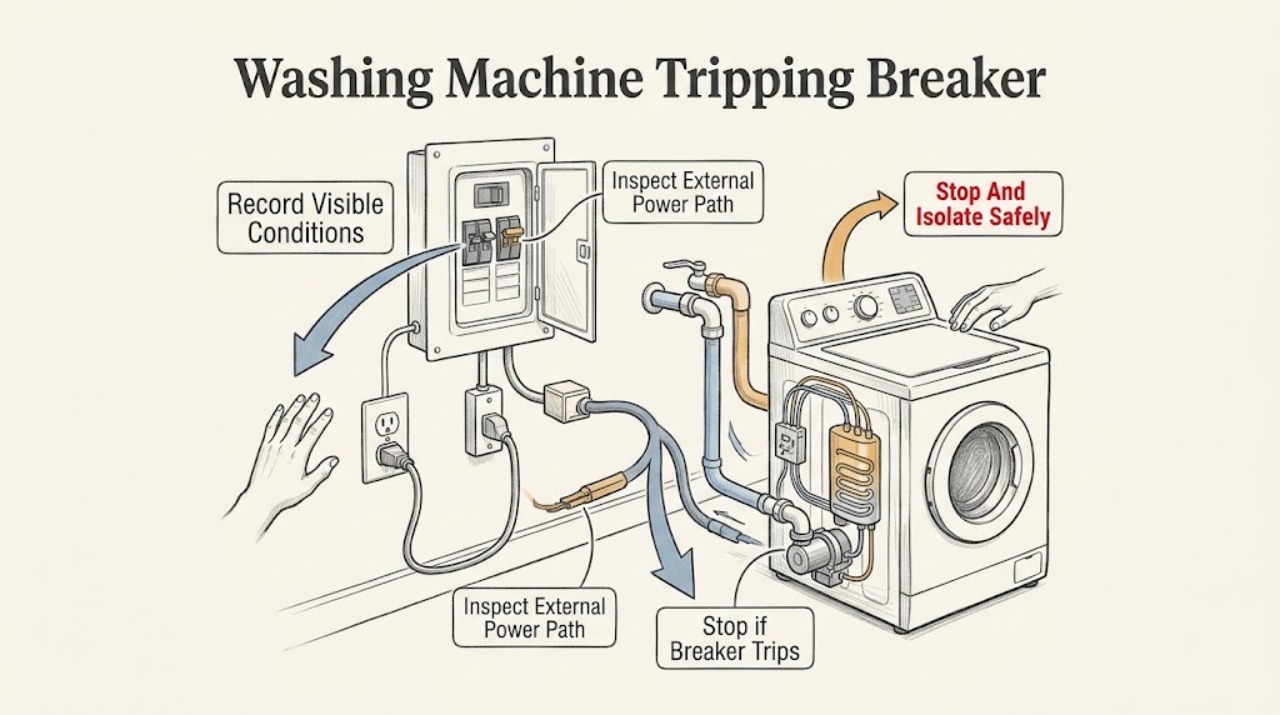
If a GE washing machine trips the breaker, stop treating it as a normal reset. From a dry, safe position, stop the washer, keep away from standing water, and turn off the washer's water valves if a leak or unwanted filling is present. If safe, disconnect the washer from power before any external inspection. Record whether the breaker trips when the washer is plugged in, when a cycle starts, or during fill, drain, or spin. GE says washers can trip from a shorted heater, timer, loose wiring, or another failed component; an immediate trip after the appliance is unplugged points toward the household wiring or breaker box. Reset a breaker only once through the normal household procedure and never keep testing after another trip, a spark, a hot smell, smoke, a damaged cord, or water near electrical equipment. A qualified electrician or appliance technician must diagnose persistent tripping.
Before you begin
Safety first
- This article covers safe isolation and external observation only. Do not touch wet electrical equipment, repeatedly reset a breaker, use an extension cord or oversized protection, open the receptacle/panel/washer, perform live electrical testing, bypass safety devices, move the washer across water, or reconnect after smoke, spark, hot odor, damaged cord, leak near electricity, or a second trip.
Work through in order
Diagnostic checks
Use only checks that match the exact appliance or system and its official guide.
-
Check 1
When the breaker trips, stop the washer and keep people away from the appliance, plug, outlet, and any water; from a dry, safe position, disconnect the appliance circuit if possible and close the washer's water valves if there is a leak or water entering while the washer is off.
Expected result: The floor or washer is dry, there is standing water or a leak, the cord or outlet is hot or damaged, or smoke, sparks, or a burning smell is present.
Next step: Leave the area safe and request qualified electrical or appliance help; only continue to dry external observations when there is no water or electrical hazard and power is safely isolated.
Stop if: Do not touch a washer, plug, outlet, cord, or water in a wet area; do not reach behind the machine, reset power, or move it across standing water.
Why this matters
Why: Water near electricity and heat, smoke, sparks, or damaged electrical equipment make this a safety incident rather than a reset problem. GE says power must be disconnected before touching or inspecting an appliance exposed to water.
-
Check 2
Without reconnecting a suspected unsafe washer, record when the breaker tripped: on plug-in, when POWER or Start was pressed, during filling, during agitation, or during drain/spin.
Expected result: The trip was immediate on plug-in, occurred only after a cycle began, followed a fill or leak, occurred during drain/spin, or the timing is unknown.
Next step: Give the timing, cycle, load, water level, and any display message to the technician; do not reproduce the trip merely to obtain a more exact timestamp.
Stop if: Stop all testing for a second trip, smoke, spark, hot odor, damaged cord, exposed wire, or water near electrical equipment.
Why this matters
Why: Trip timing separates a possible supply or input fault from an operating-stage issue, but it cannot prove a heater, pump, motor, timer, control, or wire has failed. GE lists several such possibilities for washers and dryers.
-
Check 3
From a dry, stable position, inspect only the visible washer cord, plug, receptacle face, and breaker position; confirm the washer is on the individual grounded circuit specified by the exact installation instructions, without opening the receptacle or electrical panel.
Expected result: The outlet or plug is loose, discolored, warm, wet, scorched, or damaged; the breaker will not stay on; the circuit is shared or incorrectly sized; or the visible path looks normal.
Next step: Keep the washer disconnected and arrange electrician service for a questionable outlet, circuit, or breaker; if the external path is normal, continue only with the safe water and trip-history record.
Stop if: Do not touch a hot or wet plug, open the receptacle or breaker box, use an extension cord, substitute a larger fuse or breaker, or continue after any spark or burning smell.
Why this matters
Why: A damaged or incorrectly supplied circuit can trip independently of the washer. GE says model-specific electrical requirements control and recommends an electrician when the circuit or breaker is not correctly sized or does not hold.
-
Check 4
Only when the washer is unplugged, the area is dry, and there is no odor, smoke, spark, damage, or leak, use the household breaker's normal off-then-on procedure once; do not reconnect the washer yet.
Expected result: The breaker stays on with the washer disconnected, trips immediately while the washer remains disconnected, or will not reset normally.
Next step: For an unplugged-appliance trip, stop and call a qualified electrician. If the breaker stays on, leave the washer disconnected and arrange appliance service rather than plugging it back in to see what happens.
Stop if: Do not reset repeatedly, stand in water, use a temporary breaker or fuse, reconnect the washer for another test, or touch the panel with wet hands or damaged equipment nearby.
Why this matters
Why: A breaker that trips or will not hold with the appliance unplugged points toward the household wiring or breaker box. A breaker that stays on without the washer does not clear the washer; it only makes the appliance side the next service question.
-
Check 5
With the washer still disconnected and water supply off when a leak is suspected, look from outside for water under the washer, a drip or fill when off, wet hoses, a loose visible connection, or water that reached the receptacle; do not remove hoses or panels.
Expected result: The washer is dry, water is present under or behind it, the tub fills while off, a hose or connection leaks, or water has reached electrical equipment.
Next step: Keep water and power isolated and request qualified appliance service; use an appropriate plumbing professional if the external supply or household drain is the source.
Stop if: Do not touch wet electrical equipment, pull the washer forward, remove a valve or hose, enter standing water, or restore water to a leaking appliance.
Why this matters
Why: GE says a washer that drips or fills while off may have a failed water valve and recommends turning off the supply valves; water exposure also creates fire and shock risk. A water symptom can coincide with, but does not prove, an electrical fault.
-
Check 6
Classify the event as a household breaker/outlet fault, a water or installation issue, or an appliance-only trip after the washer is connected and operating; keep the washer disconnected until that classification is made safely.
Expected result: The breaker trips while the washer is unplugged, stays on until the washer is connected, trips at a repeatable cycle stage, or the cause remains uncertain after one safe external review.
Next step: Provide the technician with model and serial information, trip timing, circuit behavior, water observations, load/cycle, and any photographs taken from a safe dry position.
Stop if: Do not open the washer, bypass safety devices, perform live electrical testing, repeatedly reset the breaker, run a test load, or continue after a second trip, odor, smoke, spark, leak, or damaged cord.
Why this matters
Why: Household-side trips need electrical diagnosis; appliance-side or stage-specific trips can involve a shorted heater, pump, motor, timer, control, loose wire, or another failed component. No external observation establishes which part is safe to replace.
Use your observations
Decision map
Find the observation that best matches what you see, then follow the next safe action.
-
PATH 01Safety boundary
What you see
There is standing water, a leak toward electricity, a wet plug or outlet, smoke, a spark, a hot electrical smell, exposed wiring, or a damaged cord.
Do this next
From a dry safe position, disconnect the appliance circuit if possible and close the washer water valves when water is entering; keep away and arrange qualified electrical/appliance or emergency help.
Why this path and its safety boundary
Why it matters: The washer presents potential shock, fire, or flooding risk and ordinary troubleshooting must stop.
Safety stop: Do not touch the appliance or water, pull the washer, reset the breaker, or inspect wiring until the area and equipment are made safe by a qualified person.
-
PATH 02Safety boundary
What you see
The breaker trips or will not remain on while the washer is unplugged, or the visible outlet/circuit is damaged, shared, or incorrectly supplied.
Do this next
Leave the washer disconnected and have a qualified electrician diagnose the circuit and breaker against the exact installation requirements.
Why this path and its safety boundary
Why it matters: The household wiring, receptacle, fuse, or breaker is the first fault domain; the washer has not been proven defective.
Safety stop: Do not keep resetting, replace a breaker with a larger one, open the panel, use an extension cord, or operate other appliances on a questionable circuit.
-
PATH 03Safety boundary
What you see
The breaker stays on with the washer unplugged but trips when the washer is connected or a cycle begins, with no external water or supply hazard visible.
Do this next
Keep the washer unplugged and request qualified appliance diagnosis; provide the exact cycle or stage that preceded the trip.
Why this path and its safety boundary
Why it matters: The appliance side may have a shorted heater, timer, pump, motor, control, loose wire, or another failed component, but the exact cause requires testing.
Safety stop: Do not reconnect repeatedly, run an empty cycle, remove panels, bypass an interlock, or replace a part from the trip symptom alone.
-
PATH 04Safety boundary
What you see
The washer drips or fills while off, a visible hose or connection leaks, or water is present under or behind the washer.
Do this next
Keep the water supply closed and the washer disconnected, then arrange appliance or plumbing service as indicated by the safe external source observation.
Why this path and its safety boundary
Why it matters: GE identifies a possible failed water valve when a washer drips or fills while off; water exposure can also create electrical danger.
Safety stop: Do not touch wet equipment, remove hoses, move the washer, or restore water to test whether the breaker holds.
-
PATH 05Safety boundary
What you see
The breaker has tripped more than once, the cause is not clear after one safe external review, or the washer shows a recurring fault without an obvious circuit or water cause.
Do this next
Leave the washer out of service and schedule qualified appliance and, if needed, electrical evaluation.
Why this path and its safety boundary
Why it matters: Repeated operation risks worsening an electrical or water fault and cannot safely establish a component diagnosis.
Safety stop: Do not reset, reconnect, run another load, or open the washer to search for a short.
Helpful context
Understand the symptom
First make the area and appliance safe
A breaker trip can leave the washer apparently dead, but a second reset can turn a fault into a shock or fire risk. If there is standing water, water at the plug, a leak toward the outlet, smoke, a spark, or a hot electrical smell, do not touch the washer or water. From a dry position, disconnect the appliance circuit if it can be done safely, and close the washer's water valves when a leak or unwanted filling is present. Do not pull a stacked or tightly installed washer across a wet floor.
When the trip occurs is useful evidence
Note whether the breaker trips immediately when the washer is plugged in, when POWER or Start is pressed, while the tub fills, or during drain or spin. An immediate trip with the washer unplugged points toward the household circuit; a working circuit that trips only when the washer operates leaves the appliance and its connected water or mechanical load as possibilities. The timing narrows the service call but does not identify a part.
Use only external checks before calling for service
GE recommends a dedicated, properly grounded circuit with model-specific breaker requirements. Check the visible cord, plug, outlet, and breaker from a dry position, and look for external leaks, kinked hoses, or water that could have reached electrical equipment. Do not open the console, remove panels, probe wiring, or run an empty cycle to reproduce a trip. A repeated trip, damaged supply, or water exposure needs qualified electrical or appliance diagnosis.
Only after diagnosis
Potential parts
- washer electronic control or wiring harness
Consider this only when qualified diagnosis finds an appliance-side electrical fault after the household circuit and water exposure are ruled out.
Controls, harnesses, connectors, and revisions are model-specific; do not infer fit from a breaker trip alone. - washer drain pump
Consider this only when the breaker trip is repeatably associated with the drain stage and qualified testing identifies the pump or its wiring.
Pump access and electrical ratings vary by model; standing water and stacked installation require a qualified service procedure. - washer water inlet valve assembly
Consider this only when a leak or fill-while-off symptom and qualified diagnosis identify the valve as the cause after safe water isolation.
Valve ports, connectors, and fit vary by exact model; do not remove or order one from a leak or breaker symptom alone.
When checks do not resolve it
Need a professional?
Safety scope: This article covers safe isolation and external observation only. Do not touch wet electrical equipment, repeatedly reset a breaker, use an extension cord or oversized protection, open the receptacle/panel/washer, perform live electrical testing, bypass safety devices, move the washer across water, or reconnect after smoke, spark, hot odor, damaged cord, leak near electricity, or a second trip.
Common questions
FAQ
Why does my GE washer keep tripping the breaker?
GE lists several possible causes, including a shorted heater, timer, loose electrical wire, or failed component. The trip timing helps separate the household circuit from the appliance, but repeated trips require qualified diagnosis rather than repeated resets.
What should I do if the GE washer trips the breaker immediately?
Stop using it. From a dry, safe position, leave the washer unplugged and use the normal breaker procedure only once if there is no water, odor, smoke, spark, heat, or damage. If the breaker trips while the washer remains unplugged, call a qualified electrician.
Can a leaking GE washer cause a breaker trip?
Water can create a shock or fire hazard and may coincide with an electrical fault. Close the washer water valves when water is entering or the washer fills while off, disconnect power safely, stay out of standing water, and arrange qualified service.
Is it safe to keep resetting a GE washer breaker?
No. A single safe reset may distinguish a dead circuit, but another trip means the washer or household circuit needs diagnosis. Never reset after a spark, hot smell, smoke, damaged cord, water near electricity, or a previous repeated trip.
Should I open the GE washer to find the short?
No. Do not remove panels, access wiring, perform live electrical testing, bypass safety devices, or handle a water-filled or wet appliance. Give the technician the model, trip timing, circuit result, and safe external observations instead.
Read the exact guide
Official sources
- Washer - Drips or Fills When Not Turned OnGE Appliances · Official GE Appliances support for washers that drip or fill while not operating.
- FAQs | WashersGE Appliances · Official GE Appliances washer FAQ; specific model manuals and support articles control detailed procedures.
- Washer - Electrical Requirements and Breaker SizeGE Appliances · Official GE Appliances support; the exact model installation instructions override typical requirements.
- Appliances - Water Damage InformationGE Appliances · Official GE Appliances safety guidance for appliances exposed to flooding or water.
- GE Appliance - Resetting Your Circuit BreakerGE Appliances · Official GE Appliances support; breaker work remains subject to household electrical safety and local code.
- GE Appliance - Circuit Breaker TripsGE Appliances · Official GE Appliances support for household appliances; exact installation instructions and local electrical codes control.
Community feedback
Share a repair observation
Share a plain-text repair observation. Accepted observations are published automatically; this page may take a moment to update.