
On this page
Start here
Quick answer
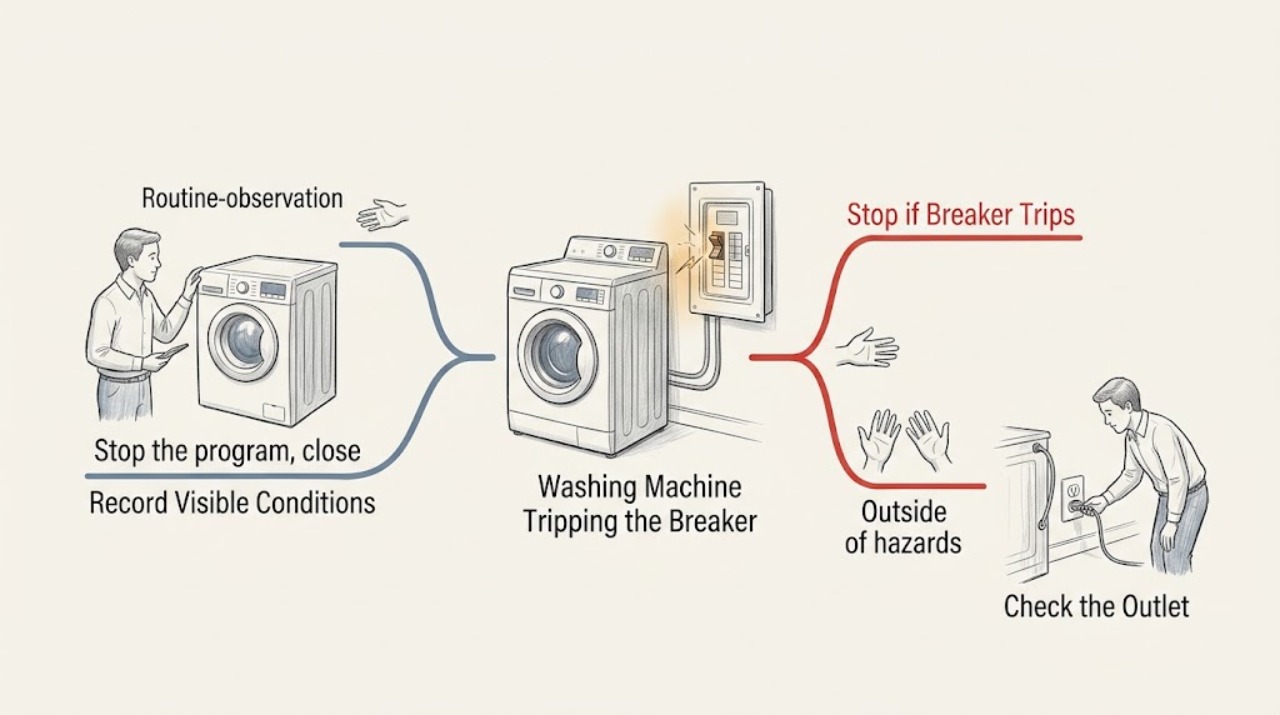
Do not keep resetting the breaker or repeatedly running a Gorenje washing machine that trips it. Stop the program, close the water tap, and disconnect power only if the plug and surrounding floor are dry and reachable without touching water; if water is present, do not reach into the area. Note whether the trip occurs on start, filling, heating, draining, or spinning, and whether the cord, plug, outlet, hoses, or cabinet are wet, hot, scorched, or damaged. Gorenje manuals require a grounded accessible outlet, prohibit extension cords, and reserve safety and performance repairs for trained experts. A second trip, burning smell, spark, damaged cord, water near electrical parts, or an unexplained trip needs an appliance technician or qualified electrician.
Work through in order
Diagnostic checks
Use only checks that match the exact appliance or system and its official guide.
-
Check 1
Stop the program, close the water tap, and make the appliance safe without reaching into water or touching a wet plug.
Expected result: The floor or outlet area may be dry, or there may be standing water, a wet cord or plug, smoke, sparks, heat, or a burning smell.
Next step: If the area is dry and the plug is safely reachable, disconnect the machine. If not, stay clear, do not reset the breaker, and have a qualified electrician or appliance technician isolate it. Keep the water supply closed.
Stop if: Never touch the appliance, plug, outlet, or breaker while standing in water or while smoke, sparking, or burning odor is present.
Why this matters
Why: A dry, accessible disconnect can isolate the appliance. Water near an electrical connection or any heat, smoke, spark, or odor is an immediate electrical and water-safety hazard.
-
Check 2
Record the exact point in the cycle when the breaker trips without restarting the machine.
Expected result: The trip may happen immediately at power-up, during fill, while the water is heating, when the pump drains, or during motor acceleration and spin; it may also coincide with another appliance starting.
Next step: Write down the program, load, cycle stage, any display message, and what else was on the circuit. Leave the washer disconnected until it is inspected.
Stop if: Do not repeat a cycle to reproduce the trip or hold the breaker on while the washer is connected.
Why this matters
Why: Timing and circuit scope give a technician useful evidence about whether the fault follows controls, water entry, heating, pumping, motor load, or the household circuit. They do not identify a replaceable part by themselves.
-
Check 3
From a dry standing position, inspect the power cord, plug, outlet face, and any visible adapter or extension arrangement without opening the outlet.
Expected result: Look for cuts, crushed insulation, looseness, discoloration, melted plastic, scorch marks, a warm outlet, an extension cord, or a non-grounded connection; alternatively, the external power path may look intact.
Next step: Leave the machine unplugged and call a qualified electrician for a damaged or hot outlet, cord, plug, grounding concern, or repeated breaker trip. Do not replace a fuse, enlarge breaker protection, or modify the plug.
Stop if: Do not touch exposed conductors, dismantle the outlet, or energize the machine to see whether the outlet trips again.
Why this matters
Why: Visible damage, heat, an extension cord, or an unsuitable outlet can make continued use unsafe. A clean appearance does not rule out a fault inside the appliance or wall circuit.
-
Check 4
Inspect the inlet and drain hoses and the outside of the cabinet for water or a leak path while the machine remains disconnected.
Expected result: An inlet connection, hose, valve area, drain hose, filter area, or floor may be wet; the drain hose may be loose, kinked, disconnected, or lying on the floor; or no external moisture may be visible.
Next step: Keep the water tap closed. Photograph the first wet point, towel only the safe floor area, and arrange service if any hose, valve, filter area, or cabinet is leaking. Do not pull the machine through standing water or remove panels.
Stop if: Stop immediately if water is near the outlet, cord, controls, or underside of the machine, or if a hose is split or spraying.
Why this matters
Why: Water can create an electrical hazard or point to the event that preceded the trip. Gorenje instructions require supplied water connections and a correctly secured discharge hose; a dry exterior does not exclude an internal leak.
-
Check 5
Check only accessible installation conditions: the machine should stand stable with ventilation openings clear and the drain hose secured as the model manual shows.
Expected result: The washer may be pressed against furniture, enclosed, unstable, or installed with a disconnected, extended, crushed, or incorrectly routed drain hose; it may instead be stable and unobstructed.
Next step: Leave the appliance off. Ask a trained installer or service technician to correct installation, especially if moving the machine would expose wet flooring, strain hoses, or require disconnecting services.
Stop if: Do not move a water-filled or wet appliance alone, bypass protective devices, or connect it through an extension cord.
Why this matters
Why: Gorenje manuals warn that incorrect placement can compromise safe operation and may contribute to overheating, while incorrect drainage can create water exposure. These are installation observations, not permission to alter wiring.
-
Check 6
Prepare a service handoff with the model and serial information, breaker behavior, cycle timing, photos, and any recent leak, move, cleaning, or electrical event.
Expected result: The rating plate may be visible inside the door, and the trip may be isolated to this appliance or may also affect the household circuit; no further powered test is needed.
Next step: Keep the water closed and the washer disconnected until an authorized service technician or qualified electrician determines the cause. Mention any error or phase-current message exactly as displayed.
Stop if: Do not use a different breaker, extension cord, temporary bypass, or repeated reset as a workaround.
Why this matters
Why: Gorenje's manuals use model and serial details for service, and the timing and visible evidence help distinguish appliance repair from an electrical-circuit inspection.
Use your observations
Decision map
Find the observation that best matches what you see, then follow the next safe action.
-
PATH 01Next step
What you see
Water, smoke, sparks, burning odor, scorched plastic, a hot outlet, or a damaged cord is present.
Do this next
Do not touch the wet or damaged area. Close the water tap if safe, isolate power only from a dry safe location, leave the machine off, and call a qualified electrician or appliance technician.
-
PATH 02Next step
What you see
The breaker trips immediately when the washer is connected or started, with no visible external damage.
Do this next
Do not reset and retry. Keep the washer unplugged and have the appliance and its grounded circuit checked by qualified professionals.
-
PATH 03Next step
What you see
The trip occurs during filling and moisture is visible at an inlet, valve, cabinet, or floor.
Do this next
Keep the water tap closed, do not reconnect power, and arrange service to inspect the water path and any affected electrical parts.
-
PATH 04Next step
What you see
The trip occurs during draining or after a drain-hose, filter, or household-plumbing problem.
Do this next
Leave the machine off and water closed. Photograph the leak or blockage and have a technician inspect the drain route and electrical exposure; do not pull the filter or panel in standing water.
-
PATH 05Next step
What you see
The trip occurs during heating, motor acceleration, or spin, with no safe external correction.
Do this next
Do not run another cycle. Provide the exact cycle stage to service so the heater, motor, wiring, and household circuit can be tested by a trained expert.
-
PATH 06Next step
What you see
The breaker trips again after any reset, or another appliance also trips the same circuit.
Do this next
Stop all testing. Keep the washer disconnected and have the household circuit checked by a qualified electrician, with appliance service as needed.
Helpful context
Understand the symptom
Treat the first trip as a warning
A breaker trip can protect against an electrical fault, overload, or current leakage. It is not a reset invitation. Leave the machine de-energized until you have established that the external area is dry and there is no heat, smoke, burning odor, or visible damage. Do not substitute a larger breaker or use an extension cord.
Use timing to narrow the handoff
Record the program and the exact moment the breaker trips. A trip immediately at start differs from one during water heating, pump-out, or high-speed spin. Also record whether other appliances on the circuit were running and whether the fault began after a move, leak, cleaning, or storm. These observations help a technician without requiring another hazardous test.
Keep checks external
Gorenje guidance says the appliance must use its supplied cord and a grounded outlet, and that connection, safety, and performance repairs belong to trained experts. You can look at a dry, de-energized cord, plug, outlet face, inlet hose, and drain hose. Do not remove panels, test live wiring, probe the motor or heater, or work inside standing water.
Safety boundary
Stop conditions
- Do not reset the breaker repeatedly or run the washing machine again after a second trip.
- Do not touch the washer, plug, outlet, or breaker while standing in water, or when smoke, sparks, heat, or burning odor is present.
- Keep the water tap closed when a hose, valve, cabinet, or floor is wet; do not pull a wet appliance or open panels.
- Do not use an extension cord, bypass grounding or protective devices, substitute a larger breaker, or test live wiring.
- Safety, electrical, water, heating, motor, and performance repairs must be handled by trained or qualified professionals.
Only after diagnosis
Potential parts
- power cord
Consider only if a qualified professional confirms the supplied cord is damaged and replacement is permitted for the exact model.
Confirm the exact model and grounding requirements; do not fit a substitute cord yourself. - inlet or drain hose
Consider only when service confirms an external hose is cracked, damaged, or unable to maintain the required connection and routing.
Use the supplied or model-approved hose and follow the exact installation instructions. - heating or motor electrical assembly
Consider only after a trained technician links the trip to a heating, motor, wiring, or control fault during diagnosis.
Do not order or install internal electrical parts based only on the breaker symptom; confirm model fit and qualified installation.
When checks do not resolve it
Need a professional?
Call a qualified electrician or appliance technician after any repeated trip, and immediately for smoke, sparks, burning odor, a hot or damaged outlet or cord, water near electrical parts, continuous filling, or an unexplained trip. Even without visible damage, a first unexplained trip should be diagnosed before the Gorenje washer is returned to service.
Common questions
FAQ
Should I reset the breaker to see if my Gorenje washer works?
No. Do not repeatedly reset or run the washer after it trips. Close the water tap and disconnect power only from a dry, safe location; record when the trip occurred and have the appliance or circuit checked by a qualified professional.
What does it mean if the breaker trips during filling?
First keep the water tap closed and inspect only from a dry position for a wet inlet connection, hose, valve area, or cabinet. Water near electrical parts is a stop condition; do not reconnect power or open panels. Have qualified service inspect both the water path and electrical exposure.
Can I use an extension cord after my Gorenje washer trips?
No. Gorenje manuals require the supplied power cord and a grounded outlet, and prohibit connecting the washer through an extension cord. A damaged or hot cord, plug, or outlet should be left disconnected and inspected by a qualified electrician.
When is a tripping breaker an emergency?
Treat water near the outlet or machine, smoke, sparks, burning odor, heat, scorched plastic, a damaged cord, or a second trip as urgent. Do not touch wet electrical areas or keep testing; isolate power only from a dry safe location and call qualified help.
Read the exact guide
Official sources
- USER MANUALGorenje · Gorenje washing machines; water leak, overflow, phase-current, motor, drain, installation, and service guidance
- USER MANUALGorenje · Gorenje washing machines; supplied cord and hoses, grounded outlet, water connection, and trained repair boundary
Community feedback
Share a repair observation
Share a plain-text repair observation. Accepted observations are published automatically; this page may take a moment to update.