
On this page
Start here
Quick answer
If an LG washing machine trips the circuit breaker, stop repeatedly resetting it and do not test it through an extension cord or power strip. Record whether the trip happened immediately, during filling, draining, spinning, or on a washer-dryer heating cycle, and look only from a dry, safe position for water, a damaged cord, a hot or discolored plug or receptacle, smoke, a burning smell, crackling, or visible arcing. LG says the washer should be connected directly to a suitable wall outlet and that a breaker that trips again needs building maintenance or an electrician; a repeat trip can also require qualified appliance service. If water has reached electrical parts, the outlet or plug is wet or hot, or there is smoke, burning odor, arcing, or a damaged cord, leave the appliance out of service and get help rather than making another test.
Before you begin
Safety first
- This article supports dry, ordinary-access observation and safe documentation only. Do not repeatedly reset or reconnect the washer, use an extension cord, open the appliance or electrical panel, probe live parts, bypass protection, or move the machine through water.
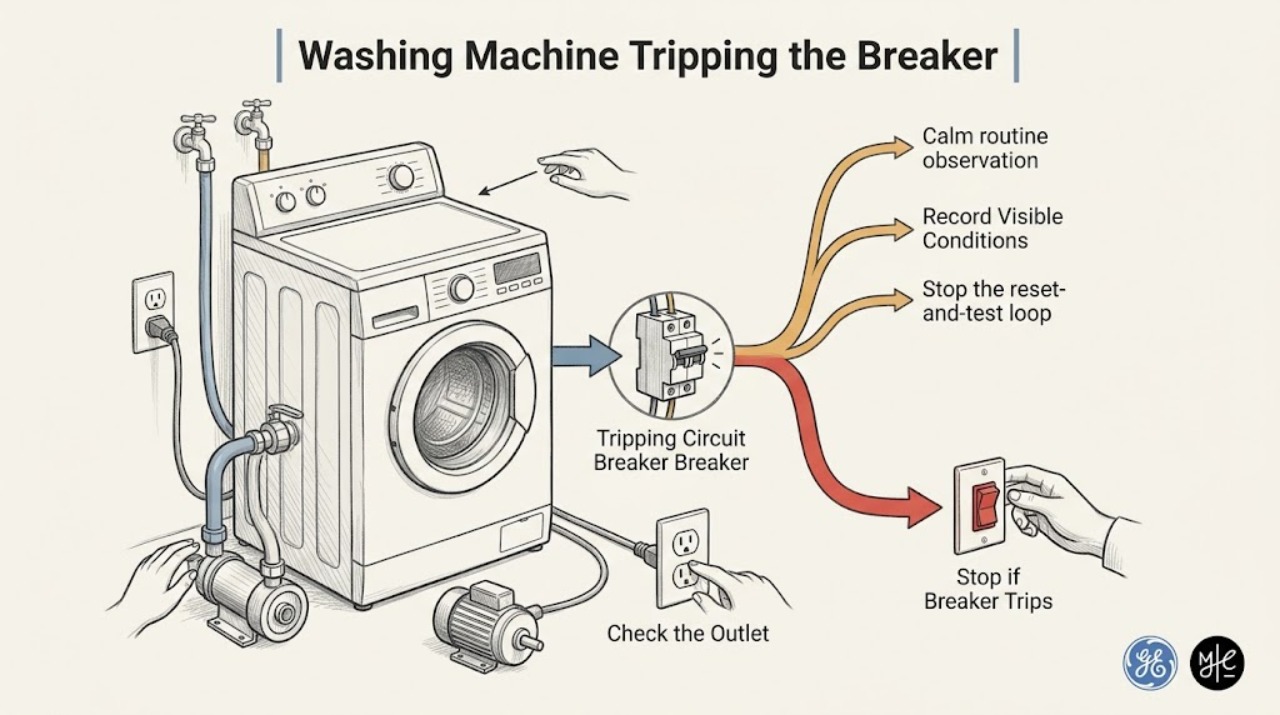
Work through in order
Diagnostic checks
Use only checks that match the exact appliance or system and its official guide.
-
Record exactly when the breaker trips
Without starting another cycle, read the washer display from a safe position and record the model label, front-load or top-load design, any code, and the last state before the breaker opened. Note whether the trip was immediate at plug-in, at power-up, during fill, wash, drain, or spin; washer-dryer models should also note whether heat or drying was selected.
Expected result: The event is reproducible only in your notes, or its timing is known to be immediate, water-related, motor-related, or tied to a combo-unit heating/drying phase.
Next step: Keep the washer out of service and give the phase, model, code, and recent move, cleaning, leak, or installation history to the appropriate electrician or appliance technician.
Stop if: Do not restart a cycle to reproduce the trip, repeatedly reset the breaker, or make a live measurement.
Why this matters
Why: The phase narrows the handoff: an immediate trip points toward supply or input protection, a fill/drain trip adds water-path and pump branches, and a spin or heat-phase trip adds motor, drive, or model-specific heating branches. A note is safer and more useful than repeated operation.
-
Stop the reset-and-test loop
From a dry, stable position, leave the washer switched off. If the plug, floor, and receptacle are dry and cool and it is safe to reach them, isolate the appliance using the normal plug or circuit control; otherwise keep away and have an electrician isolate it. Do not use an extension cord, power strip, adapter, or another improvised supply.
Expected result: The appliance remains isolated without touching a wet or heat-damaged connection, or the connection cannot be safely reached because of water, heat, damage, or arcing.
Next step: If the connection cannot be safely isolated, or if the breaker will not stay set without the washer connected, leave it alone and contact a qualified electrician or building maintenance.
Stop if: Do not reset the breaker repeatedly, hold it in, replace its rating, bypass a ground, or touch a wet, hot, scorched, loose, or arcing plug or receptacle.
Why this matters
Why: Safe isolation prevents another fault current event. LG specifically cautions that power strips and extension cords can increase the chance of a trip and recommends direct wall connection; it does not make a repeatedly tripping washer safe to keep operating.
-
Inspect the plug, cord, and outlet without opening anything
With power isolated and only from ordinary safe access, look at the visible cord, plug face, and receptacle for cuts, crushed insulation, looseness, discoloration, melted material, moisture, or signs of heat. Also note whether the washer had been sharing a strip or overloaded arrangement before the event; do not remove the outlet cover or test the outlet with another appliance.
Expected result: The connection is dry and visibly intact, or there is heat damage, a loose fit, discoloration, moisture, crackling, or other abnormal evidence.
Next step: Photograph the visible condition without touching it and request electrician assessment for outlet or circuit concerns; request appliance service as well when the washer is the only load associated with the trips.
Stop if: Stop immediately for smoke, burning smell, arcing, crackling, a hot plug or outlet, melted plastic, exposed conductor, moisture, or a breaker that trips again.
Why this matters
Why: A damaged or hot connection is an electrical fault boundary, not a washer troubleshooting step. A sound-looking connection does not clear hidden wiring or appliance faults, especially when the breaker trips again.
-
Look for a water event before the electrical event
From a dry position, inspect the floor and visible areas around the inlet hose and taps, dispenser, door gasket, drain hose, drain outlet, and lower access area. Do not pull the washer out over a wet floor and do not remove a drain filter or panel while water or electrical risk is present.
Expected result: There is no water, there is a localized dry stain, or there is active water near the cord, receptacle, base, or other electrical connection.
Next step: If the leak is active and the water valve is safely reachable without contacting wet electrical equipment, close it; otherwise keep clear. Photograph the location and arrange appliance service before further use.
Stop if: Stop for standing water, water entering the receptacle or appliance base, a wet plug or cord, a damaged gasket or hose, or any need to tilt, move, open, or drain the washer.
Why this matters
Why: LG lists the inlet connections, door gasket, dispenser, drain hose, drain filter, and drain backflow as possible leak locations. A leak close to electrical parts can explain a protection event, but the observation alone cannot identify an internal component.
-
Use the cycle phase to choose the service handoff
Compare the recorded phase with the washer's visible water and operating state; do not run a new cycle. Classify the event as immediate/power-up, fill, drain, spin, or a combo-unit heat/dry phase, and record whether the drum was moving, the pump was audible, or water was present before the trip.
Expected result: The notes point to one phase, or the phase is unknown because the washer lost power immediately.
Next step: Give the phase and observations to both service paths when uncertain: an electrician evaluates the circuit and a qualified LG appliance technician evaluates the washer. Do not infer a failed part from timing alone.
Stop if: Do not open the pump filter, bypass a door lock or safety device, remove panels, disconnect wires, or run the washer to prove the branch.
Why this matters
Why: Immediate trips need electrical and input-protection assessment; fill or drain timing adds inlet, leak, pump, and water-ingress possibilities; spin timing adds motor or drive load; a heating branch applies only when the exact LG model is a washer-dryer combo with that function.
-
Preserve the model and error evidence
Read the model and serial label without moving the machine, and photograph any displayed code, indicator, or breaker position from a safe location. Consult only the exact LG owner's or support guidance for that model; do not substitute a different model's electrical requirement or reset sequence.
Expected result: The model and code are legible, the display is blank after the trip, or the label cannot be reached without moving the washer or entering a wet or restricted area.
Next step: Send the model, code or blank-display state, trip phase, outlet observations, and leak evidence to the technician; let the technician obtain model-specific test instructions.
Stop if: Do not move the washer, remove a rear cover, access a control board, or use a model-specific reset as a way to defeat a repeated breaker trip.
Why this matters
Why: LG notes that general guidance can differ from the product, so the model controls any later service procedure. A blank display after a trip does not distinguish a supply fault from an appliance fault.
-
Escalate when the breaker trips again or a hazard is visible
Prepare a service handoff containing the model, circuit behavior, exact trip phase, whether any other load shared the circuit, photos of dry external conditions, and the presence or absence of water, heat, odor, smoke, or arcing. Keep the washer isolated while arranging qualified assessment.
Expected result: The washer is isolated and the handoff identifies a normal-looking connection, an electrical connection concern, a water event, or an unknown internal cause.
Next step: Use a qualified electrician for the receptacle, circuit, breaker, or building supply and a qualified LG appliance technician for the washer. For smoke or fire, leave the area and contact emergency services from a safe location.
Stop if: Do not reconnect the washer for a final test, make live electrical measurements, replace a breaker, bypass protection, or continue if smoke, burning odor, arcing, hot connections, or water near electricity is present.
Why this matters
Why: A repeat trip is not a successful reset. LG directs an apartment resident to maintenance and a house resident to an electrician when the breaker trips again; an appliance technician is needed when the washer itself is implicated.
Use your observations
Decision map
Find the observation that best matches what you see, then follow the next safe action.
-
PATH 01Safety boundary
What you see
The breaker opens as soon as the washer is connected or powered, before water enters.
Do this next
Keep the washer isolated and have the circuit assessed by an electrician and the appliance assessed by a qualified LG technician.
Why this path and its safety boundary
Why it matters: The event is consistent with a supply, cord, input-protection, or appliance electrical fault; timing does not identify which one.
Safety stop: Do not reconnect it to another outlet, use an extension cord, or repeatedly reset the breaker.
-
PATH 02Safety boundary
What you see
The trip is recorded while the washer is filling or shortly after water enters.
Do this next
Close the water valve only if it is safely reachable from a dry position, keep the washer out of service, and provide the leak location and timing to service.
Why this path and its safety boundary
Why it matters: Inlet connections, a leak, water ingress, or a component energized during fill are possible branches; external timing is not a component diagnosis.
Safety stop: Stop for water near the cord, outlet, base, or any electrical part, and do not pull the machine out or open it.
-
PATH 03Safety boundary
What you see
The breaker opens during draining or after the pump becomes audible.
Do this next
Keep the washer isolated, note whether water is on the floor or near the lower access area, and arrange qualified appliance service; use a plumber when the building drain is backing up.
Why this path and its safety boundary
Why it matters: A drain hose or drain backup, pump-area water, or an electrical fault associated with the drain phase is possible.
Safety stop: Do not open a pump filter or residual-water hose when the floor, plug, or appliance base is wet or the tub may contain hot water.
-
PATH 04Safety boundary
What you see
The trip happens during spin or when the drum accelerates, with no visible leak.
Do this next
Record load, movement, sound, and timing from the completed event, leave the washer isolated, and request appliance and circuit assessment.
Why this path and its safety boundary
Why it matters: Motor, drive, control, mechanical load, or circuit conditions may be involved; an absence of visible water does not clear the appliance or supply.
Safety stop: Stop for violent movement, metal-on-metal noise, smoke, burning odor, arcing, or a hot plug or outlet; do not run an empty-cycle test.
-
PATH 05Safety boundary
What you see
The event occurred during a heating or drying phase on a model that actually has washer-dryer heating functionality.
Do this next
Confirm the exact model and leave it isolated for model-specific appliance and circuit diagnosis.
Why this path and its safety boundary
Why it matters: A heating load, ventilation or moisture condition, circuit capacity issue, or appliance fault may be relevant; this branch does not apply to a washer-only model.
Safety stop: Do not infer that a washer-only model contains a heater, and stop immediately for smoke, scorching, burning odor, abnormal heat, or repeated trips.
-
PATH 06Safety boundary
What you see
The plug or receptacle is hot, wet, loose, scorched, cracked, arcing, or accompanied by smoke or a burning smell.
Do this next
Keep clear, do not touch the connection or reset the breaker, and contact an electrician or emergency services from a safe location as appropriate.
Why this path and its safety boundary
Why it matters: This is an electrical and fire-safety stop condition, not a washer test opportunity.
Safety stop: Do not unplug a hot, wet, sparking, or damaged connection and do not re-energize it.
Helpful context
Understand the symptom
The phase of the trip is useful evidence, not permission to keep testing
Write down what the washer was doing when the breaker opened: no-load standby, power-up, fill, wash, drain, spin, or—only for a washer-dryer combo—a heating or drying operation. A trip as soon as the plug is connected points toward the supply, cord, filter, or an appliance fault. A trip after water enters or when the pump starts points to a different branch than a trip when the motor accelerates. These observations help a technician without requiring live measurements or another run.
Keep the electrical check external
LG advises direct connection to a wall outlet and warns that extension cords or overloaded power arrangements can contribute to trips. Do not substitute a longer cord, power strip, adapter, or extension lead to make the symptom disappear. From a dry standing position, record the receptacle and plug condition, but do not remove an outlet cover, open the washer, probe a connector, or take a live voltage reading.
Water near power changes the decision
A leak can start at the supply connection, door gasket, dispenser, drain hose, drain filter, or a backed-up drain. Those locations are useful for an external observation, but a wet floor, plug, receptacle, cord, or washer base is not a normal troubleshooting state. If water may have reached electrical parts, keep clear, close the water supply only if it is safely reachable without touching wet electrical equipment, and arrange qualified help.
Safety boundary
Stop conditions
- Do not repeatedly reset the breaker or reconnect the washer to reproduce the fault.
- Do not use an extension cord, power strip, adapter, non-grounded outlet, or improvised circuit to test the washer.
- Do not open the washer, remove panels, probe live wiring, bypass a safety device, replace a breaker, or take live voltage measurements.
- Stop for water near the cord, receptacle, washer base, or other electrical equipment; close the water supply only when safely reachable from a dry position.
- Stop for a hot, wet, loose, scorched, cracked, or arcing plug or receptacle, exposed conductor, smoke, burning smell, or crackling.
- Stop for violent movement, damaged hoses, hot water, or a need to pull, tilt, or enter a wet or restricted area.
Only after diagnosis
Potential parts
- inlet valve or inlet hose assembly
Consider this category only if qualified diagnosis links a fill-phase trip or water leak to the inlet path and confirms the failed component.
Confirm the exact LG model and the technician's fitment diagnosis before ordering; do not replace a valve as a breaker-reset test. - drain pump assembly
Consider this category only if qualified diagnosis links a drain-phase trip or leak to a failed pump or pump housing after the drain path is assessed safely.
Confirm the exact LG model and pump design; do not open a wet pump area or substitute a part based on timing alone. - washer power cord or input protection component
Consider this category only after an appliance technician identifies damage or failure in the cord or input protection and the circuit has been assessed.
Use only the exact model-approved component installed by qualified service; never bypass protective parts or use an unverified cord.
When checks do not resolve it
Need a professional?
Arrange qualified service after a breaker trips again, whenever the washer is the only load associated with the event, or when the trip is linked to filling, draining, spinning, or a combo-unit heating phase. Use an electrician for the outlet, circuit, breaker, or building supply and a qualified LG appliance technician for the washer. Treat smoke, fire, arcing, burning odor, a hot or wet connection, exposed conductors, or water near electrical parts as an immediate stop condition; leave the area and contact emergency help from a safe location when needed.
Safety scope: This article supports dry, ordinary-access observation and safe documentation only. Do not repeatedly reset or reconnect the washer, use an extension cord, open the appliance or electrical panel, probe live parts, bypass protection, or move the machine through water.
Common questions
FAQ
Should I keep resetting the breaker when my LG washer trips it?
No. Record when the trip occurred, leave the washer out of service, and do not repeat the reset-and-run cycle. LG directs the reader to maintenance or an electrician when the breaker trips again; appliance service may also be needed when the washer is implicated.
Can I use an extension cord or power strip to see whether the LG washer still trips?
No. LG warns that extension cords and power strips can increase the likelihood of a trip and recommends a direct wall outlet. Do not change the supply arrangement as a test or use a non-grounded connection.
What if the breaker trips after I see water under the washer?
Keep the washer isolated and do not touch a wet plug, cord, receptacle, or base. If the water valve is safely reachable from a dry position, close it; otherwise keep clear and arrange qualified help. LG lists inlet, gasket, dispenser, drain hose, drain filter, and drain-backflow areas as possible leak locations, but the source requires service when water and electricity may be involved.
Does the trip timing prove that a particular LG washer part failed?
No. Immediate, fill, drain, spin, and combo-unit heating timing can prioritize different diagnostic branches, but it cannot prove a cord, pump, motor, control, heater, or circuit fault. Give the timing and model to an electrician and qualified appliance technician.
Read the exact guide
Official sources
- LG Washer - Circuit Breaker is TrippedLG USA Support · General LG washer guidance; exact model instructions control.
- LG Front Load Washing Machine Troubleshooting LeaksLG USA Support · Front-load LG washers and applicable washer-dryer combos; top-load designs and exact models may differ.
- LG Front load washing machine circuit breaker: The circuit breaker trips during twin washer use.LG USA Support · Relevant to LG washer installations with a twin-wash or shared-load arrangement; not proof that every LG washer has this configuration.
Community feedback
Share a repair observation
Share a plain-text repair observation. Accepted observations are published automatically; this page may take a moment to update.