
On this page
Start here
Quick answer
A Miele washing machine that trips a breaker is a stop-and-diagnose situation, not a reset-and-retry problem. Note whether the trip happens when the washer is switched on, when it fills, heats, drains, or begins spinning, and whether there is water near the plug or socket. Do not keep reclosing the breaker, use an extension cord, bypass protection, or open the washer. With power safely off, make only external observations of the plug, socket, dedicated circuit, hose leaks, and visible damage. Miele identifies breaker trips, heating faults, water leaks, and technical faults as separate paths; a heating, motor, pump, or control cause cannot be identified safely without model-specific service diagnosis. Smoke, burning smell, arcing, a hot or discolored outlet, wet electrics, a damaged cord, or a breaker that trips again means leave the washer out of service and obtain qualified electrical or appliance help.
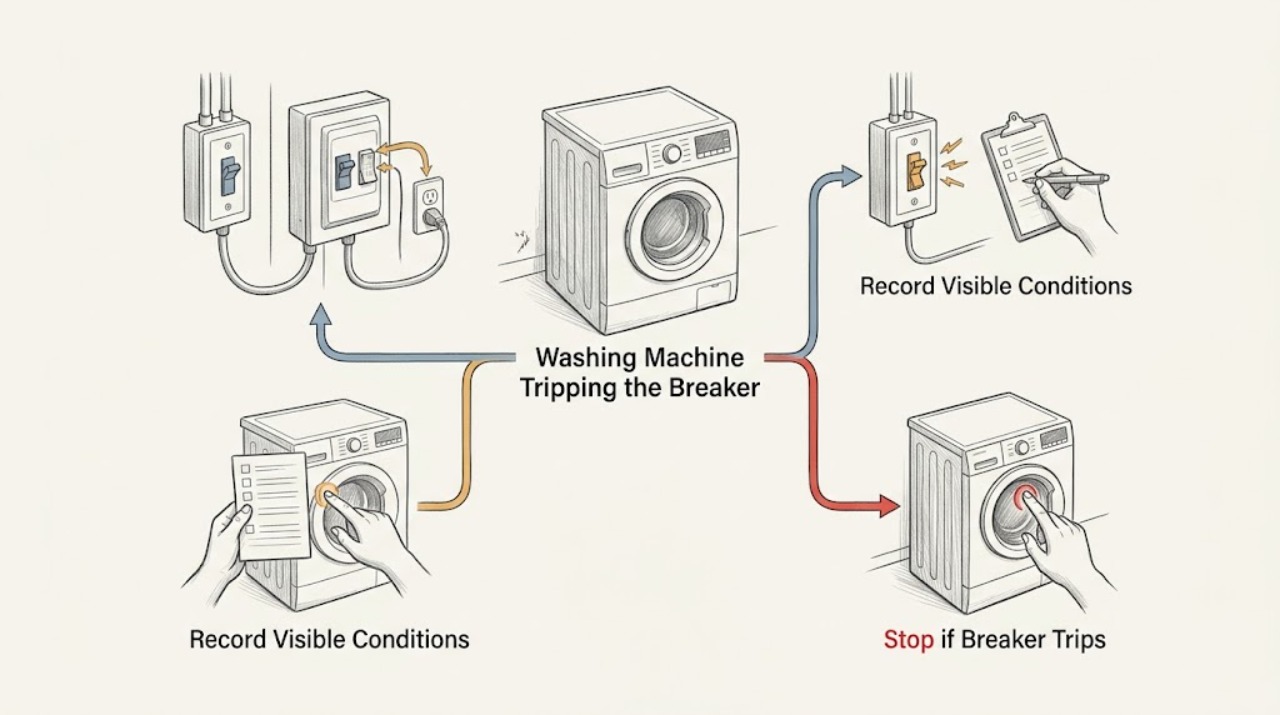
Work through in order
Diagnostic checks
Use only checks that match the exact appliance or system and its official guide.
-
Check 1
Stop the washer and do not reclose the breaker just to see whether it runs. If the trip is accompanied by smoke, burning smell, visible arc, hot or discolored plug or socket, shock, water near electrics, or a damaged cord, keep clear and arrange qualified emergency or electrical help. If there is a safe water supply shutoff, close it when water is entering or leaking.
Expected result: The breaker remains off, the area is wet or hot, the inlet cannot be shut off, or no visible hazard is present and the trip was isolated to the washer.
Next step: Leave the appliance disconnected and use qualified help for any hazard or repeat trip. Do not begin an internal diagnosis.
Why this matters
Why: A protection device that trips can be warning of an electrical fault, overload, or wet connection. CPSC treats arcing, overheating, odors, and repeated outages as warning signs; the absence of a visible sign does not make repeated testing safe.
-
Check 2
Record the exact Miele model, installation type, breaker or residual-current device involved, and when the trip occurred: on switch-on, at fill, during heating, while draining, when the drum began moving, or at another precise stage. Also note whether the display went dark, showed a fault, or remained lit.
Expected result: The trip is repeatable at a particular stage, occurs immediately on power-up, follows a leak, or affects the whole circuit rather than only the washer.
Next step: Give the full timing and display record to the electrician or Miele technician. Do not create a second trip to confirm the pattern.
Why this matters
Why: Timing separates external supply symptoms from model-specific load or component clues without proving that a heater, pump, motor, or control is defective. A dark display after a trip can simply reflect lost supply.
-
Check 3
With the circuit left off, inspect only the plug, cord, socket face, and any safely visible connection without moving the machine. Look for scorching, melting, looseness, moisture, corrosion, a damaged cord, or an outlet shared with other high-load appliances. Do not use an extension cord or substitute a higher-rated breaker.
Expected result: The plug or socket is hot, loose, wet, discolored, damaged, or the circuit serves several loads; alternatively, the external connection looks normal.
Next step: Do not use a suspect outlet or cord; arrange qualified electrical inspection. If the connection is normal, leave the washer off and continue only with non-powered, external observations.
Why this matters
Why: A hot, loose, damaged, or wet connection can be an electrical fire or shock hazard and cannot be cleared by a washer reset. A normal-looking connection does not rule out an internal washer fault.
-
Check 4
Inspect the floor, inlet hose connections, drain hose, lower access area, and underside only from an upright, stationary position. Look for fresh water, a Waterproof System or service message, a blocked or displaced drain path, or a leak that could have reached the electrical area. Do not tilt, pull out, or open the cabinet to search for a source.
Expected result: Water is present under or inside the washer, the inlet continues to flow, a leak appears during drain or fill, or the machine is dry and shows no water-related message.
Next step: Keep the inlet closed and power isolated when safe, and contact Miele Service for an internal leak or Waterproof System message. Use a qualified plumber for a site connection leak.
Why this matters
Why: Miele documents water protection and leakage as a distinct service condition. Water contacting electrical parts can make a breaker trip and creates a shock hazard; dry external surfaces do not prove the interior is dry.
-
Check 5
Use the model manual to classify the washer's visible symptom without powering it again: a heating-fault message, drain or pump message, door-lock message, dark display, or a generic technical-fault indication. Do not assume a heating, pump, motor, or control part is the cause from the timing alone.
Expected result: The exact Miele message maps to heating, door, drainage, leakage, or technical service guidance, or there is no usable message.
Next step: Report the exact code and stage to Miele Service. Do not remove parts or perform resistance, insulation, or live-voltage tests.
Why this matters
Why: Miele's pages show that different faults have different service paths. For example, a heating fault has a model-specific power-disconnection procedure, while a leakage fault is not a user-repairable condition.
-
Check 6
After the electrician or Miele technician confirms the circuit and appliance are safe, follow only the exact model's authorized return-to-service instruction. If a Miele page specifies one controlled reset for the displayed fault, perform that single reset under the stated conditions; never reset a breaker repeatedly or use a reset to bypass a trip.
Expected result: The washer completes the permitted check without a trip or abnormal odor, heat, leak, sound, or warning, or the breaker trips again or a fault returns.
Next step: Stop using the washer after any repeat trip or abnormal sign and give the technician the complete event record. Do not continue testing.
Why this matters
Why: A successful isolated restart does not establish that an intermittent fault is repaired. A repeat trip or returning fault confirms that further qualified diagnosis is needed.
Use your observations
Decision map
Find the observation that best matches what you see, then follow the next safe action.
-
PATH 01Next step
What you see
The breaker trips again, will not stay on, or any smoke, burning smell, arc, shock, hot outlet, or damaged cord is present.
Do this next
Do not reset or retest. Leave the washer out of service and contact a qualified electrician or emergency responders for fire or immediate danger.
-
PATH 02Next step
What you see
Water is near the plug or socket, the washer leaks, or Miele's Waterproof System or a leak-related fault appears.
Do this next
Close the water inlet if safely reachable, isolate power without touching wet electrical parts, do not tilt or open the cabinet, and contact Miele Service or qualified plumbing help.
-
PATH 03Next step
What you see
The trip occurs immediately when the washer is switched on and the display stays dark.
Do this next
Treat it as a supply or appliance electrical fault. Leave the breaker off, inspect only the external plug and socket, and arrange qualified electrical or Miele service.
-
PATH 04Next step
What you see
The trip occurs when heating begins or a Miele heating fault is displayed.
Do this next
Do not bypass the breaker or perform heater tests. Give Miele Service the exact code and stage; only the exact model's authorized power-disconnection path may be used by the user.
-
PATH 05Next step
What you see
The trip occurs during drain or spin and water remains, a door is locked, or the pump or motor makes an abnormal sound.
Do this next
Do not reach into a moving drum or open a filter with hot water. Leave the washer off and have Miele Service diagnose the drain, lock, motor, or suspension system.
-
PATH 06Next step
What you see
The external supply and washer remain dry, but the breaker trips only with this washer and no safe external cause is visible.
Do this next
Stop using the appliance. A component such as the heater, pump, motor, or control may be involved, but only model-specific qualified diagnosis should identify it.
Helpful context
Understand the symptom
The moment a washer trips protection, preserve the evidence instead of trying to make it finish a cycle. The trigger may occur at startup, when a water valve opens, during heating, when a pump runs, or as the drum starts; each timing pattern changes what a technician should inspect.
This guide is limited to safe external checks. Do not use an extension cord, defeat a breaker or residual-current device, remove cabinet panels, measure live voltage, or operate the washer with a wet or damaged electrical connection.
Common questions
FAQ
Should I reset the breaker when my Miele washing machine trips it?
Do not repeatedly reset it. Leave the breaker off and make only safe external observations. A qualified electrician or Miele technician should determine why it tripped, especially if it trips again.
Could a Miele washer leak cause a breaker trip?
It can be part of the risk path. Miele treats Waterproof System activation and leak-related faults separately; close the inlet, isolate power only without touching wet electrics, and contact service rather than testing the washer again.
Does a breaker trip prove the Miele washer's heater or motor is bad?
No. The trip timing can provide a useful service clue, but the heater, pump, motor, control, wiring, and external circuit require model-specific qualified diagnosis. Do not perform live or internal tests.
Read the exact guide
Official sources
- Miele Washer | Waterproof system activated appears in the washing machine display.Miele USA · Miele washer internal-leak detection and water-isolation guidance
- Miele Washer | The washing machine display shows fault F34, Door lock, contact Miele Service, or The door will not lock.Miele USA · Miele washer door-lock and overload fault guidance
- Miele Washer | The washing machine does not work. The display remains dark and no indicator light comes on.Miele USA · Miele washer no-power and breaker-trip guidance
- Miele Washer | Fault F220 appears on the washing machine display.Miele USA · Miele washer leak-related Fault F220 guidance
- Miele Washer | Fault F20 or Heating fault is shown on the display of the washing machine/washer-dryer.Miele USA · Miele washer heating fault and controlled power-disconnection guidance
- CPSC Guide to Home Wiring HazardsU.S. Consumer Product Safety Commission · Household electrical hazard recognition and qualified-service boundaries
- WWH 860-US-enMiele USA · Miele WWH 860 washing machine electrical, water, drain, and service safety instructions
- Miele Washer | Techn. fault, contact Service appears in the display on the washing machine/washer-dryer.Miele USA · Miele washer technical-fault recording and service guidance
Community feedback
Share a repair observation
Share a plain-text repair observation. Accepted observations are published automatically; this page may take a moment to update.