
On this page
Start here
Quick answer
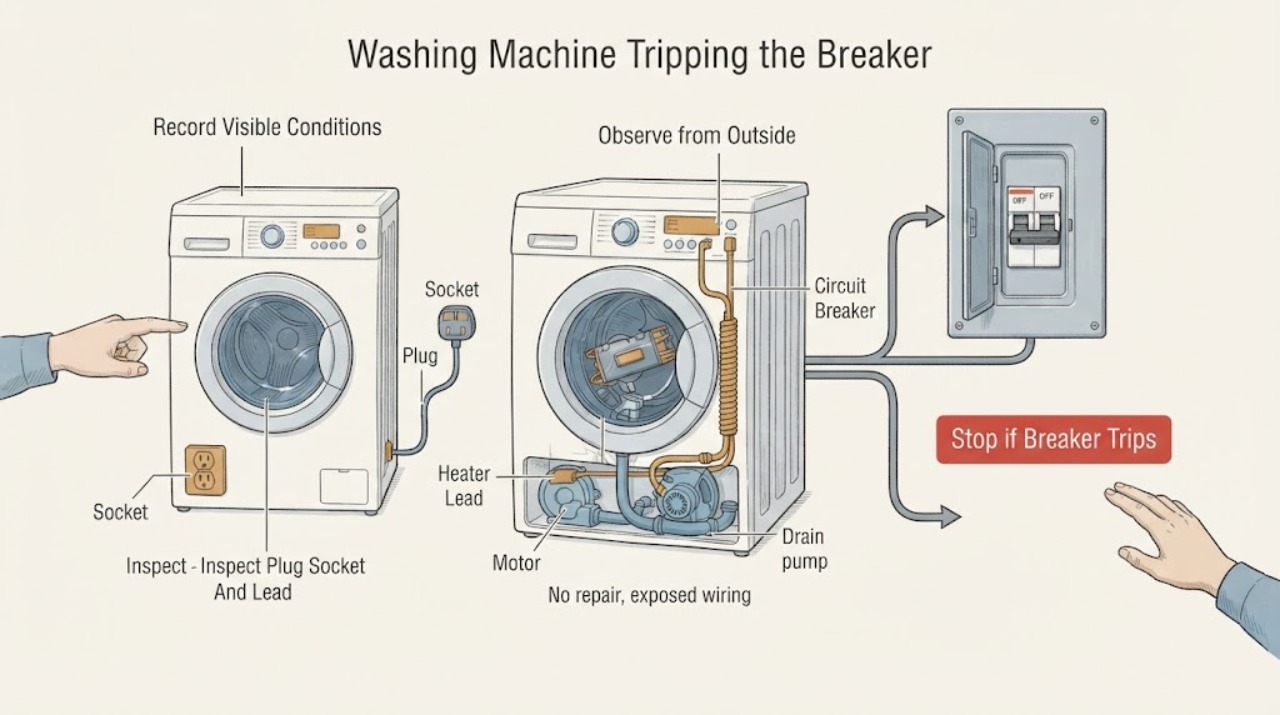
Stop using the Hotpoint washer after a breaker or RCD trip until you know whether the fault is in the appliance or the electrical installation. Do not repeatedly reset the breaker, bypass the protection, use an extension lead, or run another cycle to test it. From a dry safe position, isolate the washer if possible, then record whether the trip happened on plug-in, filling, heating, tumbling, draining, or spinning. When everything is cool and dry, make only a visual check of the plug, socket, lead, visible hoses, and drain route. Burn marks, arcing, a hot or melted plug or socket, smoke, water near electrical equipment, or an immediate repeat trip require the washer to remain disconnected and a registered electrician or qualified appliance technician to investigate.
Work through in order
Diagnostic checks
Use only checks that match the exact appliance or system and its official guide.
-
Check 1
Stop the programme and do not reset the breaker repeatedly. If the floor and electrical area are dry, isolate the washer from a safe position; if water is present near the plug, socket, or wiring, stay clear and isolate power only from a dry safe position. Record whether the trip was an RCD, circuit breaker, or fuse event if you can identify it without opening the panel.
Expected result: The protection trips immediately, only when the washer is connected, or only after the cycle has begun; water or an electrical hazard may also be present.
Next step: Keep the washer disconnected and move to a dry visual inspection only when no hazard is present. For water near electricity, smoke, arcing, melting, or a repeat trip, arrange qualified electrical or appliance help without another test cycle.
Stop if: Stop for smoke, flame, sparks, crackling, burning odor, melted plastic, water near electrical equipment, or an immediate repeat trip.
Why this matters
Why: An immediate trip can involve the supply path or an appliance fault, while a stage-specific trip helps narrow the circuit that is active. A wet or visibly damaged electrical area makes further checks unsafe regardless of timing.
-
Check 2
Once the washer is safe and cool, write down the programme, temperature, load, and exact point of failure: plug-in, start, filling, heating, tumbling, draining, or spinning. Note whether the drum was turning, whether the pump was running, whether the door was locked, and whether the trip happened once or on each attempt.
Expected result: The trip repeats at a particular stage, follows a pause or retained water, occurs only with a certain programme, or cannot be tied to a stage.
Next step: Give the timing and programme details to service and choose the matching branch below. Do not repeat a hazardous cycle just to obtain a more precise stage.
Stop if: Stop if the door remains locked over water, the washer stays hot, the circuit trips again, or any odor, smoke, spark, leak, or unusual noise appears.
Why this matters
Why: The active stage changes which systems are plausible: heating, motor movement, and drain pumping occur at different times. A programme-specific pattern is useful evidence but cannot identify a part without model and electrical testing.
-
Check 3
With the washer disconnected and the area completely dry, look at the plug, socket face, and accessible lead without removing covers. Check for scorch marks, cracks, soft or melted plastic, discoloration, crushed insulation, exposed wire, looseness, moisture, or a socket that feels unusually warm. Do not use an extension lead to bypass the socket and do not touch damaged parts.
Expected result: Damage or heat is visible at the plug, socket, or lead, or all visible supply parts look normal.
Next step: Leave a damaged, warm, wet, or discolored supply path unused and arrange a registered electrician or qualified appliance technician. If it looks normal, continue with external water-path and load observations while keeping the washer disconnected.
Stop if: Stop for scorch marks, arcing sounds, melting, exposed conductors, a wet or warm socket, a loose connection, smoke, or any need to open the plug or socket while uncertain.
Why this matters
Why: Localized damage can indicate a dangerous connection, overload, or appliance fault and needs professional assessment. A normal visual supply check does not rule out an internal fault or an installation problem.
-
Check 4
When the washer is cool, disconnected, and on a dry floor, inspect the visible inlet hose, tap connections, drain hose, standpipe or waste connection, and the area under and behind the machine for moisture. If the drum is empty and the exact manual allows it, use the manual's safe filter procedure with a container; never remove a filter against hot or retained water.
Expected result: There is a leak, moisture near electrics, a kinked or displaced drain hose, retained water, a pump or waste-path indication, or no visible water-path issue.
Next step: Keep water closed where appropriate and correct only an obvious dry external hose position under the manual. Keep the appliance off for retained water, internal moisture, or any wet electrical area and request qualified repair.
Stop if: Stop for pooled or sewage-contaminated water, a full drum, a locked door, water near electricity, rapid leakage, or any need to access a wet filter, pump, hose, or cabinet.
Why this matters
Why: Water can create a shock or leakage path and can also leave a programme stalled at drain. A blocked-looking drain route may be user-checkable only under the model manual; water beneath the cabinet may require internal diagnosis.
-
Check 5
Without reconnecting the washer, review the last load and programme: note whether the drum was tightly packed, the load was badly distributed, the machine rocked, the drum failed to turn, or a motor hum or abnormal mechanical sound preceded the trip. Do not force the drum or remove any cover.
Expected result: The trip followed heavy movement or spin, an overloaded or unbalanced load, a stalled drum, a motor sound, or none of these conditions.
Next step: Follow the exact manual's load and leveling guidance only when the appliance is safe and disconnected. For a stalled drum, repeated trip, motor-area heat, odor, or abnormal sound, keep it out of service and arrange repair.
Stop if: Stop for severe rocking, impact noise, burning odor, smoke, sparks, repeated trips, or any need to reach into moving or energized machinery.
Why this matters
Why: A load or installation issue can interrupt spin, but it does not explain a hot plug, melted plastic, smoke, or repeated electrical trips. A stalled drum or motor-related indication can narrow the service diagnosis without proving the motor is the failed part.
-
Check 6
Record every displayed or flashing code exactly, plus the model, temperature, and cycle stage, without clearing the indication. Compare it with the exact Hotpoint manual or model support page. Do not perform a live test, bypass protection, or assume a code identifies a replaceable part.
Expected result: A code or flashing pattern accompanies heating, a pause, drain, motor movement, or an immediate loss of power; no code may also be present.
Next step: Give the exact code, model, stage, and circuit behavior to qualified service. Follow a reset only when the exact manual explicitly permits it and no safety symptom was present; never use a reset to defeat a repeat trip.
Stop if: Stop for any persistent code with a trip, uncontrolled heat, retained water, a locked door, smoke, burning odor, sparks, or a request to bypass a protective device.
Why this matters
Why: Hotpoint's published examples associate F03 with temperature sensing, F07 and F08 with electronic or heater fault areas, F11 with a pump circuit, and F02 with the motor circuit. These are model guidance clues, not permission to keep running a washer that trips.
-
Check 7
Do not reconnect the washer merely to compare outlets. If a qualified person has confirmed the area is dry and safe, record whether other appliances also cause the same protective device to trip and whether the washer's socket or circuit shows a separate issue; do not open the consumer unit or alter wiring yourself.
Expected result: The protection trips with other loads, only with the washer, only at one socket, or the pattern is unknown.
Next step: Leave the washer disconnected and have a registered electrician assess the circuit when the pattern implicates the installation; have a qualified appliance technician assess the washer when the fault follows it. Do not use another outlet as a workaround.
Stop if: Stop immediately for any repeat trip, hot socket, arcing, visible damage, water, smoke, odor, or any need to alter wiring or protective settings.
Why this matters
Why: Trips with other loads or at one socket can indicate wiring, socket, overload, or protective-device trouble. A washer-only trip can indicate an appliance fault, but both the appliance and installation may need assessment.
Use your observations
Decision map
Find the observation that best matches what you see, then follow the next safe action.
-
PATH 01Next step
What you see
The breaker or RCD trips immediately, trips again on reconnection, or there is smoke, arcing, a burning smell, melting, scorching, or a hot plug or socket.
Do this next
Arrange qualified service and follow the exact model guidance.
Why this path and its safety boundary
Why it matters: Do not reset or reconnect the washer. Isolate power only from a dry safe position, keep clear, and arrange a registered electrician or qualified appliance technician to investigate the appliance and circuit.
-
PATH 02Next step
What you see
Water is pooled, leaking, retained behind a locked door, or close to the plug, socket, cord, or wiring.
Do this next
Arrange qualified service and follow the exact model guidance.
Why this path and its safety boundary
Why it matters: Do not stand in water or touch the electrical connection. Isolate power only from a dry safe position, close the water supply if safe, and arrange qualified help; do not open a wet filter or cabinet.
-
PATH 03Next step
What you see
The trip repeats when a selected wash programme reaches its heating stage, without a supply-path hazard being visible.
Do this next
Arrange qualified service and follow the exact model guidance.
Why this path and its safety boundary
Why it matters: Keep the washer disconnected and report the exact model, programme, temperature, timing, and any code. Hotpoint heater, heater-control, or temperature-sensing guidance is model-specific; do not keep testing or replace a heater based on timing alone.
-
PATH 04Next step
What you see
The trip occurs when the drum starts or accelerates, especially with a stalled drum, heavy movement, motor sound, or an F02-type model indication.
Do this next
Arrange qualified service and follow the exact model guidance.
Why this path and its safety boundary
Why it matters: Keep the washer off. Record the load and movement symptoms, follow only safe load guidance from the manual, and request qualified diagnosis for a motor, drive, control, or installation fault.
-
PATH 05Next step
What you see
The trip occurs while draining or the machine leaves water inside, runs the pump continuously, or shows a drain or pump indication.
Do this next
Arrange qualified service and follow the exact model guidance.
Why this path and its safety boundary
Why it matters: Keep power isolated and do not open the filter against retained water. Use only the exact manual's safe drain procedure; a persistent drain or pump fault needs qualified service.
-
PATH 06Next step
What you see
Other appliances also trip the protective device, the socket is hot or damaged, or the pattern changes with the household load.
Do this next
Arrange qualified service and follow the exact model guidance.
Why this path and its safety boundary
Why it matters: Treat the circuit, socket, overload, or protective device as part of the fault boundary. Leave the washer disconnected and have a registered electrician assess the installation; do not move the washer to another outlet as a workaround.
-
PATH 07Next step
What you see
There was one trip with no visible damage, no water, and no repeat pattern, but the cause is still unknown.
Do this next
Arrange qualified service and follow the exact model guidance.
Why this path and its safety boundary
Why it matters: Do not assume the appliance is cleared. Keep a record of the programme and conditions, follow the exact Hotpoint manual, and arrange qualified advice before normal unattended use; stop immediately if the protection trips again.
Helpful context
Understand the symptom
Treat a breaker trip as a safety signal
A breaker or RCD interrupts power because it detected an overload, leakage, or another electrical fault. Do not keep resetting it to see whether the washer will finish. Press stop if the controls still respond, keep clear of water, and isolate power only from a dry safe position. If there is smoke, flame, crackling, a burning smell, visible arcing, scorching, melting, or water near the plug or socket, leave the washer off and arrange urgent qualified help.
The moment of the trip is the main clue
Record whether the trip occurred as soon as the washer was plugged in, when the inlet valve filled the machine, during heating, when the drum began to tumble or spin, or while the pump drained. A trip at one repeatable stage may point a technician toward a supply, heater, motor, or pump circuit, but timing does not prove which component failed. A trip that affects other appliances or occurs with the washer disconnected may belong to the household wiring or protective device rather than the washer.
Use only cool, dry, non-invasive checks
After isolation and cooling, inspect the plug, socket face, lead, visible fill hose, drain hose, and floor around the washer. Do not touch a scorched or wet electrical part, substitute an extension lead, bypass a breaker, open the cabinet, or perform a live test. If water remains in the drum, follow only the exact model handbook's safe drain instructions; do not open a filter or door against retained water.
When to stop without further testing
The washer is not a safe test load after an immediate repeat trip, hot or damaged plug, water near electrics, smoke, burning odor, sparks, or a melted control area. Keep it disconnected and tell the technician the model, trip stage, circuit behavior, visible damage, water level, and any code. A qualified person can distinguish an appliance fault from wiring, socket, or protective-device trouble without asking you to defeat the protection.
Safety boundary
Stop conditions
- A breaker, RCD, or fuse trips again when the washer is connected or started; never bypass or repeatedly reset the protection.
- Smoke, flame, sparks, crackling or arcing, burning or melting odor, scorch marks, melted plastic, or a hot or damaged plug, socket, cord, or control area.
- Water is pooled, leaking rapidly, retained behind a locked door, or near the plug, socket, wiring, or another electrical appliance.
- A stalled drum, severe rocking, abnormal impact or motor noise, uncontrolled heat, or a trip during heating, movement, or draining.
- Any need to open the cabinet, alter wiring, perform a live test, defeat a door lock, change protective settings, or use another outlet as a workaround.
- The cause remains unclear after a safe visual review or the symptom returns during any authorized check.
Only after diagnosis
Potential parts
- washing machine heater assembly
Consider this category only when the exact model guidance and qualified diagnosis link a repeatable heating-stage trip to the heater circuit; a breaker trip alone does not identify this part.
Confirm the complete model identifier, heater configuration, rating, and safe replacement procedure before selecting any component. - washing machine drain pump or pump-path component
Consider this category only when a drain-stage trip, retained water, or model-specific pump indication is confirmed and a qualified check identifies the failed component.
Confirm the model, pump configuration, hose routing, and safe water-removal method; do not open a wet machine to test fit. - washing machine motor or drive component
Consider this category only after a qualified diagnosis links a repeatable movement-stage trip or motor indication to a failed drive component.
Confirm the exact model and drive arrangement; do not infer fit or replace an internal motor from a load symptom alone.
When checks do not resolve it
Need a professional?
The washer trips the breaker or RCD more than once, trips immediately, or affects other appliances or the household circuit., The plug, socket, cord, or cabinet is hot, scorched, discolored, melted, wet, or associated with crackling, smoke, or a burning smell., Water remains in the drum, the door is locked, the machine leaks, or the drain or pump stage is associated with the trip., The trip occurs during heating, drum movement, or spinning, or a Hotpoint code points toward heater, sensor, motor, pump, or control fault areas., The cause is unclear and the appliance would need another powered cycle, a live test, internal access, or a protective-device reset to continue.
Common questions
FAQ
Why does my Hotpoint washing machine keep tripping the breaker?
The trip may involve the washer, its plug or socket, the household circuit, or a fault that appears when heating, moving, or pumping. Record the exact stage and keep the washer disconnected. Repeated trips, water, heat, smoke, arcing, or visible damage need qualified electrical or appliance assessment.
Should I reset the breaker and try the washer again?
Do not repeatedly reset the breaker or use another outlet as a workaround. If the washer trips again, trips immediately, or shows any odor, spark, heat, melting, smoke, or water near electrics, leave it disconnected and arrange qualified help. A single event without visible danger still needs a record and cautious model-specific advice before normal use.
What if the breaker trips when the washer starts heating?
Keep the washer off and record the programme, temperature, model, and any code. Hotpoint lists model-specific temperature-sensing, heater, and heater-control fault areas, but timing alone does not prove a failed heater. Do not run more cycles or perform a live test; request qualified diagnosis.
Can water cause a Hotpoint washer to trip the breaker?
Water near electrical equipment can create a serious shock and fault risk, while retained water can also indicate a drain or pump problem. Do not stand in pooled water or touch a wet connection. Isolate power only from a dry safe position, close the water supply when safe, and do not open a wet filter or cabinet.
When should an electrician check the washer circuit?
Have a registered electrician investigate when the protection trips with other appliances, the socket is hot or damaged, the pattern follows one circuit, or the RCD keeps tripping even with the washer disconnected. A qualified appliance technician may also need to assess the washer; do not alter wiring or protective settings yourself.
Read the exact guide
Official sources
- Washing Machine Error Codes Troubleshooting Guide - Hotpoint - HotpointHotpoint · Hotpoint washing machine heater, temperature, motor, pump, electronic, and water-related fault-code guidance
- Washing Machine Troubleshooting - Quick fixes & Tips - Hotpoint - HotpointHotpoint · Hotpoint washing machine power isolation, supply, drain, load, door, and model-manual troubleshooting guidance
- Plugs and fusesElectrical Safety First · Safe visual checks for disconnected plugs, leads, fuses, overheating, melting, discoloration, and circuit protection
- FAQ for Electrical Safety - Your Questions AnsweredElectrical Safety First · Electrical protection trips, RCD concerns, arcing, burn marks, and registered electrician investigation guidance
- Electrical Safety Advice for Washer Machines / Washing Machines SafetyElectrical Safety First · Washing machine plug, socket, lead, circuit-breaker, arcing, overheating, extension-lead, and safe-use guidance
Community feedback
Share a repair observation
Share a plain-text repair observation. Accepted observations are published automatically; this page may take a moment to update.