
On this page
Start here
Quick answer
Stop using the Maytag washer after a breaker trips, especially if it trips again, and do not keep resetting it to test the machine. From a dry position, note when the trip occurs, inspect only the accessible plug, cord, outlet, and surrounding floor for visible damage or water, and confirm the washer is on the grounded, dedicated supply specified for its model with no extension cord. A trip during filling, washing, draining, spinning, or an optional heated function gives a technician a useful symptom but does not identify a part by itself. If there is smoke, a burning smell, arcing, a hot outlet, standing water near electrical equipment, or a wet plugged-in appliance, leave it off and obtain qualified electrical or appliance help.
Before you begin
Safety first
- Do not repeatedly reset the breaker, use an extension cord, bypass protection, open the washer or electrical hardware, probe live wiring, or operate a wet or damaged appliance.
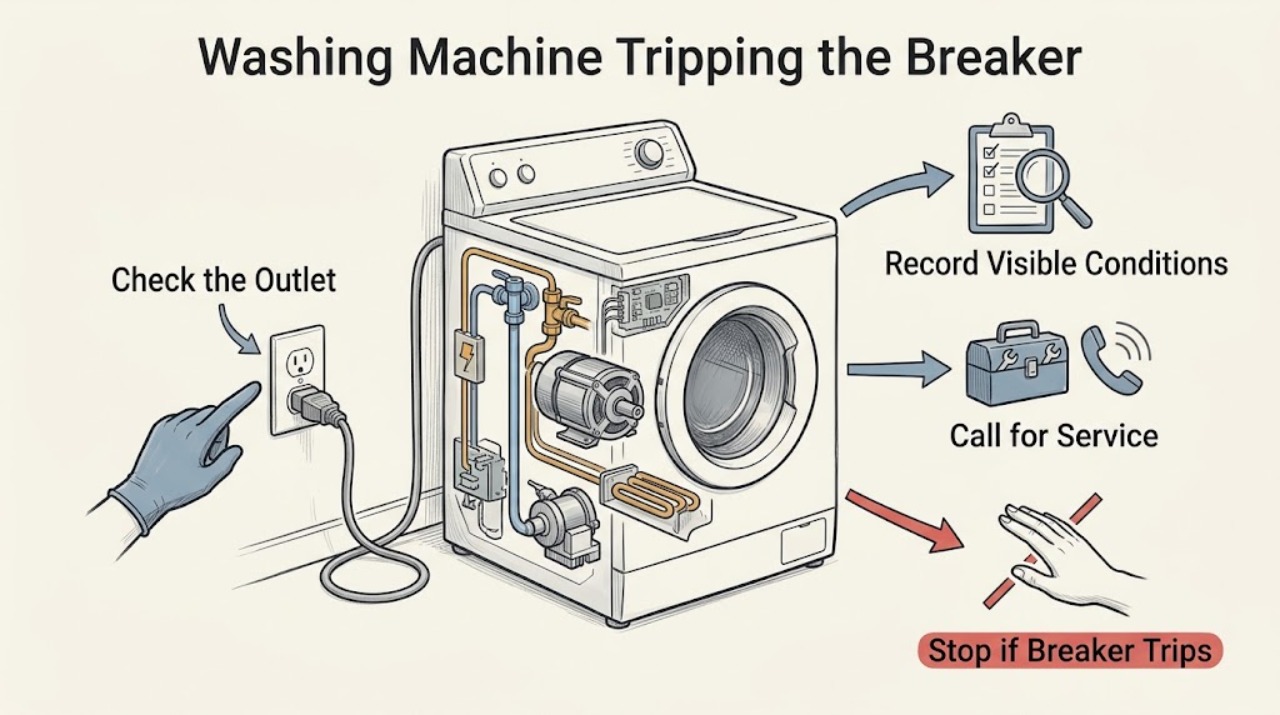
Work through in order
Diagnostic checks
Use only checks that match the exact appliance or system and its official guide.
-
Check 1
Leave the washer off after the breaker trips and look from a dry standing position for smoke, a burning or electrical smell, sparks, arcing, a hot or discolored outlet, a damaged cord, or water around the washer and electrical connection. Do not touch a wet appliance or try another reset.
Expected result: There is an active hazard, or the area and the washer appear dry with no visible damage or unusual odor.
Next step: For any active hazard, keep away and obtain qualified help; only if the area is dry and hazard-free, record the symptom without restarting the washer.
Stop if: Stop for wet surfaces, a wet plugged-in appliance, exposed conductors, heat, smoke, odor, sparks, or any need to move the appliance to reach wiring.
Why this matters
Why: Smoke, heat, arcing, damage, or water can make the situation unsafe for ordinary troubleshooting; a dry visual check only means that the next low-risk observation may be possible and does not clear an internal fault.
-
Check 2
Write down the selected cycle, display or error indication, washer type, load condition, and the exact point at which the breaker opens: immediately on power-up, during filling, wash or tumble, drain, spin, or a model-specific heated function.
Expected result: The trip repeats at one phase, happens as soon as the washer is energized, or is inconsistent and cannot be tied to a phase.
Next step: Give the timing, model number, cycle, load, and any displayed code to the electrician or appliance technician; do not run extra cycles to make the pattern repeat.
Stop if: Stop if identifying the phase would require restarting a washer that has tripped repeatedly or has any safety warning sign.
Why this matters
Why: A repeatable phase is a useful service clue for the circuit or the component active at that phase; an immediate or inconsistent trip keeps both the household supply and multiple internal circuits in scope.
-
Check 3
From a dry position, visually inspect the accessible plug, cord, and outlet face for looseness, scorching, melting, cracking, moisture, or an unusual gap; confirm that the washer is not connected through an extension cord, power strip, or adapter. Do not pull the appliance out or remove an outlet or cover.
Expected result: The plug, cord, or outlet is damaged, hot, wet, loose, or incorrectly extended, or the accessible connection looks intact and matches the installation instructions.
Next step: Keep the washer off and arrange an electrician for a damaged or uncertain outlet, cord, grounding, or circuit; do not substitute an extension cord or higher-rated protection.
Stop if: Stop for a hot or discolored outlet, damaged insulation, exposed metal, moisture, buzzing, or any need to open electrical hardware.
Why this matters
Why: Damage or an unsuitable connection can be an electrical hazard and requires qualified electrical assessment; an intact appearance does not rule out a supply, grounding, or internal washer fault.
-
Check 4
Use the Maytag installation instructions for the exact model to identify the required grounded outlet and circuit arrangement, and note whether other high-load appliances share that circuit. Do not change breaker size, wiring, grounding, or outlet hardware yourself.
Expected result: The washer is on a grounded supply serving only it as recommended, or the circuit, grounding, breaker rating, or recent installation is uncertain or does not match the manual.
Next step: Have a qualified electrician assess the circuit when its rating, grounding, shared load, or recent work is uncertain; give an appliance technician the circuit findings if the installation checks out.
Stop if: Stop for an improvised adapter, extension cord, repeated breaker operation, uncertain grounding, or any request to bypass protection.
Why this matters
Why: Maytag's general guidance calls for a model-correct supply and recommends a separate circuit; an uncertain or mismatched installation can trip independently of a washer part, while a correct-looking circuit still needs appliance diagnosis if the trip persists.
-
Check 5
Without touching electrical parts, look for a fresh puddle, hose or door-seal leak, water under the cabinet, a wet wall or floor, or water that could have reached the outlet or washer base. If it is safe to reach a separate water shutoff without stepping in water, close it and document where and when the leak appeared.
Expected result: Water is near the appliance or electrical connection, or the surrounding floor and connection are dry with no visible leak.
Next step: Do not operate a wet washer; keep people away from the water and obtain qualified electrical or appliance assessment. If dry, continue recording the trip phase without a test run.
Stop if: Stop for standing water, a wet plugged-in washer, water inside an outlet or panel, or any need to move the washer while the floor is wet.
Why this matters
Why: Water near energized equipment creates shock and fire risk and may have affected wiring or protection; a dry exterior reduces that particular concern but does not explain a breaker trip on its own.
-
Check 6
When the washer is fully stopped and safe to access, record whether the load was unusually heavy, tightly packed, or visibly unbalanced, and whether the last attempt involved severe shaking, a motor hum, a stalled basket, or an unusual pump sound. Do not reach into a moving basket or remove panels.
Expected result: The trip coincided with severe imbalance or a stalled or abnormal mechanical sound, or there was no such clue and the trip occurred before movement.
Next step: Report the load and sound observations and keep the washer out of service after a breaker trip; do not use an empty cycle as a repeated electrical test.
Stop if: Stop for violent movement, metal-on-metal noise, a jammed basket, a burning smell, or any need to reach internal moving or electrical parts.
Why this matters
Why: Maytag notes that an out-of-balance load can cause movement, noise, vibration, reduced spin, and a stop during spin; those observations can help a technician separate a cycle/load event from an electrical event but do not authorize internal repair.
-
Check 7
Only when the washer and surrounding area are dry, no hazard was observed, and the breaker has not been repeatedly opening, follow the exact Maytag model manual for one power-cycle reset; do not use a reset to continue a known breaker fault or to defeat a protection device.
Expected result: The washer remains stable after the single model-approved reset, or the breaker opens again immediately or during the same phase.
Next step: If it trips again, leave the washer off and arrange qualified service. If it remains stable, do not run repeated tests; monitor only as the manual permits and stop at the first recurrence.
Stop if: Stop before any reset when there is water, smoke, odor, heat, damage, arcing, repeated trips, or uncertain electrical work.
Why this matters
Why: A stable reset can clear a temporary control interruption but does not prove the circuit or washer is safe; another trip confirms that continued testing is inappropriate.
-
Check 8
Arrange qualified appliance service and, when the circuit or outlet is uncertain, qualified electrical service; provide the Maytag model number, washer type, circuit observations, exact trip phase, display code, load, water findings, and whether one safe reset changed the symptom.
Expected result: The breaker trips again, the installation is uncertain, or the washer remains out of service after the safe external checks.
Next step: Keep the washer disconnected or otherwise out of service as directed by the qualified professional, and do not buy or replace a part based only on a breaker-trip symptom.
Stop if: Stop all user troubleshooting for repeated trips, water or electrical damage, smoke, burning odor, arcing, hot hardware, or internal access.
Why this matters
Why: The remaining possibilities include the household circuit, grounding, water-related damage, or a model-specific valve, pump, motor, heater, control, or wiring fault that cannot be identified safely from the symptom alone.
Use your observations
Decision map
Find the observation that best matches what you see, then follow the next safe action.
-
PATH 01Next step
What you see
Smoke, burning smell, sparks, arcing, a hot or scorched outlet, exposed conductors, or a damaged cord is present.
Do this next
Arrange qualified service and follow the exact model guidance.
Why this path and its safety boundary
Why it matters: Do not touch, reset, unplug, or operate the washer or nearby electrical equipment; keep clear and obtain qualified emergency, electrical, or appliance help according to local safety guidance.
-
PATH 02Next step
What you see
Standing water, a wet washer, or a leak has reached the outlet, cord, appliance base, or electrical area.
Do this next
Arrange qualified service and follow the exact model guidance.
Why this path and its safety boundary
Why it matters: Keep away from the wet plugged-in equipment and do not operate it; have the affected electrical equipment and appliance evaluated before use.
-
PATH 03Next step
What you see
The outlet, grounding, breaker arrangement, shared circuit, or extension connection does not match the model installation requirements or is uncertain.
Do this next
Arrange qualified service and follow the exact model guidance.
Why this path and its safety boundary
Why it matters: Leave the washer off and have a qualified electrician assess the supply; do not install a larger breaker, alter wiring, or bypass protection.
-
PATH 04Next step
What you see
The breaker opens immediately when the washer is energized, before filling or movement.
Do this next
Arrange qualified service and follow the exact model guidance.
Why this path and its safety boundary
Why it matters: Do not repeat the power-up; document the immediate timing and arrange electrical and appliance diagnosis because both the supply and the washer input circuit remain possible.
-
PATH 05Next step
What you see
The breaker opens during filling or draining, with a leak, pump sound, or water-related symptom.
Do this next
Arrange qualified service and follow the exact model guidance.
Why this path and its safety boundary
Why it matters: Keep the washer off, close the water supply only if it can be reached safely from a dry position, and have the water path, pump, supply, and electrical protection checked by a qualified professional.
-
PATH 06Next step
What you see
The trip occurs at spin or with violent shaking, a stalled basket, or an abnormal mechanical sound.
Do this next
Arrange qualified service and follow the exact model guidance.
Why this path and its safety boundary
Why it matters: Do not run another cycle; provide the load, vibration, and sound details for service. Maytag's unbalanced-load guidance does not establish that imbalance caused an electrical trip.
-
PATH 07Next step
What you see
The breaker opens again after a reset or after a previous trip.
Do this next
Arrange qualified service and follow the exact model guidance.
Why this path and its safety boundary
Why it matters: Stop all testing and leave the washer off; arrange qualified electrical and appliance diagnosis instead of repeatedly restoring power.
-
PATH 08Next step
What you see
The area is dry, the accessible connection has no visible damage, and the event cannot be tied to an obvious installation issue.
Do this next
Arrange qualified service and follow the exact model guidance.
Why this path and its safety boundary
Why it matters: Do not assume the washer is safe. Preserve the timing and display information, use at most the one model-approved reset only when appropriate, and arrange service if the trip recurs or the washer is not normal.
Helpful context
Understand the symptom
Treat a recurring trip as a safety fault
A breaker can open because of an installation or circuit problem, moisture, or a fault that appears only when a washer component is energized. The point at which it opens is more useful than repeatedly restoring power. Keep the washer out of service until the hazard and the correct professional are clear. The exact Maytag model and whether it is a top-load or front-load washer matter for any later service diagnosis.
Use the phase of the cycle as a clue, not a diagnosis
Record whether the trip is immediate, during fill, while the basket tumbles, when the pump drains, at spin, or during a model-specific heated or steam function. A symptom that occurs at one phase can narrow the technician's inspection, but it does not prove that the motor, pump, heater, valve, wiring, or control is the failed component.
Safety boundary
Stop conditions
- The breaker trips more than once, or opens again after a reset.
- Smoke, a burning or electrical smell, sparks, arcing, scorch marks, heat, or a damaged cord or outlet is present.
- Standing water, a wet washer, or water near the plug, outlet, breaker, or appliance base is present.
- The washer has exposed wiring, a cracked or hot control, a severe leak, violent movement, or metal-on-metal noise.
- Troubleshooting would require removing panels, probing live wiring, changing breaker or grounding hardware, bypassing protection, or using an extension cord.
- The supply, grounding, breaker arrangement, or model-specific installation is uncertain.
When checks do not resolve it
Need a professional?
The breaker opens again or the trip occurs at a repeatable washer phase., The outlet, cord, grounding, breaker, shared circuit, or recent electrical installation is damaged or uncertain., Water has reached the washer, its base, the cord, outlet, or any electrical equipment., Smoke, burning odor, arcing, a hot outlet, a severe leak, or unsafe movement occurred., The accessible supply is correct but the washer still trips, or a model-specific valve, pump, motor, heater, control, or wiring fault is suspected.
Safety scope: Do not repeatedly reset the breaker, use an extension cord, bypass protection, open the washer or electrical hardware, probe live wiring, or operate a wet or damaged appliance.
Common questions
FAQ
Why does my Maytag washer keep tripping the breaker?
The cause may be the household supply, grounding, moisture, or a washer circuit that is energized at a particular cycle phase. A breaker trip alone cannot identify a motor, pump, valve, heater, control, or wiring part, so record the phase and have the supply and washer assessed instead of repeatedly resetting it.
Should I keep resetting the breaker to see whether the washer runs?
No. Do not repeatedly reset it. Maytag recommends a correct grounded supply and directs users to an electrician when the breaker or GFCI problem continues; use a model-approved power cycle only once when the area is dry and no hazard or repeated-trip condition exists.
What if water is near the washer after the breaker trips?
Do not touch a wet washer that is still plugged in. Keep away from wet electrical equipment and obtain professional evaluation before use; if it is safe to reach a separate water shutoff from a dry position, close it and report the leak location.
Does a trip during spin mean the load was unbalanced?
An unbalanced load can cause shaking, noise, reduced spin, and a stop during spin, but that observation does not prove it caused an electrical trip. Do not run another test cycle after a breaker event; give the vibration and timing details to service.
Can I use an extension cord with a Maytag washer after a breaker trips?
No. Maytag's electrical guidance says to use the specified grounded outlet and not an extension cord. An electrician should assess an unsuitable, shared, damaged, or uncertain circuit rather than changing the connection as a workaround.
Read the exact guide
Official sources
- Front Load Washer Installation Checklist - Product Help | MaytagMaytag · Supports checking an operational grounded three-prong outlet, avoiding extension cords, and calling an electrician if a breaker or GFCI problem continues; front-load installation details are model-specific.
- Stops Mid Cycle- Washer - Product Help | MaytagMaytag · Supports recording cycle phase and the distinction between an out-of-balance spin symptom and an electrical diagnosis; it does not identify the cause of a breaker trip.
- Electrical Supply Needed for a Washer - Product Help | MaytagMaytag · Supports grounded three-prong 120 V 60 Hz AC-only supply, no extension cord, separate circuit recommendation, and qualified electrician boundary; local code and the model manual remain controlling.
- How to Reset a Washer - Product Help | MaytagMaytag · Supports the model-manual power-cycle procedure and control-lock check; it does not make a repeated breaker trip safe or diagnose an internal fault.
- CPSC Urges Flood Victims to Take Steps to Prevent CO Poisoning, Electrocution, Explosion and FiresU.S. Consumer Product Safety Commission · Supports not touching wet plugged-in appliances, professional evaluation of water-affected electrical equipment, and leaving immediately for a suspected gas leak; the washer-specific repair diagnosis remains with Maytag or qualified service.
- Tripping Breaker - Washer - Product Help | MaytagMaytag · Supports the model-correct supply, 120 V 60 Hz AC-only 15 or 20 A fused supply, time-delay protection, separate-circuit recommendation, and service boundary; exact model installation instructions control.
Community feedback
Share a repair observation
Share a plain-text repair observation. Accepted observations are published automatically; this page may take a moment to update.