
On this page
Start here
Quick answer
A Maytag washer that smells musty most often has moisture, detergent or soil residue, wet laundry left in the tub, or buildup in the dispenser, door seal, agitator, tub, pump, or drain path. First identify whether the odor is mildew-like, sewage-like, or burning/electrical, then follow the matching safe check. For a mildew or detergent odor, use the model-approved Clean Washer procedure, clean accessible areas, use the correct detergent amount, and leave the door or lid open to dry. A burning smell, smoke, hot plug, arcing, shock, water at electrical parts, or repeated breaker trip is not a cleaning problem: stop using the washer and get qualified help.
Work through in order
Diagnostic checks
Use only checks that match the exact appliance or system and its official guide.
-
Check 1
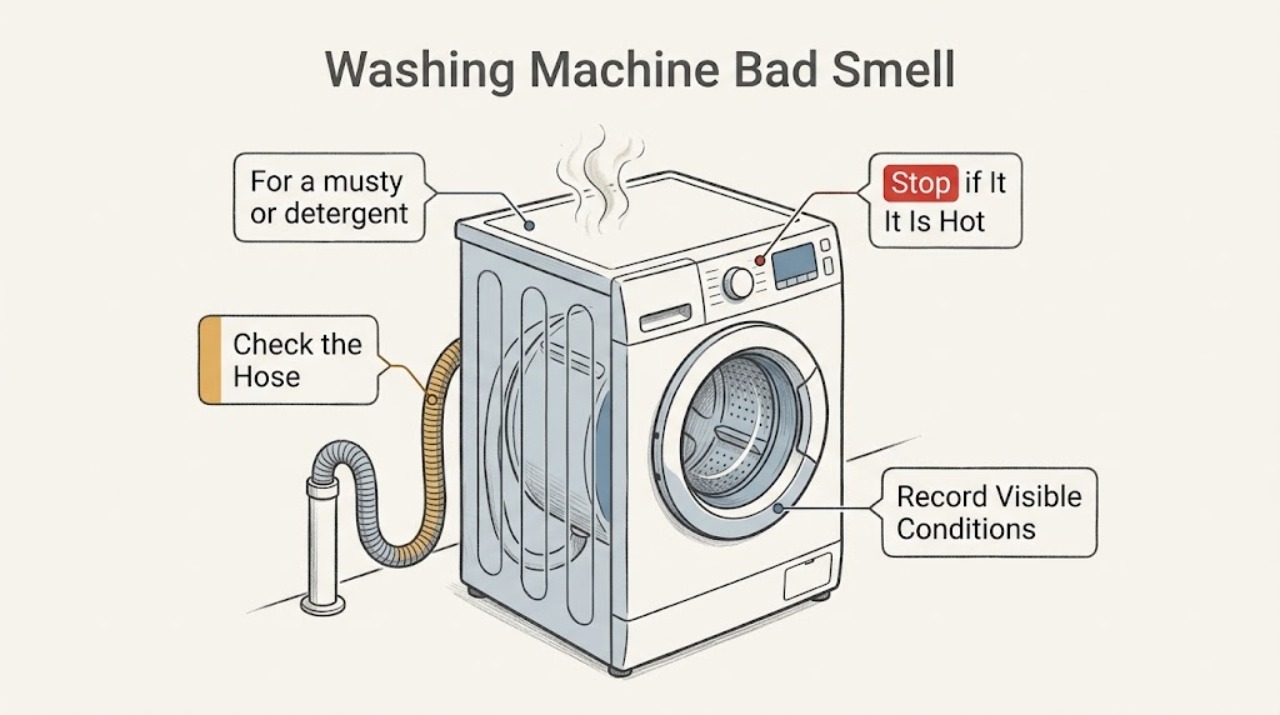
With the washer stopped, empty, and safe to approach, smell and look only at accessible areas: the tub or drum, door or lid opening, dispenser, front-load seal folds, agitator if present, drain hose area, plug, and receptacle. Classify the odor as musty or sour, sewage-like, or burning/electrical.
Expected result: A musty or sour odor with damp residue supports a cleaning and drying path. A sewage-like odor concentrated at the drain points to hose or household plumbing. A hot-plastic, rubber, electrical, or burning odor, smoke, visible arc, or heat at the plug is a stop condition.
Next step: For musty residue continue to the model and cleaner check. For a drain odor inspect only external drain routing. For burning or electrical signs stop, keep the washer off, and call qualified help.
Why this matters
Why: The smell location changes the diagnosis; treating an electrical odor as mildew can create a fire or shock risk.
-
Check 2
Record whether the washer is front-load or top-load and retrieve the exact model's Use and Care Guide. Check whether it offers a Clean Washer cycle and what cleaner, bleach restriction, rinse step, and control sequence the guide specifies.
Expected result: Maytag's cleaning method varies by model; some front-load models should not use bleach, and some models have a dedicated cleaning cycle while others use a specified hot cycle.
Next step: Follow only the guide-approved procedure. If the manual is unavailable or the washer has an unusual odor, leak, error, or damaged seal, do not improvise chemical or disassembly steps; arrange support.
Why this matters
Why: The same product or amount is not automatically safe for every Maytag washer. The model guide is the authority for the chemical and cycle choice.
-
Check 3
For a musty or detergent odor and an intact, dry washer, remove all laundry and run the model-approved Clean Washer cycle. If the model has no such cycle, use only the alternate cycle and temperature named in its guide. Do not add detergent or combine cleaners, and do not interrupt the cycle unless the guide says how.
Expected result: Residue or odor that lessens after the approved empty cleaning cycle supports buildup as the cause. Suds, a leak, an error, a new burning smell, or odor that stays strong indicates the procedure should stop rather than repeat blindly.
Next step: If the cycle completes safely, use the guide's rinse instruction and wipe away accessible residue. If it fails, leaks, overheats, or the odor persists, leave the washer off and arrange qualified diagnosis.
Why this matters
Why: A clean cycle can address accessible odor-causing residue but cannot prove that a pump, drain, seal, motor, or control is healthy.
-
Check 4
After the approved cycle and with the washer off, clean accessible residue from the dispenser, door or lid opening, and front-load seal folds with the method allowed by the manual. Dry those areas and leave the door or lid open between loads; remove wet laundry promptly.
Expected result: Visible film or trapped lint that decreases after wiping supports a local residue source. A torn seal, standing water, repeated leak, or odor returning immediately from inside the machine needs service rather than harder scrubbing.
Next step: Continue the drying and detergent-use prevention routine if the odor fades. If the seal, dispenser, or tub cannot be cleaned safely, document the area and contact Maytag support or an appliance technician.
Why this matters
Why: Maytag identifies dispensers, door areas, moisture retention, and wet loads as odor contributors, but an inaccessible buildup or damaged seal may need a technician.
-
Check 5
If the smell is sewage-like or strongest during draining, observe the external drain hose, standpipe or laundry tub, and nearby household drain for kinks, an overly deep hose insertion, slow drainage, standing water, or backflow. Do not reach into a drain or move a heavy washer while it is connected.
Expected result: Maytag says a drain hose placed too far into the drain can allow water to siphon back in; a slow or backing-up household drain can also leave contaminated water or odor near the washer.
Next step: Correct only an obvious, accessible hose-routing issue according to the installation guide. For a blocked household drain, persistent backflow, leak, or inaccessible connection, stop the washer and use qualified plumbing or appliance service.
Why this matters
Why: A drain-path odor can be outside the tub. Re-cleaning the washer will not correct a blocked drain, incorrect hose installation, or backflow.
-
Check 6
Inspect the plug, cord, and receptacle without touching damaged parts or opening the washer. Check whether the outlet or plug is hot, loose, discolored, melted, wet, smoking, sparking, or associated with a breaker that trips again.
Expected result: Any heat, smoke, arc, shock, damaged insulation, water at electrical parts, or repeat trip indicates an electrical hazard rather than washer odor residue.
Next step: Stop using the washer and do not keep resetting the breaker. If there is smoke, fire, or immediate danger, move away and contact emergency help; otherwise arrange a qualified electrician or appliance technician.
Why this matters
Why: A washer should not be operated to see whether an electrical smell goes away. CPSC treats hot receptacles, smoke, sparks, damaged cords, and overheating as reasons to stop use and obtain qualified help.
Use your observations
Decision map
Find the observation that best matches what you see, then follow the next safe action.
-
PATH 01Next step
What you see
The odor is musty or sour, the washer is dry enough to operate safely, and there is visible residue or a missed cleaning routine.
Do this next
Use the exact model-approved empty cleaning cycle, clean accessible dispenser and seal areas, and leave the door or lid open to dry.
-
PATH 02Next step
What you see
The odor is sewage-like, strongest during drain, or accompanied by standing water or backflow.
Do this next
Stop treating it as a tub-cleaning issue. Check external hose routing and household drain condition; use qualified plumbing or appliance service for a blockage, backflow, leak, or inaccessible connection.
-
PATH 03Next step
What you see
The smell is burning, electrical, hot rubber, or hot plastic, or there is smoke, arcing, shock, water at electrical parts, or repeated breaker tripping.
Do this next
Stop using the washer immediately, do not run a test cycle, and obtain emergency or qualified electrical/appliance help as the situation requires.
-
PATH 04Next step
What you see
The approved cleaning cycle completes but a strong odor returns, or there is a torn seal, persistent water, error, unusual noise, or incomplete draining.
Do this next
Leave the washer off and give a technician the model, odor type, location, cycle used, and any leak or error observations. Do not disassemble the pump, motor, control, or cabinet.
Helpful context
Understand the symptom
Identify the smell before cleaning
A damp, earthy, or sour smell that appears after wet clothes sit is a different problem from a sewage-like odor near the drain or a sharp hot-plastic, rubber, or electrical smell. Note where the odor is strongest: inside the drum, around a front-load door seal, at the dispenser, near the drain hose, or at the plug and outlet. Do not run another cycle until you have ruled out the safety stop conditions below.
Mildew and detergent residue
Maytag says moisture, wet laundry left in the washer, excess detergent, and residue can support mildew odors. Use only the cleaner and amount permitted by the model's Use and Care Guide. Never mix cleaning chemicals. A front-load seal has folds that can retain moisture; a top-load washer may instead retain residue around the lid, opening, agitator, dispenser, or tub.
When the odor does not behave like mildew
A sewage-like smell that returns after cleaning can involve a drain hose, standpipe, household drain, or backflow rather than the washer tub alone. A burning or electrical odor can indicate a cord, outlet, motor, pump, or control fault. Do not remove panels or probe wiring to identify it. Stop the washer and arrange qualified service if the source is not an accessible, harmless residue.
Only after diagnosis
Potential parts
- front-load door seal
Consider only if the exact model's seal is torn, distorted, leaking, or cannot be cleaned and a qualified diagnosis confirms replacement is needed.
Confirm the complete washer model and manufacturer fit information before ordering; do not use a visually similar seal. - washer drain hose
Relevant only when an external hose is cracked, damaged, or incompatible with the model's installation requirements after the odor source is confirmed.
Check the exact model and installation instructions and address household drain problems separately.
When checks do not resolve it
Need a professional?
Call Maytag support or a qualified appliance technician when the approved cleaning cycle does not remove the odor, when a seal, pump, drain, motor, or control may be involved, or when there is a leak or error. Use qualified plumbing service for household drain backflow. For smoke, fire, shock, arcing, or a hot electrical connection, stop immediately and obtain emergency or qualified electrical help.
Common questions
FAQ
Why does my Maytag washer smell musty after a wash?
Moisture, wet clothing left in the washer, excess detergent, and residue can contribute to a mildew-like odor. Follow the exact model's approved cleaning cycle, clean accessible seal and dispenser areas, and leave the door or lid open to dry.
Can I use bleach to clean a smelly Maytag washer?
Only if the model's Use and Care Guide permits it and specifies the procedure. Maytag notes that bleach is not suitable for some front-load models. Do not mix bleach with detergent, vinegar, or another cleaner.
What if the smell is like sewage or burning plastic?
A sewage-like odor needs an external drain and backflow check. A burning or electrical smell, smoke, heat, arcing, shock, water at electrical parts, or repeated breaker trip requires immediate stop-use and qualified help; do not run another test cycle.
Read the exact guide
Official sources
- Removing Odor or Smell - WasherMaytag Product Help · Maytag top-load washer odor, detergent residue, wet laundry, and Clean Washer guidance
- Leaking from Underneath or Bottom - Front Load WasherMaytag Product Help · Maytag front-load washer external hoses, drain backup, leaks, and detergent-related overflow
- CPSC Guide to Home Wiring HazardsU.S. Consumer Product Safety Commission · Electrical outlet, breaker, appliance cord, overheating, smoke, and arcing safety
- HOW TO FIX A WASHER THAT SMELLS LIKE MILDEWMaytag · Maytag washer mildew odor causes, model-dependent cleaning, residue, and prevention
- Service & Support Owners CenterMaytag · Maytag model-specific manuals, troubleshooting, and service support
- HOW TO CLEAN A WASHING MACHINE: STEP-BY-STEP GUIDEMaytag · Maytag front-load and top-load washer cleaning, odor prevention, dispensers, seals, and ventilation
- Removing Odors from the Interior of a WasherMaytag Product Help · Maytag washer interior odor maintenance, Clean Washer cycle, HE detergent, ventilation, and model guidance
- Gurgling, Slurping or Humming Noise - Front Load WasherMaytag Product Help · Maytag front-load washer drain hose installation, siphoning, and drain-path behavior
- Cleaning a Front Load Washer Door SealMaytag Product Help · Maytag front-load washer door seal cleaning, moisture, residue, odor, and leak prevention
Community feedback
Share a repair observation
Share a plain-text repair observation. Accepted observations are published automatically; this page may take a moment to update.