
On this page
Start here
Quick answer
First identify whether the smell is stale or food-like, sewage-like, chemical, or burning, and whether water remains in the tub. Haier's dishwasher guidance points to door-seal, spray-arm, and filter cleaning, removing large food residue before washing, and leaving the door slightly open after a cycle when the dishwasher will sit unused. Unplug the dishwasher before model-approved filter cleaning, use only the exact manual's architecture and cleaning directions, and never mix household chemicals or open the pump area. Persistent standing water, dirty drain water, a sewage odor that returns, burning or electrical odor, smoke, sparks, or a leak needs service.
Before you begin
Safety first
- The user may identify the model and layout, inspect visible standing water and hose routing, unplug the appliance, clean model-approved accessible filters, seals, and spray arms, remove large food residue, and use documented products. Qualified personnel must handle pump, sensor, heater, wiring, control, hidden hose, leak, and live electrical diagnosis.
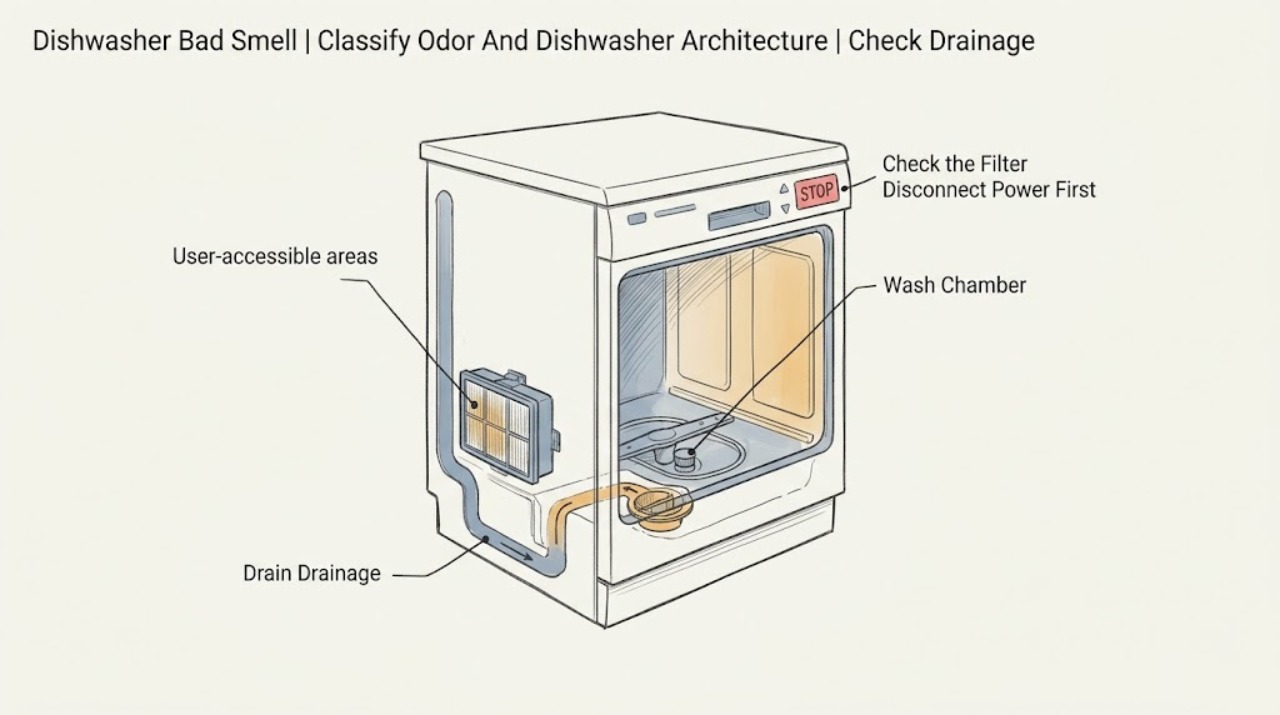
Work through in order
Diagnostic checks
Use only checks that match the exact appliance or system and its official guide.
-
Check 1
Record the complete Haier model and serial information and identify whether the dishwasher is freestanding, built in, drawer style, countertop, or another layout. Describe the smell as stale or food-like, sewage-like, detergent or chemical, or burning or electrical, and note whether it appears during a cycle, immediately after, or after the closed dishwasher has sat.
Expected result: The architecture and model are known; the chamber smells stale with no visible water; standing water or slow drainage accompanies the smell; or the smell is chemical, burning, or electrical.
Next step: Use only the checks that match the model and odor branch. Keep the dishwasher off and unplugged for any cleaning step, and do not add a deodorizer to an unidentified odor.
Stop if: Stop immediately for smoke, sparks, a burning or electrical odor, hot or damaged wiring, a leak near electrical parts, or chemical fumes.
Why this matters
Why: Haier's removal and maintenance steps differ by dishwasher type. Stale odor selects residue and ventilation checks, standing water selects filter and drain checks, and a burning or electrical odor is a stop condition rather than a cleaning task.
-
Check 2
With the dishwasher off, look at the tub floor and the accessible drain-hose route without pulling the appliance or opening the pump housing. Note whether water remains after a completed cycle, whether it is cloudy or contains food residue, and whether the hose is visibly kinked, flattened, or blocked at an accessible outlet.
Expected result: The tub is dry or only has the model-expected residual water; water is standing and dirty; the drain hose is visibly bent or blocked; or the visible drain path is clear but water remains.
Next step: Correct only an obvious accessible hose kink and continue to the unplugged filter check. If standing water persists, keep the dishwasher off and arrange appliance or plumbing service.
Stop if: Do not pull a built-in dishwasher, remove the drain pump, disconnect a hose under the sink, or reach into stagnant water without suitable protection and the exact manual.
Why this matters
Why: Standing or dirty water can hold food residue and create odor. Haier's drainage guidance treats a bent or blocked drain path and a clogged filter as separate checks; a clear visible path with persistent water points beyond a user cleaning correction.
-
Check 3
Unplug the dishwasher and follow the exact model manual for filter access. Haier says removal differs among dishwasher types; where the model uses the documented removable filter, rotate and remove it as instructed, rinse the separated pieces under running water, wipe the flat filter with a damp cloth, and reinstall every part securely. Remove large food residue from dishes before the next cycle.
Expected result: The filter contains food, grease, or slime; the filter is clear but the smell or water remains; the filter cannot be identified or removed as the manual describes; or cleaning restores normal drainage and reduces the smell.
Next step: Reinstall the filter exactly as the manual shows and observe one normal cycle. If the filter is damaged, missing, difficult to remove, or the smell returns with water, arrange service.
Stop if: Do not operate the dishwasher with the filter absent, pry a fixed filter, use sharp tools on the pump opening, or clean while the appliance is energized.
Why this matters
Why: A clogged filter can retain odor-causing residue and restrict drainage. A clean filter with persistent standing water or odor is not proof that the pump or sensor is bad, but it does justify model-specific service rather than repeated cleaning.
-
Check 4
With power disconnected and the tub cool, wipe visible residue from the door seal and the chamber using the model-approved method. If the manual permits removal, rinse the spray arm and clear its holes only with a soft, non-sharp method; confirm that dishes or large residue do not block spray-arm rotation. Do not scrape the seal or use an unapproved solvent.
Expected result: Residue or slime is present on the seal, spray arm, or tub; spray holes are obstructed; the spray arm cannot rotate freely; or these areas are clean and the odor remains.
Next step: Remove only visible residue, reinstall the spray arm correctly, and run a model-approved cycle with the correct dishwasher detergent. If the smell persists or water remains, stop repeated cleaning and use the service branch.
Stop if: Do not use bleach, drain cleaner, solvents, abrasive tools, or mixed chemicals; do not force a spray arm or remove a fixed panel.
Why this matters
Why: Haier links regular door-seal and spray-arm care with odor prevention and effective washing. A clean seal and spray arm with a returning odor shifts concern toward retained water, detergent or chemical misuse, drain plumbing, or an internal service fault.
-
Check 5
Check the exact manual for the dishwasher detergent, rinse aid, and salt compartments and use only the specified product and amount. Do not use hand dish soap or a household deodorizer. After a completed cycle, leave the door slightly open only when the model and installation make that safe, especially if the dishwasher will sit unused for a long time.
Expected result: The door has been kept closed while damp; the wrong or excessive product was used; no detergent was used; or detergent and ventilation match the model instructions but the odor returns.
Next step: Correct only the documented product and ventilation practice and monitor one normal cycle. If the smell is chemical, returns despite correct use, or comes with poor drainage, keep the dishwasher off and arrange service.
Stop if: Do not mix cleaning chemicals, pour hand soap or drain cleaner into the dishwasher, exceed the manual's dosage, or leave the door open where it creates a trip or child-access hazard.
Why this matters
Why: Haier says a slightly open door supports ventilation after washing when the dishwasher is not used for a long period. Product misuse can leave residue or foam, while Haier's drainage guidance says failure to add detergent can contribute to scale on a turbidity sensor in certain models; neither observation identifies a part by itself.
-
Check 6
Stop owner cleaning when the filter, visible drain path, seal, spray arm, and documented product use are correct but the odor persists, or when the dishwasher leaves standing or dirty water, shows a drainage error, leaks, trips protection, or smells like burning or electricity. Give service the model, architecture, odor description, timing, water condition, error code, and checks completed.
Expected result: The odor clears and drainage is normal after a model-approved cleaning, or the odor returns, drainage remains abnormal, a code persists, or a hazard is present.
Next step: Keep the dishwasher unplugged when a hazard or persistent drainage fault is present and arrange qualified Haier appliance or plumbing service. Do not select a pump, sensor, hose, or seal from odor alone.
Stop if: Do not open the pump or control area, make live tests, bypass a leak or door safety, or run repeated cycles to hide a burning, chemical, or sewage odor.
Why this matters
Why: A successful cleaning supports a residue, ventilation, or visible drain explanation. Recurring odor with clean accessible parts can involve the drain pump, sensor, hose connection, internal contamination, or household plumbing; burning or electrical odor is outside cleaning diagnosis.
Use your observations
Decision map
Find the observation that best matches what you see, then follow the next safe action.
-
PATH 01Safety boundary
What you see
The odor is stale or food-like, the tub has no abnormal standing water, and residue is visible on the seal, spray arm, filter, or chamber.
Do this next
Unplug the dishwasher, clean only the model-approved accessible parts, remove large food residue before washing, and leave the door slightly open after a cycle when safe and appropriate.
Why this path and its safety boundary
Why it matters: Retained food residue and poor ventilation are more likely than a failed pump or control.
Safety stop: Do not mix cleaners, use sharp tools, or operate without the filter installed.
-
PATH 02Safety boundary
What you see
The odor is stale or sewage-like and the tub contains standing or dirty water, or drainage is slow.
Do this next
Check the visible hose route and clean the model-approved filter with power disconnected. Arrange appliance or plumbing service if water remains or the odor returns.
Why this path and its safety boundary
Why it matters: A restricted filter, bent or blocked drain path, drain connection, or internal drainage fault is more likely than a surface odor alone.
Safety stop: Do not remove the pump, disconnect hidden hoses, or keep running cycles with stagnant water.
-
PATH 03Safety boundary
What you see
The smell began after a detergent, rinse aid, salt, deodorizer, or household cleaner change, or it smells strongly chemical without a normal food-residue explanation.
Do this next
Stop adding products, ventilate the room, keep the dishwasher off, and consult the exact manual or qualified service for safe flushing guidance. Do not combine chemicals or run a cycle to mask the smell.
Why this path and its safety boundary
Why it matters: Product type, amount, compartment use, or incompatible cleaning chemistry is more likely than a mechanical odor source, but fumes can be hazardous.
Safety stop: Stop and leave the area for irritating fumes, breathing difficulty, heat, smoke, or a burning odor; obtain appropriate emergency or professional help.
-
PATH 04Safety boundary
What you see
The filter, seal, spray arm, visible drain path, ventilation, and documented product use are correct, but the odor returns or a drainage error persists.
Do this next
Keep the dishwasher off and arrange model-specific Haier appliance service, or plumbing service when the household drain connection is implicated. Provide the model and any code.
Why this path and its safety boundary
Why it matters: An internal drain, sensor, pump, hose, or household plumbing problem becomes more likely; accessible cleaning has reached its safe limit.
Safety stop: Do not open the pump or control compartment, perform live tests, or order an internal part from odor alone.
-
PATH 05Safety boundary
What you see
The smell is burning or electrical, or it is accompanied by smoke, sparks, a hot cord, a leak near electrical parts, or a repeated protective-device trip.
Do this next
Stop the dishwasher, disconnect power only if it can be done without contact with water or damage, and arrange qualified appliance or electrical service.
Why this path and its safety boundary
Why it matters: The condition exceeds odor cleaning and may involve an electrical or heating fault or a water-related hazard.
Safety stop: Do not reconnect the appliance, run another cycle, remove covers, or touch wiring or heating parts.
Helpful context
Understand the symptom
The odor and the remaining water choose the first check
A stale smell with a damp, empty-looking chamber points toward residue and ventilation. A smell with visible standing water, slow draining, or dirty water points toward the filter or drain path. A chemical, burning, or electrical odor is not a cleaning problem. Haier publishes different cleaning steps for freestanding, drawer, countertop, and other dishwasher layouts, so identify the model and architecture before removing anything.
Use a clean, model-approved process
Haier's maintenance guidance calls for regular door-seal, spray-arm, and filter care and says to leave the door slightly open after washing when the appliance is not being used for a long time. Its filter instructions require disconnecting power, using the model-appropriate removal method, rinsing the filter, and reinstalling it correctly. Do not improvise a filter location or mix bleach, drain cleaner, dish soap, vinegar, or other chemicals in the chamber.
An odor that returns after cleaning can be a drainage or service issue
Haier's drainage troubleshooting checks a bent or blocked drain path and a clogged filter, and sends unresolved conditions to after-sales service. If the filter and visible drain path are clean but water remains, a sewage odor returns, the dishwasher leaves dirty water, or the smell is electrical or burning, keep the appliance off and arrange qualified appliance or plumbing service rather than opening the pump or wiring.
Safety boundary
Stop conditions
- Burning or electrical odor, smoke, sparks, a hot or damaged cord, or a repeated protective-device trip
- Water near electrical parts or an active leak
- Strong chemical fumes, breathing irritation, or an odor after mixed or unapproved cleaners
- Standing or dirty water that remains after the visible drain and filter checks
- Any need to open the pump, control, heater, or wiring area or make a live test
When checks do not resolve it
Need a professional?
Arrange qualified Haier appliance service when odor returns after model-approved filter, seal, spray-arm, drainage, and ventilation checks; when standing or dirty water remains; when a drainage code persists; or when pump, sensor, hose, wiring, heater, or internal contamination is suspected. Use plumbing service for a household drain connection or sewage odor that affects the dishwasher and sink. Stop immediately for chemical fumes, burning or electrical odor, smoke, sparks, a hot cord, water near electrical parts, a leak, or a repeated protective-device trip.
Safety scope: The user may identify the model and layout, inspect visible standing water and hose routing, unplug the appliance, clean model-approved accessible filters, seals, and spray arms, remove large food residue, and use documented products. Qualified personnel must handle pump, sensor, heater, wiring, control, hidden hose, leak, and live electrical diagnosis.
Common questions
FAQ
Why does my Haier dishwasher smell bad after a cycle?
Check whether water remains and whether residue is on the filter, door seal, spray arm, or tub. Haier recommends regular care of these areas, removing large food residue before washing, and leaving the door slightly open after a cycle when the appliance will sit unused. Unplug before model-approved filter cleaning.
Can a clogged Haier dishwasher filter cause an odor?
Yes, retained food residue and restricted drainage can make stale odor more likely. Disconnect power, follow the exact model's filter-removal method, rinse the filter, wipe the flat filter as directed, and reinstall it securely. If odor or standing water returns, arrange service.
Should I leave my Haier dishwasher door open?
Haier says to leave the door slightly open after washing when the dishwasher will not be used for a long time, to keep it ventilated. Do this only when the model and installation make it safe, and do not create a child-access or trip hazard.
What if my Haier dishwasher smells like sewage and has standing water?
Treat this as a drainage issue first: check the visible hose route and clean the model-approved filter with power disconnected. Haier's drainage guidance separates a bent or blocked path from a clogged filter. If dirty water remains or the smell returns, keep the dishwasher off and arrange appliance or plumbing service.
Can I pour bleach, drain cleaner, or dish soap into a smelly Haier dishwasher?
No. Do not mix household chemicals or use hand dish soap or drain cleaner in the dishwasher. Stop adding products, ventilate the room, and follow only the exact manual's approved cleaning process. Strong chemical fumes or a burning odor require immediate professional help.
Read the exact guide
Official sources
- Dishwasher display code E1 (not draining or draining slowly)Haier Egypt · Haier dishwasher drainage troubleshooting for the regional models covered by this support article; codes and procedures vary by model.
- Don't know how to use the dishwasherHaier Egypt · Haier dishwasher guidance covering freestanding, drawer, countertop, and sink layouts; exact model instructions and regional product features vary.
- How to clean the filterHaier South Africa · Haier dishwasher filter guidance; removal differs by dishwasher type and the matching manual controls.
- The dishwasher displays error code E2Haier Egypt · The E2 meaning and procedure are explicitly conditional on the countertop dishwasher models covered by this article; do not generalize the code to other Haier layouts.
Community feedback
Share a repair observation
Share a plain-text repair observation. Accepted observations are published automatically; this page may take a moment to update.