
On this page
Start here
Quick answer
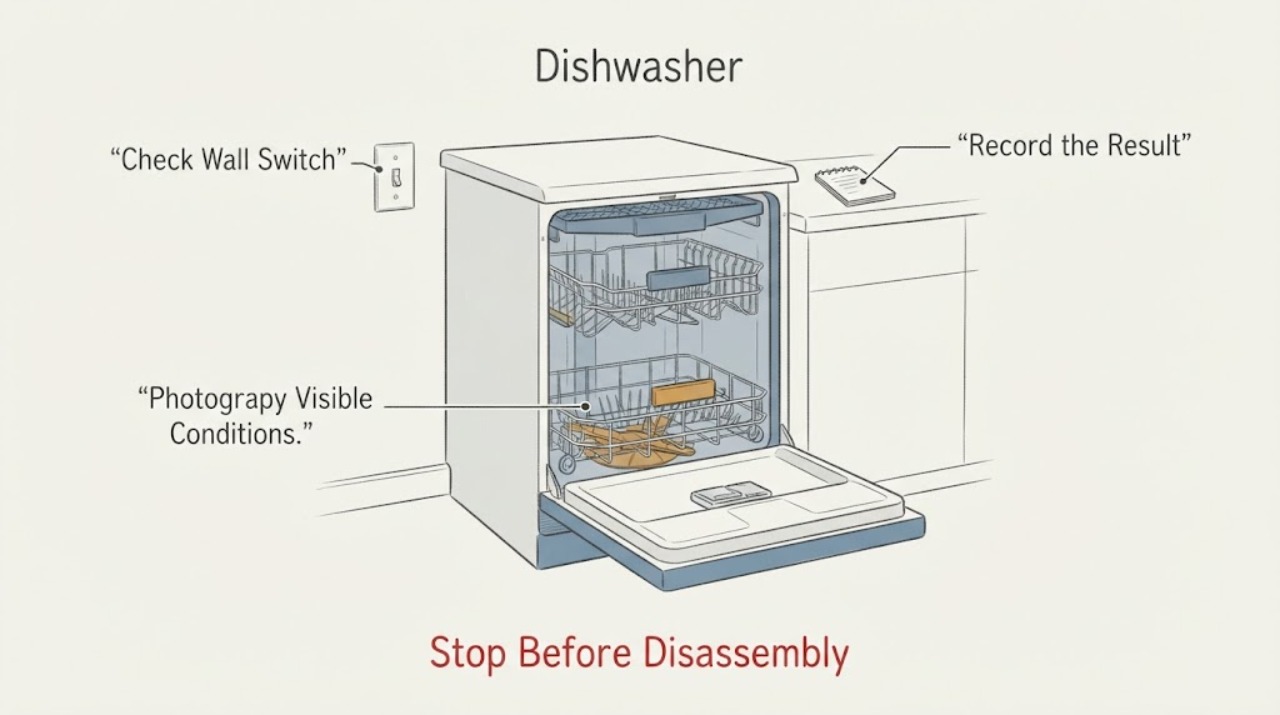
Do not run the Haier DWL2825SDSS after an unidentified ring, clip, seal, or other part falls out while the filter is being cleaned. Unplug the dishwasher from a dry, safe location, close the water valve if there is a leak, and preserve the part and the scene. Photograph the part beside a ruler, measure its outside and inside dimensions, note its material and color, record exactly where it was found, and photograph the filter, retaining screen, sump opening, and any visible fasteners before moving them. Haier's official support directs owners to enter the complete model number to obtain the matching manual; the public pages opened for this research do not identify an exploded-view location for DWL2825SDSS. Do not force the part into a groove, substitute a similar-model diagram, remove the pump or filter housing, or run a test cycle. If the exact Haier documentation does not positively identify the part and its orientation, leave the dishwasher out of service and arrange qualified service.
Work through in order
Diagnostic checks
Use only checks that match the exact appliance or system and its official guide.
-
Check 1
Stop the dishwasher before trying to identify the part. From a dry, safe position, switch it off and unplug it or isolate its supply using the normal accessible isolator; if water is leaking or near electrical parts, close the accessible water valve and keep clear. Do not start a cycle to see whether the machine still works.
Expected result: The dishwasher is dry and intact, the filter will not lock, there is standing water or an active leak, or there is a damaged cord, heat, smoke, odor, or water near electrical parts.
Next step: Leave the dishwasher out of service for any loose, damaged, unsecured, or wet condition. Isolate power only from a safe dry location and arrange qualified appliance service; use an electrician for a damaged supply or repeated protective-device operation.
Stop if: Do not reach into standing water, bypass a sensor or latch, repeatedly reset a breaker, or run a cycle with the unidentified part absent.
Why this matters
Why: An unidentified loose part can affect a seal, retaining feature, or water path, and a filter or guard that is not secured can turn a harmless cleaning task into a leak or damage risk. Haier's flood guidance describes water-level and pan sensors that can cancel a cycle and start draining; it does not make operation with an unknown part safe.
-
Check 2
Photograph the complete rating plate and the open tub from several angles before moving the unknown part. Record DWL2825SDSS exactly as printed, the serial number, market or country, whether the filter was twisted or lifted, the position where the part was found, and which filter pieces were removed.
Expected result: The label confirms the complete model and serial identity, only a family or partial model is visible, or the label is missing or unreadable.
Next step: Use the complete label when requesting the matching Haier manual, parts information, or service. If the identity cannot be confirmed, stop model-specific reassembly and do not borrow instructions from a similar Haier or other-brand dishwasher.
Why this matters
Why: Haier's manual workflow is model-number based, and its obsolete-literature guidance says older models can have limited documentation. A family name or similar model cannot establish the geometry, seal, or retaining method of this dishwasher's filter assembly.
-
Check 3
Preserve the part as evidence. Place it in a clean bag or container and photograph both sides beside a ruler or caliper; record outside diameter, inside diameter, thickness, approximate weight if available, material, color, cracks, flattening, cuts, and any residue. Do not clean, stretch, cut, glue, or reshape it.
Expected result: The object is a uniform ring, a broken or distorted piece, a clip or fastener, a soft seal, a hard fragment, or its shape and material cannot be determined safely.
Next step: Send the photographs, dimensions, and complete model identity to Haier or a qualified technician. Keep the part out of the sump until its identity and orientation are confirmed by exact documentation or inspection.
Why this matters
Why: Shape alone does not prove whether the object is part of the filter, a pump seal, a retaining feature, packaging, or debris. Damage or an incomplete fragment is especially unsafe to identify by fit or by a visual match to another model.
-
Check 4
With power isolated and hands kept out of standing water, inspect only the visible filter assembly and tub floor from above. Note whether the filter screen, frame, retaining tabs, screws, and visible sump opening are complete, seated, and free of obvious food particles or loose objects. Do not remove the pump, filter housing, guards, or lower panels.
Expected result: The filter locks and all visible pieces appear intact, the filter will not lock, a tab or fastener is missing, the sump is obstructed, or the visible area does not explain the part.
Next step: Remove only an obviously loose food particle or object that is safe to lift without reaching into water or a guarded opening. For a missing tab, damaged screen, unsecured filter, unexplained location, or any need to access the pump, stop and arrange service.
Stop if: Do not force the filter, press an unknown ring into a groove, insert tools into the sump, or use a similar-model parts diagram.
Why this matters
Why: Haier recommends checking spray arms and inspecting the bottom around the drain for loose items, but an unexplained component is not cleared by a clean-looking sump. A filter that will not retain or a missing visible fastener can compromise sealing or allow debris into the drain path.
-
Check 5
Use Haier's model-number lookup and request the exact DWL2825SDSS documentation, including any owner or installation material and an exact parts or exploded view if Haier can provide one. Compare only the photographed filter parts, fasteners, and orientation shown for that complete model and market; do not treat an index entry or a near-model drawing as a match.
Expected result: An exact document names the part and shows its location and orientation, only a family or near-model document is available, or no applicable diagram is available.
Next step: Only if the exact documentation positively matches every visible feature may a qualified person decide whether reassembly is appropriate. If the document does not identify the part and location, leave the dishwasher unplugged and arrange qualified service rather than testing it.
Why this matters
Why: An exact identification can support a controlled reassembly decision. A family or near-model illustration leaves compatibility unresolved; Haier says obsolete models may have limited literature and that service manuals are for professionals.
-
Check 6
Check for water evidence without operating the dishwasher: photograph any water around the filter, sump, door edge, or floor; note whether it is a small amount around the filter after a prior wash or a full bottom, fresh leak, or water near electrical parts. Do not tilt the dishwasher or disconnect a pressurized hose.
Expected result: Only a small amount of water is around the filter, the bottom is full, water is returning from the sink-side drain path, or water is leaking toward the floor or electrical connection.
Next step: Keep the appliance off; correct only a plainly visible, safe sink-side condition if no unknown part or leak remains. For a full tub, fresh leak, repeated water, or water near electrical parts, isolate safely and arrange qualified service.
Stop if: Do not run a drain test, remove the pump, reach through the filter opening, or continue using the dishwasher to see whether the water returns.
Why this matters
Why: Haier says a small amount around the filter after a wash can be normal, but a full bottom calls for visible drain-path checks such as a kinked hose or sink-side blockage. A leak or water near electrics is a separate stop condition and is not explained by the unknown part without inspection.
Use your observations
Decision map
Find the observation that best matches what you see, then follow the next safe action.
-
PATH 01Next step
What you see
The exact DWL2825SDSS document identifies the photographed part, the visible filter assembly matches its drawing, and the filter locks without force or leftover pieces.
Do this next
Follow only the exact document, preferably with qualified service if the part is a seal, retainer, or water-path component. Do not run the dishwasher if any uncertainty remains.
Why this path and its safety boundary
Why it matters: This is the only pattern that can support a model-specific reassembly decision; a similar-looking ring or an unverified fit is not enough.
-
PATH 02Next step
What you see
The part remains unidentified, the available drawing is for a family or similar model, the filter will not lock, or a tab, screw, screen, or seal appears missing or damaged.
Do this next
Keep the dishwasher unplugged and do not run it. Provide the part, measurements, photographs, complete model label, found location, and filter-assembly state to Haier or a qualified appliance technician.
Why this path and its safety boundary
Why it matters: The evidence does not establish a safe installation position. Forcing a part can create a leak, allow debris into the pump, or leave a retaining feature unreliable.
-
PATH 03Next step
What you see
There is only a small amount of water around the filter with no visible leak, but the unknown part has not been identified.
Do this next
Treat the part identity as the blocking issue: preserve it and obtain exact documentation or service before operation.
Why this path and its safety boundary
Why it matters: The small water amount may be normal according to Haier's drain guidance, but it does not validate the filter assembly or the loose part.
-
PATH 04Next step
What you see
The bottom is full, water is leaking, water is near electrical parts, the dishwasher has a damaged cord, or the appliance trips protection.
Do this next
Keep clear, isolate power from a dry safe location, close the accessible water valve if safe, and arrange qualified appliance or electrical service. Do not tilt the unit or reach into the tub.
Why this path and its safety boundary
Why it matters: Water or electrical safety takes priority over identifying the part. Haier describes overflow protection that can de-energize filling and run the drain pump, but that protection is not a reason to continue operating a questionable assembly.
Helpful context
Understand the symptom
The model and the loose part must be treated as separate questions. Photograph the rating label so the complete identity is not reduced to a family name, then keep the ring or other part with the dishwasher. Haier's model lookup asks owners to enter the appliance model number for the matching manuals, installation information, and energy guides. Its opened support pages do not provide a public DWL2825SDSS exploded view that would justify naming this part or assigning it to a particular seal, pump, or filter seat.
A filter-cleaning event does not prove that the fallen object belongs in the filter assembly. Haier does recommend inspecting the bottom around the drain for loose items and food particles, and says a small amount of water around the filter after a cycle can be normal. Those general maintenance points do not make an unknown part safe to reinstall. Keep the dishwasher off when the filter will not lock, a fastener or seal appears missing, a part is cracked or deformed, or water is present where it should not be.
When checks do not resolve it
Need a professional?
Arrange qualified Haier dishwasher service when the unknown part cannot be matched to exact DWL2825SDSS documentation, the filter will not lock, a seal or retaining feature is missing or damaged, the part may belong below the visible filter, water remains or leaks, or any inspection would require removing the pump, filter housing, guard, or panel. Keep the dishwasher unplugged and do not run a confirmation cycle. Isolate power only from a dry, safe location; use an electrician for a damaged supply, repeated trip, smoke, burning odor, or water near electrical parts.
Common questions
FAQ
Can I put the unknown ring or part back where it seems to fit?
No. A visual fit does not establish the part's identity, orientation, or sealing function. Keep the dishwasher unplugged, photograph and measure the part, and use exact DWL2825SDSS documentation or qualified service before reassembly.
Is a little water around the Haier dishwasher filter automatically a leak?
Not necessarily. Haier says a small amount around the filter after a wash can be normal, while a full bottom requires visible drain-path checks. That guidance does not clear an unidentified loose part; leave the dishwasher off until the filter assembly and part are accounted for.
Can I use a DWL2825 or similar Haier diagram to identify this part?
Do not assume a family or similar-model diagram applies. Haier's support workflow is based on the complete model number, and its obsolete-literature guidance warns that older models may have limited documentation. If the exact model document does not identify the part and position, use qualified service rather than a near-model installation.
Read the exact guide
Official sources
- Haier - Service Manual RequestsHaier Appliances · Supports escalation when identifying or accessing an internal dishwasher part would require service documentation or repair; it does not identify the loose part.
- Haier - Dishwasher MaintenanceHaier Appliances · Supports only safe visible checks around the dishwasher bottom, drain, spray arms, and door gasket; it does not identify an unknown part or authorize pump disassembly.
- Haier Dishwashers - Active Flood ProtectHaier Appliances · Supports the stop boundary for water and electrical risk; it is not evidence that DWL2825SDSS has this feature or that an unknown part may be tested.
- Haier - Dishwasher Will Not DrainHaier Appliances · Supports distinguishing a small amount of water around the filter from a full bottom and checking only visible sink-side drain conditions; it does not clear an unidentified part for operation.
- Haier Appliances, Parts, and Literature No Longer AvailableHaier Appliances · Supports requesting exact model assistance when literature is unavailable and refusing an unverified substitute; it does not identify the unknown part.
- Support by Product LineHaier Appliances · Supports selecting dishwasher support and searching by model; it does not identify the unknown loose part or provide an exploded view.
- Owner's Manual & Installation InstructionsHaier Appliances · Use to require the complete model number and matching manual; it is not evidence that an unidentified part belongs in a particular filter or pump location.
Community feedback
Share a repair observation
Share a plain-text repair observation. Accepted observations are published automatically; this page may take a moment to update.