
On this page
Start here
Quick answer
Stop the program and first determine whether water is coming from an accessible inlet connection, drain hose or sink connection, the door area, excess foam, or beneath the built-in cabinet. Haier's dishwasher manual says to unplug the appliance and turn off the water supply before cleaning or maintenance, and says a malfunctioning appliance should be switched off, have its water supply turned off, and not be tampered with. With the machine cool, power isolated, and water tap closed, look for a loose or damaged hose, a kinked or incorrectly routed drain hose, a blocked filter or siphon, a door gasket or loading obstruction, or detergent foam. On the cited Haier model family, E4 means water leak and E21 means uncontrolled water supply; E21 requires the tap to be closed immediately and the appliance disconnected from power. Haier's overflow-protection features are model-specific and can cancel a cycle, stop filling, drain, and alert when water is detected. Do not tilt or pull out a built-in dishwasher, open the base, bypass flood protection, or work on the inlet valve, pump, wiring, or control yourself.
Before you begin
Safety first
- The user may perform dry, accessible, model-supported observation of the tap, visible hose routing, door loading, gasket surface, siphon, and removable filter only after safe water and power isolation. Qualified service must handle hidden hoses, base pans, pumps, valves, seals, sensors, controls, wiring, built-in movement, and live tests.
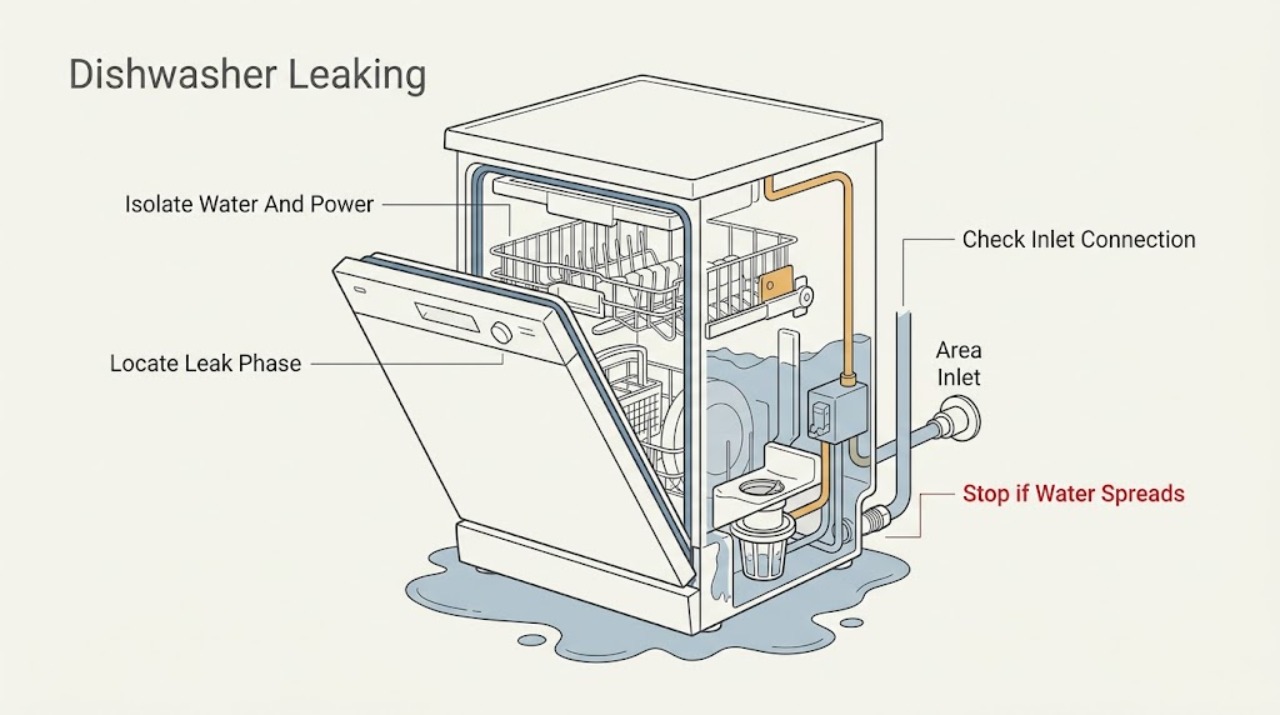
Work through in order
Diagnostic checks
Use only checks that match the exact appliance or system and its official guide.
-
Check 1
Stop the dishwasher and note whether water is still entering. From a dry, accessible position close the dishwasher water tap; disconnect the plug only when the manual and conditions make that safe. Do not touch wet electrical parts.
Expected result: Water continues entering, the machine has stopped filling, water is near the cord or outlet, or there is smoke, odor, heat, or visible damage.
Next step: Keep the tap closed and the appliance isolated. For smoke, arcing, a hot cord, or water at the electrical connection, obtain qualified electrical or appliance help without moving the machine.
Stop if: Do not restore power to a wet or damaged dishwasher, repeatedly reset it, or open the base.
Why this matters
Why: Continued filling or a wet electrical area can turn a leak into an immediate flooding or shock hazard. Haier's manual treats uncontrolled water supply as an urgent stop condition and directs service for a malfunctioning appliance.
-
Check 2
Without restarting the dishwasher, dry the surrounding floor from a safe position and record where the first fresh moisture appears: inlet side during fill, door front during wash, drain or sink connection during drain, or beneath the cabinet after the machine stops. Record the model number and any display code.
Expected result: The drip is at a visible hose connection, the door perimeter, the sink or siphon connection, only beneath the unit, or no new moisture appears after the tap is closed.
Next step: Follow only the matching branch below. If the source is beneath the built-in cabinet or cannot be seen without moving it, leave the tap closed and arrange service.
Stop if: Do not tilt, slide, or remove cabinetry around a leaking dishwasher.
Why this matters
Why: The phase and location distinguish an accessible connection or loading issue from an internal leak or flood-protection response. A dry outside surface does not rule out water in the base pan.
-
Check 3
For a fill-phase leak visible at the tap or inlet connection, inspect the supplied inlet hose for a kink, crack, crushed section, or a visibly loose connection. Keep the water tap closed. Tighten only an accessible connection if the exact manual permits it; do not cut, splice, or open a water-stop housing.
Expected result: The hose is kinked or visibly damaged, a seal is displaced, the connection is wet at the tap, or the inlet route is dry but water appears under the unit.
Next step: Leave the tap closed and replace a damaged hose only through Haier service or an exact approved part path. If the connection remains wet or the source is internal, arrange qualified service.
Stop if: Do not reuse an old hose set, cut a Waterblock/Aquastop hose, or test the inlet valve while energized.
Why this matters
Why: Haier's manual requires the supplied/new hose set, proper tightening, and a hose without damage; some models use Waterblock or Aquastop assemblies containing safety components. A leak under the unit is not explained by an external connection alone.
-
Check 4
For water appearing during drain, inspect only the visible drain hose from the sink side for kinks, trapping, immersion, or a loose connection, and inspect the accessible siphon connection for an obvious blockage. With power isolated and the tub cool, clean the removable filter only as the exact manual describes.
Expected result: The outlet hose is kinked, submerged, loose, or blocked; the siphon or filter is obstructed; or the visible drain route is clear but water still appears under the appliance.
Next step: Correct only a visible external routing problem or model-permitted filter obstruction, then check for a dry connection without running a hazardous test. If leakage persists, keep the tap closed and call service.
Stop if: Do not disconnect hidden hoses, reach into the pump, use drain chemicals, or run the dishwasher with panels removed.
Why this matters
Why: Haier's manual says the outlet hose must not kink or be immersed, and its troubleshooting table links drain faults and E4 leak indications to the drain pipe, filter, and siphon. A clear visible route with an under-cabinet leak suggests internal hose, pump, seal, or pan diagnosis.
-
Check 5
For moisture at the front of the door during washing, inspect the visible gasket and door edge for food residue, a displaced seal, or damage. Check that dishes, racks, and utensils are not preventing the door from closing evenly. Look for foam escaping from the door; do not run another cycle while the leak is active.
Expected result: A visible loading obstruction or residue is present, the gasket is torn or displaced, suds are escaping, or the door area looks normal while water comes from below.
Next step: Remove only an obvious loading obstruction or clean the visible gasket with power isolated. If the gasket is damaged, foam recurs, or water is below the door, leave the appliance off and arrange service.
Stop if: Do not stretch or glue a gasket, add more detergent, or force the door closed.
Why this matters
Why: A door obstruction, seal condition, or excessive detergent can send water over the front edge, but an intact door area does not clear the internal tub, hose, pump, or overflow system. Haier documents door, loading, detergent, and filter differences by model.
-
Check 6
Read the display, LEDs, or app alert without moving the dishwasher. Compare the exact code with the matching Haier manual. Treat an overflow, water-level, uncontrolled-inlet, or flood-protection alert as a stop-use event.
Expected result: The model shows E4 or another leak/overflow indication, E21 or uncontrolled water supply, a pan or water-level alert, or only a generic recurring fault.
Next step: Keep the water tap closed and power isolated as safely directed. Arrange qualified Haier appliance service, giving the exact model, code, water location, and phase; do not reset the protection repeatedly.
Stop if: Do not remove the overflow pan, defeat a sensor, tilt the machine, or access the inlet valve, wiring, or control.
Why this matters
Why: On the cited Haier model, E4 is water leak and E21 is uncontrolled water supply. Haier's Active Flood Protect page says equipped models can stop filling, run the drain pump, cancel the cycle, and alert when sensors detect excess water or moisture; these systems do not identify the failed internal part.
-
Check 7
Stop owner diagnosis when the visible inlet, drain, gasket, loading, filter, and siphon checks are normal but water still appears, when water is beneath the cabinet, or when any hose, pump, seal, pan, valve, wiring, or control requires access.
Expected result: One obvious external correction stops the leak, or the leak or alert returns despite a dry visible path and closed loading.
Next step: Keep the water supply off and arrange qualified Haier appliance service. Use qualified electrical help for a wet, hot, damaged, or repeatedly tripping supply circuit.
Stop if: No cabinet disassembly, live electrical testing, safety bypass, or deliberate reproduction of a leak.
Why this matters
Why: Recurrence can involve an internal hose or seal, drain or circulation pump, inlet valve, water-level or flood sensor, control, or installation connection. The official material does not justify selecting one part from the leak location alone.
Use your observations
Decision map
Find the observation that best matches what you see, then follow the next safe action.
-
PATH 01Safety boundary
What you see
Fresh water appears at the tap or inlet hose while the dishwasher is filling.
Do this next
Close the tap, inspect only the visible route, and arrange approved hose or service work if wetness or damage remains. Do not cut or open a safety hose.
Why this path and its safety boundary
Why it matters: An external hose, connection, seal, kink, or model-specific water-stop assembly is more likely than a door leak.
Safety stop: Keep the unit off for water at the appliance body or any electrical part.
-
PATH 02Safety boundary
What you see
Water or suds appear at the door edge during washing, with no water under the cabinet and no uncontrolled-fill alert.
Do this next
With power isolated, correct only visible loading or gasket-residue issues and follow the exact manual for detergent. If the gasket is damaged, foam recurs, or water reaches below the door, call service.
Why this path and its safety boundary
Why it matters: Loading interference, gasket residue or damage, or excessive foam is more likely than a drain connection.
Safety stop: Do not run repeated cycles to test a door leak or force the door.
-
PATH 03Safety boundary
What you see
Water appears at the drain or sink connection during pump-out, or the visible outlet hose is kinked, immersed, or blocked.
Do this next
Close the tap, isolate power, and correct only a visible route or model-permitted filter issue. Arrange service for hidden connections or persistent leakage.
Why this path and its safety boundary
Why it matters: Drain routing, siphon, filter, or connection restriction is more likely; a clear external path with under-cabinet water is not a routine hose correction.
Safety stop: Do not disconnect hidden plumbing, use chemicals, or reach into a pump or disposer.
-
PATH 04Safety boundary
What you see
The dishwasher keeps filling, shows E4/E21 or another applicable water alert, pumps continuously, cancels the cycle, or water is detected beneath the unit.
Do this next
Close the tap immediately, isolate power only from a dry accessible position, do not move the dishwasher, and arrange qualified service.
Why this path and its safety boundary
Why it matters: A water-level, leak, inlet-valve, flood-sensor, or internal leak condition is more likely than a harmless drip. Equipped Haier protection systems intentionally stop or drain in response to detected water.
Safety stop: Do not reset repeatedly, remove a pan, defeat a sensor, or restore power while wet.
-
PATH 05Safety boundary
What you see
The visible connections, door, filter, siphon, and hose route are dry or normal, but water returns under the cabinet or the alert recurs.
Do this next
Keep the tap closed and the appliance out of use until qualified service examines the exact model.
Why this path and its safety boundary
Why it matters: An internal hose, seal, pump, valve, sensor, control, or installation issue remains possible and cannot be identified safely from an external symptom.
Safety stop: No tilting, sliding, base-panel removal, or live test.
Helpful context
Understand the symptom
Make the appliance safe before locating the leak
Stop the program. Keep clear of pooled water near the power connection. If it is safe to do so from a dry, accessible position, close the dishwasher's water tap and disconnect power as the exact manual directs. Do not pull out or tilt a built-in machine to see underneath: Haier warns that moving or tilting can affect the overflow safety device, and the manual says repair work belongs to an approved service agent.
The leak phase narrows the path
A drip at the inlet connection while filling points outward toward the supply tap, hose, or its seal. Water at the sink or siphon connection during drain points toward the outlet route. Water at the front of the door during washing makes loading, foam, or the door seal more relevant. Water appearing under the cabinet, a flood alert, or uncontrolled filling is a service path rather than a reason to keep running cycles.
Model differences are important
Haier sells freestanding and integrated dishwashers with different filters, hoses, displays, overflow systems, and controls. The XS 4A4M4PB manual is useful evidence for the mechanisms and codes it documents, but its E4/E21 meanings and button sequences must not be applied to an unidentified model. Find the complete model or product code before interpreting a code or removing a component.
Safety boundary
Stop conditions
- Close the water tap and stop using the dishwasher for uncontrolled filling, water under the unit, a leak or overflow alert, smoke, burning odor, arcing, a hot cord, or water near electrical parts.
- Before cleaning or maintenance, follow the exact manual to unplug the appliance and turn off the water supply; keep the floor and hands dry.
- Do not tilt, slide, or pull out a built-in dishwasher to find a leak. Do not remove a base pan, defeat overflow protection, cut a Waterblock/Aquastop hose, or perform live tests.
- Use the complete Haier model number for error codes, filters, hoses, gaskets, and parts. Internal pumps, valves, seals, sensors, controls, wiring, and hidden plumbing require qualified service.
Only after diagnosis
Potential parts
- inlet hose, seal, or Aquastop/Waterblock assembly
Consider this category only when the exact model has a visible fill-side leak or its manual identifies a damaged water-stop hose after the tap is closed.
Haier manuals state that hose and safety assemblies are model-specific; never cut a hose containing live or safety parts and verify the complete model before ordering. - door gasket or door-latch assembly
Consider this category only when a matching model's visible door area is damaged or the latch cannot close after loading and seal checks.
A front leak can also be caused by loading or foam. Confirm model fit and let qualified service handle latch alignment or internal wiring. - drain hose, drain pump, or sump seal
Consider this category only when the leak tracks to drain operation and the exact manual-permitted external hose, siphon, and filter checks are clear.
A clear visible drain path does not prove pump or seal failure. Do not select a part from a leak location alone; verify the exact model. - water-level sensor, flood sensor, valve, or control
Consider these categories only after the exact model's leak or overfill diagnosis identifies an internal component.
Protection systems and internal interfaces differ by model. These are service-only components; do not bypass or test them live.
When checks do not resolve it
Need a professional?
Arrange qualified Haier appliance service for water beneath the cabinet, a recurring leak, E4/E21 or another model-specific water alert, uncontrolled filling, a damaged gasket or hose that needs replacement, or any diagnosis requiring movement, cabinet access, pump, valve, sensor, control, seal, or wiring work. Use qualified electrical service when water reaches the electrical supply, the cord or outlet is hot or damaged, or a protective device trips. Treat smoke, arcing, burning odor, and active flooding as immediate stop-use conditions.
Safety scope: The user may perform dry, accessible, model-supported observation of the tap, visible hose routing, door loading, gasket surface, siphon, and removable filter only after safe water and power isolation. Qualified service must handle hidden hoses, base pans, pumps, valves, seals, sensors, controls, wiring, built-in movement, and live tests.
Common questions
FAQ
What should I do first when my Haier dishwasher is leaking?
Stop the program, close the dishwasher water tap, and isolate power only from a dry accessible position as the exact manual directs. Record where the first moisture appeared and whether it happened during filling, washing, or draining. Do not move a built-in unit or restore power while it is wet.
What does E4 mean on a Haier dishwasher?
In the opened XS 4A4M4PB manual, E4 is listed as a water-leak error. That manual tells the user to check the model's drain pipe, filter, and siphon and to contact Technical Assistance if the fault persists. Confirm the exact model before applying E4 to another Haier dishwasher.
What if my Haier dishwasher keeps filling while it leaks?
Close the water tap immediately and disconnect power only when safe, then leave the machine off. The cited manual identifies uncontrolled water supply as E21 and directs immediate water shutoff and disconnection; an internal inlet valve or protection fault requires service.
Can a Haier dishwasher's flood protection cause it to cancel a cycle?
On Haier models equipped with Active Flood Protect, yes. Haier says its sensors can stop filling, activate the drain pump, cancel the cycle, and alert when excess water or moisture is detected. The feature is not on every model, and an alert is a reason to keep the water off and arrange service rather than bypass the sensor.
Why is water leaking from the front door of a Haier dishwasher?
Check only visible causes with the appliance isolated: a dish or rack blocking the door, residue or damage at the gasket, or escaping foam from excessive or unsuitable detergent. If the door area looks normal, water appears below the cabinet, or the leak returns, internal seals, hoses, pumps, or protection systems need qualified diagnosis.
Read the exact guide
Official sources
- XS 4A4M4PB EN (70031041.C) User ManualHaier Europe / Candy Hoover Group · Specific Haier Europe XS 4A4M4PB model manual; use as model-specific evidence and a conditional mechanism reference, not a universal Haier code table.
- Haier Dishwashers - Active Flood ProtectHaier Appliances · Only Haier dishwasher models equipped with Active Flood Protect; the feature page does not establish that every Haier dishwasher includes it.
- XS 4A4M4PB-80 | I-Pro Shine Series 4 DishwasherHaier Europe · Specific Haier Europe product page for XS 4A4M4PB-80; it links the cited user manual and confirms that appliance features are model-specific.
Community feedback
Share a repair observation
Share a plain-text repair observation. Accepted observations are published automatically; this page may take a moment to update.