
On this page
Start here
Quick answer
First record when the sound starts and whether it comes from the wash cabinet, the drain area, or the household pipework. Check the load only after stopping the program and waiting for movement and spray to cease: a loose dish or an item that restricts a spray arm can create a rattle or knock. Haier also directs owners to consider a blocked spray-arm outlet, low inlet flow, a bent drain hose, a clogged filter, or a drain outlet obstruction when the noise is accompanied by weak washing or standing water. Those checks are model- and region-dependent, so use the exact Haier manual before accessing a filter or pump. Leave the dishwasher off for grinding, a repeated loud hum with poor draining, a leak, smoke, burning odor, a tripped breaker, or a noise that remains with a clear load, and arrange qualified Haier appliance service. Do not open electrical or pump covers, reach into a moving tub, or perform live electrical checks.
Before you begin
Safety first
- This article covers observation from outside, safe load rearrangement, gentle spray-arm clearance checks, visible hose inspection, and only model-approved filter or nozzle checks. Do not open electrical or mechanical covers, alter plumbing, or perform live testing.
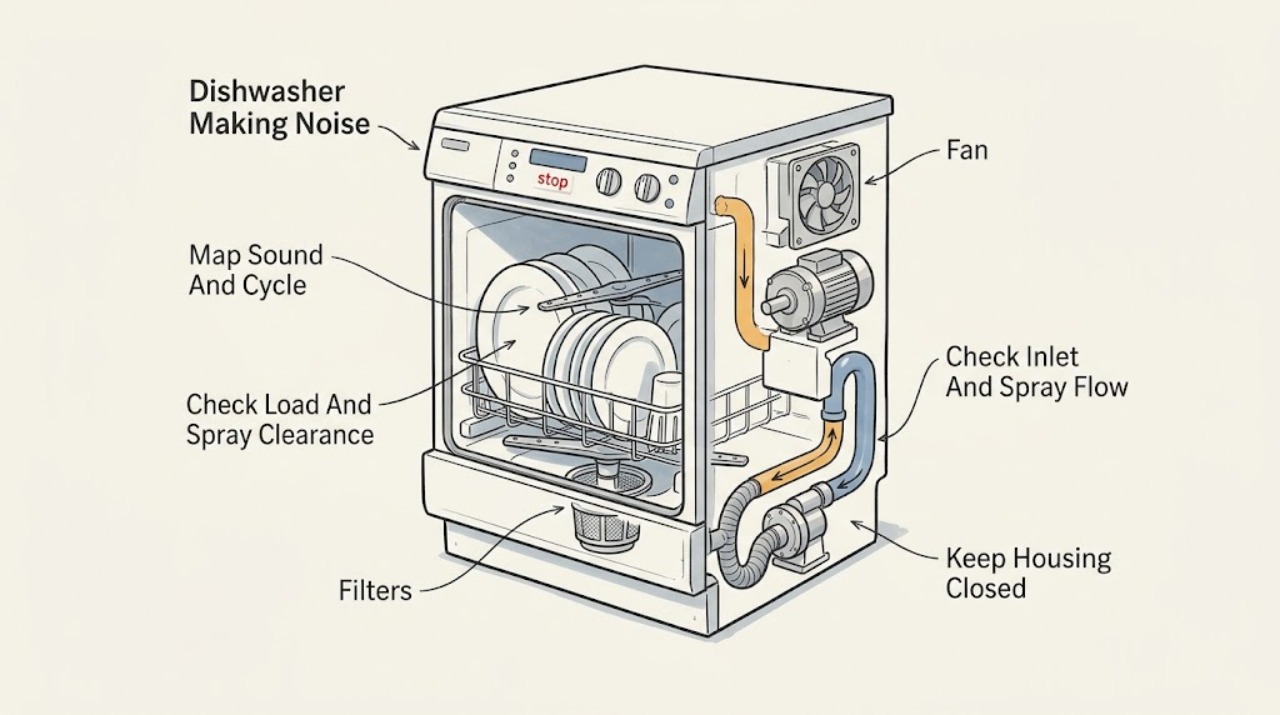
Work through in order
Diagnostic checks
Use only checks that match the exact appliance or system and its official guide.
-
Check 1
From outside the dishwasher, record the program phase, sound location, duration, and whether the tub drains and cleans normally. Note any standing water, leak, odor, display message, or recent installation or plumbing change.
Expected result: The sound is a brief fill rush, repeating spray knock, drain hum or grind, pipe noise, a persistent idle noise, or a noise paired with a fault or leak.
Next step: Use the matching load, spray, drain, plumbing, or service branch below. Stop immediately for smoke, burning odor, sparks, exposed wiring, a significant leak, or water near electrical equipment.
Stop if: Do not reach into the tub, move a built-in dishwasher, or continue a cycle when a leak or electrical or heat hazard is present.
Why this matters
Why: Timing and location separate water-flow or load contact from a drain-path, installation, or internal mechanical condition; a safety hazard overrides sound diagnosis.
-
Check 2
Stop the program normally and wait for movement and spray to cease. Inspect the accessible racks, secure loose dishes, move items out of a spray-arm path, and gently turn the spray arm by hand.
Expected result: A dish or utensil is loose or blocking the arm, the arm catches, the arm rotates freely, or the sound returns with the load correctly arranged.
Next step: Rearrange the load and reassess only if there is no leak or other hazard. If the arm still catches or the sound persists, use the exact model manual or arrange service.
Stop if: Do not put a hand into a moving or recently spraying tub, force the spray arm, or dismantle the arm to make clearance.
Why this matters
Why: Load contact or restricted spray-arm movement is more likely when the sound follows an item in the rack; a clear load with the same noise makes a pump, motor, inlet, or installation cause more likely.
-
Check 3
If the noise is during filling or washing and spray is weak, check household flow from a dry, safe position and confirm the dishwasher faucet is fully open. Look only at accessible spray outlets for visible obstruction, following the exact model guidance.
Expected result: Other faucets also have low flow, the dishwasher faucet is partly closed, spray is weak with normal household flow, a spray outlet is visibly blocked, or the inlet and spray path appear normal.
Next step: Wait for household pressure to normalize or fully open the clearly identified faucet. Clean an accessible spray outlet only as the exact manual permits; arrange service if flow remains weak or noise persists.
Stop if: Do not loosen a pressurized hose, force a nozzle, enter service diagnostics, or use a different model's spray-arm procedure.
Why this matters
Why: Haier separates low household pressure, a partly open faucet, and a blocked spray outlet as different causes of weak spray; a pump fault should not be assumed from sound alone.
-
Check 4
When noise begins during draining, inspect the visible drain hose for a sharp bend and check whether water is above the filter or only below it. Clean a removable filter only when the exact Haier manual identifies that access and the appliance is safely disconnected from power.
Expected result: Water is only below the filter, water stands above it, the hose is bent, the filter is visibly blocked, the drain outlet is obstructed, or the visible path is clear but draining remains poor.
Next step: Correct only an obvious accessible hose bend and clean only the approved filter access. If the pump area is hidden, sharp debris is suspected, or the fault remains, leave the dishwasher off and arrange service.
Stop if: Do not pull out a built-in appliance, open a pump cover on an unidentified model, force debris free, or work with power connected.
Why this matters
Why: Haier describes water below the filter as a normal pressure-balance feature in the referenced guidance, while water above the filter can relate to filter, hose, drain-outlet, or backflow conditions. A clear path with persistent noise may indicate an internal drain fault.
-
Check 5
With the dishwasher idle, listen from a safe position for a knock in the wall or pipework and inspect only visible hose sections for contact or a new kink. Do not loosen connections or move a built-in appliance.
Expected result: The sound starts as water flow begins or stops, started after plumbing work, is clearly in the pipework, or is clearly inside the wash cabinet.
Next step: Arrange qualified plumbing service for persistent pipe hammer, changed installation, or leaks. Arrange appliance service for a tub-origin sound that remains after safe checks.
Stop if: Do not alter pipework, loosen pressurized fittings, or operate when water is reaching electrical equipment.
Why this matters
Why: A pipe-origin noise follows an installation or plumbing path rather than proving an appliance motor failure; a cabinet-origin sound should be assessed through the load, spray, and drain branches.
-
Check 6
Record the complete Haier model, program and phase, exact sound description, sound location, drain result, and any code. Leave the appliance off when the sound persists with a clear load or empty tub, a function has failed, or any leak or electrical or heat hazard is present.
Expected result: The noise disappears after rearranging dishes, returns with a clear load, coincides with poor draining, remains after the visible checks, or is paired with a leak, smoke, burning odor, or breaker trip.
Next step: Arrange model-specific Haier appliance service and provide the recorded observations. Use qualified plumbing service for pipe-origin noise and qualified electrical service for a supply or wiring issue.
Stop if: Do not open the base or control area, perform live testing, bypass a door or safety device, or continue operation with a leak, smoke, burning odor, or exposed electrical part.
Why this matters
Why: A persistent clear-tub sound may involve an internal pump, motor, valve, fan, bearing, wiring, or control. Hazard symptoms are not suitable for further owner diagnosis.
Use your observations
Decision map
Find the observation that best matches what you see, then follow the next safe action.
-
PATH 01Safety boundary
What you see
The sound is inside the wash cabinet during spraying and a dish or utensil is loose, projects into the spray-arm path, or prevents free rotation.
Do this next
Stop safely, rearrange the load, confirm gentle free arm rotation, and reassess only when there is no leak or other hazard.
Why this path and its safety boundary
Why it matters: Load contact or restricted spray movement is more likely than an internal pump failure.
Safety stop: Do not force the arm or continue if it still catches after the load is clear.
-
PATH 02Safety boundary
What you see
The noise is during filling or washing and spray is weak, household water pressure is low, the faucet is partly closed, or a spray outlet is blocked.
Do this next
Restore normal household flow or fully open the identified faucet; clean an accessible outlet only under the exact manual and arrange service if the symptom remains.
Why this path and its safety boundary
Why it matters: Haier's support path makes water supply and spray outlet checks more likely than a confirmed motor fault.
Safety stop: Do not loosen the inlet hose or force a nozzle.
-
PATH 03Safety boundary
What you see
The noise starts during draining and water stands above the filter, a visible hose is bent, the filter is blocked, or the drain outlet is obstructed.
Do this next
Correct only an accessible hose bend and clean only the model-approved filter. Leave the unit off for a hidden pump, sharp debris, leak, or persistent poor drain and call service.
Why this path and its safety boundary
Why it matters: A restricted drain path or backflow condition is plausible; persistent noise after the approved check may indicate an internal drain fault.
Safety stop: Do not open an unapproved pump area or force debris free.
-
PATH 04Safety boundary
What you see
The knock is in the surrounding pipework, occurs as water starts or stops, or began after installation or plumbing changes.
Do this next
Arrange qualified plumbing assessment and do not pull out or dismantle a built-in appliance; address any leak before further use.
Why this path and its safety boundary
Why it matters: The source may be pipe routing, installation, or water hammer rather than the dishwasher's internal motor or pump.
Safety stop: Stop using the unit if water reaches electrical equipment or pipe movement is severe.
-
PATH 05Safety boundary
What you see
The noise returns with a clear or empty tub, draining or cleaning fails, a code persists, or there is grinding, smoke, burning odor, a leak, exposed wiring, or a breaker trip.
Do this next
Leave the dishwasher off and arrange authorized Haier or qualified appliance service with the model, phase, sound location, drain result, and any code.
Why this path and its safety boundary
Why it matters: An internal pump, motor, valve, fan, bearing, wiring, or control issue is more likely, and the exact model is required for safe diagnosis.
Safety stop: Do not open covers, perform live electrical work, bypass a safety device, or replace internal parts by guesswork.
Helpful context
Understand the symptom
Match the sound to the program phase
A short water-inlet rush, intermittent spray impact, drain hum, and a new grinding sound do not point to the same part. From outside the appliance, record whether the noise begins during filling, alternates with washing, appears only when draining, occurs during drying, or continues after the cycle. Note whether water remains, cleaning performance changed, or a code or leak appeared. Haier's product pages and support pages cover different model families and regions, so a general sound label is not enough to choose a component or access procedure.
Start with the load and spray-arm path
Stop the program normally and wait until spraying and movement have ceased. Inspect the accessible racks for a plate, utensil, or other item that is loose or projecting into a spray-arm path. Gently turn the arm by hand to confirm it is free, without forcing it or dismantling it. If the sound disappears after rearranging the load, the noise was more consistent with contact or loading than with an internal motor fault. If an arm still catches, leave the machine off and use the exact manual or service channel.
Weak spray or a water-flow sound needs a separate inlet check
If the sound occurs during filling or washing and the spray is weak, check from a dry, safe position whether other household taps also have low flow and whether the dishwasher faucet is fully open. Haier's support guidance treats low household pressure, a partly open faucet, and a blocked spray outlet as distinct possibilities. Do not infer that a pressure or spray-arm symptom proves a failed pump, and do not force a nozzle or use a different model's disassembly steps.
Drain noise and standing water change the decision
When the sound starts at the end of the cycle and water remains above the filter area, inspect only the visible hose routing and the filter access that the exact Haier manual identifies. Haier's published drainage guidance distinguishes normal water below the filter from accumulation above it, and points to a bent hose, drain-outlet obstruction, filter blockage, or installation-related backflow. A built-in unit should not be pulled forward to reach a hidden hose. If cleaning the approved filter does not restore draining, stop using the dishwasher and arrange service.
Persistent mechanical noise is a service symptom
A grinding sound, a loud hum that returns with a clear tub, a noise accompanied by a leak, or a sound that persists after the load and visible drain checks is not a reason to open the base. The exact Haier model determines the pump, motor, valve, fan, filter, and control layout. Record the model, cycle phase, sound location, drain result, and any displayed code, then give those details to Haier support or a qualified appliance technician.
Safety boundary
Stop conditions
- Stop immediately for smoke, burning odor, sparks, damaged wiring, a significant leak, water near electrical parts, or a repeatedly tripping breaker.
- Do not reach into a moving or recently spraying tub, force a spray arm, or use tools to break loose sharp debris.
- Do not open electrical, pump, motor, valve, fan, or control covers or perform live electrical testing.
- Use filter, drain, and spray-outlet procedures only when the exact Haier manual or support path identifies them, with power disconnected where required.
- Do not pull out a built-in dishwasher or alter pressurized water and drain plumbing; use qualified appliance or plumbing service.
When checks do not resolve it
Need a professional?
Arrange model-specific Haier appliance service when noise persists with a correctly loaded or empty tub, draining or cleaning has failed, a code remains, or a pump, motor, valve, fan, wiring, or control would need access. Use qualified plumbing service for pipe-origin noise, installation-related water hammer, or leaks. Stop immediately for smoke, burning odor, sparks, exposed wiring, water near electrical parts, a significant leak, or a repeatedly tripping breaker.
Safety scope: This article covers observation from outside, safe load rearrangement, gentle spray-arm clearance checks, visible hose inspection, and only model-approved filter or nozzle checks. Do not open electrical or mechanical covers, alter plumbing, or perform live testing.
Read the exact guide
Official sources
- Water accumulation at the bottom of the dishwasherHaier · Haier Egypt dishwasher support guidance; filter layout, drain routing, and installation requirements vary by model.
- The washing arm of the bowl machine does not discharge water from the spray holeHaier · Haier Egypt dishwasher support guidance; exact spray-arm construction, nozzle access, and regional instructions vary by model.
- Dishwasher display code E1 (not draining or draining slowly)Haier · Haier Egypt E1 support article; the E1 code and exact drain procedure are not universal across Haier dishwasher models or regions.
- Haier Service & SupportHaier · Official Haier Egypt support hub; available resources and service contacts vary by market and product model.
- HDWE15-46BK6EG 15ps AI Dishwasher product page and user guideHaier · Official Haier Egypt product page for model HDWE15-46BK6EG; it establishes a Haier dishwasher example and model-specific guide availability, not universal specifications or procedures for every Haier dishwasher.
Community feedback
Share a repair observation
Share a plain-text repair observation. Accepted observations are published automatically; this page may take a moment to update.