
On this page
Start here
Quick answer
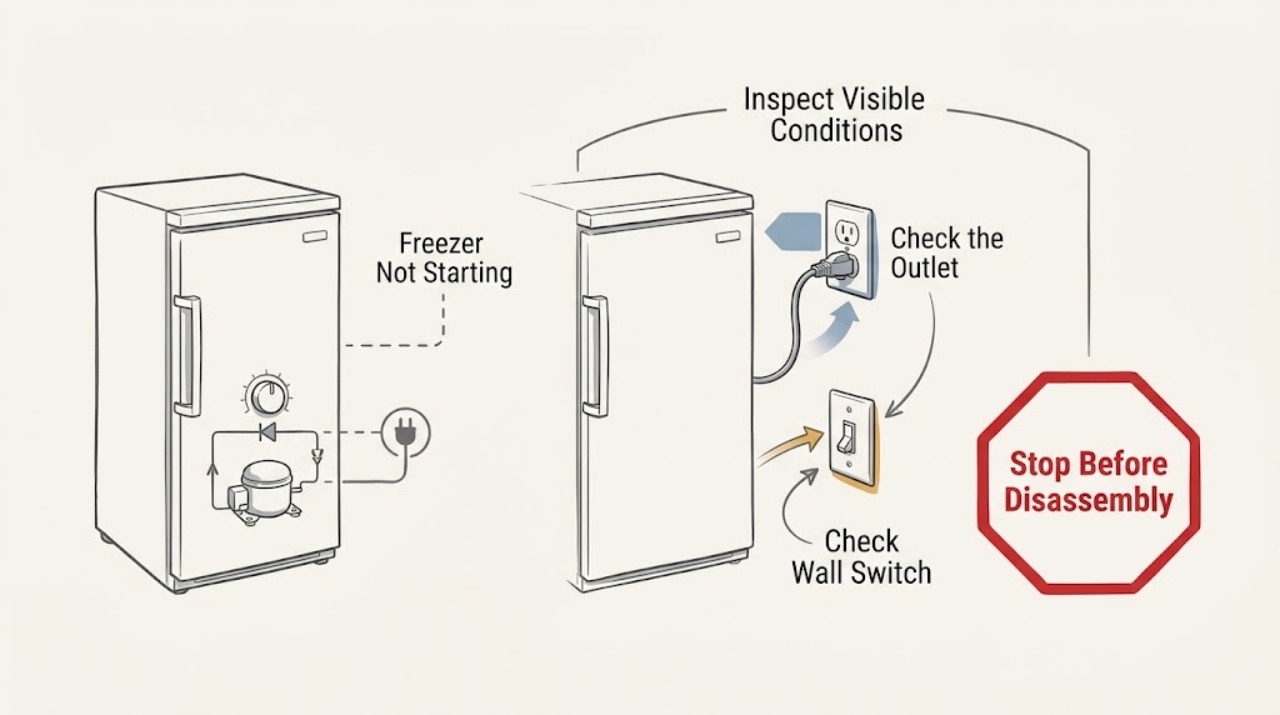
If a Haier freezer is not starting, first determine whether the cabinet is completely dead or the compressor is simply between cycles. Check the plug and wall outlet without opening the appliance, confirm that the unit is on and the thermostat is set to a cold setting, then wait 30–40 minutes for a possible compressor restart. If the controls remain dead, the breaker trips, the cord is damaged, there is smoke or a burning smell, or the freezer still will not start after these checks, stop and arrange qualified service. Protect food during a prolonged outage and do not bypass electrical or temperature controls.
Work through in order
Diagnostic checks
Use only checks that match the exact appliance or system and its official guide.
-
Check 1
With the freezer closed, observe whether any interior light, display, indicator, fan sound, or compressor sound is present. Note whether it is a chest or upright model and whether the failure began after an outage, moving the appliance, or cleaning.
Expected result: A completely dark and silent freezer differs from a freezer with lights or controls on but no compressor sound; a recent outage provides a separate power-interruption lead.
Next step: Use the matching branch below: inspect external power for a dead unit, or continue to the control and restart checks for a powered unit.
Why this matters
Why: Darkness makes the supply, plug, outlet, or main control path the first safe area to check. Lights or a display show that at least some power is reaching the appliance, so a delayed compressor cycle or control setting remains possible.
-
Check 2
Inspect the plug and cord from outside the appliance. Make sure the plug is fully seated in a known-working wall outlet, with no scorch marks, looseness, cuts, crushed sections, or warm connection. If an extension cord or power strip is being used, stop using it and follow the model's installation instructions for the proper supply.
Expected result: The outlet powers another suitable appliance and the freezer cord and plug look intact, or the outlet is dead / the cord is visibly damaged.
Next step: If the cord, plug, or outlet is unsafe, disconnect only if it can be done without touching damage and arrange qualified help. If the external supply is sound, continue without opening the freezer.
Why this matters
Why: A dead outlet or damaged cord can prevent any start and needs household electrical or appliance service. A sound external supply makes a thermostat setting, delayed compressor cycle, or internal fault more likely.
-
Check 3
Using the normal external control for the exact model, confirm that the freezer is switched on and the thermostat or temperature control is set to a cold setting rather than Off, Demo, or a warmest/defrost position. Do not force a dial or press combinations that are not in the manual.
Expected result: The unit was off or set too warm, or it was already on a cold setting and accepts the normal control input.
Next step: Correct only the normal user setting, close the door or lid, and allow the appliance to respond. Retrieve the exact manual by model if the control behavior is unclear.
Why this matters
Why: An off or warm control explains a no-start symptom without proving that a part has failed. If the setting is correct and the control does not respond, the control or main power path may require service.
-
Check 4
If the freezer has power and the setting is cold, leave it closed and listen for a start over the next 30–40 minutes. Do not repeatedly unplug and replug it or keep changing the thermostat while waiting.
Expected result: The compressor or normal cooling sounds begin within that interval, or the freezer remains silent with no cooling response.
Next step: If it starts, check that cooling returns and monitor it without opening the cabinet unnecessarily. If it does not, proceed to the service boundary rather than removing panels.
Why this matters
Why: A start after the wait is consistent with a compressor that had cycled off, as Haier describes. Continued silence after a confirmed supply and cold setting is not resolved by waiting and may indicate a control, start, compressor, or other internal fault.
-
Check 5
If the problem followed a storm or outage, record whether power has been stable and keep the freezer closed. Once household power is restored, reconnect the unit only when the cord and outlet are safe; do not keep resetting a breaker that trips.
Expected result: The freezer resumes normal sounds after stable power returns, or the breaker trips / the unit stays dead when power is restored.
Next step: For a prolonged interruption, inspect food and discard spoiled or thawed items according to local food-safety guidance, then clean the freezer before reuse. Arrange service for repeated trips or no restart.
Why this matters
Why: A restart after restored power supports an interruption-related event. A repeated trip, burning indication, or persistent dead cabinet points to an electrical fault that needs professional assessment.
-
Check 6
Make one final external check for a closed door or lid, an obviously blocked control, or an alert shown by the model. Do not remove the inner liner, access the compressor compartment, test capacitors, or perform electrical testing.
Expected result: A simple obstruction or documented model-specific alert is found, or all external checks are normal but the freezer still does not start.
Next step: Follow only the exact manual's user-level instruction for the alert; otherwise stop troubleshooting and provide the model number, symptom timeline, outage history, and observed lights/sounds to a qualified service provider.
Why this matters
Why: A removable obstruction can explain a control or closure-related symptom. No external explanation leaves internal electrical, starting, or sealed-system causes that cannot be identified safely from the outside.
Use your observations
Decision map
Find the observation that best matches what you see, then follow the next safe action.
-
PATH 01Safety boundary
What you see
The cord or plug is damaged, the outlet is unsafe, smoke or a burning smell is present, water has reached electrical parts, or a breaker trips again.
Do this next
Stop operating the freezer, keep clear of damaged electrical parts, and arrange qualified electrical/appliance help. Do not open covers or repeatedly restore power.
Why this path and its safety boundary
Safety stop: Continue with the external power, control-setting, and timed restart checks.
-
PATH 02Safety boundary
What you see
The freezer is completely dark and silent after a known-good outlet and intact external cord have been confirmed.
Do this next
Treat the symptom as an unresolved supply or internal control fault and arrange service; do not bypass the thermostat or door/lid controls.
Why this path and its safety boundary
Safety stop: If lights or controls work, allow the compressor cycle to complete and verify the cold setting before escalating.
-
PATH 03Safety boundary
What you see
The cold setting and safe power are confirmed, but no compressor or cooling response appears after 30–40 minutes.
Do this next
Stop user-level troubleshooting and request appliance service for a control, start, compressor, or refrigeration diagnosis.
Why this path and its safety boundary
Safety stop: Monitor the freezer after it starts and keep the door or lid closed while it returns to temperature.
-
PATH 04Safety boundary
What you see
The freezer was stopped by a prolonged outage and food is thawed or spoiled.
Do this next
Discard questionable food, clean the freezer before reuse, and address the no-start symptom separately.
Why this path and its safety boundary
Safety stop: Continue monitoring food temperature and cooling after a successful restart.
Helpful context
Understand the symptom
Start by separating a dead freezer from a quiet compressor
A dark display or missing interior light points toward the supply path, while a powered cabinet with no hum may only be between compressor cycles. Chest and upright Haier freezers use different control layouts, so identify which type you have and use its exact manual before assuming a control is faulty. Keep the lid or door closed while you diagnose so cold air and food condition are not made worse.
Food safety while the freezer is stopped
If the interruption has lasted long enough for food to thaw, do not treat a later restart as proof that every item is safe. Haier says to inspect and discard spoiled or thawed food after a prolonged outage and clean the freezer before reusing it.
What not to repair at home
The checks below stay outside the cabinet: do not remove covers, probe live wiring, bypass a control or door switch, replace a sealed-system component, or repeatedly reset a breaker that trips. A qualified appliance technician should handle internal electrical and refrigeration diagnosis.
Only after diagnosis
Potential parts
- temperature control or thermostat
Consider this category only if the outlet and cord are sound, the normal control does not respond or does not call for cooling, and a technician's diagnosis points to the control.
Confirm the exact Haier model and manufacturer's fit information before ordering any part. - compressor start component
Consider this category only when the freezer has correct external power and control settings but a qualified technician identifies a start-circuit fault.
Start components are model- and compressor-specific; verify fitment from the exact model documentation.
When checks do not resolve it
Need a professional?
Arrange qualified service when the freezer stays dead after a safe outlet and intact cord are confirmed, does not start after the correct cold setting and 30–40 minute wait, repeatedly trips protection, shows burning or smoke, or needs an internal electrical, compressor, sealed-system, or control diagnosis. Have the exact model number, whether the unit is chest or upright, the last known working time, outage history, and observed lights or sounds ready.
Common questions
FAQ
Why is my Haier freezer not starting even though it is plugged in?
Confirm that the outlet itself works, the freezer is on, and its thermostat is set cold. If those checks pass, Haier says the compressor may have cycled off; leave the freezer closed and allow 30–40 minutes for a restart. Continued silence requires service rather than an internal DIY repair.
Should I keep resetting the breaker when the freezer will not start?
No. If the breaker trips again or there is heat, smoke, a burning smell, or cord damage, stop operating the appliance and arrange qualified help. Do not bypass protection or open electrical covers.
What should I do with food if the Haier freezer stopped during an outage?
Keep the door or lid closed while checking the problem. After a prolonged interruption, inspect the food and discard items that are spoiled or thawed, then clean the freezer before reuse as Haier advises.
Read the exact guide
Official sources
- Haier - Chest and Upright Freezer Power InterruptionsHaier Appliances · Haier chest and upright freezer outage recovery and food handling
- Haier - Chest and Upright Freezer Not Coming OnHaier Appliances · Haier chest and upright freezer no-power and no-start checks
- Haier - Chest and Upright Freezer Cleaning and MaintenanceHaier Appliances · Haier chest and upright freezer cleaning after disconnecting power
- Owner's Manual & Installation InstructionsHaier Appliances · Haier model-specific owner's, use-and-care, and installation instructions
Community feedback
Share a repair observation
Share a plain-text repair observation. Accepted observations are published automatically; this page may take a moment to update.