
On this page
Start here
Quick answer
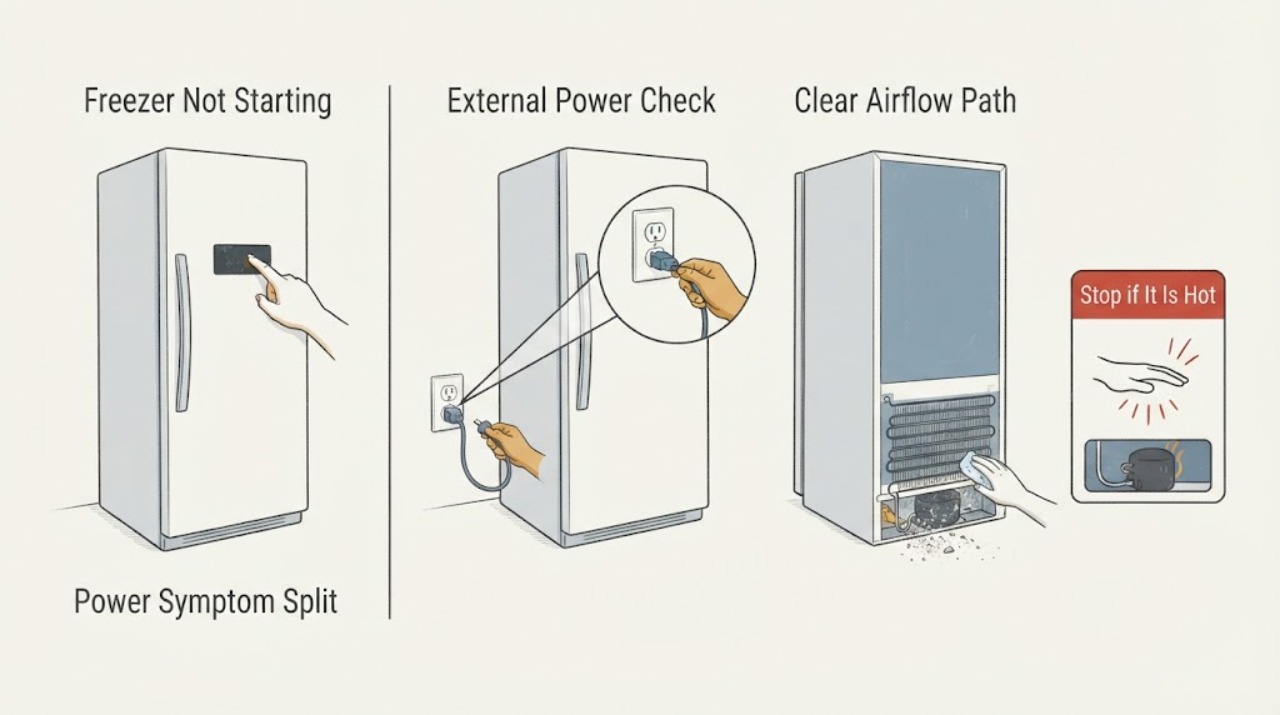
If a Kenmore freezer will not start, first check whether the interior light or control responds and listen for a compressor or fan sound without opening the cabinet. With the freezer safe to access, confirm the plug, outlet, breaker, temperature control, and door closure, then check the appliance thermometer and keep the door closed to protect the food. Do not remove the rear cover, handle a start capacitor, or make live electrical or sealed-system repairs. If power is present but the compressor never starts, a breaker trips again, the cabinet is warm, or food is thawing, stop troubleshooting and arrange qualified appliance service while following food-safety guidance.
Work through in order
Diagnostic checks
Use only checks that match the exact appliance or system and its official guide.
-
Check 1
Without moving the freezer or opening any panel, note whether the interior light, display, alarm, or temperature control responds. Listen briefly with the door closed for a compressor or fan sound, and check whether other appliances in the same area have power.
Expected result: The light and controls are dead; the light works but there is no motor sound; the freezer hums or clicks; or it runs but the contents are warming.
Next step: Continue with the external power checks for a dead cabinet. If power is present and the freezer only clicks or stays warm, limit further checks to visible, user-safe observations and prepare for service.
Why this matters
Why: No light or response makes a household power or control issue more likely. A hum or repeated click means the freezer may be receiving power but failing to start its cooling system. A running sound with warming food is a cooling-performance problem rather than a complete no-start.
-
Check 2
With the control set to a normal cooling position, check that the plug is fully seated and that the outlet can power another small appliance. Check the relevant household breaker or fuse once, without opening the freezer or using an adapter that changes the supply. If the breaker trips again, leave it off.
Expected result: The outlet is dead, the plug is loose, a breaker is tripped, or the outlet and breaker are normal.
Next step: Use only ordinary, safe household corrections such as reseating an accessible plug or resetting a breaker once. If the supply is normal or the breaker trips again, do not continue with electrical testing; arrange qualified service.
Why this matters
Why: A dead outlet or loose plug can explain a silent freezer without indicating an internal failure. A breaker that trips again can indicate an electrical fault. Normal household power shifts the investigation toward the freezer's controls or cooling components.
-
Check 3
Using the exact Kenmore manual for the model, verify that the temperature control is not in an Off or demonstration setting and that the door closes fully. Look only at accessible shelves, vents, and the door gasket for a package blocking airflow, heavy frost, a torn seal, or a door that cannot latch. Do not chip ice or remove covers.
Expected result: The control was off or mis-set; the door or gasket is not sealing; an internal vent is blocked; heavy frost is present; or these visible conditions are normal.
Next step: Correct only a clearly wrong setting or a movable package, then close the door and observe without repeatedly cycling the control. For heavy frost, damage, or a persistent warm cabinet, keep the door closed and request service rather than using sharp tools or heat.
Why this matters
Why: A control setting, open door, blocked vent, or failed gasket can make the freezer appear not to start or can cause warming even when the motor runs. Heavy frost or a normal visible interior can point to a defrost, airflow, or sealed-system issue that needs model-specific diagnosis.
-
Check 4
If the freezer has an appliance thermometer, read it without leaving the door open. Record whether the freezer is at or below the model's recommended setting, whether packages still have ice crystals, and whether the unit has had power for long enough to respond after a recent outage. Keep the door closed between observations.
Expected result: The cabinet is still at a safe freezing temperature; the temperature is rising; food is partly thawed but still has ice crystals; or food is soft and warm.
Next step: Protect or transfer food if needed and follow the government food-safety chart. If the freezer remains warm or silent after power is confirmed, stop repeated resets and arrange service.
Why this matters
Why: A safe reading suggests the apparent no-start may have been a brief interruption or delayed cycle. Rising temperature means the cooling fault is active. Food with ice crystals or at 40°F or below may be handled according to FoodSafety.gov guidance, while warm or unsafe food should not be judged by taste.
-
Check 5
Record the model number, whether the light works, the sound pattern, the breaker result, the temperature reading, any recent outage or move, and any visible frost or damage. Do not remove the rear cover, access a start capacitor, test energized wiring, open the sealed refrigerant system, or substitute a component based on a symptom.
Expected result: Power is normal but the compressor never starts, the freezer repeatedly clicks, the breaker trips, the cabinet is warm, a control fault persists, or the freezer is physically damaged.
Next step: Leave the freezer connected only if the electrical supply is stable and there is no heat, smoke, burning odor, or damage; otherwise disconnect it safely and keep it off. Book qualified Kenmore appliance service and provide the recorded observations.
Why this matters
Why: These results can involve a control, start circuit, fan, compressor, defrost system, or sealed cooling circuit. Confirming which internal component has failed requires model-specific service procedures and may involve stored electrical energy or refrigerant.
Use your observations
Decision map
Find the observation that best matches what you see, then follow the next safe action.
-
PATH 01Next step
What you see
The freezer has no light, display, or sound and the outlet is also dead.
Do this next
Address the household power issue safely or have an electrician check it. Do not open the freezer or bypass the breaker.
-
PATH 02Next step
What you see
The outlet and breaker are normal, but the Kenmore freezer is silent.
Do this next
Verify the model-specific control setting and door closure once. If it remains silent, leave internal controls and wiring alone and arrange appliance service.
-
PATH 03Next step
What you see
The freezer clicks or hums but does not establish cooling.
Do this next
Do not keep power-cycling it or remove the rear cover. Record the sound and temperature and request qualified diagnosis of the start and cooling system.
-
PATH 04Next step
What you see
The freezer runs but food is warming or heavy frost is blocking airflow.
Do this next
Keep the door closed, move only obvious packages away from visible vents, and follow the model manual or service guidance for defrost and temperature checks. Do not chip ice or apply heat.
-
PATH 05Next step
What you see
A breaker trips again, there is smoke or a burning odor, the cabinet is damaged, or food is rapidly thawing.
Do this next
Stop using the freezer and arrange urgent qualified service. Protect food using FoodSafety.gov guidance, and never taste food to decide whether it is safe.
Helpful context
Understand the symptom
First separate no power from no cooling
A freezer that is truly not starting may have no light, display, hum, or fan sound. A freezer that is running but not cooling usually has some sound or airflow even though the food is soft. That distinction determines whether the next safe check is the household power path or the cooling and temperature symptoms.
Use the exact Kenmore manual
Kenmore's manual page asks for the appliance model number and includes manuals for freezers. Controls, alarm behavior, temperature adjustment, and access to a particular model's service information can differ, so use the manual for the actual model instead of assuming that a reset or component diagnosis applies to every Kenmore freezer.
Protect the food while you diagnose
Keep the freezer door closed as much as possible while a no-start condition is unresolved. FoodSafety.gov says a full freezer can hold a safe temperature for about 48 hours, or about 24 hours when half full, if the door remains closed; food can be refrozen when ice crystals remain or its temperature is 40°F or below, subject to the published food-specific chart.
Only after diagnosis
Potential parts
- start relay or overload protector
Consider this category only when qualified service confirms a start-circuit fault after household power and the model-specific controls have been checked.
Confirm the exact Kenmore model and the manufacturer's parts information; do not infer fit from a similar-looking relay. - temperature control or electronic control
Consider this category only if service diagnostics show that the control is not requesting or regulating cooling despite stable power.
Control parts vary by model and electrical design; qualified service should verify the model and safe replacement path. - evaporator or condenser fan
Consider this category only when a qualified technician confirms a fan fault after the freezer is powered and the cabinet's visible airflow checks are complete.
Verify exact model fitment and electrical specification before ordering; do not access a fan behind a cover while energized.
When checks do not resolve it
Need a professional?
Request Kenmore appliance service when safe external checks do not restore starting or cooling, or immediately for repeated breaker trips, burning odor, smoke, physical damage, or a warm freezer with thawing food.
Have this ready
- Provide the model number, whether the interior light responds, outlet and breaker results, sound pattern, temperature reading, visible frost or gasket condition, and the timing of any outage, move, or spill.
Common questions
FAQ
Why is my Kenmore freezer completely silent?
Start by separating a dead outlet or tripped breaker from a freezer that has power but no motor response. Check the accessible plug, outlet, breaker, and model-specific temperature control once. If power is normal and the freezer remains silent, leave internal wiring and controls alone and arrange service.
What does a clicking sound mean when a Kenmore freezer will not start?
A repeated click with no sustained cooling means the freezer may be receiving power while its start or cooling system fails to run. Record the sound and temperature, avoid repeated power cycling or cover removal, and request qualified diagnosis.
How long will food stay safe if the freezer stops?
FoodSafety.gov says a full freezer can hold a safe temperature for about 48 hours and a half-full freezer for about 24 hours when the door stays closed. Food may be refrozen if it still has ice crystals or is at 40°F or below; use the government chart for the food type and never taste food to test it.
Should I replace the Kenmore freezer start relay myself?
Not from the symptom alone. A start circuit can include stored electrical energy and model-specific parts. Have qualified service confirm the failed component and exact model fitment before any replacement.
Read the exact guide
Official sources
- Kenmore ManualsKenmore · Kenmore appliance manuals, including freezers
- Customer Care & Support | Kenmore AppliancesKenmore · Kenmore product care, manuals, parts, recalls, and repairs
- Food Safety During Power OutageFoodSafety.gov · Government food-safety guidance during freezer power outages
Community feedback
Share a repair observation
Share a plain-text repair observation. Accepted observations are published automatically; this page may take a moment to update.