
On this page
Start here
Quick answer
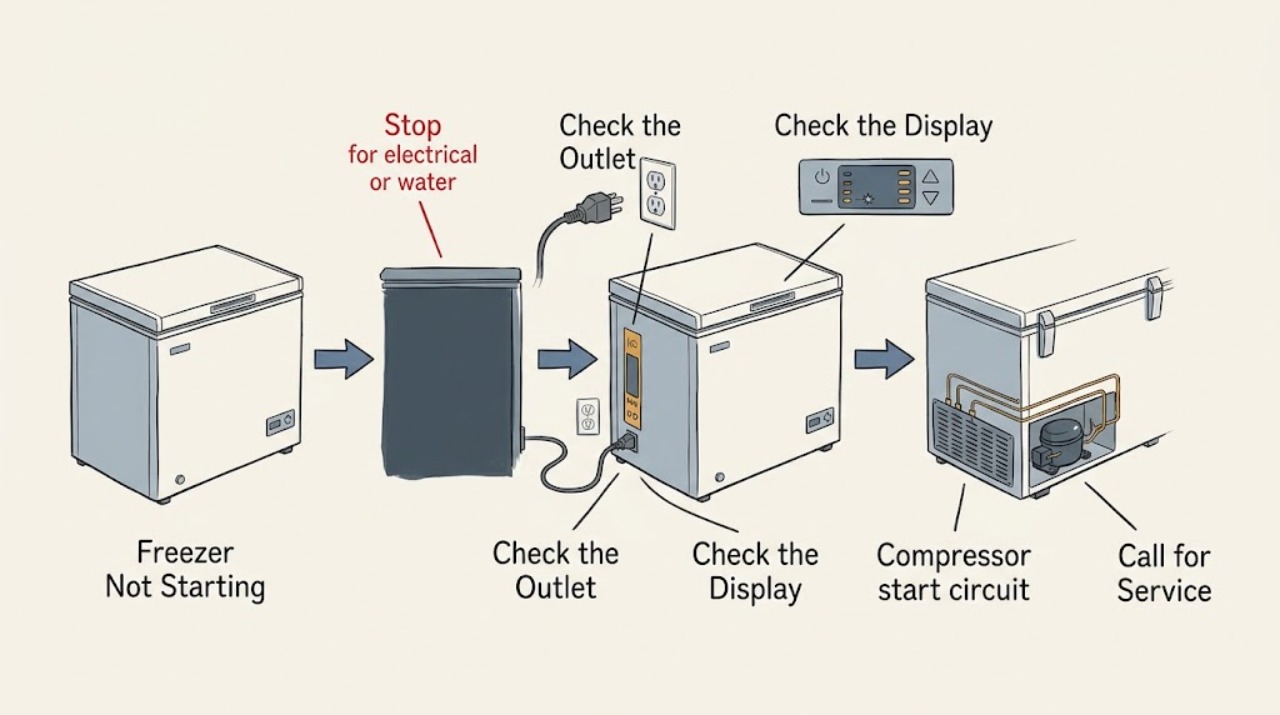
If a GE freezer is not starting, first protect people and food: stop for a burning smell, damaged cord, water near electrical parts, smoke, or a breaker that trips again. Without opening the appliance, check that the plug is seated, the outlet and breaker have power, and the temperature control is not set to OFF. GE advises setting the control to its highest setting and waiting about 10 minutes for the compressor to start, then checking the outlet with a small lamp if it does not. If the outlet works but the freezer remains silent or a fault returns after the model-approved reset, keep the door closed, move food to safe cold storage, and arrange qualified GE appliance service.
Work through in order
Diagnostic checks
Use only checks that match the exact appliance or system and its official guide.
-
Stop for electrical or water hazards
Look at the power cord, plug, outlet area, cabinet floor, and visible controls without opening the freezer. Do not touch wet electrical parts. Stop immediately for a frayed or hot cord, scorch mark, smoke, burning smell, water at the outlet, or a breaker that trips again when the freezer is connected.
Expected result: A hazard or repeated trip is present, or the freezer is dry with an intact cord and no unusual smell.
Next step: For any hazard, leave the freezer isolated when safe, keep clear, and arrange a qualified appliance technician or electrician. If no hazard is present, continue without removing covers or using live test equipment.
Why this matters
Why: The first result indicates an electrical or water-safety fault that is outside a user start check. A dry, intact appliance can proceed to an external supply check.
-
Confirm the outlet and freezer supply
Make sure the plug is fully seated and the accessible freezer switch, if fitted, is on. Set the temperature control to its highest setting and wait about 10 minutes for a compressor response. If it does not start, use a small lamp or other low-load appliance to check the outlet; do not use a damaged tester or open the outlet.
Expected result: The freezer starts after the control or plug is corrected, the lamp also fails at the outlet, or the lamp works but the freezer remains silent.
Next step: If the outlet is dead, check the accessible breaker once or call an electrician. If the outlet has power but the freezer does not start, stop trying to reproduce the fault and arrange GE appliance service.
Why this matters
Why: A failed lamp test points to the outlet, circuit breaker, or fuse. A working outlet with no freezer response points to a freezer-side control, relay, wiring, or compressor fault rather than a household supply issue.
-
Check the temperature control and normal start clues
With the freezer powered and safe, check that the temperature control is not at OFF and that the door or lid closes without a package holding it open. Listen from a safe distance for a compressor or fan response after the timed supply check; do not remove a guard or reach behind the cabinet.
Expected result: The control was OFF, the door or lid was held open, the compressor starts after correction, or the lights work while the compressor remains silent and the temperature rises.
Next step: Correct only the control or accessible loading obstruction and monitor normally. If the compressor still does not start or the freezer remains warm, keep the door closed and arrange qualified service rather than repeatedly changing the control.
Why this matters
Why: OFF stops cooling on models with that control, while an obstructed door can allow warming even when the cabinet is powered. Lights with no compressor response can indicate a control, relay, wiring, or compressor fault requiring service.
-
Record and clear a displayed freezer fault once
If the model has an electronic display, photograph or write down the exact fault indication and consult the model's Owner's Manual. Only if that manual or GE's model guidance permits it, disconnect power for the specified short reset and restore it once; keep hands away from internal parts.
Expected result: The indication clears and the freezer starts, or it returns immediately or the freezer remains not starting after the documented reset.
Next step: Keep the model and code available for service. If the code returns, GE recommends service and, for affected upright models, leaving the freezer unplugged until it is serviced.
Why this matters
Why: A code can identify a control or sensor condition, but a reset does not prove the underlying fault is repaired. A recurring code needs technician diagnosis.
-
Check cooling conditions without opening the sealed system
If the compressor runs but the freezer is not holding temperature, verify that packages are not holding the door or lid open, the door gasket is seated, interior air vents are not blocked, and the cabinet has the clearance required by the model instructions. Do not scrape heavy frost with a sharp tool or access sealed-system components.
Expected result: A package, loose gasket, blocked vent, or restricted clearance is found, or the freezer is correctly closed and ventilated but remains warm.
Next step: Remove the accessible obstruction and monitor without frequent door opening. If the freezer stays warm, frosts abnormally, or the compressor cycles off and does not recover, arrange service and protect the food.
Why this matters
Why: Air leakage, blocked airflow, or poor clearance can make a working freezer appear not to start cooling. Correcting an accessible obstruction will not fix a silent compressor, sealed-system fault, or persistent no-cool condition.
Use your observations
Decision map
Find the observation that best matches what you see, then follow the next safe action.
-
PATH 01Next step
What you see
The outlet or circuit has no power.
Do this next
Check the accessible breaker or fuse once without opening electrical equipment. If the circuit will not restore or trips again, call a qualified electrician and leave the freezer disconnected.
-
PATH 02Next step
What you see
The outlet has power, the control is not OFF, but the GE freezer remains silent or does not cool.
Do this next
Stop repeated start attempts, keep the door closed, move food to safe cold storage, and schedule qualified GE appliance service for the control, start circuit, wiring, compressor, or sealed system.
-
PATH 03Next step
What you see
A package, door gasket, vent, or clearance issue is found while the compressor is running.
Do this next
Remove the accessible obstruction, close the door or lid, and monitor temperature according to the model guidance. If it stays warm or the issue returns, arrange service.
-
PATH 04Safety boundary
What you see
A fault code returns after the model-approved reset.
Do this next
Stop resetting it. Record the code and model, leave the appliance unplugged if GE instructs for that model, protect the food, and arrange qualified service.
Why this path and its safety boundary
Safety stop: True
-
PATH 05Safety boundary
What you see
There is smoke, burning smell, a damaged cord, water at electrical parts, a cracked cabinet, or a repeated breaker trip.
Do this next
Stop immediately and keep clear. Isolate the accessible supply only if safe, do not open the appliance, and arrange qualified electrical or appliance service before use.
Why this path and its safety boundary
Safety stop: True
Helpful context
Understand the symptom
Keep electrical work outside the user checks
Do not remove the rear cover, test live terminals, bypass a ground connection, or dismantle the compressor or relay. Stop if the cord or plug is damaged, the cabinet or outlet is wet, you smell burning, see smoke, or the breaker trips again. Isolate the freezer at the plug or breaker only when it is safe to do so and arrange qualified service.
A freezer can be powered without the compressor running
Some GE upright and chest freezers have no dedicated power light. A lit interior lamp or control does not prove the compressor is running, and a quiet compressor can also be in its normal cycle. Use the control, outlet, and timed response checks below to separate a supply fault from a freezer-side start or cooling fault.
Protect food while diagnosing
Limit door openings while the freezer is warm or stopped. Move food to a known-working freezer or other safe cold storage as soon as practical, and follow local food-safety guidance for items that have thawed or warmed. Do not keep restarting a freezer that trips power or has an electrical smell just to save food.
Only after diagnosis
Potential parts
- freezer temperature control
Consider this only after a technician confirms the freezer has a correct supply and the control does not respond or does not call for cooling.
Confirm the complete GE model and the manufacturer's fit information; controls vary by freezer design. - freezer start relay
Consider this only when qualified diagnosis identifies a failed compressor start component after the outlet and temperature control are verified.
A technician must confirm the exact GE model, compressor configuration, and safe replacement procedure before ordering.
When checks do not resolve it
Need a professional?
A technician is appropriate for a persistent no-start condition, a repeated code, a failed control or start circuit, compressor silence, abnormal frost or temperature, or any suspected wiring or sealed-system fault.
Common questions
FAQ
Why is my GE freezer not starting even though the light works?
A light only shows that some power reaches the appliance. Check that the temperature control is not OFF, set it high once, and wait about 10 minutes for a compressor response. If the outlet works but the freezer stays silent or warm, arrange service for the control, start circuit, wiring, or compressor.
How can I tell whether my GE freezer outlet has power?
With the freezer disconnected or not being disturbed, use a small lamp or other safe low-load appliance at the outlet as GE describes. If it does not work, check the accessible breaker or call an electrician. Do not open the outlet or perform live electrical tests.
Should I reset a GE freezer that shows a fault code?
Record the code and check the exact model guidance first. If GE permits the reset for that model, disconnect power for the documented short interval and restore it once. If the code returns or the freezer remains stopped, stop resetting and arrange service.
What should I do with food when my GE freezer stops?
Keep the door closed as much as possible and move food to a known-working cold-storage location as soon as practical. Follow local food-safety guidance for items that have thawed or warmed, and do not repeatedly restart a freezer with an electrical smell or a tripping breaker.
Read the exact guide
Official sources
- Upright Freezer - Error, Fault or Function CodesGE Appliances · GE freezer not starting with a fault indication, documented power reset, recurring code, and service escalation
- Upright & Chest Freezer - Not WorkingGE Appliances · GE freezer not starting or not cooling, OFF temperature control, defrost control, relay, wiring, compressor, and repair service
- Refrigerators, Freezers and Icemakers Troubleshooting and SupportGE Appliances · GE freezer support, model-specific troubleshooting, qualified service, and temperature or airflow support paths
- Upright & Chest Freezer - Electrical Requirements and Breaker SizeGE Appliances · GE freezer electrical supply, grounding, dedicated circuit, breaker, and qualified electrical service boundary
- Refrigerator or Freezer - Normal Run TimeGE Appliances · GE freezer not starting or not cooling, compressor cycling, door gasket, blocked vents, condenser, and clearance checks
- Food Freezer Problem SolverGE Appliances · GE freezer not starting, food protection during power loss, electrical safety, grounding, and thawed-food handling cautions
- Upright & Chest Freezer - How to Confirm Power to the FreezerGE Appliances · GE freezer not starting, temperature control, outlet check, breaker or fuse, compressor start wait, and service escalation
Community feedback
Share a repair observation
Share a plain-text repair observation. Accepted observations are published automatically; this page may take a moment to update.