
On this page
Start here
Quick answer
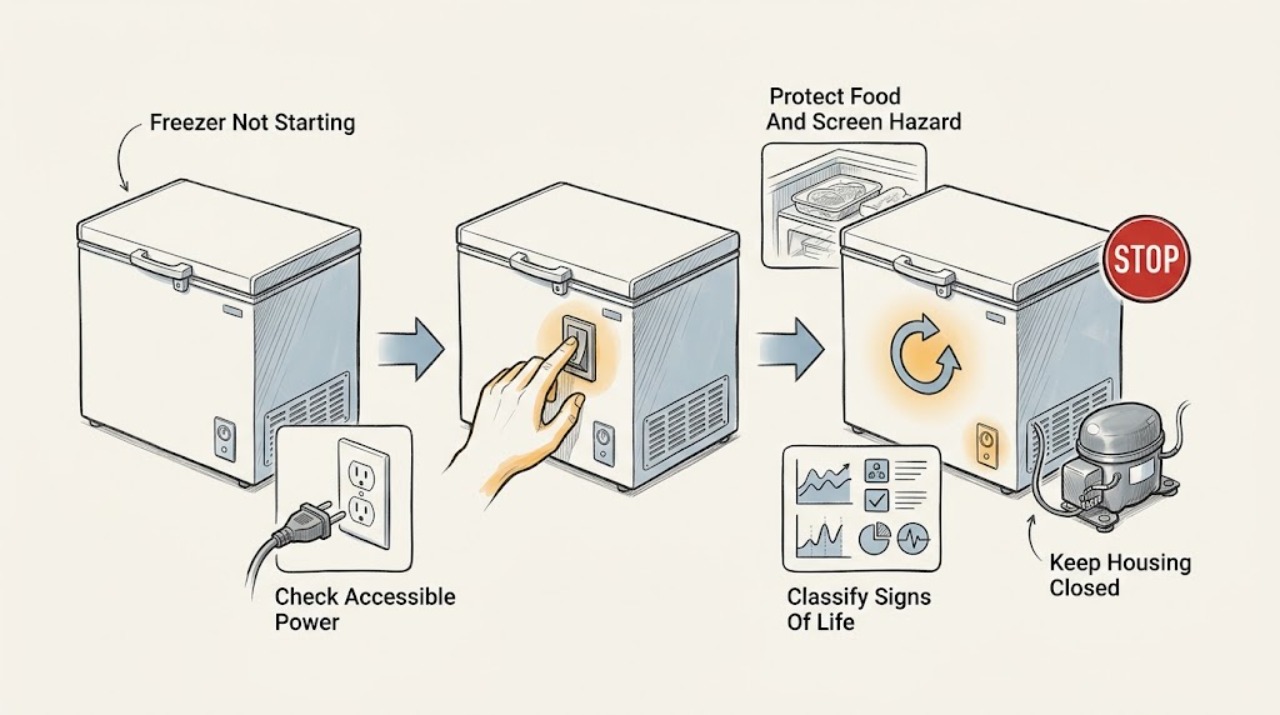
When a Whirlpool freezer is not starting, first protect the food and distinguish a completely dead appliance from a freezer that has power but is not cooling. From ordinary safe access, check whether any light, display, alarm, or compressor sound is present; confirm the cord, outlet, accessible switch, breaker or GFCI, and model-specific On/Off control; then check the temperature setting, demo/showroom or Sabbath mode where applicable, door closure, airflow, frost, room conditions, and recent power interruption or installation. Whirlpool notes that some freezers must be manually turned back on after an outage or surge and that the exact control procedure varies by model. A breaker that trips again, a hot or damaged cord, smoke, burning odor, sparks, abnormal heat, water near electrical parts, or a freezer that remains warm requires stopping and qualified service. Do not use an extension cord, open an electrical cover, test live circuits, or replace a compressor or control by guesswork.
Before you begin
Safety first
- This article supports food protection, listening, ordinary-access inspection, model-approved controls, and safe power triage only. Do not open covers, reach fans or compressors, chip frost, access live wiring, handle refrigerant, bypass protection, or repeatedly reset a tripping circuit.
Work through in order
Diagnostic checks
Use only checks that match the exact appliance or system and its official guide.
-
Check 1
Keep the freezer door or lid closed as much as practical, move food only if necessary to protect it, and look from a safe position for smoke, burning odor, sparks, abnormal heat, a damaged cord, water near electrical parts, cabinet damage, or signs of a serious leak.
Expected result: Record whether food is still hard frozen, has ice crystals, is partially thawed, or is warming; record any visible electrical, water, heat, or cabinet hazard and whether the outage or failure is ongoing.
Next step: For a power outage, keep the door closed and follow Whirlpool's outage guidance for duration and food condition. For smoke, sparks, burning odor, abnormal heat, water near electrical parts, or a damaged cord, stop using the appliance and disconnect only from a safe position before arranging qualified help.
Stop if: Do not operate or repeatedly reconnect a smoking, sparking, wet, burning-smelling, overheated, or visibly damaged freezer; do not taste food whose safety is uncertain.
Why this matters
Why: Food protection and immediate safety take priority over making the compressor start. A hazard means the freezer is not a troubleshooting object; a normal exterior permits only the external checks below.
-
Check 2
Without moving the freezer or removing a cover, note whether the interior light, power indicator, display, alarm, or control response is present, and whether any compressor or fan sound occurs after a normal call for cooling.
Expected result: Classify the result as no indicator and no sound, indicator/light but no compressor sound, display or alarm with controls unresponsive, intermittent start, or compressor/fan sound with the cabinet still warm.
Next step: Continue only with the branch matching the observation and record the exact model, display text, alarm pattern, and time the failure began. Use the model manual for indicator meanings.
Stop if: Stop if the cord or receptacle is hot or damaged, a breaker/GFCI operates again, there is a burning smell, or the symptom requires exposing wiring or an internal component.
Why this matters
Why: No signs of life point to the outlet, cord, household protection, switch, or control path. A powered display with no cooling sound points to a setting, mode, control, start, or refrigeration diagnosis. A running sound with warmth is not a no-power symptom and needs the cooling/door checks.
-
Check 3
If there is no hazard, check that the plug is fully seated in the intended grounded outlet, any accessible isolation switch is on, and the household breaker, fuse, or GFCI has not operated; verify an uncertain outlet with a small lamp or appliance rather than opening the freezer.
Expected result: Record whether the outlet works, whether the freezer's indicators return, whether the breaker or GFCI resets once and holds, and whether the cord, plug, and receptacle remain cool and intact.
Next step: Correct only an obvious accessible plug or switch condition and restore power once. If the outlet is dead, the protection device will not hold, the cord is damaged, or the freezer remains without indicators, stop and involve an electrician or qualified appliance technician.
Stop if: Do not use an extension cord, bypass a fuse/GFCI or other protection, repair a cord, open an electrical cover, or repeatedly reset a breaker.
Why this matters
Why: Whirlpool lists an unplugged cord, switched outlet, open breaker or fuse, and power interruption among no-operation causes. A protection device that trips again indicates an electrical fault or circuit problem, not a reason to keep resetting it.
-
Check 4
With power present, inspect the model-specific temperature control or panel for Off, standby, showroom/demo, Sabbath, control-lock, or power-outage indications, and operate only the On/Off or acknowledgement control described in the exact Owner's Manual.
Expected result: Record whether an On indicator returns, a power-outage message clears after acknowledgement, the panel accepts input, the cooling function is enabled, or a mode remains active; do not infer a code meaning from another model.
Next step: Use the manual's exact sequence once and allow normal cooling time after the cooling function is enabled. If the panel stays unresponsive, the freezer will not stay on, or the mode cannot be identified, preserve the display and request service.
Stop if: Do not use undocumented button combinations, open the control panel, bypass a lock or mode, or keep cycling controls when there is heat, smoke, odor, sparks, or a repeated trip.
Why this matters
Why: Whirlpool says some chest freezers need a manual On action after an outage or surge, while some refrigerator/freezer panels can disable cooling or most commands in demo, showroom, Sabbath, or power-outage states. A model-specific control state can look like a failed start.
-
Check 5
If the freezer has power or a running sound, check the model-approved temperature setting, that the door or lid closes fully, packages and baskets are not blocking closure or vents, the gasket contacts the cabinet, and the appliance has the manual's required clearance from heat sources and surrounding walls.
Expected result: Record whether the setting is too warm, the door/lid is held open, the gasket is displaced, heavy frost is visible, air paths are blocked, the room is unusually hot or cold, or a recent installation or large load explains a temporary temperature rise.
Next step: Rearrange only accessible food to restore closure and airflow, set the control only as the manual directs, and keep the door closed while the freezer recovers. If it remains warm, frosts rapidly, or needs an internal inspection, arrange service.
Stop if: Do not remove panels, chip frost, apply direct heat, reach toward a fan, move a heavy or built-in unit, or continue if food is unsafe or water is near electrical parts.
Why this matters
Why: Whirlpool links warm-freezer symptoms to setting, large food loads, recent installation, ambient conditions, open or obstructed doors, frost, and inadequate clearance. Those conditions can make the compressor run longer or make a freezer seem not to start even though it is operating.
-
Check 6
After the external checks, perform at most one model-approved power or control recovery when there is no hazard and the manual permits it; then decide whether the freezer can remain in service or should stay off for repair.
Expected result: Record whether indicators return, the cooling function stays enabled, the compressor starts, temperature begins to recover, a display or alarm returns, or the breaker/GFCI trips again.
Next step: Keep the door closed, protect food, and provide the technician the model, exact symptom, power and control observations, temperature/alarm history, door/frost/clearance findings, and any outage or recent installation details. Leave the freezer off when a stop condition is present.
Stop if: Do not repeatedly cycle power, test live circuits, replace a start component or compressor by guesswork, or continue if there is smoke, burning odor, sparks, abnormal heat, a leak, or food-safety uncertainty.
Why this matters
Why: A single permitted recovery can clear a temporary control state, but repeated failure, no cooling, recurring alarms, or repeated tripping points to a fault. A temporary restart does not prove the freezer is safe if it has an odor, heat, damaged cord, leak, or unstable temperature.
Use your observations
Decision map
Find the observation that best matches what you see, then follow the next safe action.
-
PATH 01Safety boundary
What you see
There are no lights, display, alarm, indicator, or compressor/fan sounds.
Do this next
Check the accessible plug, outlet, switch, and household protection once, then check the model-specific On state. Use service or an electrician if power is absent or will not hold.
Why this path and its safety boundary
Why it matters: Power delivery, an accessible switch, a breaker/fuse/GFCI, or the control/On state is more likely than a temperature-setting issue.
Safety stop: Do not reset a protection device repeatedly or open an electrical cover; stop for a hot/damaged cord, burning odor, sparks, smoke, or abnormal heat.
-
PATH 02Safety boundary
What you see
A display, light, or indicator works, but cooling is off, controls are unresponsive, or an outage/demo/showroom/Sabbath/standby state is shown.
Do this next
Follow only the exact Owner's Manual sequence to acknowledge an outage, leave a mode, or turn cooling on; arrange service if the panel remains locked or the state returns.
Why this path and its safety boundary
Why it matters: A model-specific control state can disable cooling or commands without removing all visible power.
Safety stop: Do not guess a code or undocumented key sequence, bypass a lock, or open the control panel.
-
PATH 03Safety boundary
What you see
The freezer has a compressor or fan sound or an active indicator but does not get cold.
Do this next
Check the setting, closure, vents, visible frost, clearance, recent load, and installation timing. Keep the door closed and request service if cooling does not recover.
Why this path and its safety boundary
Why it matters: The appliance is not a no-power case; setting, recovery time, door/airflow, frost, ambient conditions, fan, compressor, or refrigeration faults are possible.
Safety stop: Do not access the compressor, fan, sealed system, or energized components, and stop for smoke, odor, sparks, abnormal heat, water near electrical parts, or unsafe food.
-
PATH 04Safety boundary
What you see
The problem began after a power outage, surge, move, installation, cleaning, or a large fresh-food load.
Do this next
Keep the door closed, follow the model manual, and allow the model's normal recovery period. Protect or relocate food when the outage is prolonged or its condition is uncertain.
Why this path and its safety boundary
Why it matters: A manual On action, outage acknowledgement, recovery time, or temporary temperature rise may explain the symptom, but the exact model behavior still controls.
Safety stop: Do not keep opening the door to check, repeatedly cycle power, or continue if a breaker trips, the cord is damaged, or food has become unsafe.
-
PATH 05Safety boundary
What you see
The freezer runs but the door/lid does not seal, vents are blocked, frost is heavy, or the unit lacks the required clearance or is near a heat source.
Do this next
Restore closure and accessible airflow, use only the manual-approved defrost or placement procedure, and call service for a damaged gasket, rapid frost return, or persistent warmth.
Why this path and its safety boundary
Why it matters: Warm air, excess moisture, restricted airflow, or ambient heat can prevent temperature recovery and make the compressor run longer.
Safety stop: Do not chip frost, apply direct heat, remove panels, or move a heavy/built-in appliance without appropriate help.
-
PATH 06Safety boundary
What you see
There is smoke, burning odor, sparking, abnormal heat, repeated breaker/GFCI operation, water near electrical parts, a damaged cord, or food safety is uncertain.
Do this next
Stop using the freezer. From a safe position disconnect power or use an accessible water shutoff only when it does not require contact with a hazard; leave the area for smoke/fire risk and arrange emergency, electrical, or qualified appliance help as appropriate.
Why this path and its safety boundary
Why it matters: People, fire/electrical safety, and food protection take priority; ordinary start-up troubleshooting is no longer appropriate.
Safety stop: Do not touch wet components, use a flame, operate switches near a suspected fire hazard, repeatedly reset power, or reopen the appliance to investigate.
Helpful context
Understand the symptom
First separate no power from no cooling
A freezer that appears not to start can have no power at all, power with the controls turned off, a display locked by a model-specific mode, or a running system that is simply not cooling. Check the symptom before assuming a failed compressor. No light, display, alarm, or sound points first to the supply and control path. Lights or a display with no cooling points to settings, door/airflow conditions, compressor or fan operation, or a model-specific fault. The exact Whirlpool freezer type and model number matter because chest and upright controls differ, while a refrigerator with a freezer compartment can have additional display modes.
Recent outage or installation can change the expected behavior
After a power interruption, a control can show a power-outage state or require acknowledgement, and some Whirlpool freezers need to be turned back on manually after an outage or surge. A newly installed or recently loaded freezer may need time to pull down to its operating temperature. Do not leave the door open while waiting: the freezer warms and moisture can promote frost. Follow the exact model manual for any control sequence rather than applying a button combination from another Whirlpool model.
Keep electrical and refrigeration work out of a home start-up check
Ordinary-access checks can confirm an outlet, accessible switch, breaker/GFCI state, controls, door seal, temperature setting, vents, and visible frost. They do not justify removing a rear panel, reaching a compressor or fan, opening a control compartment, measuring energized circuits, handling refrigerant, or bypassing a protection device. If the appliance trips power again, smells hot or burnt, sparks, smokes, leaks near electrical parts, or has unsafe food, stop troubleshooting and arrange appropriate help.
Safety boundary
Stop conditions
- Stop immediately for smoke, burning odor, sparks, arcing, abnormal heat, a hot or damaged cord, repeated breaker/GFCI operation, or visible electrical damage; disconnect only from a safe position and arrange qualified help.
- Stop for water near electrical parts, a persistent leak, a wet supply area, or cabinet damage; do not touch wet components or continue cycling the freezer.
- Do not use an extension cord, bypass a fuse/GFCI or other protection, repair the cord, open an electrical cover, or make live electrical measurements.
- Do not remove interior or rear covers, reach toward a fan or compressor, handle refrigerant or sealed-system tubing, or replace internal start/control parts by guesswork.
- Do not chip frost, use knives or direct heat, force a stuck door or line, or move a heavy/built-in freezer as a start-up check.
- Keep the freezer closed and protect or relocate food when it is warming, alarming, during a prolonged outage, or when its condition is uncertain; do not refreeze food that has become unsafe.
When checks do not resolve it
Need a professional?
Arrange qualified Whirlpool or appliance service when the freezer has power but does not cool, will not remain on, the control panel stays unresponsive, an alarm or mode returns, a gasket or cabinet is damaged, frost returns rapidly, or external checks do not restore operation. Use an electrician for a dead or repeatedly tripping circuit, and treat smoke, sparking, burning odor, abnormal heat, water near electrical parts, or fire risk as an immediate safety escalation.
Safety scope: This article supports food protection, listening, ordinary-access inspection, model-approved controls, and safe power triage only. Do not open covers, reach fans or compressors, chip frost, access live wiring, handle refrigerant, bypass protection, or repeatedly reset a tripping circuit.
Common questions
FAQ
Why is my Whirlpool freezer not starting even though the outlet works?
Check whether the model-specific On/Off control, standby, outage, demo/showroom, or Sabbath state is preventing cooling. Whirlpool notes that some freezers must be manually turned on after an outage or surge. Use only the exact Owner's Manual sequence and arrange service if the state returns or the panel stays unresponsive.
What should I check when a Whirlpool freezer has no light or sound?
From a safe position check the plug, intended outlet, accessible switch, breaker/GFCI/fuse, and model-specific On state once. Do not use an extension cord or repeatedly reset a protection device. A dead outlet, damaged cord, or protection device that trips again needs electrician or appliance service.
Can a Whirlpool freezer take time to start cooling after installation or a large load?
Yes. Whirlpool says a newly installed freezer or one loaded with a large amount of unfrozen food can need hours to stabilize. Keep the door closed, use the model's temperature setting, and arrange service if it stays warm beyond the model's recovery guidance.
What do I do with food when the Whirlpool freezer stopped during an outage?
Keep the door closed while the outage is short. For a prolonged outage, move food to suitable frozen storage when possible and judge it by its condition; Whirlpool notes that ice crystals may permit refreezing with quality loss, while poor-condition food should be discarded. Follow local food-safety guidance.
When should I stop trying to start a Whirlpool freezer?
Stop for smoke, burning odor, sparks, abnormal heat, a damaged cord, repeated breaker/GFCI operation, water near electrical parts, a major leak, or unsafe food. Do not open covers, access live wiring, reach the compressor or fan, chip frost, or repeatedly reset power; arrange appropriate qualified help.
Read the exact guide
Official sources
- No Operation - Will Not Turn On - RefrigeratorWhirlpool Product Help · Whirlpool French-door/bottom-freezer refrigerator guidance; exact freezer type and model manual control details may differ.
- Not Freezing - Door is Sealing - Upright FreezerWhirlpool Product Help · Whirlpool upright freezer guidance; chest freezer and refrigerator/freezer configurations may differ.
- Control Panel Not Working - RefrigeratorWhirlpool Product Help · Whirlpool refrigerator models with the described panel modes; not every freezer has these controls.
- Door is Not Sealing - Not Cooling - Upright FreezerWhirlpool Product Help · Whirlpool upright freezer door-sealing guidance; exact model and chest-lid design may differ.
- What to do with my Freezer during a Power Outage? - Upright FreezerWhirlpool Product Help · Whirlpool upright-freezer outage guidance; local food-safety rules and the exact model manual also apply.
- Not Powering On - Not Operating - Chest FreezerWhirlpool Product Help · Whirlpool chest freezer guidance; upright/freezer-compartment controls can differ.
- Setting the Controls for a FreezerWhirlpool Product Help · Whirlpool chest-freezer control guidance; use the exact Owner's Manual for a specific model.
Community feedback
Share a repair observation
Share a plain-text repair observation. Accepted observations are published automatically; this page may take a moment to update.