
On this page
Start here
Quick answer
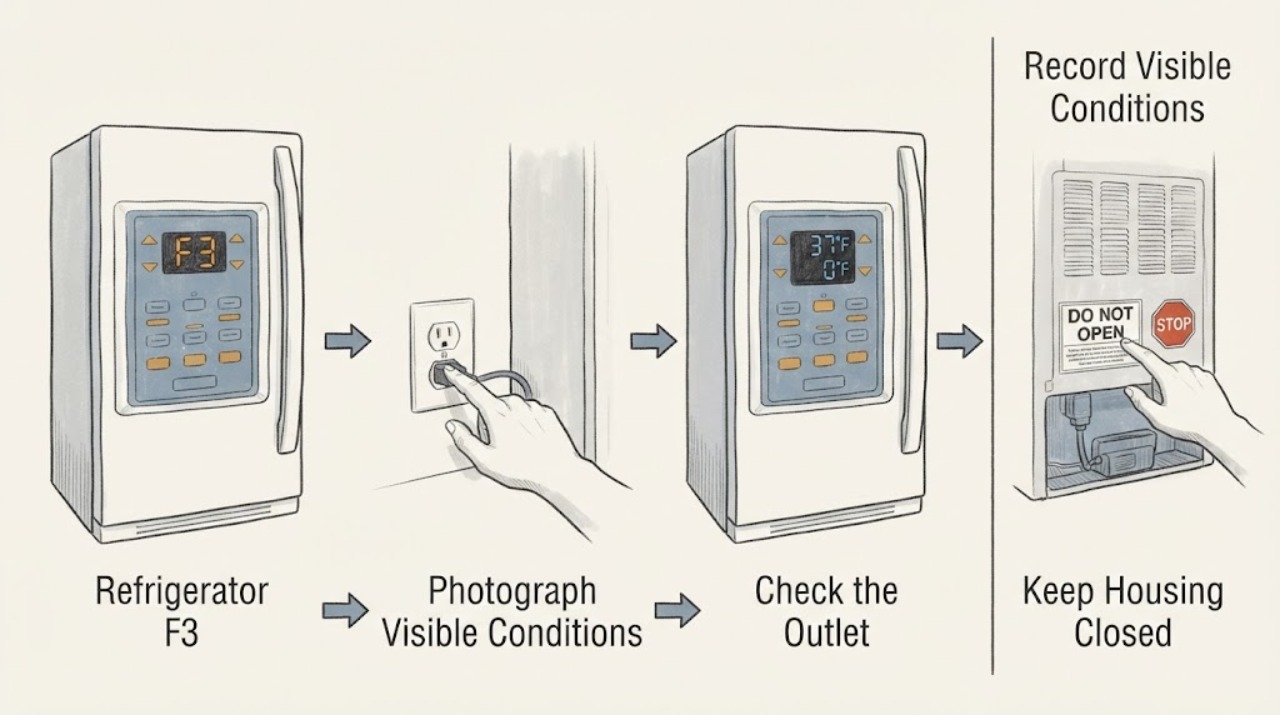
Do not treat Haier refrigerator F3 as a universal code. Haier India, Saudi Arabia, and Bangladesh refrigerator support pages place F3 in a group of F1-F9 sensor errors, but each page also warns that different series display different codes and directs owners to service rather than user repair. Photograph the complete display, record every character and any repeating pattern, and locate the rating-label model and market before applying the sensor-error description. Check only safe external conditions such as visible temperature readings, door closure, blocked air outlets, water, odor, or unusual heat. Do not remove covers, enter test mode, probe a sensor, or order a sensor, fan, defrost part, or control board from F3 alone.
Before you begin
Safety first
- Do not remove interior or rear covers, probe sensors or live wiring, enter hidden test mode, chip ice near a fan, or replace a sensor, fan, defrost part, or control board solely from F3. Isolate power only from a safe dry position when an electrical hazard is present.
Work through in order
Diagnostic checks
Use only checks that match the exact appliance or system and its official guide.
-
Check 1
Before unplugging or resetting anything, photograph the complete display and rating label. Record whether the code is exactly F3, whether it alternates with another code or temperature, the display location, any flashing rhythm, the complete model/product number, and the country or market.
Expected result: The display and model are complete and the refrigerator is identified, or the code is partial, alternates, appears only as a flash pattern, or the model/market is missing.
Next step: Use the exact model manual or regional Haier support page. If the identity remains uncertain, retain the photo and arrange service rather than applying another series' F3 table.
Stop if: Do not press hidden key combinations, enter diagnostic mode, or open the display/control panel to expose a code.
Why this matters
Why: Haier says different refrigerator series display different codes. The three opened regional pages support an F3 sensor-error group, but an incomplete display cannot establish that the same interpretation applies to this appliance.
-
Check 2
From outside the appliance, note the displayed temperatures and whether the refrigerator and freezer compartments are cooling normally. Look only for food visibly blocking a clearly marked air outlet, a door that cannot close, water on the floor, or an unusual odor or heat.
Expected result: One compartment is warm, both are warming, an outlet or door is visibly obstructed, temperatures appear normal, or water/odor/heat is present.
Next step: Move only an obvious food obstruction and close the door normally. Protect perishables if temperatures are abnormal; if water, burning odor, excessive heat, or electrical damage is present, stop use and arrange service.
Stop if: Do not remove interior covers, chip ice near a fan, use tools in an air channel, or touch wet electrical areas.
Why this matters
Why: A blocked outlet or door condition can affect cooling, but F3's official scope remains a sensor-error group and does not prove a fan, defrost system, sealed system, or control failure. Warm food compartments create a separate food-safety decision.
-
Check 3
If there is no visible hazard and the exact model manual permits a normal restart, you may power the refrigerator off and on once from an accessible dry connection after preserving the code record. Do not use repeated power cycling as a repair test.
Expected result: F3 clears and stays away, F3 returns after several hours or normal operation, or the refrigerator fails to cool, remains dark, or trips protection.
Next step: If F3 returns or cooling remains abnormal, leave the unit to qualified Haier service with the model, market, code photo, and temperature timeline. Do not keep restarting it.
Stop if: Do not reset a wet or damaged connection, change breaker ratings, use an extension cord, or access refrigerator wiring.
Why this matters
Why: Haier warns that power cycling can make an error disappear temporarily and that it may return after a few hours. A cleared display does not disprove a sensor-related condition or certify safe cooling.
-
Check 4
Treat F3 as a service-scope clue, not a parts order. Give service the exact model, market, display photo, compartment temperatures, door and air-outlet observations, whether the code returned after a restart, and any food-safety or electrical concern.
Expected result: F3 remains on a dry, identified refrigerator, recurs after restart, appears with abnormal cooling, or the code/model cannot be matched to an exact manual.
Next step: Arrange Haier or qualified refrigerator service. Keep the appliance out of use for electrical, odor, heat, or water hazards and protect perishable food when cooling is unreliable.
Stop if: Do not replace a sensor, fan, defrost component, or control board from F3 alone; do not open covers or perform live measurements.
Why this matters
Why: The official Haier pages direct users to service for refrigerator error codes and do not provide a user procedure for resolving the F1-F9 sensor group. Model-specific diagnosis is needed to distinguish sensor, fan, defrost, communication, or control causes.
Use your observations
Decision map
Find the observation that best matches what you see, then follow the next safe action.
-
PATH 01Next step
What you see
The complete model and market match one of the Haier refrigerator support environments whose table lists F3 in the F1-F9 sensor-error group.
Do this next
Record the display and cooling timeline, make only safe external observations, and contact Haier service if F3 persists or returns. Do not order a part from F3 alone.
Why this path and its safety boundary
Why it matters: F3 can be described as a sensor-error scope for that regional guide, but the page does not identify which sensor, wiring, board, or repair is involved and directs the user to service.
-
PATH 02Next step
What you see
The model, market, display format, or exact F3 sequence cannot be confirmed, or the appliance is a wine cellar, freezer, washer, or another Haier product.
Do this next
Correct the appliance identity, retrieve the exact manual, and arrange service if the code remains. Do not use a neighboring product's F3 explanation.
Why this path and its safety boundary
Why it matters: Haier explicitly distinguishes product and series code families. The refrigerator F3 sensor grouping cannot be transferred to an unidentified or different platform.
-
PATH 03Next step
What you see
F3 clears after one safe restart but returns later, or the refrigerator's cooling is unstable or one compartment is warming.
Do this next
Stop repeated restarts, monitor food safety with a reliable temperature method, and arrange prompt Haier service with the recurrence timing and compartment readings.
Why this path and its safety boundary
Why it matters: Haier warns that power cycling can temporarily hide an error and that it may return after hours. A temporary clear is not a confirmed repair, and food-temperature risk must be handled separately.
-
PATH 04Next step
What you see
The refrigerator has water near electrical parts, a hot or damaged cord, smoke, burning odor, arcing, a repeatedly tripping protective device, or both compartments are rapidly warming.
Do this next
Stop using the refrigerator, keep clear of wet electrical areas, isolate power only from a safe dry position if possible, protect perishable food, and arrange qualified appliance or electrical service. Use emergency assistance for active fire or immediate danger.
Why this path and its safety boundary
Why it matters: This is a water, electrical, fire, or food-safety boundary that overrides ordinary F3 interpretation.
Helpful context
Understand the symptom
The available Haier evidence supports a bounded meaning, not a universal one. Official refrigerator pages for India, Saudi Arabia, and Bangladesh list F3 in the F1-F9 sensor-error group. They separately list fan, communication, ice-maker, defrost, and door-related groups, and each page warns that different refrigerator series can display different codes. That supports recording F3 as a sensor-error scope in those regional guides, not naming a particular sensor or component on an unidentified refrigerator.
Haier's pages say refrigerator error codes are not user-resolvable and that a code can disappear after power-off and return later. The useful owner decision is therefore model and display identification, safe external observation, food-temperature protection, and service escalation—not repeated resets or internal testing.
When checks do not resolve it
Need a professional?
Contact Haier or qualified refrigerator service for a persistent or returning F3, an unmatched model/market, abnormal cooling, or any need to inspect a sensor, fan, defrost system, communication circuit, or control. Stop immediately for water near electrical parts, smoke, burning odor, excessive heat, arcing, a damaged cord, repeated trips, or unsafe food temperatures.
Safety scope: Do not remove interior or rear covers, probe sensors or live wiring, enter hidden test mode, chip ice near a fan, or replace a sensor, fan, defrost part, or control board solely from F3. Isolate power only from a safe dry position when an electrical hazard is present.
Common questions
FAQ
What does F3 mean on a Haier refrigerator?
Haier India, Saudi Arabia, and Bangladesh refrigerator support pages place F3 in an F1-F9 sensor-error group. They also warn that different series display different codes and direct owners to service, so this does not identify a specific sensor or part for an unknown model.
Can I fix Haier refrigerator F3 by unplugging it?
Haier says power-off/power-on can make an error disappear temporarily and that it may return after a few hours. If the exact manual permits a normal restart and there is no hazard, preserve the code and do it once; a returning F3 needs service, not repeated resets.
Does F3 tell me to replace the temperature sensor?
No. The regional Haier pages identify a sensor-error group but do not select a sensor, wiring point, fan, defrost part, or control board. Confirm the exact model and let qualified service diagnose the circuit.
Read the exact guide
Official sources
- The error code for the refrigerator and freezerHaier Bangladesh · Official Bangladesh regional page; it warns that different series display different codes and lists F3 in the refrigerator F1-F9 sensor-error group.
- The error code for the refrigerator and freezerHaier India · Official India regional page; it says different series display different codes and lists F3 in the refrigerator F1-F9 sensor-error group.
- The error code for the refrigerator and freezerHaier Saudi Arabia · Official Saudi regional page; it warns that different series display different codes and lists F3 in the refrigerator F1-F9 sensor-error group.
Community feedback
Share a repair observation
Share a plain-text repair observation. Accepted observations are published automatically; this page may take a moment to update.