
On this page
Start here
Quick answer
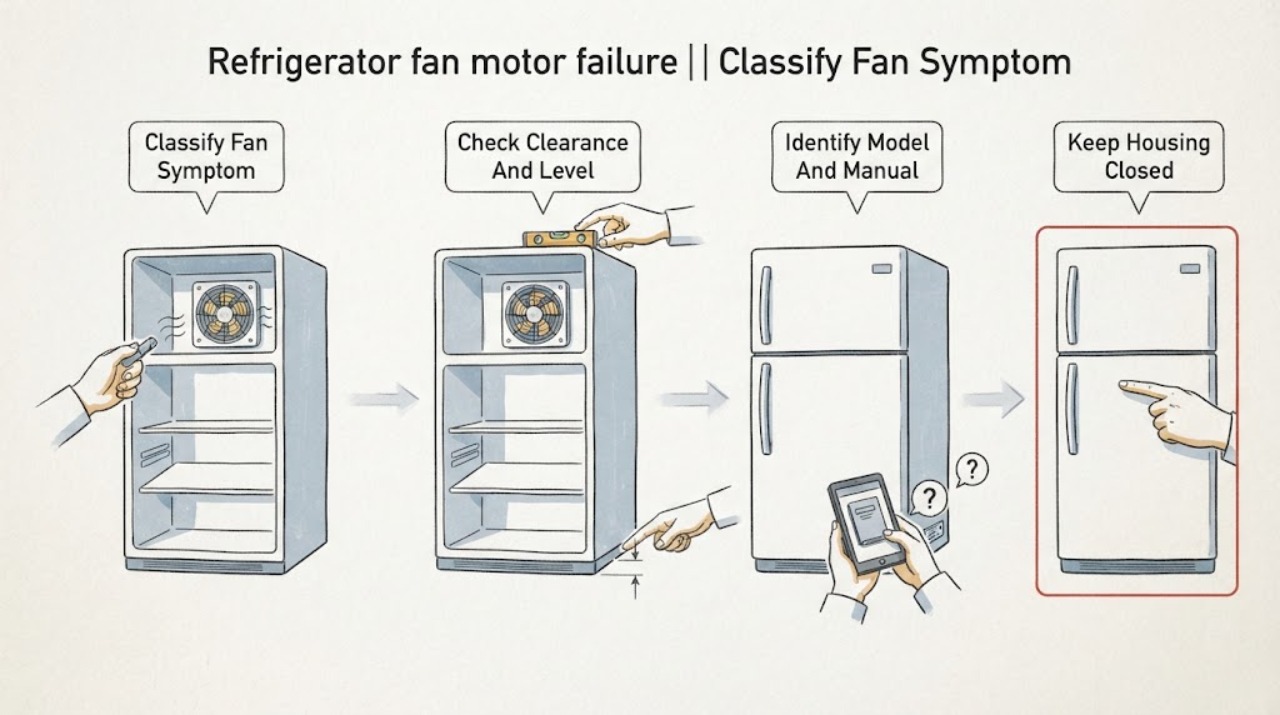
A refrigerator fan motor cannot be confirmed as failed from the word “fan” or from one sound alone. Haier says some fan whirring and speed changes are normal when the refrigerator is first plugged in, after frequent or extended door opening, or after adding a large amount of food. First record whether the sound is a normal changing whir, a new scraping/rattling sound, or no fan sound together with poor cooling; check only the external level, airflow and model documentation. Haier recommends about 1 inch of air clearance around its refrigerators and says to consult the Owner's Manual for leveling. If an unusual sound persists, cooling changes, or the model-specific checks do not resolve it, arrange service rather than removing covers, testing live wiring or ordering a fan motor without model evidence.
Work through in order
Diagnostic checks
Use only checks that match the exact appliance or system and its official guide.
-
Check 1
From outside the cabinet, record when the sound occurs: immediately after power-up, after doors were opened often, after loading a large amount of food, during a temperature change, or continuously. Describe it as a normal changing whir, a new scrape/rattle, or no audible fan with a cooling complaint.
Expected result: The sound matches one of Haier's documented normal whir/speed-change conditions, or it is new, harsh, persistent or absent while cooling is affected.
Next step: If the sound is normal and cooling is stable, monitor it without opening the cabinet. If it is abnormal, persistent or paired with poor cooling, continue only with external checks and prepare a service request.
Why this matters
Why: Haier identifies several normal fan operating conditions, so those conditions do not establish a failed motor. A persistent new noise or a missing fan sound together with poor cooling needs model-specific service evaluation.
-
Check 2
Check from outside that the refrigerator is not flush against surrounding surfaces and that the air path around it is not blocked. Observe whether the cabinet rocks or vibrates; use the exact Owner's Manual for any leveling adjustment.
Expected result: The unit has less than the recommended external clearance, blocked airflow, or an obvious leveling/vibration issue, or the installation appears clear and stable.
Next step: Correct only accessible external placement or obstruction and use the model manual for leveling. Do not remove rear covers or reach toward the fan; if the sound or cooling issue remains, request service.
Why this matters
Why: Haier says about one inch around the unit supports airflow and that poor leveling can cause vibration or rattling. These conditions can imitate a mechanical noise and can impair heat rejection, but they do not prove fan-motor failure.
-
Check 3
Find the complete Haier model number and region from the rating label, then use Haier's refrigerator support or manual lookup to obtain the matching Owner's Manual and installation instructions. Compare the manual's fan, cooling and noise information with the observed symptom.
Expected result: A complete model manual is available and matches the refrigerator, or the model remains incomplete/unavailable.
Next step: Use only the matching manual for model-specific external checks. If the model cannot be identified or the manual does not resolve the symptom, provide the model and recordings to Haier service rather than guessing a part.
Why this matters
Why: Fan location, control behavior and service procedures can vary by model. Haier's support pages require the model number for model-specific manuals, so a generic motor or wiring instruction is not justified without it.
-
Check 4
Without opening the refrigerator or repeatedly cycling it, observe whether food temperature remains stable and whether the sound coincides with normal door openings or recent loading. Do not use a warm compartment as proof that the fan motor is the failed component.
Expected result: Cooling is stable and the sound follows a documented operating condition, or cooling is worsening/food is not being kept cold while the sound persists or disappears.
Next step: For worsening cooling or unsafe food temperatures, minimize door opening and arrange qualified service. Do not remove panels, touch a fan or attempt a motor test.
Why this matters
Why: Stable cooling with a documented whir is more consistent with normal operation. A persistent sound plus cooling deterioration needs service diagnosis; other cooling components or installation conditions can produce the same user-level symptom.
-
Check 5
Stop user troubleshooting if there is scraping from inside the cabinet, burning smell, smoke, exposed wiring, visible damage, a repeated electrical trip or continued cooling loss. Keep hands and tools away from the fan and wiring.
Expected result: A safety symptom or persistent unresolved fan/cooling problem is present, or the issue has cleared after documented external installation checks.
Next step: Disconnect power only if safe, keep the refrigerator out of service as appropriate, and schedule Haier/qualified appliance service. If no safety symptom remains and cooling is stable, monitor without internal intervention.
Why this matters
Why: These conditions exceed safe external observation. A suspected motor fault cannot be confirmed or safely repaired from the supplied identity alone.
Use your observations
Decision map
Find the observation that best matches what you see, then follow the next safe action.
-
PATH 01Next step
What you see
The refrigerator is newly plugged in, has had frequent/extended door opening or a large food load, and the sound is a changing whir while cooling remains stable.
Do this next
Keep the cabinet clear and observe without opening panels. Use the model manual if the sound changes or cooling becomes abnormal.
Why this path and its safety boundary
Why it matters: Haier identifies these as normal conditions in which fan whirring or speed changes can occur; they do not confirm a failed fan motor.
-
PATH 02Next step
What you see
The refrigerator is flush against surrounding surfaces, has blocked air clearance, rocks or vibrates, and the sound resembles rattling or vibration.
Do this next
Restore accessible clearance and use the exact manual for leveling. If the noise or cooling issue persists, request service.
Why this path and its safety boundary
Why it matters: Haier links airflow to condenser cooling and says poor leveling can cause vibration/rattling; this is an installation branch, not a motor diagnosis.
-
PATH 03Next step
What you see
A new scrape, harsh rattle, absent fan sound with worsening cooling, or another unusual symptom persists after external clearance and leveling checks.
Do this next
Give Haier service the complete model, symptom timing, cooling observations and any recording. Do not remove covers or buy a motor without model-matched diagnosis.
Why this path and its safety boundary
Why it matters: The symptom warrants diagnosis, but it does not identify the motor, blade, wiring or control as the failed part.
-
PATH 04Next step
What you see
There is burning smell, smoke, exposed wiring, visible damage, repeated breaker operation or an unsafe temperature/cooling failure.
Do this next
Stop using the refrigerator and disconnect power only if safe; keep clear of damaged equipment and arrange qualified service. Do not touch the fan or perform live tests.
Why this path and its safety boundary
Why it matters: This is a stop-use and professional-service condition, not a fan observation that should be reproduced.
Helpful context
Understand the symptom
Do not treat every fan sound as a failed motor
Haier says a refrigerator contains a fan that helps maintain the selected temperature. It also says whirring is common after first plugging in, after frequent or extended door opening, or after adding a large amount of food, and that fan speed can change as temperature responds to door openings. A suspected fan-motor failure therefore needs a symptom pattern, not just a label or a single normal operating sound.
Check the installation before blaming the fan
Haier recommends about one inch of clearance around its refrigerators so air can circulate around the condenser and says the refrigerator cannot be flush installed. Haier also notes that vibration or rattling can occur when the refrigerator is not level. These are external installation observations; they do not prove a motor, blade or control failure.
Use the exact model manual for the next decision
No model is supplied for this topic. Haier's support pages direct owners to search by product type or model number and to download the model's Owner's Manual and installation instructions. Use that document for any model-specific fan location, control behavior or service procedure; do not import a fan part or wiring instruction from another Haier refrigerator.
Stop at persistent noise or cooling change
If the sound is new and persistent, the refrigerator is not maintaining temperature, or the external checks do not resolve the issue, Haier directs owners to service. Do not remove covers, touch the fan, probe wiring while energized, or order a motor solely from a symptom label.
When checks do not resolve it
Need a professional?
Have this ready
- complete Haier refrigerator model and region
- sound description and when it occurs
- whether cooling and food temperature remain stable
- clearance, leveling and vibration observations
- whether any smoke, burning smell, exposed wiring or breaker trip occurred
- the matching Owner's Manual and any safe external recording of the symptom
Common questions
FAQ
Does a whirring sound prove a Haier refrigerator fan motor is bad?
No. Haier says whirring and fan-speed changes can be normal after first plugging in, frequent door opening or adding a large amount of food. A persistent abnormal sound or cooling loss needs model-specific service diagnosis.
Can a tight installation make a Haier refrigerator sound or cool poorly?
It can affect airflow and heat rejection. Haier recommends about one inch of clearance around the unit and says it cannot be flush installed. Correct the external installation before treating a noise as a motor failure.
Can I test or replace the refrigerator fan motor myself?
The supplied topic has no model or confirmed motor diagnosis. Use Haier's exact manual for model-specific information and arrange qualified service; do not remove covers, touch the fan, probe live wiring or buy an unverified motor.
What information should I give Haier service?
Provide the complete model and region, when the sound occurs, whether cooling remains stable, the clearance/leveling observations and any safe external recording. Mention smoke, burning smell, visible damage or breaker trips immediately.
Read the exact guide
Official sources
- Haier - Refrigerator Air ClearanceHaier Appliances · Haier US refrigerator airflow and installation clearance guidance
- Owner's Manual & Installation InstructionsHaier Appliances · Haier US model-number owner manual and installation-document lookup
- Support by Product Line | Haier AppliancesHaier Appliances · Haier US product/model support, manuals and service lookup
- Haier Refrigerator - Noises and SoundsHaier Appliances · Haier US refrigerator normal fan sounds, speed changes, vibration and service guidance
- Schedule ServiceHaier Appliances · Haier US major-appliance service scheduling
Community feedback
Share a repair observation
Share a plain-text repair observation. Accepted observations are published automatically; this page may take a moment to update.