
On this page
Start here
Quick answer
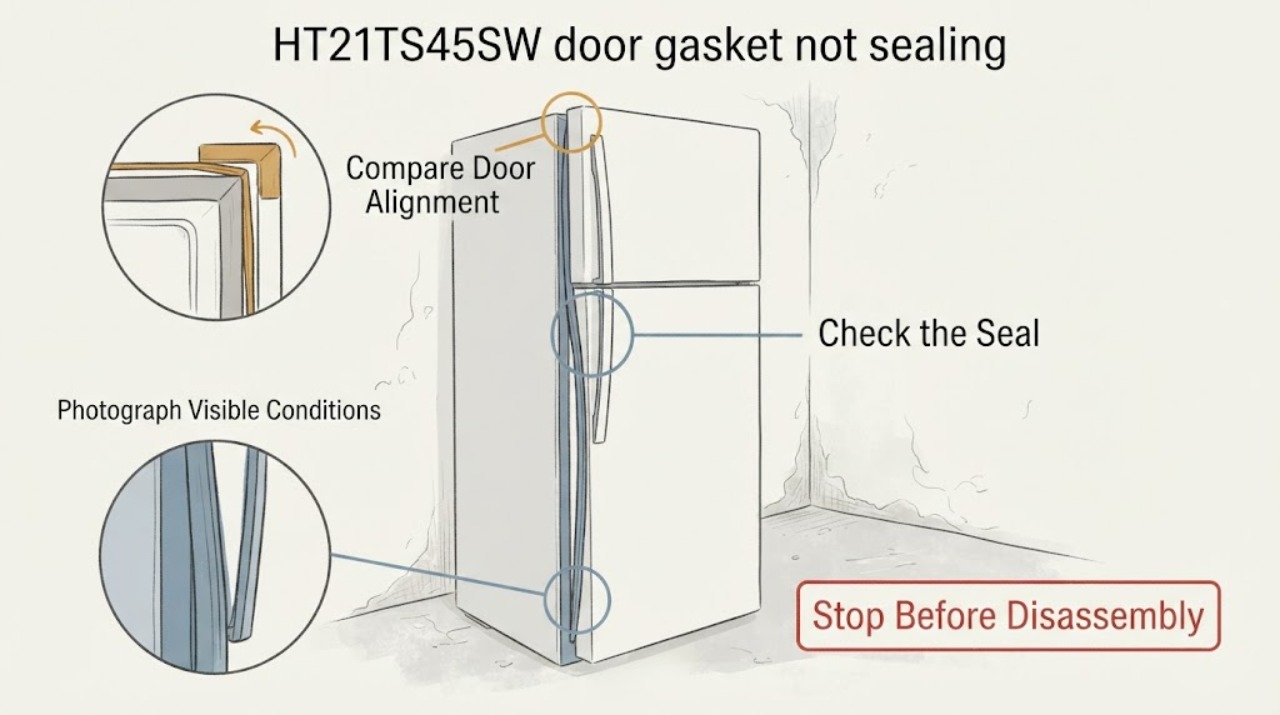
Treat HT21TS45SW as an identity and sealing decision, not as permission to order a US gasket by appearance. Photograph the rating plate and transcribe the model and serial exactly, confirm the Haiti supply and service market, then inspect the gasket perimeter, hinge-side seating, cabinet level, and packages that may hold the door open. With power isolated only when safe, clean the gasket using Haier's gentle baking-soda-and-warm-water guidance, dry it, and perform a paper check around the closed perimeter without forcing, heating, cutting, gluing, or replacing the gasket solely because it looks similar to another model. Measure refrigerator and freezer temperatures with a suitable thermometer and protect perishable food if the cabinet cannot maintain the locally required safe range. If the gasket is torn, split, permanently deformed, the door remains open, or cleaning and seating do not restore a consistent seal, arrange qualified service and confirm a market-compatible part from the exact model documentation; no US part number or availability is established here.
Work through in order
Diagnostic checks
Use only checks that match the exact appliance or system and its official guide.
-
Check 1
Photograph the rating plate and transcribe the complete model, serial, electrical marking, and any regional distributor or service information. Record that the appliance is operating in Haiti and whether the gasket was replaced, the door was reversed, or the refrigerator was transported or installed recently.
Expected result: The plate clearly confirms HT21TS45SW and a local support path, or the suffix, serial, market, or supply information is missing or conflicts with the task record.
Next step: Use the exact model and serial with Haier or the local authorized service channel to request the gasket and installation instructions. Until that is confirmed, limit work to external observation and cleaning; do not order by dimensions or a US listing.
Stop if: Do not erase the plate, infer the model from the cabinet, or treat HT21TS45SW as proof that a US-market part is available in Haiti.
Why this matters
Why: Haier's official manual portal supplies manuals by model number, but the opened materials do not confirm a Haiti-specific gasket catalogue or an exact replacement part for this model. Identity uncertainty makes a visually similar gasket unsafe to order.
-
Check 2
With the refrigerator closed normally and power isolated only from a dry, safely reachable point, inspect the entire gasket perimeter and hinge side. Look for dirt, dried food, a fold trapped behind the lip, gaps, tears, splits, hardening, or permanent deformation; also check that shelves or packages are not holding the door open.
Expected result: The gasket is dirty but flexible and continuous, a fold or package is obstructing contact, or the rubber is torn, split, hardened, deformed, or still leaves a visible gap.
Next step: Remove only an accessible package or foreign material and continue to the gentle cleaning check if the gasket is intact. If it is torn, split, or permanently deformed, keep the door closed as practical, protect food, and arrange qualified service rather than patching it.
Stop if: Do not stretch the gasket, remove its retainer, heat it, cut it, glue it, or pry on the door or hinge.
Why this matters
Why: Haier identifies dirty or damaged gaskets, obstructing packages, and misalignment as sealing conditions. A visible tear or split is not a cleaning result and may allow warm humid air into the cabinet.
-
Check 3
Clean an intact gasket with Haier's permitted gentle method: use the model manual first; where that manual is unavailable, use a soft cloth and the official Haier baking-soda-and-warm-water guidance, wipe the gasket folds and cabinet contact surface, then rinse the cloth and dry the seal completely. Do not apply mixed cleaners or abrasive tools.
Expected result: Dirt or residue wipes away and the gasket remains flexible, or a sticky film, odor, mold-like contamination, or damage remains after gentle cleaning.
Next step: For a clean intact gasket, dry it and continue with the paper and temperature observations. If contamination persists or the rubber is damaged, stop improvising cleaners and request local qualified service; do not dismantle the gasket.
Stop if: Do not mix chemicals, use chlorine or ammonia, pour cleaner into the gasket channel, scrub with metal, or use heat to reshape the rubber.
Why this matters
Why: Haier says clean, pliable gaskets make a better seal and warns against harsh chemicals, bleach, solvents, abrasives, and metal scouring pads. Persistent contamination or damage is not proof that a whole refrigerator must be replaced, but it does need service or exact-model guidance.
-
Check 4
Close the clean, dry door normally and perform a paper check at several points around the gasket: place a narrow sheet so the closed door lightly grips it, then repeat at the top, hinge side, latch side, and bottom. Do not pull hard or use the paper check to force an adjustment.
Expected result: The paper has similar light resistance around the perimeter, or it slips freely at one area, the door springs open, or the gap changes when the cabinet is gently observed from the front.
Next step: If the result is uneven, photograph the location and provide it to Haier or local service with the exact model and serial. Do not bend hinges, add shims, pull the gasket out, or fit a replacement without confirmed documentation.
Stop if: Do not trap fingers, force the door shut, insert tools into the gasket channel, or use a heated or sharp object to correct the gap.
Why this matters
Why: A consistent paper grip is evidence of contact at those test points, not proof of perfect refrigeration. A repeatable free-slip area or door that cannot stay closed supports a sealing, alignment, hinge, or cabinet problem; it does not identify a gasket part.
-
Check 5
Check the refrigerator's level and accessible loading conditions without moving the cabinet: verify that packages are not pushing the door, the door is not visibly sagging, and the gasket perimeter is not being pulled out of alignment. Record whether the problem began after transport, door reversal, or installation.
Expected result: The door is obstructed or visibly misaligned after installation or reversal, or the cabinet and door appear normal while the gasket still fails the paper check.
Next step: Remove only an accessible obstruction and follow the exact model installation instructions for any approved leveling or alignment step. If the issue persists, use qualified service; do not alter hinges or install unofficial retainers.
Stop if: Do not tilt or drag the refrigerator, remove hinge hardware, add nonofficial spacers, or force a door that does not align.
Why this matters
Why: Haier lists leveling, door alignment, and packages blocking closure as external door-closing checks, and notes that gasket alignment can change after door reversal. A normal exterior does not distinguish gasket wear from a hinge or cabinet issue.
-
Check 6
Place suitable thermometers in the refrigerator and freezer compartments and record readings at consistent times with the doors closed as much as practical. Note frost or condensation near the gasket, food warming, odor, or whether only one compartment is affected; compare readings with local food-safety requirements and the exact manual rather than relying on cabinet feel.
Expected result: Temperatures remain in the locally required safe range and the gasket contact is consistent, or temperatures drift unsafe, frost accumulates near the gap, or one or both compartments warm.
Next step: Move or discard perishable food according to local food-safety guidance if safe temperatures cannot be maintained. Arrange qualified Haier or local appliance service when warming persists, frost returns, or the seal fails after cleaning and external alignment checks.
Stop if: Do not keep high-risk food in a refrigerator that cannot hold safe temperature, remove interior panels, scrape frost with sharp tools, touch refrigeration tubing, or add refrigerant.
Why this matters
Why: Haier says gasket sealing, blocked vents, door use, and warm loads can affect cooling, while temperature ranges vary by product. A good paper check does not prove safe food storage, and an unsafe temperature makes food protection more urgent than a parts search.
Use your observations
Decision map
Find the observation that best matches what you see, then follow the next safe action.
-
PATH 01Next step
What you see
The model and market are confirmed, the gasket is intact, residue wipes away, the paper check is consistent, and measured temperatures remain safe.
Do this next
Keep the gasket clean and pliable, avoid packages blocking the door, monitor temperatures, and follow the exact local manual. Do not order a replacement solely from appearance.
Why this path and its safety boundary
Why it matters: The immediate pattern is consistent with contamination or a minor closure obstruction rather than a confirmed failed gasket or refrigerator.
-
PATH 02Next step
What you see
The gasket is clean but paper slips repeatedly at one perimeter area, the door is visibly misaligned, or frost or condensation returns along the same gap.
Do this next
Keep the refrigerator closed, document the gap and rating plate, protect food, and arrange qualified local service. Ask for a part check against HT21TS45SW and the Haiti market before any order.
Why this path and its safety boundary
Why it matters: A sealing or alignment problem remains. The observation cannot distinguish a gasket, hinge, cabinet, or installation issue and does not establish a compatible replacement part.
-
PATH 03Next step
What you see
The gasket is torn or split, the door cannot close, food temperatures are unsafe, water reaches electrical areas, or the refrigerator shows smoke, burning odor, or a hot or damaged cord.
Do this next
Protect or relocate perishable food. Isolate power only from a dry, safely reachable point when necessary; for smoke, burning, or electrical danger leave the area and obtain emergency or qualified help. Keep the refrigerator out of service until assessed.
Why this path and its safety boundary
Why it matters: This is a containment, food-safety, or electrical hazard rather than routine gasket maintenance.
-
PATH 04Next step
What you see
Only HT21TS45SW is available but the complete plate, suffix, serial, local market, or service channel cannot be confirmed.
Do this next
Capture the plate and contact Haier or the local authorized service organization for model and market confirmation. Until then, use only soft-cloth or warm-water cleaning, a non-force paper observation, temperature monitoring, and food protection.
Why this path and its safety boundary
Why it matters: The general Haier cleaning guidance can support a cautious external clean, but it cannot establish a Haiti-compatible gasket, exact fit, electrical specification, or installation procedure.
Helpful context
Understand the symptom
HT21TS45SW is the assigned model string, but the task does not establish the full regional product record, service network, or parts channel in Haiti. Haier's official manual finder asks for the appliance model number, so preserve the rating-plate photograph and serial number before asking for a gasket. A part that appears in a US catalogue is not automatically obtainable, electrically or mechanically compatible, or supported in Haiti.
A sealing complaint has two separate questions: does the flexible gasket make continuous contact, and is the refrigerator still holding safe food temperature? Dirt, misalignment, a package in the way, or a door/hinge issue can resemble a failed gasket. A tear, split, permanent deformation, repeated air gap, frost, or unsafe temperature moves the decision to qualified service rather than improvised repair.
When checks do not resolve it
Need a professional?
Arrange qualified service for a torn, split, hardened, or permanently deformed gasket; a door that cannot close; a repeatable perimeter gap after gentle cleaning; recurring frost or condensation at the seal; or temperatures that cannot remain in the locally required safe range. Stop and isolate the refrigerator for smoke, burning odor, a hot or damaged cord, water near electrical parts, or another electrical hazard. Do not use heat, cutting, glue, unofficial retainers, guessed dimensions, or an unverified US-market part, and do not replace the whole refrigerator from a sealing complaint alone.
Common questions
FAQ
Can I order a Haier gasket by measuring the old one?
No. Use the complete rating-plate model and serial with the applicable local service channel. The opened Haier documentation requires model-specific manuals, and no Haiti-compatible gasket part or availability was verified for HT21TS45SW.
Can I heat or glue the gasket so it seals?
Do not improvise that repair. Clean an intact gasket gently, inspect the closure, and obtain qualified service for a torn, split, deformed, or persistently leaking seal.
Does a paper check prove the food is safe?
No. It only samples contact at a few points. Use compartment thermometers and local food-safety guidance; relocate or protect perishables if measured temperatures are unsafe, even when the gasket looks closed.
Read the exact guide
Official sources
- Haier - Cleaning Inside the RefrigeratorHaier Appliances · Haier refrigerator interior and door-gasket cleaning and chemical-safety boundaries
- Haier Refrigerator - Ice or Frost Forming on Back WallHaier Appliances · Haier refrigerator gasket perimeter, door alignment, obstruction, frost, and service boundary
- Haier - Refrigerator Door Not Shutting ProperlyHaier Appliances · Haier refrigerator external door-closure checks, including leveling, alignment, and packages blocking the door
- Haier - Refrigerator Running but Not CoolingHaier Appliances · Haier refrigerator cooling, gasket, accessible-vent, temperature-monitoring, and service escalation guidance
- Owner's Manual & Installation Instructions | Haier AppliancesHaier Appliances · Haier refrigerator model and market documentation lookup for the assigned HT21TS455W string (also recorded as HT21TS45SW) and exact installation or gasket instructions
- Haier - Compact Refrigerator or Beverage Center MoistureHaier Appliances · Haier refrigerator gasket cleaning, pliability, obstruction, and sealing observations; general guidance only until HT21TS45SW market documentation is confirmed
- Haier - Cleaning Non-Stainless Refrigerator ExteriorHaier Appliances · Haier refrigerator gasket maintenance frequency, pliability, and harsh-cleaner boundaries
Community feedback
Share a repair observation
Share a plain-text repair observation. Accepted observations are published automatically; this page may take a moment to update.