
On this page
Start here
Quick answer
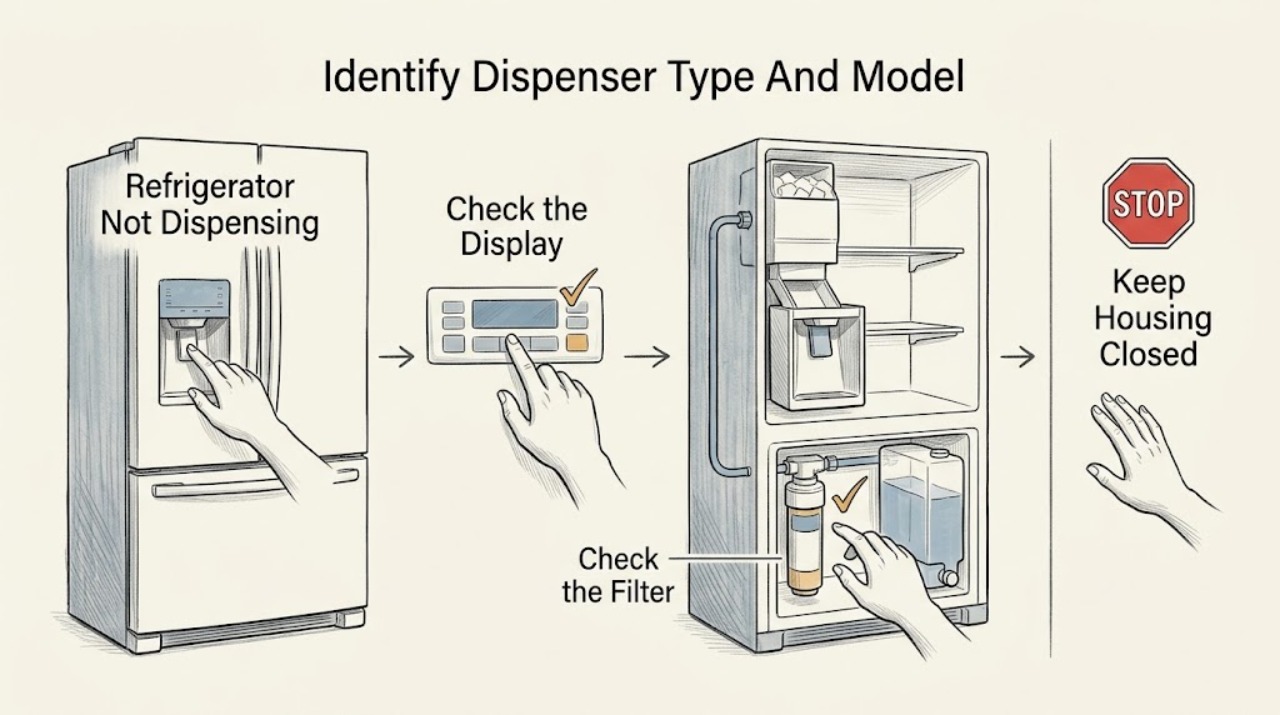
First record the complete Haier model number and identify whether the appliance has an internal water dispenser, an external water-and-ice dispenser, an ice-only chute, or no dispenser. Test the symptoms without dismantling: does the control respond, does the water selector work, does water flow, does the icemaker make ice, and is the ice bucket empty, clumped, or blocked? On Haier electronic-control refrigerators, the panel can lock after 30 seconds; hold LOCK for three seconds only when the exact model's controls match that instruction. For water that will not dispense, verify the model-specific water supply is on, the filter is fully seated and the correct cartridge is installed, and look only at accessible tubing for a kink or leak. Haier's filter instructions for the HB21FC75, HB21FC45, and HB21FC10 say to fully seat the cartridge and run the water dispenser for about 3–5 minutes after replacement to flush the tank; do not apply that procedure to another model without its manual. For ice, check that the icemaker is on, the supply is connected, the freezer is 10°F or colder, and cubes are not clumped into one block; Haier lists 20–60 psi as the water-pressure range for the built-in icemaker guidance. If both water and ice stop together, a shared supply, filter, lock, or internal valve is more likely; if only ice stops, investigate the ice bucket, maker, and freezer conditions. If a water line or valve leaks, water reaches electrical parts, the panel remains unresponsive after the documented unlock check, or the dispenser still fails with normal external conditions, shut off the accessible water supply when safe, leave the refrigerator alone, and arrange qualified service.
Before you begin
Safety first
- The user may perform dry, accessible checks of the model-matched control lock, function selection, filter seating, ice bucket/chute, freezer condition, and visible supply line only as the exact manual permits. Qualified service must handle pressurized tubing, valves, door wiring, actuators, auger or icemaker motors, sensors, control boards, rear covers, and live tests.
Work through in order
Diagnostic checks
Use only checks that match the exact appliance or system and its official guide.
-
Check 1
Record the complete Haier model number and identify the physical arrangement without moving the refrigerator: internal water outlet, external water-and-ice dispenser, ice chute only, icemaker bucket without a dispenser, or no dispenser. Note whether water, ice, or both fail and whether the control panel responds.
Expected result: The model has internal filtered water, an external dispenser, an ice-only path, no dispenser, or an uncertain configuration; only one function fails or both functions fail.
Next step: Use the exact model manual and follow the water-only, ice-only, both-fail, or no-dispenser branch below. Do not remove a filter or ice bucket until the component is confirmed for the model.
Stop if: Stop for a leaking line or valve, water near electrical parts, a damaged cord, smoke, burning odor, or any need to pull a built-in refrigerator forward.
Why this matters
Why: The model and symptom split select different paths. A refrigerator without the relevant dispenser cannot be diagnosed with that dispenser procedure, and simultaneous water-and-ice failure points toward a shared supply or control condition rather than an ice-chute jam alone.
-
Check 2
With the refrigerator standing safely in place, observe the dispenser display, selected water/ice option, and lock indicator. On an applicable electronic-control bottom-mount, French-door, or quad-door model, hold LOCK for three seconds once to unlock it, then select the requested function according to the exact manual.
Expected result: The lock indicator clears and the control responds, the wrong water/ice selection was active, the display is merely dark until a button or door is used, or the control remains unresponsive.
Next step: If the control responds, continue with the matching water or ice path. If it remains unresponsive after the model-supported unlock check, do not open the control or door wiring; arrange service.
Stop if: Do not repeatedly press controls, bypass a lock, insert tools into the dispenser switch, or work on powered wiring.
Why this matters
Why: Haier documents automatic control locking after 30 seconds on applicable electronic-control refrigerators. A cleared lock or wrong selection can explain a silent dispenser; a persistently unresponsive control points toward power, control, or switch service rather than a filter blockage.
-
Check 3
Only for a model that has a water dispenser, inspect the accessible filter housing and visible water line. Check whether the correct filter is fully seated, whether a recent filter change left the cartridge partly inserted, and whether the visible line is sharply kinked. For HB21FC75, HB21FC45, or HB21FC10 models, follow Haier's documented cartridge-turning and seating procedure; after replacement, Haier says to run the dispenser about 3–5 minutes to flush the tank.
Expected result: There is no filter on this model, the filter is not fully seated, the filter is due or visibly blocked according to the manual, the line is kinked, water flows weakly after the model-approved flush, or all visible conditions are normal but no water dispenses.
Next step: Refit or replace the filter only when the exact manual confirms the cartridge, then use the model's documented flush procedure. If the dispenser remains dry or the line leaks, close the accessible water supply when safe and arrange service.
Stop if: Do not force an incompatible cartridge, remove a pressurized filter housing, disconnect tubing, or keep dispensing when a fitting leaks.
Why this matters
Why: A filter or trapped air condition can restrict the water-only path, especially after a cartridge change. A normal filter and visible supply do not prove a failed valve or dispenser actuator; those are internal, model-specific causes.
-
Check 4
Only for a model with an icemaker or ice dispenser, remove the ice bucket only if the exact manual permits it and inspect the bucket, chute, and visible ice surface without reaching into a moving auger. Look for clumped cubes, a single frozen block, an empty bucket, an icemaker switch that is off, and a freezer temperature that is not at or below 10°F. Consider whether the refrigerator was installed or switched on within the last 24–48 hours.
Expected result: Ice is clumped or blocking the chute, the tray has one large block, the icemaker is off, the bucket is empty because the unit is new, the freezer is warmer than the documented threshold, or these visible conditions are normal but no ice dispenses.
Next step: Remove only loose, accessible clumps or refit the bucket as the exact manual directs; allow the documented start-up time for a new unit. If ice still does not dispense, leave the mechanism closed and arrange service.
Stop if: Do not chip ice with sharp tools, reach into the auger, force the bucket, or run a test with a jammed or damaged mechanism.
Why this matters
Why: Haier identifies clumping, a large ice block, an off icemaker, warm freezer conditions, and the normal start-up period as possible reasons for absent or slow ice. A clear bucket and correct conditions make an internal auger, motor, valve, icemaker, or control issue more likely, but the symptom does not select one part.
-
Check 5
Compare the results of the water and ice checks. From a dry accessible position, verify that the refrigerator's external water shutoff is open and that the visible supply connection is dry and intact. Do not disconnect the line to measure pressure. For an applicable built-in icemaker path, compare the home's measured pressure only if a qualified person has already provided it; Haier's guidance lists 20–60 psi.
Expected result: Both water and ice fail, only one function fails, the shutoff is closed, the line is visibly kinked or leaking, measured pressure is outside the documented built-in-icemaker range, or the supply appears normal.
Next step: Correct only a clearly closed shutoff or visible kink when safe and permitted. If pressure, plumbing, or the line is abnormal, use a qualified plumber or appliance technician; do not alter the supply or continue with a leak.
Stop if: Do not disconnect pressurized tubing, adjust a pressure regulator, move the refrigerator across a wet floor, or bypass a water shutoff.
Why this matters
Why: A shared supply, filter, or inlet path is more plausible when both functions fail together. A water-only or ice-only pattern localizes the user-level checks. A visible leak or inadequate supply is not evidence that the refrigerator valve itself is defective.
-
Check 6
Stop owner diagnosis when the lock, selection, model-approved filter/bucket checks, and visible supply are normal but the dispenser still fails. Document whether the dispenser makes a click or motor sound, whether water and ice fail together, when the failure began, and whether any leak or error is present; do not deliberately repeat a hazardous test.
Expected result: One safe external correction restores dispensing, the same function fails again, both functions remain unavailable, the line or rear valve leaks, the control is unresponsive, or water reaches electrical parts.
Next step: Close the accessible water valve when safe, isolate power only from a dry accessible position if water has reached electrical areas, protect the floor, and arrange qualified Haier appliance service. Provide the model number and the water/ice symptom split.
Stop if: No cabinet or rear-cover removal, live measurement, safety bypass, pressurized-line disconnection, or symptom-based part replacement.
Why this matters
Why: Recurrence can involve the dispenser actuator, inlet valve, tubing, ice auger or maker, sensor, control, or wiring. Haier's leak guidance routes a leaking icemaker line or rear water valve to service, and external symptoms cannot distinguish internal parts safely.
Use your observations
Decision map
Find the observation that best matches what you see, then follow the next safe action.
-
PATH 01Safety boundary
What you see
The display shows a lock or the dispenser selection is not the requested water/ice function, and there is no leak or electrical hazard.
Do this next
Use the exact model controls; on the applicable Haier guidance, hold LOCK for three seconds, select the desired function, and reassess without dismantling. Escalate if the panel remains unresponsive.
Why this path and its safety boundary
Why it matters: A control state is more likely than a blocked filter, icemaker, or water valve. Applicable Haier electronic-control refrigerators can lock after 30 seconds of non-use.
Safety stop: Do not bypass the lock or insert tools into the actuator.
-
PATH 02Safety boundary
What you see
Ice is available or the icemaker path appears normal, but the water dispenser is dry or only produces a weak flow.
Do this next
Use only the exact model's filter procedure; for the documented HB21 models, fully seat the cartridge and flush the dispenser for about 3–5 minutes after replacement. Arrange service if flow does not return or a leak appears.
Why this path and its safety boundary
Why it matters: The water filter seating, model-specific filter condition, trapped air after a filter change, visible supply line, or water-side dispenser path is more likely than an ice-bucket problem. A normal filter and supply still do not identify the internal valve or actuator.
Safety stop: Do not force a cartridge, disconnect a pressurized line, or continue dispensing from a leaking connection.
-
PATH 03Safety boundary
What you see
Water dispenses normally but ice is absent, stuck in the chute, or not delivered from the bucket, with no leak or electrical hazard.
Do this next
Check the bucket and visible chute only as the model manual permits, verify the icemaker setting and freezer condition, and allow the documented new-unit period. If the mechanism remains clear but ice does not dispense, arrange service.
Why this path and its safety boundary
Why it matters: A clumped bucket, frozen block, off icemaker, freezer warmer than 10°F, insufficient start-up time, or ice-making path is more likely than a water-dispenser filter fault. Haier's built-in icemaker guidance lists 20–60 psi and water supply checks, but applies only to that type of icemaker path.
Safety stop: Do not reach into the auger, chip ice with metal tools, or force a bucket or motor.
-
PATH 04Safety boundary
What you see
Both water and ice fail, and the lock, selections, and visible bucket/filter state do not explain the symptoms.
Do this next
Verify only the accessible shutoff and visible connection; keep the valve closed for a leak and arrange appliance or plumbing service. Do not disconnect the line to prove pressure or open the rear of the refrigerator.
Why this path and its safety boundary
Why it matters: A shared external shutoff, supply line, filter, inlet path, or internal valve/control is more likely than two unrelated dispenser failures. A supply leak overrides normal troubleshooting.
Safety stop: Do not move the refrigerator through water, bypass the supply, or live-test the inlet path.
-
PATH 05Safety boundary
What you see
A rear water valve or icemaker line leaks, water reaches electrical parts, the control stays unresponsive, or the same dispenser failure returns after all model-approved external checks.
Do this next
Close the accessible water supply and isolate power only from a safe dry position when necessary, then arrange qualified service with the exact model and the observed water/ice split.
Why this path and its safety boundary
Why it matters: A pressurized connection, internal valve, actuator, motor, sensor, wiring, or control issue is possible. Haier specifically routes a leaking refrigerator water line or rear water valve to service; a symptom does not establish which component is at fault.
Safety stop: Do not restore a wet unit, remove covers, disconnect tubing under pressure, bypass controls, or choose a replacement part from the symptom alone.
Helpful context
Understand the symptom
Confirm which dispenser path exists
“Not dispensing” is not one universal Haier refrigerator fault. Haier's refrigeration information describes newer French-door models with internal filtered water and a factory-installed icemaker, while other refrigerators may have no dispenser, an ice-only chute, or different control and filter locations. Record the full model number and use its owner's manual before removing a filter or trying a button sequence. A water-only failure and an ice-only failure should not be diagnosed as the same part.
Use the symptom split before touching the water path
Check whether the panel responds, whether the selected water or ice function is shown, and whether water, ice, or both are absent. If both functions fail, a shared supply, filter, lock, or internal inlet path becomes more plausible. If water works but ice does not, inspect the ice bucket, clumping, icemaker setting, freezer temperature, and ice-making time. If ice works but water does not, focus on the water filter and dispenser path. These are symptom-based directions; they do not prove that a valve, actuator, or control board has failed.
Keep water, ice, and electrical work safe
Inspect only dry, accessible controls, the filter housing, the ice bucket, the chute, and visible tubing. Do not remove rear covers, reach into an auger or moving mechanism, disconnect a pressurized line, or live-test a valve or wiring. If water is leaking from the refrigerator line or rear valve, isolate the accessible water supply if safe and arrange service. Keep power isolated from a dry accessible position if water has reached an outlet, cord, or electrical area; do not restore a wet or damaged refrigerator.
Safety boundary
Stop conditions
- Stop using the dispenser immediately for a leaking refrigerator line or rear water valve, water near the cord or outlet, smoke, burning odor, a hot/damaged cord, or any electrical hazard.
- Close the accessible water shutoff from a safe dry position when a supply or valve leak is visible; do not move the refrigerator through water or disconnect a pressurized line.
- Inspect only dry, accessible controls, filter housing, ice bucket, chute, and visible tubing. Do not reach into an auger, remove rear or door panels, live-test wiring, or bypass a lock or safety control.
- Use the exact Haier manual for the refrigerator's dispenser layout, filter, controls, and icemaker. Internal valves, actuators, motors, sensors, wiring, and control work require qualified service.
Only after diagnosis
Potential parts
- model-specific water filter cartridge
Consider only when the exact model has a filter, the cartridge is due, incorrect, damaged, or cannot be seated, and the model instructions support replacement after the water-only symptom is confirmed.
Haier filter shape and housing vary by model; the HB21 procedure does not establish fit for another refrigerator. - model-specific water inlet valve, tubing, or filter housing
Consider only after a qualified technician confirms an internal water-path fault with the visible shutoff, line, and model-approved filter checks normal, or identifies the leaking valve/connection.
Do not select a valve or tube from a no-flow symptom; pressure, connectors, routing, and electrical specifications are model-dependent. - model-specific dispenser actuator, switch, or control interface
Consider only when the control is unlocked and selected correctly but the dispenser does not actuate, and service diagnosis confirms the actuator or switch.
Internal door wiring and actuator designs vary by dispenser layout; do not open the door panel or bypass the switch. - model-specific icemaker, auger motor, or ice-chute component
Consider only for a confirmed ice-only failure after the bucket, clumping, icemaker setting, freezer temperature, supply, and model-specific start-up period are normal.
An ice maker without a dispenser, an internal ice bucket, and an external chute use different mechanisms; confirm the complete model and technician diagnosis.
When checks do not resolve it
Need a professional?
Arrange qualified Haier appliance service when water or ice remains unavailable after the exact model's lock, selection, filter, bucket, freezer, and visible-supply checks; when both functions fail together; when the control remains unresponsive; or when internal access is needed. Use qualified plumbing service for a household shutoff, supply line, or pressure problem. Treat a leaking rear valve or icemaker line, water near electrical parts, smoke, burning odor, or a damaged/hot cord as immediate stop-use conditions.
Safety scope: The user may perform dry, accessible checks of the model-matched control lock, function selection, filter seating, ice bucket/chute, freezer condition, and visible supply line only as the exact manual permits. Qualified service must handle pressurized tubing, valves, door wiring, actuators, auger or icemaker motors, sensors, control boards, rear covers, and live tests.
Common questions
FAQ
Why will my Haier refrigerator not dispense water?
First unlock and select the water function according to the exact model, then check the model's accessible water shutoff, filter seating, and visible line. For HB21FC75, HB21FC45, and HB21FC10 models, Haier says to fully seat the filter and flush the water dispenser for about 3–5 minutes after replacement. A normal filter and supply with no water still requires service diagnosis of the internal water path.
Why does my Haier refrigerator make ice but not dispense it?
Check the ice bucket and chute for clumped cubes or one large frozen block, and confirm the control is set to ice. Haier's built-in icemaker guidance also calls for the icemaker to be on and the freezer to be 10°F or colder. If the bucket and chute are clear but the ice function still fails, an auger, actuator, motor, or control fault needs service.
Can the Haier refrigerator control lock stop the dispenser?
It can on applicable electronic-control bottom-mount, French-door, and quad-door refrigerators. Haier says the controls can lock after 30 seconds of non-use and documents holding LOCK for three seconds to unlock them. If the panel remains unresponsive after the model-supported check, do not open the control panel; arrange service.
Should I replace the Haier refrigerator filter when the dispenser stops?
Only if the exact model has that filter and its instructions support replacement. Haier's published procedure for the HB21FC75, HB21FC45, and HB21FC10 says to turn and fully seat the cartridge, then run the water dispenser for about 3–5 minutes to flush the tank. Do not force a cartridge or use that procedure as proof of compatibility with another model.
What should I check when both water and ice stop dispensing?
Check the lock and selections, then inspect only the accessible water shutoff and visible line for a closed valve, kink, or leak. Because water and ice can share a supply, filter, or inlet path, both-fail symptoms point toward a shared condition more than an ice-chute jam. A leak requires closing the water supply and service.
How long should a new Haier refrigerator take before ice dispenses?
Haier's installation guidance says a refrigerator can take up to 24 hours to reach its set temperature. Its built-in icemaker guidance says a new refrigerator can take up to 24 hours to begin making ice and about 48 hours for temperature to stabilize, so a new unit may not dispense ice immediately. A water leak, electrical hazard, or failure after the stated start-up period needs service.
What if the Haier refrigerator dispenser water line is leaking?
From a safe dry position, close the accessible water shutoff and stop using the dispenser. Haier says a leaking water line to the refrigerator or rear refrigerator water valve requires service. Do not pull the refrigerator forward, disconnect a pressurized fitting, or restore power if water has reached electrical parts.
Read the exact guide
Official sources
- Haier - Replacing the Filter in the HB21FC75, HB21FC45. and HB21FC10 RefrigeratorHaier Appliances · Only the named HB21FC75, HB21FC45, and HB21FC10 French-door refrigerator models; do not infer filter fit for another model.
- Haier Refrigeration - Full Size Refrigerators, Compact Refrigerators, Beverage CentersHaier Appliances · Haier's product-family page; the described internal water and factory-icemaker features apply to the product family shown, not every Haier refrigerator.
- Haier Refrigerator - Leaking / Water on FloorHaier Appliances · Haier refrigerator leak guidance; apply only to a model with the described icemaker or water-line path.
- Haier Refrigerator - Ice Maker Not Making IceHaier Appliances · Built-in icemaker path described by Haier; freezer, pressure, controls, and dispenser architecture vary by model.
- Haier Appliance Support By ProductHaier Appliances · Haier support directory; use the complete appliance model number to obtain the applicable manual.
- Haier - Refrigerator Controls Not WorkingHaier Appliances · Bottom-mount, French-door, and quad-door refrigerators with the applicable electronic controls; do not generalize to every Haier layout.
- Delivery & InstallationHaier Appliances · Haier installation guidance; actual connection and clearance requirements are model and location dependent.
Community feedback
Share a repair observation
Share a plain-text repair observation. Accepted observations are published automatically; this page may take a moment to update.