
On this page
Start here
Quick answer
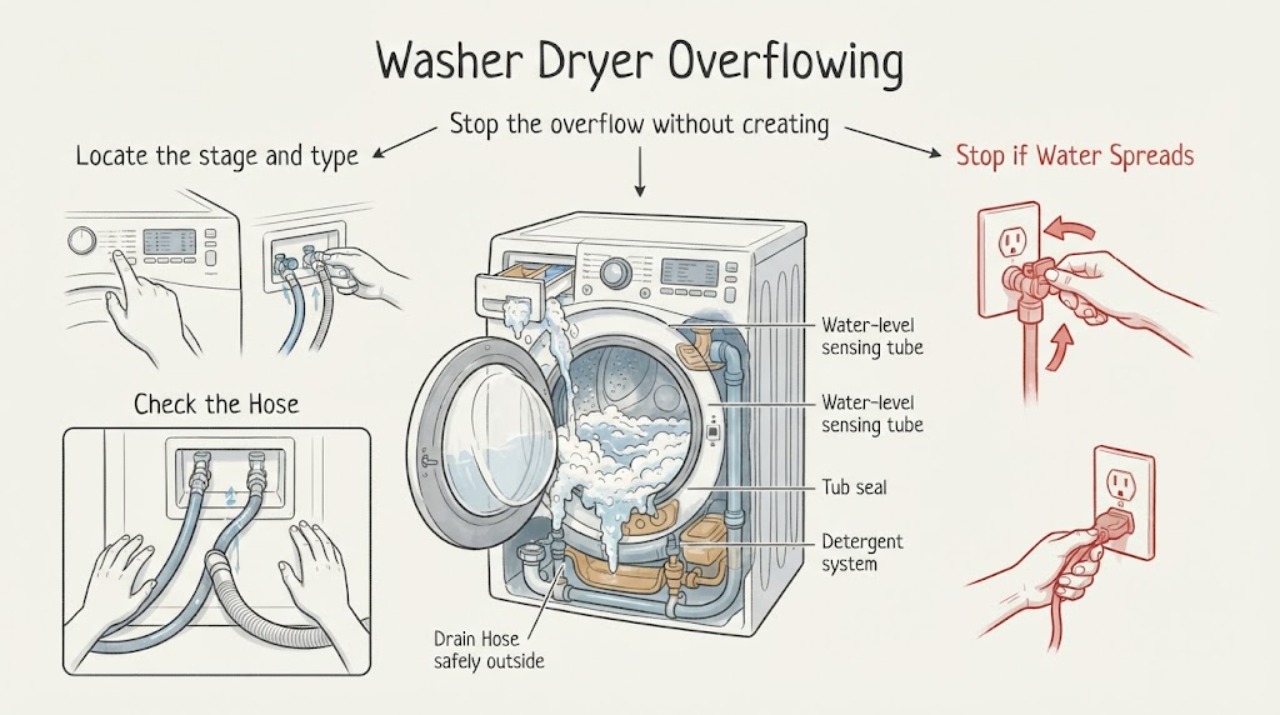
Stop the cycle, close both water taps, and disconnect power only when you can do so without stepping into unsafe standing water or touching a wet connection. If water continues entering with the controls Off, keep the taps closed and arrange service. After the area is safe, identify whether the overflow is clean incoming water, used drain water, or foam; then inspect only accessible hoses, the drain path, detergent amount, and the model-specific error guidance. Do not remove panels, reach into a moving drum, or attempt to repair the inlet valve or water-level sensor.
Work through in order
Diagnostic checks
Use only checks that match the exact appliance or system and its official guide.
-
Stop the overflow without creating an electrical hazard
Press Pause or Off if the controls respond. Close the hot and cold supply taps. If water is near the plug, outlet, power strip, or other electrical equipment, do not reach through it or pull a wet plug; leave the area and use a qualified professional. If the connection is dry and accessible, disconnect the washer's power as Haier directs for an overfill condition.
Expected result: The water stops when the taps are closed, or it continues entering even though the controls are Off and power is disconnected.
Next step: Keep both taps closed and the washer out of service. If there is significant standing water, a wet electrical connection, or water migration under the appliance, arrange safe cleanup and service before any inspection.
Why this matters
Why: Water that stops at the taps suggests an inlet-side or control problem. Water that continues with the machine isolated indicates a supply or valve condition that must not be tested by repeatedly reopening the taps.
-
Locate the stage and type of overflow
Once the area is safe and the washer is idle, note whether the escape occurred during filling, agitation, rinsing, or draining. Look from the outside for the highest wet point and note whether the liquid is clean supply water, cloudy used water, or mostly suds. Do not open a door or lid against a high water level unless the manual explicitly allows it and it can be done without release of water.
Expected result: Clean water appears at the inlet or dispenser during fill; used water backs up at the drain; water leaks from the cabinet or door seal; or a light foam blanket rises over the tub.
Next step: Follow the matching branch below. If the source cannot be seen without moving the appliance or removing a panel, stop at the external observations and provide them to service.
Why this matters
Why: The stage and liquid type separate inlet, drain, hose/seal, and detergent paths. Foam can look like a leak, while water from beneath the cabinet or a damaged tub is not a simple hose adjustment.
-
Inspect the inlet hose and faucet connections
With the water taps closed and power isolated, inspect only the outside of each inlet hose and its faucet and washer connection. Look for a loose coupling, missing or aged sealing washer, crack, bulge, kink, or water track from the faucet. Do not remove the cabinet or attempt to disassemble the inlet valve.
Expected result: A coupling is visibly loose, a seal is missing or damaged, or the hose body is cracked; or all external inlet connections are dry and intact.
Next step: Leave a damaged hose or unresolved connection unused and arrange service or a compatible manufacturer-approved repair path. Do not reopen the taps to watch a suspected leak.
Why this matters
Why: A connection or hose defect can release water during fill. Dry external connections make an internal valve, dispenser, pressure-sensing, or control issue more likely, but do not prove which component failed.
-
Check the accessible drain route
With the drum not moving and the floor safe, inspect the drain hose from end to end for a sharp bend, flattening, disconnection, crack, or obstruction at the drain opening. Confirm its routing and support against the exact Haier manual; do not push the hose deeply into a drain or alter its height based on another model's instructions. Do not open a pump filter while water could discharge onto the floor or electrical area.
Expected result: The hose is kinked, blocked, detached, damaged, or backed up at the drain; or the external drain route is clear but water remains in the tub.
Next step: Correct only a clearly displaced external hose without energizing the appliance. If the route is damaged, the tub remains full, or the pump/filter cannot be accessed safely, keep the washer isolated and arrange service.
Why this matters
Why: A restricted or displaced drain route can make water back up and appear to be an overfill. A clear route with retained water can indicate a pump, filter, internal hose, or control fault.
-
Distinguish foam overflow from liquid overflow
After the area is dry and only when the machine is safe to use again under the manual, review the detergent type and amount used. Compare it with the product instructions and the Haier model manual. Do not add more detergent or run a full cycle to force the foam to recur.
Expected result: The material is mostly suds and the tub water level itself did not rise unusually, or clear water is escaping despite a normal detergent amount.
Next step: Use the specified detergent amount on a future supervised cycle only if no other stop condition exists. If foam returns, drainage is poor, or clear water overflows, stop and arrange service.
Why this matters
Why: Excessive or unsuitable detergent can create foam that travels over the tub and resembles a leak. Clear-water overflow points back to the inlet, sensing, drain, or structural system rather than detergent alone.
-
Record the model evidence and escalate unresolved overfill
Record the Haier model, any displayed code, cycle stage, water type, highest wet point, whether closing the taps stopped entry, whether the drain hose was clear, detergent used, and any visible hose or seal damage. Compare the code only with the exact manual or Haier support page for that model; do not infer a failed sensor or valve from the code alone.
Expected result: The same high-water condition returns after an external hose/drain issue is corrected, an overfill code remains, or the washer overfills without a visible external cause.
Next step: Keep the taps closed and power isolated, then use Haier's service channel with the recorded evidence. Do not reach into the machine, bypass a safety device, or perform an internal repair as a user test.
Why this matters
Why: A recurring or unexplained overfill may involve the inlet valve, pressure sensing, pump, wiring, or control system. These are not safe guesses to test by bypassing parts or opening the cabinet.
Use your observations
Decision map
Find the observation that best matches what you see, then follow the next safe action.
-
PATH 01Next step
What you see
Clean water enters during fill or continues after the controls are Off.
Do this next
Arrange qualified service and follow the exact model guidance.
Why this path and its safety boundary
Why it matters: The washer remains out of service pending inlet-system and control assessment.
-
PATH 02Next step
What you see
Used water rises or escapes during draining, or the drum remains full after the cycle.
Do this next
Arrange qualified service and follow the exact model guidance.
Why this path and its safety boundary
Why it matters: A simple external restriction can be corrected safely; retained water or a clear route requires service evaluation.
-
PATH 03Next step
What you see
The escape is mostly foam and coincides with heavy sudsing rather than an abnormal clean-water level.
Do this next
Arrange qualified service and follow the exact model guidance.
Why this path and its safety boundary
Why it matters: If the symptom does not recur with correct detergent and a clear drain, it was likely foam-related; recurring foam or any clear-water overflow needs service.
-
PATH 04Next step
What you see
Water comes from beneath the cabinet, a door seal/tub area is damaged, standing water reaches electrical parts, or the source is inaccessible.
Do this next
Arrange qualified service and follow the exact model guidance.
Why this path and its safety boundary
Why it matters: The risk of further water damage or electrical contact is controlled while a qualified technician inspects the appliance.
Helpful context
Understand the symptom
First separate an active fill from a drainage overflow
Overflow can happen because the machine is still admitting water, because used water cannot leave through the drain path, or because foam rises and looks like water. The timing is the first useful clue: water rising during fill points toward inlet control or sensing; water backing up during drain points toward the hose, standpipe, filter, or pump path; foam during wash or spin points toward detergent or a drainage problem. Keep the washer out of service until the floor and electrical connections are dry and safe.
Why the exact Haier model matters
Haier publishes regional and model-specific troubleshooting. An overfill condition is labeled differently on different products, and hose-routing instructions vary by design. Treat a displayed code as a clue, not as a universal diagnosis: record it and compare it with the exact owner's manual. Do not use a code from another model to justify opening the machine or replacing a component.
When checks do not resolve it
Need a professional?
Call Haier support or a qualified appliance technician for any active or recurring overfill, unresolved drain backup, internal leak, water-level fault, damaged hose/seal, or unsafe electrical condition.
Common questions
FAQ
What should I do first if my Haier washer-dryer is overflowing?
Stop the cycle, close both water taps, and disconnect power only from a dry, safe location. If water is near an outlet or wet plug, do not touch it; leave the area and arrange safe assistance. Keep the washer isolated if water continues entering or the source is unclear.
How can I tell whether it is a drain problem or an inlet problem?
Clean water rising during filling points toward the inlet or water-level system. Used water backing up during drain points toward the hose, drain opening, filter, pump, or internal drain path. The exact model manual is needed to interpret a displayed code.
Can too much detergent make a Haier washer overflow?
It can create foam that travels over the tub and looks like a water leak. Review the detergent type and amount against the exact manual, but do not assume foam is the cause if clear water is entering, the water level is abnormal, or the problem returns.
Should I replace the inlet valve or water-level sensor myself?
No. Haier's safety guidance says not to decompose, repair, or alter the machine by yourself. Keep the taps closed and request qualified service when an overfill recurs or cannot be explained by an accessible hose or drain issue.
Read the exact guide
Official sources
- The display shows F2Haier Philippines · Haier Philippines front-load washer troubleshooting page; the code and drain guidance are not universal across Haier models.
- Common problem trouble shooting for top load washing machineHaier India · Haier India top-load washer troubleshooting table; error labels and hose guidance vary by model.
- Water leakage of top load washing machineHaier Malaysia · Haier top-load washer troubleshooting page; apply the location and hose/foam distinctions only where the reader's design is comparable.
- Error Code-Control panel display Err8Haier Malaysia · Haier Malaysia troubleshooting page for a washer overfill condition; use the model and region caveat before applying the code.
- HWM85-0713S Haier output manualHaier · Haier washer manual used for general safety boundaries; follow the reader's exact manual for operating and drain-hose details.
Community feedback
Share a repair observation
Share a plain-text repair observation. Accepted observations are published automatically; this page may take a moment to update.