
On this page
Start here
Quick answer
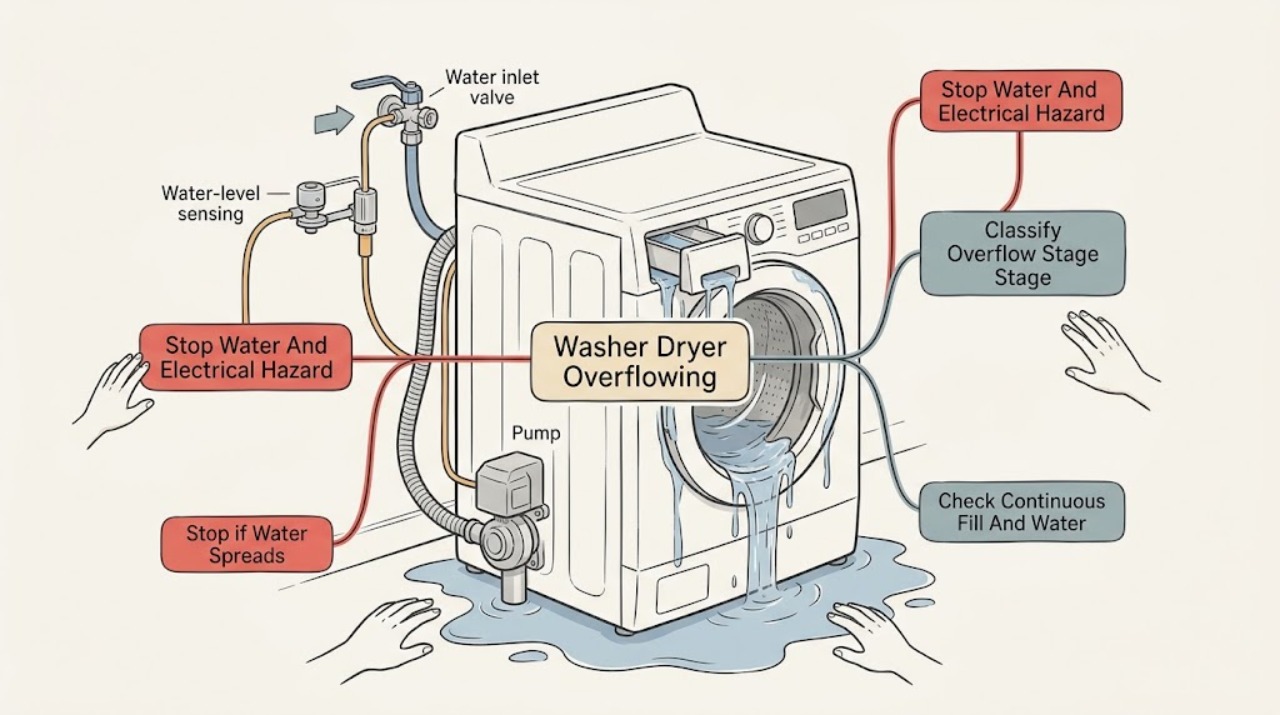
Stop the cycle immediately and close the hot and cold supply faucets from a dry position. If water is near the plug or outlet, there is smoke, a burning smell, a damaged cord, or active flooding, do not touch the appliance; isolate power only from a safe dry location and arrange help. Then identify when the water rises: continuously while filling, from the detergent drawer, out of a top-load lid, or back onto the floor during draining. LG links drawer overflow with too much or hardened detergent and residue that blocks flow; it links top-load overflow with an overloaded or floating load, excessive water level, high supply pressure, or a restricted household drain; and it warns that a low drain hose can create siphoning as the tub fills. Clean only accessible dispenser or gasket areas, use the exact model's level and detergent guidance, and never open the cabinet to test an inlet valve or water-level sensor. If water continues with the faucets closed, reaches the cabinet underside, returns after an accessible correction, or a leak is near electricity, keep the washer dryer off and arrange qualified service.
Before you begin
Safety first
- A user may stop the cycle, close supply faucets, inspect accessible hoses, drawer, seal, load, drain position, and model-approved settings from a dry position. Inlet valves, water-level sensors, pumps, cabinet hoses, controls, and live electrical work require qualified service.
Work through in order
Diagnostic checks
Use only checks that match the exact appliance or system and its official guide.
-
Check 1
Press Stop or Pause only if the controls are dry and accessible, then close both water supply faucets from a dry position; if water is near the plug or outlet, there is smoke, a burning smell, sparking, a hot plug, damaged cord, or active flooding, do not touch the appliance.
Expected result: Record whether incoming water stops when the faucets close, whether water remains in the tub, whether the display or controls are wet, and whether any heat, odor, smoke, or electrical protection trip is present.
Next step: Keep the washer dryer off and arrange qualified appliance, electrical, or plumbing help for any hazard or ongoing uncontrolled flow. If the area is dry and controlled, continue with source tracing.
Stop if: Stop immediately for water near electricity, smoke, burning odor, sparking, a hot plug, damaged wiring, or uncontrolled flooding.
Why this matters
Why: Water that stops with the faucets points toward an inlet or fill-path condition. Continued water can be retained tub water, drain backflow, or an internal fault; an electrical or flooding hazard takes priority over diagnosis.
-
Check 2
After the flow is controlled, dry the accessible floor and observe the first location and cycle stage without moving the appliance: continuous fill, detergent drawer, door or lid, rear connections, drain hose or standpipe, or underneath.
Expected result: Note whether the water rises before washing begins, only when detergent is dispensed, during agitation or spinning, or when the pump drains; take a photograph before changing a connection.
Next step: Use the matching fill, drawer, load, drain, or service branch below. If the first wet point is inside or underneath the cabinet, stop and arrange service.
Stop if: Do not reach under a wet cabinet, pull the machine through standing water, or run another cycle near an electrical hazard.
Why this matters
Why: Timing and first wet point separate inlet or level-sensing, dispenser, load splash, drain backflow, external plumbing, and internal-cabinet causes.
-
Check 3
If water keeps entering during fill, keep the supply faucets closed and consult the exact model manual for the water-level and fill behavior; on supported top-load models, check only the documented load, course, and water-level setting after the machine is safe.
Expected result: Record whether an empty tub also rises unusually high, whether the water-level control responds as documented, whether the load is wet or unusually bulky, and whether water enters with the cycle stopped and faucets open only under safe observation.
Next step: Correct only a clearly wrong documented course or level setting. If the empty-tub behavior is abnormal, the tub approaches overflow, water does not stop, or the fault returns, keep the faucets closed and arrange service.
Stop if: Do not open the inlet valve, pressure-sensor hose, control area, or cabinet; do not leave the appliance unattended while testing fill behavior.
Why this matters
Why: LG says sensed water level varies with load weight and course, while a true continued fill with no appropriate stop can indicate an inlet-valve or water-level sensing fault. A low level can also be perceived when bulky light items float, so visible height alone is not proof of failure.
-
Check 4
If water rises from the detergent drawer, with the appliance stopped and water controlled, inspect for hardened detergent, residue, a blocked passage, an incorrect insert, or filling above the model's guide mark; clean the accessible drawer and housing with lukewarm water and a soft brush as the manual permits.
Expected result: Note whether detergent remains or clumps, whether the drawer is seated correctly, whether foam is excessive, and whether water overflows at the front only during fill or dispensing.
Next step: Reassemble the drawer securely and use only the model-specified detergent type and amount for one safe test. If overflow returns, the drawer is damaged, or water comes from inside the panel, arrange service.
Stop if: Do not mix cleaners, pour unapproved chemicals into the drawer, pry the dispenser housing, or operate through an uncontrolled foam or water overflow.
Why this matters
Why: LG says excess or hardened detergent and residue can restrict water flow and cause drawer overflow; residue can also be carried into the rinse and create excessive suds.
-
Check 5
For water over a top-load lid, reduce a tightly packed or floating load and follow the model's loading guidance; for overflow during draining, inspect the visible drain hose for a loose, kinked, or low position and observe whether the household standpipe backs up.
Expected result: Record whether bulky items float above the wash water, whether the drain hose is secure and positioned as the manual requires, and whether water rises from the household drain rather than the appliance.
Next step: Correct only an accessible load or hose-position issue. If the standpipe overflows, arrange plumbing help; if the hose is damaged, the tub still overflows, or water comes from underneath, arrange appliance service.
Stop if: Do not insert hands into the drain, pour chemicals into the machine, reposition a heavy appliance alone, or continue a drain cycle that floods the floor.
Why this matters
Why: LG links top-load overflow with overloaded or floating laundry and links drain-stage floor overflow with a loose hose or restricted standpipe. A drain hose installed too low can siphon water while the tub fills.
-
Check 6
Only when the floor and electrical area are dry, the water supply is controlled, and the model manual permits it, run one short empty or correctly loaded test while observing from a safe position; otherwise skip testing and prepare service details.
Expected result: Record whether overflow returns, the exact cycle stage, first wet point, supply-faucet response, detergent and load condition, drain behavior, and any error, odor, unusual noise, or electrical symptom.
Next step: Stop the test at the first unsafe or uncontrolled flow and arrange qualified LG appliance service or plumbing help. Provide the model and serial information, photographs, and all observations.
Stop if: Do not repeat tests, leave the machine unattended, bypass a water-level or door control, test live wiring, or remove cabinet panels.
Why this matters
Why: A single corrected load, dispenser, or hose condition that stays dry supports an accessible cause. Overflow with an empty tub, a closed cabinet-side path, or a repeated safe test supports an internal inlet, sensor, pump, seal, or control fault.
Use your observations
Decision map
Find the observation that best matches what you see, then follow the next safe action.
-
PATH 01Safety boundary
What you see
Water is near the plug or outlet, there is smoke, burning odor, sparking, a hot plug, damaged wiring, or uncontrolled flooding.
Do this next
Keep the washer dryer off, leave the hazard area as appropriate, and arrange qualified appliance, electrical, or plumbing help.
Why this path and its safety boundary
Safety stop: Do not touch the appliance, pull it through water, or continue testing.
-
PATH 02Safety boundary
What you see
The tub keeps filling or approaches overflow even though the cycle should have stopped.
Do this next
Close both supply faucets, record whether the flow stops, and use only the model's documented water-level check.
Why this path and its safety boundary
Safety stop: A continuing fill, abnormal empty-tub behavior, or returning overflow needs service; do not open the inlet or sensing system.
-
PATH 03Safety boundary
What you see
Water comes from the drawer during filling or detergent remains, clumps, or creates excessive suds.
Do this next
Clean and correctly reassemble the accessible drawer and use the model-specified detergent amount.
Why this path and its safety boundary
Safety stop: A recurring overflow, damaged drawer, or internal front leak needs service.
-
PATH 04Safety boundary
What you see
Water splashes over a top-load lid with a tightly packed or floating load.
Do this next
Stop the cycle and reduce or redistribute the load according to the model guide.
Why this path and its safety boundary
Safety stop: Overflow with an empty or correctly loaded tub requires service.
-
PATH 05Safety boundary
What you see
Overflow appears during draining, from the standpipe, or while filling and draining at the same time.
Do this next
Check the visible drain hose position and determine whether the household drain is backing up.
Why this path and its safety boundary
Safety stop: A blocked household drain needs plumbing help; a damaged hose or internal drain fault needs appliance service.
-
PATH 06Safety boundary
What you see
Water comes from underneath or inside the cabinet, or overflow returns after an accessible correction.
Do this next
Keep the water supply closed and arrange qualified diagnosis of the inlet, level sensor, pump, seal, or control path.
Why this path and its safety boundary
Safety stop: Do not run more cycles, remove panels, or replace internal parts by guesswork.
Helpful context
Understand the symptom
Stop the incoming water first
An overflowing washer can add water faster than a floor drain can handle it. Press Stop or Pause if the controls are dry and accessible, close both supply faucets, and protect the floor only from a safe position. Water near an outlet or plug changes this into an electrical safety event: do not touch the wet appliance or cord, and arrange help.
The stage of overflow identifies the branch
Water rising continuously during fill suggests the inlet or water-level path. Water from the drawer suggests detergent, buildup, or flow restriction. Top-load water over the lid can follow an overloaded or floating load. Water appearing during drain can be household drain backflow or a loose hose. A low drain hose can also siphon water out while the washer fills, creating an unusual fill-and-drain pattern rather than a true tub overfill.
Use model-specific water and detergent settings
LG says water level is limited by course and adjusted from load conditions on supported top-load models, so a visible level is not automatically unsafe. Use the installed model's water-level setting, detergent type, and fill mark. Do not add detergent to create suds, force the water level, or open a control or valve to prove a theory.
When overflow requires service
If the tub keeps filling after the faucets are closed, water returns from an appliance-side valve or underneath the cabinet, a fault message appears, or overflow returns after cleaning and load or hose corrections, leave the washer dryer off. Provide the model and serial information, the first overflow point, cycle stage, photographs, and whether the supply faucets stopped the flow.
Only after diagnosis
Potential parts
- water inlet valve
Consider only when water continues or an empty-tub fill is abnormal after the safe supply, course, and water-level checks.
Confirm the exact model and valve configuration; do not open or test a live valve. - water-level sensor or pressure path
Consider only when the machine misjudges level or repeatedly overfills after load and course conditions are ruled out.
Sensor and pressure components are model-specific and require qualified diagnosis. - detergent dispenser assembly
Consider only when cleaning, correct insert assembly, and detergent amount do not stop a drawer overflow.
Verify the exact model and drawer design before replacement; do not pry the housing. - drain hose or drain pump
Consider only when a damaged hose, retained water, or recurring drain-stage overflow remains after safe hose and household-drain checks.
Drain access and water-release procedures vary by model and require safe, model-specific handling. - door or lid seal
Consider only when a damaged or distorted seal is confirmed after accessible cleaning and closure checks.
Confirm the exact model and seal profile; a front or lid overflow can also originate from the dispenser or load.
When checks do not resolve it
Need a professional?
Arrange qualified LG appliance service for water that continues with the supply faucets closed, overflow from an appliance-side valve or underneath the cabinet, a recurring overflow, a damaged seal or hose, a fault message, or any water near electricity. Contact a plumber for a household tap or standpipe that overflows.
Safety scope: A user may stop the cycle, close supply faucets, inspect accessible hoses, drawer, seal, load, drain position, and model-approved settings from a dry position. Inlet valves, water-level sensors, pumps, cabinet hoses, controls, and live electrical work require qualified service.
Have this ready
- Provide the exact LG model and serial information, first overflow point, cycle stage, whether the flow stopped at the supply faucets, water-level or course setting, detergent type and amount, load details, drain-hose and standpipe observations, photographs, and any error, odor, noise, or electrical symptom.
Common questions
FAQ
What should I do first if my LG washer dryer is overflowing?
Stop or pause the cycle if the controls are dry and close both water supply faucets from a safe position. Keep water away from electrical parts, then identify whether the first overflow is from the tub, drawer, rear hose, drain, or underneath.
Why does an LG washer overflow from the detergent drawer?
LG links drawer overflow with too much or hardened detergent, residue, an incorrect insert, and restricted water flow. Clean the accessible drawer and housing, reassemble it correctly, and use the model-specified amount.
Why does my LG top-load washer splash water over the lid?
An overloaded or tightly packed tub, or a bulky item that floats, can splash water out. Stop and redistribute the load according to the model guide; overflow with an empty or correctly loaded tub needs service.
Can a drain hose make an LG washer appear to overfill?
Yes. LG explains that a drain hose installed too low can siphon water out while the tub fills, and a clogged standpipe can overflow during draining. Check only the visible hose position and household drain from a safe position.
When should I stop using an LG washer dryer that overflows?
Stop for water near electricity, smoke, burning odor, uncontrolled flooding, continuous filling, a leak from underneath, a damaged hose or seal, or overflow that returns after a safe correction. Keep it off and arrange qualified help.
Read the exact guide
Official sources
- LG Top Load Washer - LeakingLG Electronics USA Support · Use the top-load branches for models with a lid; front-load and combo layouts require their own model instructions.
- [LG top load washing machine water supply] The water level cannot be adjusted. The water level is too high. The water level is too low.LG Electronics USA Support · Use the level and course guidance only for supported top-load models; controls and available options differ by model.
- [LG Washing Machine] Water Overflowing from Detergent DrawerLG Electronics USA Support · The page covers model-dependent dispenser and detergent checks; use the installed model's drawer instructions and fill marks.
- [LG Front Load Washing Machine] Troubleshooting LeaksLG Electronics USA Support · The guide covers front-load door, dispenser, rear, drain, and access-cover paths; the exact model controls maintenance access.
Community feedback
Share a repair observation
Share a plain-text repair observation. Accepted observations are published automatically; this page may take a moment to update.