
On this page
Start here
Quick answer
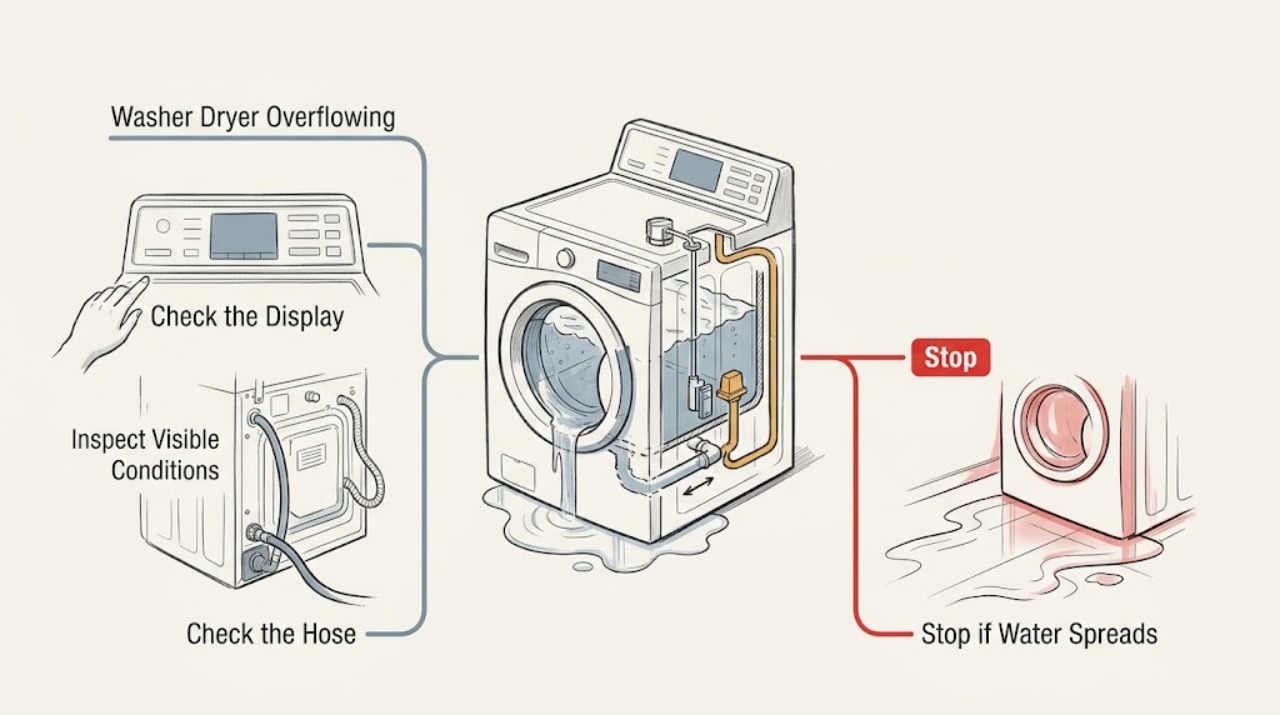
If a GE washer-dryer is overflowing, stop the fill immediately: pause or turn the appliance off, and do not unplug it while standing in water. Once power is off, close the household hot and cold water valves behind the washer. Then determine whether water enters while the washer is off, whether the tub fills and drains at the same time, or whether suds and leaks appear only during agitation. GE says an overflow while filling may require service for the water valve or pressure switch; a drain hose that is too low can also siphon water as the tub fills.
Work through in order
Diagnostic checks
Use only checks that match the exact appliance or system and its official guide.
-
Check 1
For active flooding, press Pause or turn the washer off at its controls if they respond. If water is on the floor, do not unplug the appliance while standing in water; use the appliance breaker only if it can be reached without entering the wet area. After power is off, close both household water supply valves behind the washer.
Expected result: Water stops entering after the controls or breaker are turned off, or water continues to enter even after power is off and the supply valves are closed.
Next step: Keep the appliance off, do not restart it in standing water, and arrange qualified appliance or plumbing help. Photograph the leak area only from a dry, safe position if useful for service.
Why this matters
Why: Stopping power and water limits additional flooding. Continued water after the valves are closed indicates residual water or a plumbing issue that needs immediate attention rather than a washer-cycle test.
-
Check 2
With the washer off and the floor dry, observe whether water enters the tub when no cycle is running. Keep the household water valves closed while making this observation if the washer has already filled by itself.
Expected result: Water enters or accumulates while the washer is turned off, or the tub stays dry until a cycle begins.
Next step: If it fills while off, leave both water valves closed and request service; do not keep testing it. If it stays dry while off, continue with the controlled fill and drain-path checks.
Why this matters
Why: Filling while off points toward a water inlet valve that is not closing. Filling only during a cycle shifts attention to water-level sensing, drain installation, detergent, or a cycle-specific leak.
-
Check 3
Inspect the drain hose installation without starting a cycle. Confirm that it is supported at the height specified for the exact GE model; GE's general guidance for the cited top-load washer is to raise the hose to 30 inches, because a lower hose can siphon water out while the tub fills.
Expected result: The hose is low, pushed too far into the standpipe, kinked, or otherwise incorrectly supported, or its installation matches the model instructions.
Next step: Correct only an obvious hose placement issue using the model installation instructions, then test with the water level watched closely. If the hose is correctly installed but the washer still overfills, stop and request service.
Why this matters
Why: A low or poorly installed drain hose can make the washer fill and drain at the same time, confusing the water-level behavior and contributing to overflow or an endless fill.
-
Check 4
If the water level is normal but suds or water spill over during agitation, review the detergent amount, detergent type, water softness, and recent use of bleach combinations. Once the active leak is controlled and the area is dry, run only the model-approved cleaning or rinse procedure without adding more detergent.
Expected result: The tub contains unusually heavy suds, or the water is not excessively sudsy and the spill begins during filling or draining.
Next step: Use the amount and detergent type specified for the model and water conditions. If overflow returns without excessive suds, stop using the washer and arrange service.
Why this matters
Why: Excess detergent and oversudsing can push water over the basket even when the fill level is otherwise normal. A non-sudsy overflow is more consistent with a fill, level-sensing, hose, or plumbing fault.
-
Check 5
After the water valves, power, hoses, and floor are safe, identify where the water appears: from the dispenser or door seal, from a rear hose connection, from the tub during fill, or from the drain or standpipe. Check only visible, accessible connections for a loose hose, kink, damage, or a household drain that backs up.
Expected result: The leak is localized to a dispenser or seal, a fill or drain hose, the household standpipe, or the tub level itself.
Next step: Do not tighten or remove a pressurized connection. With water valves closed, document the location and arrange the appropriate appliance service or plumber; persistent tub overfill requires appliance service.
Why this matters
Why: The location separates an accessible installation or buildup issue from an internal fill-valve, pressure-sensing, or appliance fault. A household drain blockage is a plumbing issue, not a washer control adjustment.
Use your observations
Decision map
Find the observation that best matches what you see, then follow the next safe action.
-
PATH 01Next step
What you see
Water is actively overflowing or standing on the floor.
Do this next
Pause or turn off the appliance without unplugging while standing in water. Once power is off, close both household water valves. Do not restart until the area and cause are safe.
-
PATH 02Next step
What you see
The tub fills while the washer is turned off.
Do this next
Keep the water valves closed and arrange service for the water inlet valve or related fill control. Do not continue cycling the washer to test it.
-
PATH 03Next step
What you see
The washer fills and drains at the same time.
Do this next
Check the visible drain-hose installation against the model instructions. If the path is correct or the household drain backs up, arrange appliance or plumbing service.
-
PATH 04Next step
What you see
The water level is normal but thick suds spill over during agitation.
Do this next
Stop adding detergent, use the model-approved rinse or cleaning procedure once the area is safe, and correct the detergent amount and type. If it overflows without suds, request service.
-
PATH 05Next step
What you see
The washer overfills without excessive suds after the hose and water supply checks.
Do this next
Leave the water valves closed and the appliance off, then arrange qualified appliance service. Do not bypass the water-level control or open internal panels.
Helpful context
Understand the symptom
Treat active overflow as a water-and-electricity safety event before diagnosing the cause. Stop the cycle from the controls if they respond, or switch off the appliance circuit if that is the safe accessible option. Do not reach behind the washer, pull its plug, or step into standing water to shut off power.
A GE washer-dryer may be a one-piece combo or a stacked laundry center, but the overflow decision is the same: stop incoming water, identify whether the washer fills while off or only during a cycle, then check the drain path and detergent before service.
Only after diagnosis
Potential parts
- water inlet valve
Only consider this component if testing confirms that water enters while the washer is off or the valve does not close when the fill command ends.
Confirm the complete GE model and the manufacturer's fit information before ordering any component. - water level pressure-sensing component
Only consider this component if the drain hose and detergent are not causing the overflow and service testing identifies a level-sensing fault.
Use the full model identification and manufacturer fit information; do not infer compatibility from a similar-looking part.
When checks do not resolve it
Need a professional?
Request appliance service for a GE washer-dryer that overfills during a fill cycle, fills while off, or continues to overflow after the visible hose, drain, and detergent checks.
Have this ready
- Provide the complete model number, whether water enters while off, when overflow begins, whether the tub is sudsy, the leak location, the drain-hose arrangement, and whether the breaker or water valves were affected.
Common questions
FAQ
What should I do first if my GE washer-dryer is overflowing?
Pause or turn the appliance off, and do not unplug it while standing in water. Once power is off, close the household hot and cold water valves behind the washer.
Why does my GE washer fill with water when it is turned off?
GE says water entering while the washer is off can indicate a failed water valve or valve assembly. Keep the water valves closed and arrange service rather than continuing to run the appliance.
Can a drain hose make a GE washer overflow?
Yes. GE notes that a drain hose installed too low can siphon water out while the tub fills, making the washer fill and drain at the same time. Check the exact model installation instructions before correcting the hose position.
Can too much detergent cause an overflow?
Excess detergent can create heavy suds that spill over the basket, especially in softer water. If the tub overflows without excessive suds, the fill, level-sensing, drain, or appliance system needs service.
Read the exact guide
Official sources
- Washer OverflowingGE Appliances · GE washers and washer-dryer laundry appliances
- Washer - Won't Stop FillingGE Appliances · GE washers
- Top Load Washer - Leaking Water in FrontGE Appliances · GE top-load washers and washer-dryer laundry centers
- Washer - Drips or Fills When Not Turned OnGE Appliances · GE washers and washer-dryer laundry appliances
- Front Load Washer - Leaking WaterGE Appliances · GE front-load washers and washer-dryer laundry appliances
Community feedback
Share a repair observation
Share a plain-text repair observation. Accepted observations are published automatically; this page may take a moment to update.