
On this page
Start here
Quick answer
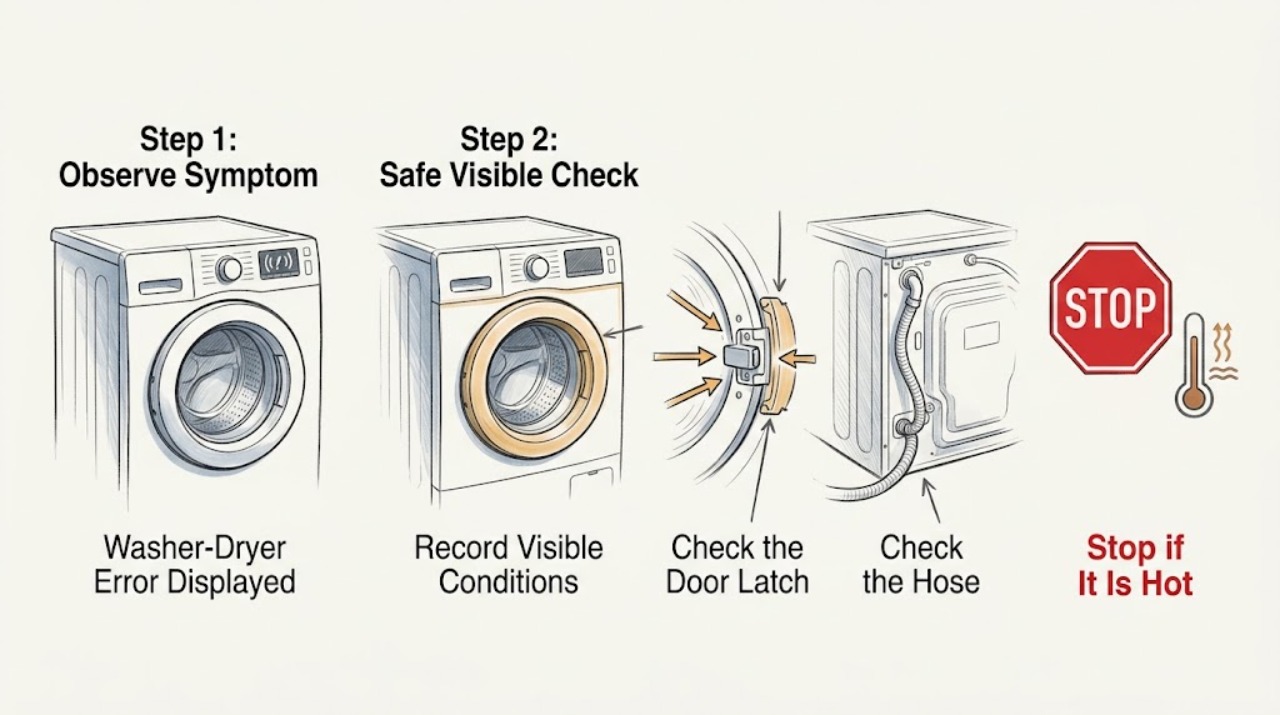
When a Haier washer-dryer displays an error, record the complete code and the point in the cycle where it appeared before resetting anything. Haier's combination washer-dryer chart separates door and drain codes from water-fill, motor, sensor, heating, and communication faults. User checks can be limited to a fully closed door, accessible hose and filter conditions, the selected water supply, and a balanced load where the code permits it. If the code calls for service, returns after one model-approved reset, the drum contains water that cannot be safely drained, or the appliance needs internal electrical or heating work, stop using it and arrange qualified service.
Work through in order
Diagnostic checks
Use only checks that match the exact appliance or system and its official guide.
-
Check 1
Write down the exact code, symbols, and any accompanying message. Note whether it appeared during filling, washing, draining, spinning, drying, or at startup, and whether the door is locked or water remains in the drum.
Expected result: The code and cycle stage distinguish a door, drain, water-fill, balance, dryer sensor, heating, motor, or general service branch. A code that returns immediately after clearing is more significant than a single interrupted display.
Next step: Keep the code with the model number and follow only the matching user check below. If the chart says service is required, skip repeated resets.
Why this matters
Why: Haier's chart is organized by fault code, so a generic description cannot safely identify a failed part or justify a replacement.
-
Check 2
For Err1 or E2, stop the cycle and check from the outside that the door is fully closed, no garment is caught in the seal, and the latch area is not obstructed. Do not force the door or defeat the lock.
Expected result: A door that closes normally and allows one model-approved retry supports a simple closure interruption. A door that will not latch, remains locked with water inside, or shows the same code again indicates a lock or control fault.
Next step: Retry once only if the door closes normally and the manual allows it. If the code returns or the door remains locked, leave the appliance off and arrange service.
Why this matters
Why: Haier maps Err1 to a door that is not closed and E2 to a door-lock problem on the combination chart; the latter should not be treated as a loose-door adjustment.
-
Check 3
For Err2 or E1, unplug the washer-dryer and inspect the user-accessible drain-pump filter and drain hose according to the model manual. Check for a kink or obvious obstruction without reaching into standing water or opening sealed plumbing connections.
Expected result: A blocked accessible filter or kinked hose can explain a drain code. If the drum still holds water after the accessible check, the pump is noisy without moving water, or the filter cannot be safely accessed, the drain problem is unresolved.
Next step: Restore the filter and hose, then perform one manual-approved drain test. If water remains, the code returns, or the water is hot, stop and arrange qualified service.
Why this matters
Why: Haier distinguishes a unit that cannot drain from a door or fill issue; a remaining water problem can also keep the door locked and should not be bypassed.
-
Check 4
For Err5, E4, or LF-style fill symptoms, verify that both water lines are connected, both supply valves are open, and the hoses are not kinked or crushed. With power disconnected and the valves closed, inspect only the accessible inlet filters or screens for debris; do not alter plumbing or use an unapproved flow-restricting hose.
Expected result: A closed valve, restricted filter, kinked hose, interrupted supply, or poor flow can prevent the selected fill level from being sensed. If both supplies and accessible filters are clear but the code persists, the fault may be internal.
Next step: Correct only the accessible supply issue and run one model-approved fill test. If the code returns or an internal valve or sensor test would be needed, stop and request service.
Why this matters
Why: Haier maps fill codes to the water path and warns that restricted flow can make the appliance assume water is unavailable; this does not prove that the inlet valve or level sensor has failed.
-
Check 5
For an Unb code, pause the appliance and redistribute the load evenly without reaching into a moving drum. Select the low-speed spin or other option specified by the model before attempting a single retry; do not overload the drum to force the cycle to continue.
Expected result: A balanced load that completes the permitted retry supports a load-distribution condition. A repeated Unb code with a normal load, severe vibration, or an appliance that is not level needs further diagnosis.
Next step: Stop using the appliance if it repeatedly becomes unstable or the code returns with a balanced load, and arrange qualified service.
Why this matters
Why: Haier identifies Unb as an unbalanced load, which is different from the motor and communication codes that require service.
-
Check 6
For F7, F9, FA, FC, Fd, FE, Err7, Err8, Err9, E10, or E8, record the code and stop at the external observation stage. Do not open the cabinet, bypass a lock, test a motor or heater, or reset the appliance repeatedly.
Expected result: Haier's combination chart assigns these codes to motor, dryer sensor, water-level sensor, driver feedback, abnormal dryer heating, motor, high-level, or service-required conditions.
Next step: Leave the washer-dryer off and arrange qualified service with the exact code, cycle stage, and model number.
Why this matters
Why: These code families require model-specific diagnosis and can involve electrical, heating, water-level, or drive systems that are not safe to identify by appearance alone.
Use your observations
Decision map
Find the observation that best matches what you see, then follow the next safe action.
-
PATH 01Next step
What you see
The code is Err1 or E2 and the door is not fully closed or the latch area is obstructed.
Do this next
Clear only the visible obstruction, close the door normally, and retry once if the manual permits. A recurring code needs service.
-
PATH 02Next step
What you see
The code is Err2 or E1 and an accessible filter or drain hose is blocked.
Do this next
With power disconnected, correct the accessible restriction and perform one manual-approved drain test. If water remains, arrange service.
-
PATH 03Next step
What you see
The code is Err5, E4, or LF-style fill failure and a supply valve, filter, or hose is restricted.
Do this next
Restore the accessible water supply condition, then run one fill test. Persistent failure requires service diagnosis.
-
PATH 04Next step
What you see
The code is Unb and the clothing is visibly gathered on one side.
Do this next
Redistribute the load evenly and use the model's low-speed spin or retry instruction once. Repeated imbalance needs service.
-
PATH 05Next step
What you see
The chart marks the code as service required, the code returns, the door remains locked with water inside, or the appliance leaks, overheats, or makes an abnormal drive noise.
Do this next
Stop using the washer-dryer and arrange qualified appliance service. Do not bypass safety devices or access internal electrical, motor, water-level, or heating parts.
Helpful context
Understand the symptom
Read the code before choosing a fix
Error displayed is not one diagnosis. On Haier combination washer-dryers, Err1 and E2 involve the door, Err2 and E1 involve draining, Err5 and E4 involve filling, Unb involves load balance, and other codes identify motor, sensor, heating, level, or communication faults. The same code can be model-specific, so use the complete model number and the owner's manual when the chart does not match your panel.
What a user may safely check
Unplug the appliance before touching a hose, filter, or other accessible maintenance item. Do not bypass the door lock, reach into a moving drum, open the control area, test live wiring, or replace a heating or motor component as a guess. If water is hot, the door is locked, or the machine is leaking, leave it in a safe state and use qualified service.
When checks do not resolve it
Need a professional?
Qualified service is appropriate for any recurring Haier washer-dryer error, any code marked service required, unresolved door or drain lockout, abnormal heating or motor behavior, and any diagnosis involving the control board, sensors, wiring, pump, or heater.
Common questions
FAQ
What should I do first when my Haier washer-dryer displays an error?
Record the complete code and cycle stage, then match it to the model's manual or Haier's combination error chart. Perform only the listed external check and arrange service when the code is marked service required or returns.
What does Err5 or E4 mean on a Haier combination washer-dryer?
These codes relate to water filling. Check both supply lines, open valves, kinked hoses, and accessible inlet filters with power disconnected. If the code persists, service may be required.
What does Err2 or E1 mean on a Haier washer-dryer?
These codes relate to draining. Check the user-accessible pump filter and drain hose according to the model manual. If water remains, the door is locked, or the code returns, arrange qualified service.
Which Haier washer-dryer errors require service?
Haier marks several motor, sensor, heating, water-level, communication, and general fault codes as service required. A recurring door, drain, or fill code also needs service after the matching external check fails.
Read the exact guide
Official sources
- Haier Combination Washer/Dryer - Error CodesHaier Appliances · Haier chart for door, drain, water-fill, balance, motor, sensor, heating, water-level, and communication codes on combination washer-dryers.
- Haier - Washer Displays LFHaier Appliances · Haier guidance for a full-fill sensing problem, water lines, supply valves, inlet filters, hose restrictions, and service escalation.
Community feedback
Share a repair observation
Share a plain-text repair observation. Accepted observations are published automatically; this page may take a moment to update.