
On this page
Start here
Quick answer
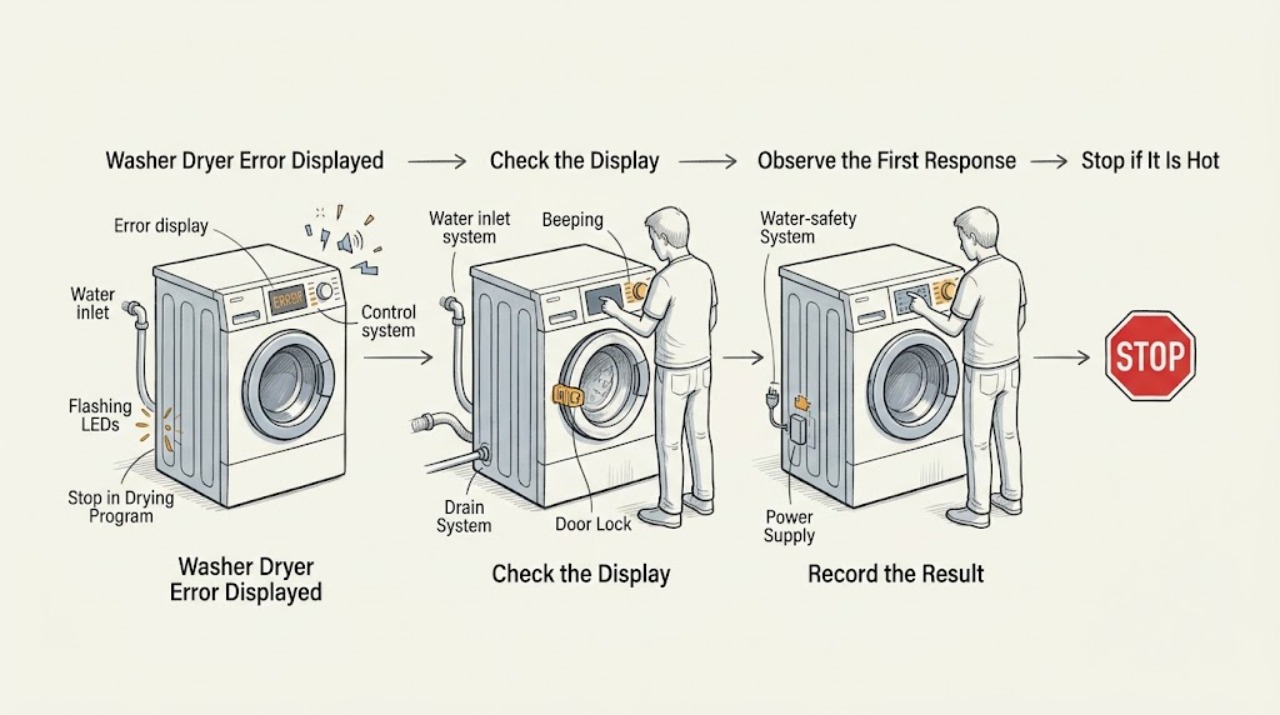
An Electrolux washer dryer error is a routing clue, not a complete diagnosis, and the exact meaning can vary by model. Write down the full code, beeps or flashes and the point where the programme stopped, then use the model's manual or Electrolux support page. E10, E11 or C1 generally route to visible water-inlet and drain checks; E40 points to door closure or locking; EF0, EFo or EF3 needs a water-safety, leak, foam, or door-seal response; E90–E94 indicates an electronic configuration or communication problem; and EH0-series codes point to the power supply. Check only accessible taps, hoses, door, filter, detergent, socket, and model-documented reset steps. Stop for a leak, water near electrics, smoke, burning odor, a damaged door seal or cord, or a recurring code, and arrange qualified service rather than opening the cabinet or guessing a part.
Work through in order
Diagnostic checks
Use only checks that match the exact appliance or system and its official guide.
-
Check 1
Before switching the washer dryer off, photograph or write down the complete display code, beeps or flashes, selected programme, and whether the machine was filling, washing, draining, spinning, or drying. Note whether the display is still responsive and whether water is visible in or around the appliance.
Expected result: The code is complete and repeatable; only a partial code or light pattern is visible; the machine has stopped with water; or the code disappeared after power was lost.
Next step: Keep the record for the next branch and retrieve the exact manual using the model number. Stop immediately for smoke, burning odor, sparking, water at the electrical connection, or a damaged cord or seal.
Stop if: Do not keep restarting the appliance just to reproduce an error, and do not force a locked door when water may be inside.
Why this matters
Why: A complete code can be matched to the exact Electrolux support guidance, while a partial or model-unknown indication cannot safely be assigned to a component. Water present or a leak changes the situation from a simple code lookup to a safety and water-control branch.
-
Check 2
For E10, E11, C1, or a similar water-inlet or drain indication, check from outside that the water tap is open, visible inlet hoses are not kinked, and the visible drain hose is not twisted or incorrectly positioned. Follow the exact manual for any user-accessible filter check; do not loosen a pressurized connection or open the pump housing with uncontrolled water.
Expected result: A tap is closed, an inlet hose is kinked, the drain hose is twisted or routed incorrectly, an accessible filter warning is present, or the visible water and drain paths appear correct.
Next step: Correct only an obvious tap or hose-routing issue described by the manual, then make one supervised programme attempt. If the code returns, water remains, or a filter or pump is not safely accessible, stop and arrange service.
Stop if: Do not disconnect a pressurized hose, open a wet cabinet, reach into a pump, use sharp tools in the drain, or run the machine with a leak.
Why this matters
Why: Electrolux links this code family to insufficient water intake or drainage and identifies visible tap, hose, drain-position, filter, and excess-foam checks. A correct external path with a returning code can involve an inlet valve, level sensing, pump, or control and cannot be identified by the code family alone.
-
Check 3
For E40 or a similar door-lock indication, stop the programme normally, wait until the drum is still, and check that no laundry is caught between the door seal and glass and that the load is not preventing the door from closing. Close the door firmly without slamming or forcing it; use the exact manual for any child-safety-lock procedure.
Expected result: The door clicks and the code clears; trapped laundry or an overloaded drum was found; a mechanical child lock is active; or the door appears closed but the code returns.
Next step: Remove only an obvious obstruction or excess load, follow the model manual, and make one restart attempt. If the lock does not engage or the code returns, keep the washer dryer off and arrange service.
Stop if: Do not force the door, insert tools into the lock, bypass the interlock, or open a door with water visible behind it.
Why this matters
Why: Electrolux identifies incomplete closure, trapped laundry, overload, and a child lock as possible reasons for an E40 door condition. A recurring code after the door is clear can indicate a failed lock or control signal, not a reason to bypass the interlock.
-
Check 4
For EF0, EFo, EF3, repeated beeps or flashes for a water-safety condition, stop the programme and inspect only from outside for water at the door seal, bottom filter area, supply-hose connections, or floor. Note whether excessive foam or a visibly dirty dispenser is present, and turn off the water tap if there is an active leak and it can be reached safely.
Expected result: There is active water, a damaged or leaking seal or hose, excess foam, detergent or dispenser buildup, a clear dry exterior, or an uncertain source of water.
Next step: Leave the appliance off, protect the floor without moving the machine, and arrange service for any leak, damaged seal, recurring water-safety code, or inaccessible filter. If only excess detergent or an accessible dispenser condition is clearly identified, follow the exact manual once before retesting.
Stop if: Do not tilt the washer dryer, remove panels, open a wet filter housing, reconnect water after an active leak, or work near a wet electrical connection.
Why this matters
Why: Electrolux says this code family can involve leakage, over-foaming, a dirty dispenser, laundry caught in the seal, or a filter or hose issue. A leak or uncertain water path is a safety boundary; a dry exterior does not prove that the internal tray or water system is sound.
-
Check 5
For E90, E91, E92, E93, or E94, copy the code exactly, switch the washer dryer off, disconnect power only from a dry and safe position, wait the interval stated by the exact Electrolux guidance, and reconnect once for a single test. Do not attempt a factory reset or open the control area.
Expected result: The code clears and one programme runs normally, the same code returns, or the display and controls remain unresponsive.
Next step: If the code returns or the controls remain unresponsive, leave the appliance off and arrange an authorised or qualified service visit with the code and model details.
Stop if: Do not repeat power cycles, enter diagnostic mode, probe the control board, or work inside the machine while connected to power.
Why this matters
Why: Electrolux describes this family as configuration or communication problems with electronic parts. A one-time documented restart can clear a temporary state, but a returning code needs service and does not identify a replaceable board by itself.
-
Check 6
For EH0, EH1, EH2, EH3 or another power-related code, check the same socket with a different safe product only if doing so is dry and safe, and note whether the washer dryer's display and supply protection behave normally. Use the appliance's normal plug and socket only; do not use an extension cable.
Expected result: The other product also fails; the washer dryer has no display; the outlet or safety switch has tripped; the supply appears normal but the code returns; or the code clears after a single model-documented restart.
Next step: If the socket or household wiring is suspect, leave the washer dryer disconnected and arrange a qualified electrician. If external supply is normal but the code returns, arrange appliance service with the exact code.
Stop if: Do not remove the plug or outlet cover, alter wiring, use an extension cable, repeatedly reset a safety switch, or test live conductors.
Why this matters
Why: Electrolux identifies EH0-series codes as power-supply problems and says a failed comparison product can point to wiring. A normal socket does not prove the appliance electronics are sound, while a repeated trip needs electrical attention rather than repeated resets.
-
Check 7
For a code not covered by the routes above, use the complete model or product number to retrieve the exact Electrolux manual and support article, compare the displayed code character by character, and perform only the listed external action. Keep a record of the cycle phase and whether the error returned.
Expected result: The model guide identifies a safe external correction and the code clears once, the code is not listed, or the same code returns after the documented step.
Next step: Arrange qualified service for an unlisted or recurring code and provide the exact code, model, programme, water state, and checks completed. Do not choose a part from a generic code chart.
Stop if: Stop if the code accompanies smoke, burning odor, sparking, water near electrics, an active leak, a damaged seal or cord, or abnormal heat.
Why this matters
Why: Electrolux's overview states that code meanings and quick guides are model-specific. An unlisted or recurring code cannot be safely mapped to a motor, heater, pump, lock, or control from the display alone.
Use your observations
Decision map
Find the observation that best matches what you see, then follow the next safe action.
-
PATH 01Next step
What you see
The display shows E10, E11, C1, or a similar water-inlet or drain indication.
Do this next
Check only visible taps and hoses and use the exact manual for accessible maintenance. Make one test; arrange service if water remains or the code returns.
Why this path and its safety boundary
Why it matters: The likely user-level routes are water supply, visible hose routing, drain position, an accessible filter, or excess foam; the code does not prove which item failed.
-
PATH 02Next step
What you see
The display shows E40 or a similar door-lock code.
Do this next
Clear only an obvious external obstruction, close the door without force, and follow the manual once. A returning code or failed latch requires service.
Why this path and its safety boundary
Why it matters: The lock may not detect a fully closed door because of trapped laundry, overload, child lock, damaged alignment, or an internal lock fault.
-
PATH 03Next step
What you see
The display shows EF0, EFo, EF3, repeated water-safety beeps, or the appliance keeps pumping out water.
Do this next
Stop use, inspect externally for water and turn off the tap if safe. Arrange service for a leak, damaged seal, recurring code, or any inaccessible water path.
Why this path and its safety boundary
Why it matters: Leakage, foam, dispenser or seal issues, or a water-system fault may be involved.
-
PATH 04Next step
What you see
The display shows E90, E91, E92, E93, or E94.
Do this next
Perform the official one-time 30-second restart only when safe. If the code returns, leave the machine off and arrange service; do not open the control area.
Why this path and its safety boundary
Why it matters: Electrolux identifies these as configuration or communication problems with electronic parts.
-
PATH 05Next step
What you see
The display shows EH0, EH1, EH2, EH3, or another power-supply indication.
Do this next
Check the socket only from a dry, safe position and arrange qualified electrical help if the comparison product also fails or the safety device trips again. Arrange appliance service if the external supply is normal but the code persists.
Why this path and its safety boundary
Why it matters: The supply, socket, safety switch, or appliance power circuit may be involved.
-
PATH 06Next step
What you see
The code is unlisted, incomplete, or returns after the exact model's documented user step.
Do this next
Stop repeating resets and arrange qualified service with the exact code, model, programme phase, water state, and prior checks.
Why this path and its safety boundary
Why it matters: The display cannot distinguish an internal lock, valve, pump, motor, sensor, heater, control, or communication fault without model-specific diagnosis.
-
PATH 07Next step
What you see
There is an active leak, water near electrical parts, smoke, burning odor, sparking, damaged cord or door seal, or a repeated electrical trip.
Do this next
Stop using the washer dryer, turn off the water if a leaking tap can be reached safely, and arrange qualified appliance or electrical service. Isolate power only without touching water or damaged equipment.
Why this path and its safety boundary
Why it matters: The fault is a safety condition, not a code-lookup problem.
Helpful context
Understand the symptom
Treat the display as a decision point
Do not clear an error before recording it. Note the complete code, whether it is an E-code, C-code, EF-code, EH-code, beeps or flashes, whether the washer or dryer phase was running, and whether water is visible. Electrolux says its general code families are only a starting point and directs readers who do not see their code to model-specific support.
What the main washer-dryer code families change
An inlet or drain code changes the first checks to taps, hoses, drain routing, and accessible filters. A door code changes the check to closure, trapped laundry, overload, and the lock state. An EF0-type water-safety code changes the boundary to stopping water use and checking for visible leakage or excess foam. An E90-type code points toward electronics after one documented reset, while EH0-type codes require a supply check and an electrician if the outlet or wiring is suspect. These families are useful routing clues, not permission to open the appliance.
Use the exact manual before changing a setting
Electrolux washer dryers differ in control layouts, code formats, filters, and access. The model number and product documentation are more reliable than a button sequence copied from another machine. Keep the appliance out of service when the fault returns after the documented user step, and give the technician the code and the sequence that produced it.
Safety boundary
Stop conditions
- Stop immediately for an active leak, water near the plug or electrical connection, smoke, burning odor, visible sparking, abnormal heat, or a damaged cord or door seal.
- Do not force or bypass the door lock, open a locked door with water visible, tilt the appliance, or open a wet filter or cabinet.
- Do not disconnect pressurized hoses, probe live wiring, enter a service mode, or remove the control area.
- Do not repeatedly reset an error, breaker, safety switch, or power supply when the code or symptom returns.
- Stop when the code is unlisted or recurring after the model-specific external step, or when diagnosis would require an internal valve, pump, motor, heater, sensor, lock, or control check.
Only after diagnosis
Potential parts
- door lock assembly
Consider this only if qualified diagnosis confirms a failed door-lock signal after the door is correctly aligned and free of trapped laundry.
Confirm the exact Electrolux model and manufacturer fit information before ordering; never bypass the interlock or infer fit from an E40 code alone. - water inlet valve
Consider this only if qualified diagnosis confirms an inlet-valve fault after the visible tap and hose checks for an E10 or C1 condition.
Confirm the exact model, valve configuration, and manufacturer fit information before ordering or replacing this internal component. - drain pump
Consider this only if qualified diagnosis confirms a pump fault after visible drain routing and any model-approved accessible filter checks are clear.
Confirm the exact model and manufacturer fit information; an E10 or C1 code does not by itself identify a compatible pump.
When checks do not resolve it
Need a professional?
Arrange qualified Electrolux appliance or electrical service when an error code is unlisted or returns after the model-specific user step, E40 persists after safe door checks, E10/C1 persists after visible water and drain checks, EF0/EFo/EF3 involves any leak or recurring water-safety condition, E90-series or EH0-series codes return, or there is smoke, burning odor, sparking, abnormal heat, water near electrics, a damaged cord or seal, or a repeated circuit trip.
Common questions
FAQ
What should I do first when my Electrolux washer dryer displays an error?
Record the complete code, beeps or flashes, selected programme, stopped phase, water state, and model number before switching it off. Then use the exact Electrolux support article or manual; the code family routes the next safe check but does not identify a part by itself.
What does E10 or C1 mean on an Electrolux washer dryer?
Electrolux uses E10, E11, and C1 for a family of water-intake or drainage conditions. Check only visible taps, inlet and drain hoses, accessible filters, and excess-foam context as the model manual directs. A returning code or retained water needs service.
What does E40 mean on an Electrolux washer dryer?
E40 is a door-lock family indication. Check that the door is fully closed, no laundry is caught in the seal, the load is not preventing closure, and any child-safety lock is handled by the model manual. If the code returns, do not bypass the lock; arrange service.
What should I do for EF0, EFo, or EF3?
Treat these as water-safety indications. Stop the appliance, inspect externally for a leak at the door seal, filter area, or supply hose, and note excess foam or dispenser buildup. Do not tilt or open a wet cabinet; leave the water and appliance system to qualified service if there is a leak or the code returns.
What do E90 to E94 mean on an Electrolux washer dryer?
Electrolux identifies E90–E94 as configuration or communication problems with electronic parts. Perform only the official one-time 30-second restart when safe. If the code returns, arrange service and provide the exact code; do not open the control area.
What does EH0 or EH3 mean on an Electrolux washer dryer?
EH0-series codes point to a power-supply condition. Check the socket safely with another product if appropriate, do not use an extension cable, and arrange qualified electrical help if the socket or safety switch is suspect. A normal socket with a returning code needs appliance service.
When should I stop troubleshooting an Electrolux washer dryer error?
Stop for a leak, water near electrical parts, smoke, burning odor, sparking, abnormal heat, a damaged cord or door seal, or a repeated circuit trip. Also stop when the code is unlisted or returns after the exact model's external check or single documented reset.
Read the exact guide
Official sources
- Washer dryer displays error message EF0, EFo, EF3 or emits 15 beeps / 15 flashesElectrolux · Applies to integrated and freestanding washer dryers; use the exact manual and stop using the machine for a leak or damaged seal.
- Washer dryer displays error message E90, E91, E92, E93 or E94Electrolux · Applies to freestanding and integrated washer dryers; a recurring code needs service rather than control-board access.
- Washer dryer displays error message E40 or emits 4 beeps / 4 flashesElectrolux · Applies to integrated and freestanding washer dryers; exact child-lock steps are model-specific.
- Before Requesting Service for Your Electrolux ApplianceElectrolux · General Electrolux service-preparation guidance; it does not replace code- or model-specific instructions.
- Washer dryer displays error message E10, C1 or emits 1 beep / 1 flashElectrolux · Applies to the listed washer-dryer code family; exact access and drain installation follow the model manual.
- Washing machine displays error message EHO / EH0Electrolux · Power guidance for applicable Electrolux washer dryers; local electrical safety rules and the model manual govern.
- Washing machine displays an error code, how to fix it?Electrolux · Family-level routing only; the exact code meaning and action remain model-specific.
Community feedback
Share a repair observation
Share a plain-text repair observation. Accepted observations are published automatically; this page may take a moment to update.