
On this page
Start here
Quick answer
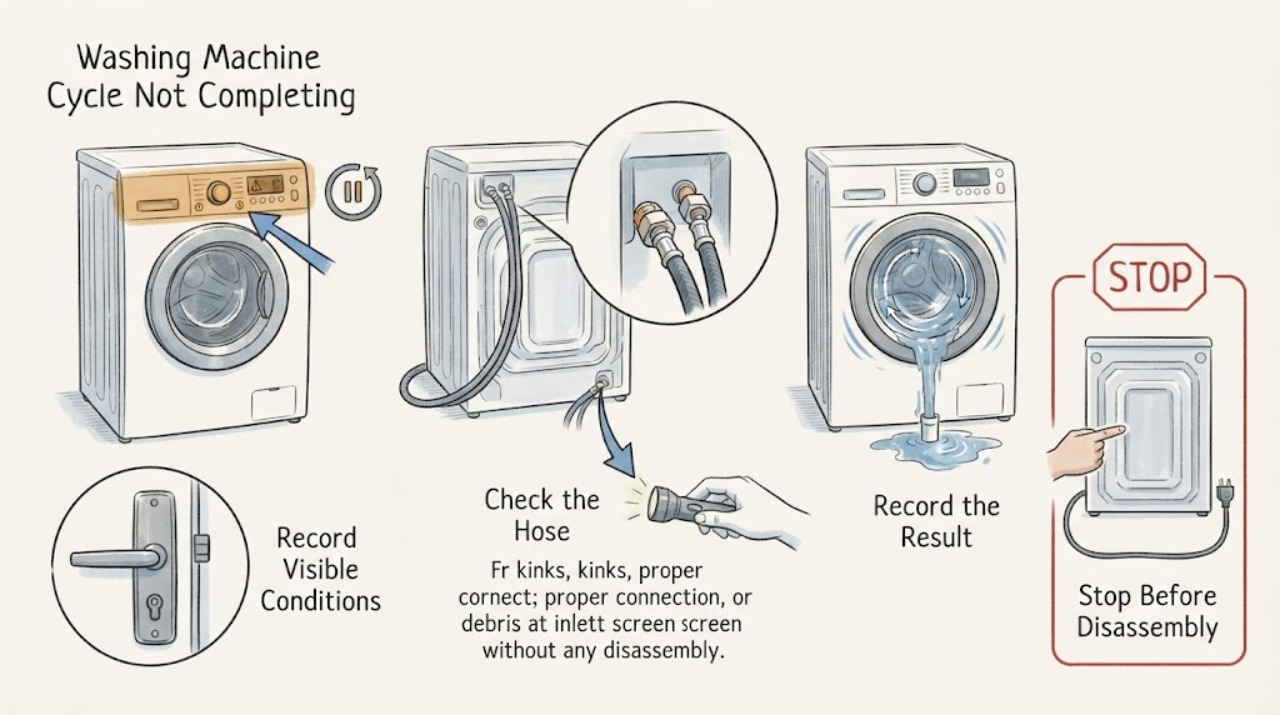
When a Haier washing machine does not complete a cycle, note the exact stage where it stops: start, fill, wash, drain, or spin. Check pause, delay, child lock, door or lid closure, and the display code first. Then check the water tap and inlet path, the visible drain hose and pump-filter instructions, and finally load balance and foam. A machine that fills and drains together, leaves water behind, or refuses to spin often has a drainage or balance condition rather than a failed motor. Stop immediately for a leak, water near electrical parts, violent vibration, burning odor, smoke, sparks, or a tripped breaker; do not force the door or open panels.
Work through in order
Diagnostic checks
Use only checks that match the exact appliance or system and its official guide.
-
Check 1
Record the cycle stage and display before changing anything. Check whether the machine is paused, in a delay or end-time mode, showing a child-lock symbol, or waiting for a normal Start/Pause action. Confirm that the door or top lid is fully closed without fabric caught in it; do not force a lock.
Expected result: The cycle resumes after a normal Start/Pause action or setting correction; the child lock or delay remains; the door or lid will not latch; or a code is displayed while the drum is stopped.
Next step: Use the model manual to clear the indicated setting and make one supervised restart. If the lock, control, or code remains abnormal, keep the machine off and request service rather than bypassing the lock.
Why this matters
Why: A pause, delayed start, child lock, or closure condition can look like a mechanical failure. Haier states that an unclosed door or lid can prevent the programme from entering its wash stage, and that a delayed or non-washing programme can be selected by mistake on some models.
-
Check 2
If the cycle stops during filling or shows a water-related alert, inspect the household water tap or taps and the visible inlet hose. Make sure the required tap is open and the hose is not bent, crushed, damaged, or leaking. Check the inlet screen or valve only as described in the model manual, with water turned off before touching the connection.
Expected result: The tap is closed, water service is interrupted, the inlet hose is restricted, the inlet path is dirty, water pressure is poor, or the external supply appears normal but no water enters.
Next step: Restore only an obvious external supply or hose condition and make one supervised fill attempt. If water still does not enter, a code returns, or a connection leaks, stop and arrange qualified service.
Why this matters
Why: Haier lists a closed tap, blocked inlet valve, low water pressure, and water or power failure among causes of a cycle that stops or does not fill. A clear external supply with no inlet response may indicate an internal valve, sensor, or control fault.
-
Check 3
If the washer stops with water inside, drains very slowly, or fills and empties at the same time, inspect only the visible drain hose and its outlet. Look for a kink, flattening, blockage, loose connection, or an installation position that lets water leave as it enters. Follow the model manual before touching a pump filter, and disconnect power first if that procedure is explicitly supported.
Expected result: Water remains in the drum; the hose is blocked or distorted; water flows out immediately; the pump makes an abnormal sound; or drainage is normal but the cycle still does not advance.
Next step: Correct only a visible hose issue using the model instructions and run one supervised drain check. Stop for a leak, standing water near electrical equipment, or a blocked filter that needs risky access; arrange service instead.
Why this matters
Why: Haier identifies drain-hose blockage or height, a blocked pump path, and direct draining as causes of incomplete cycles. Incomplete drainage can also prevent spin, while an unobstructed path with weak pumping can require a technician.
-
Check 4
If the washer reaches wash or rinse but pauses before spin, stop and inspect the load without reaching under the appliance. Untangle and distribute clothing evenly, remove excess items, and confirm the machine is stable and level on its feet. Note whether water has fully drained and whether there is excessive foam from detergent.
Expected result: The load is uneven or excessive; the machine rocks; water remains; foam is excessive; or the load and surroundings are normal but spin still does not begin.
Next step: Redistribute the load or correct visible stability once, then make one supervised spin attempt. If violent vibration, repeated stopping, abnormal noise, leaking, overheating, or an electrical symptom occurs, stop using the washer and call a qualified technician.
Why this matters
Why: Haier explains that an uneven load can make the washer reduce spin for safety, while excess load, incomplete drainage, and detergent foam can also prevent normal spin progression. A drained, stable machine that still will not spin needs model-specific diagnosis.
-
Check 5
Compare the exact display code with the model manual rather than assuming all Haier codes mean the same thing. For a lid, fill, drain, water-level, communication, or over-level alert, perform only the external check named by the manual. If the machine stopped after a power or water interruption, allow the supply to stabilize and use the normal reset procedure once; do not repeatedly restart a machine with a hazard.
Expected result: The code clears after an external correction; the code returns; no code appears but the same stage always stops; or the washer shows a critical water level or other fault that the manual directs to service.
Next step: Keep the machine off and arrange qualified service when the code returns, the cycle repeatedly stops at the same stage, or the manual directs service. Provide the code, stage, load, water and drain observations, and any safety symptom.
Why this matters
Why: Haier's troubleshooting tables assign different next steps to lid, fill, drain, spin, water-level, and communication conditions. A recurring code or a stage-specific stop after external checks is evidence for service, not a reason to guess a part.
Use your observations
Decision map
Find the observation that best matches what you see, then follow the next safe action.
-
PATH 01Next step
What you see
The machine is paused, delayed, child-locked, on a non-wash programme, or waiting for a properly closed door or lid.
Do this next
Use the model manual to correct the setting or closure once, then supervise one restart. Request service if the lock or controls remain abnormal.
Why this path and its safety boundary
Why it matters: The programme may not be mechanically stuck; it is waiting for a valid user state.
-
PATH 02Next step
What you see
The cycle stops at fill and the tap, water supply, inlet hose, valve screen, or pressure is visibly restricted.
Do this next
Restore the supply or correct the visible hose issue with water turned off, then make one supervised fill attempt; call service if flow remains absent.
Why this path and its safety boundary
Why it matters: The external water path is the supported first cause.
-
PATH 03Next step
What you see
The washer leaves water inside, drains slowly, or fills and drains together.
Do this next
Check only the visible drain hose and follow the manual for any controlled filter procedure. Stop for leaks or unsafe water access and arrange service.
Why this path and its safety boundary
Why it matters: A drain hose, pump path, or drain installation condition may be preventing the cycle from advancing.
-
PATH 04Next step
What you see
The washer reaches spin but slows, pauses, or refuses to spin with an uneven load, rocking cabinet, remaining water, or excess foam.
Do this next
Correct the visible load or stability issue once and supervise a spin attempt; request service if a balanced, drained machine still will not spin.
Why this path and its safety boundary
Why it matters: Load balance, stability, drainage, or detergent foam is the likely first branch.
-
PATH 05Next step
What you see
The cycle repeatedly stops at the same stage, a code returns after external checks, or there is a leak, wet electrical area, violent vibration, burning odor, smoke, sparks, or a tripped breaker.
Do this next
Stop using the washer and arrange qualified appliance service. Keep clear of wet electrical areas, do not reset a breaker repeatedly, do not force the door, and do not open panels.
Why this path and its safety boundary
Why it matters: An unresolved internal fault or immediate safety condition is present.
Helpful context
Understand the symptom
Use the stopping stage as the clue
A cycle can appear stuck while it is sensing, waiting for water, correcting an unbalanced load, or slowing down because water has not drained. Record whether the drum contains water, whether the display is active, and the exact code or indicator. The correct button sequence and code meaning vary by model, so use the model manual for final confirmation.
Protect the machine and the room
Keep hands out of the drum while it moves. Turn off the water supply before handling a hose. If water is present, do not force the door or remove a pump filter unless the exact manual gives a safe, controlled procedure. Disconnect power before cleaning or inspecting, and never spray or pour water onto the appliance.
Safety boundary
Stop conditions
- Stop immediately for a leak, water near a plug or outlet, violent vibration, burning odor, smoke, sparks, overheating, or a breaker that trips again.
- Do not force a locked door or lid, remove a filter while water remains unless the exact manual gives a safe procedure, or reach beneath the machine while it operates.
- Do not spray or pour water onto the appliance, open electrical panels, bypass a safety lock, or attempt internal pump, motor, sensor, heater, or control repairs.
Only after diagnosis
Potential parts
- washing machine door or lid lock
Consider only when the door or lid closes normally but a technician confirms the lock signal is preventing the programme from progressing.
Confirm the complete model and manufacturer fit information before ordering. - washing machine water inlet valve
Consider only when household water flow, the hose, and accessible inlet path are normal and service confirms the valve does not admit water.
Verify model-specific fitment and installation requirements. - washing machine drain pump
Consider only when the external drain path is clear but a technician confirms weak or absent pumping or a pump fault.
Drain components vary by model; confirm approved fit information before purchase or installation. - washing machine motor or control component
Consider only when water, drainage, load balance, and closure are normal and service confirms a persistent stage-specific drive or control fault.
Do not infer compatibility from an error code; use the exact model documentation and qualified installation.
When checks do not resolve it
Need a professional?
Arrange qualified service when a Haier washer still cannot complete a cycle after the external power, pause, delay, lock, water, drain, load, balance, and code checks; when a code returns; or when diagnosis would require a pump, motor, sensor, control, wiring, or panel inspection. Stop immediately for a leak, water near electrical parts, violent vibration, burning odor, smoke, sparks, overheating, or a tripped breaker.
Common questions
FAQ
Why does a Haier washer stop before the cycle ends?
The stopping stage matters. Pause or delay, a door or lid condition, no water, incomplete drainage, an unbalanced load, foam, or a model-specific code can each stop progress. Record the stage and use the matching external check.
Why does a Haier washer refuse to spin?
Haier identifies an uneven or excessive load, a washer that is not level, water that has not drained, a door-lock condition, and some power or control conditions as possible causes. Correct only the visible load or hose condition and request service if the problem returns.
Can a drain problem make the washer appear stuck?
Yes. A blocked or distorted drain hose, an incorrectly positioned drain outlet, or a pump fault can leave water inside and prevent the next stage, including spin. Do not open a water-filled pump area unless the model manual gives a safe procedure.
When should I stop using a Haier washing machine?
Stop for a leak, water near electrical parts, violent vibration, burning odor, smoke, sparks, overheating, or a repeated breaker trip. Keep it off and arrange qualified service instead of forcing the door or opening panels.
Read the exact guide
Official sources
- Common problem trouble shooting for top load washing machineHaier India Service & Support · Haier top-load washer drain, lid, spin, fill, water-level, and fault-code troubleshooting
- The screen displays "E3"Haier India Service & Support · Haier washer E3 no-spin, uneven laundry, leveling, and service guidance
- Operation stops before completing wash cycle for HW100-HD15G.Haier India Service & Support · Haier washer operation stopping before cycle completion, water, electric, and pause checks
- Remain water in clothes after washingHaier Philippines Service & Support · Haier washer spin speed, load balance, drain hose, pump filter, and drain-pump service boundary
- Spin does not work immediatelyHaier India Service & Support · Haier washer spin, power, door lock, overload, drainage, and technician boundary
- Not wash of front load washing machineHaier India Service & Support · Haier front-load washer power, door lock, water, drain, programme, delay, and child-lock checks
Community feedback
Share a repair observation
Share a plain-text repair observation. Accepted observations are published automatically; this page may take a moment to update.